mvp 78
-
Posts
85,927 -
Joined
-
Last visited
-
Days Won
259
Content Type
Profiles
Boston Red Sox Videos
2026 Boston Red Sox Top Prospects Ranking
Boston Red Sox Free Agent & Trade Rumors, Notes, & Tidbits
Guides & Resources
2025 Boston Red Sox Draft Pick Tracker
News
2026 Boston Red Sox Draft Tracker: Picks & Bonuses
Forums
Blogs
Events
Store
Downloads
Gallery
Everything posted by mvp 78
-
 At this point, they may need to.
 -
Even the dirt worst teams in the league win 33% of the time. I think expecting a sweep is too much. 4-3 on this road trip is an absolute win.
-
He could look like early season Durbin and not get to June/July Durbin until next season or maybe not ever.
-
Red Sox Acquire Curtis Mead for Connelly Early
mvp 78 replied to TriplePlay8's topic in Boston Red Sox Talk
The organization put more on the kids (hope, expectations, extensions, etc.) than the majority of fans. The idea of it being "The Big Three" came from within the FO. This probably caused a lot of more casual fans to buy in and and the feel burned. -
Red Sox Acquire Curtis Mead for Connelly Early
mvp 78 replied to TriplePlay8's topic in Boston Red Sox Talk
The problem with Duran is that baseball is 90% mental and the other half is physical. -
Red Sox Acquire Curtis Mead for Connelly Early
mvp 78 replied to TriplePlay8's topic in Boston Red Sox Talk
They are 11th in SB. Duran having a 254 OBP and Story being on the IL doesn't help. The others seem to be about where they were last year. -
A Realistic Look at the 2026 Red Sox: Part I
mvp 78 replied to moonslav59's topic in Boston Red Sox Talk
Cabrera and Yelich are much further behind in appearances than the others. Beckett, Miggy and Yellich only played with the Marlins for 4.5 seasons! -
Red Sox Acquire Curtis Mead for Connelly Early
mvp 78 replied to TriplePlay8's topic in Boston Red Sox Talk
Unless the news is really bad. Then you have to hide it on Friday nights. -
Red Sox's Trade Deadline Wishlist Following Curtis Mead Blockbuster
mvp 78 replied to Ben Lofy's topic in Boston Red Sox Talk
Please, don't skin cats. It's gross enough when the leopard gecko starts molting... -
Red Sox's Trade Deadline Wishlist Following Curtis Mead Blockbuster
mvp 78 replied to Ben Lofy's topic in Boston Red Sox Talk
Yeah, I don't think they want to call upon Uberstine as he's not stretched out. Wehunt really shouldn't be called up yet. Any help has to come from outside the org once you get beyond plugging Bello back into the rotation. I wonder what is going on with Mullins this year? I thought he would be in line to help out by the end of this season at least for bulk relief innings. -
Red Sox Acquire Curtis Mead for Connelly Early
mvp 78 replied to TriplePlay8's topic in Boston Red Sox Talk
The views on here are very similar to what I've seen on other internet forums, Reddit and other social media platforms. They may differ from call in radio shows, but I think that's because they are for a different purpose altogether. "Yes caller, you want to talk about how the Red Sox are doing ok and you are somewhat happy with how some of the prospect have turned out? That sounds like terrible radio. Sorry, maybe call back another time." "You want to talk about how mad you are at Sox development, medical staff and how Breslow is a blowhard? You're on next!" -
Red Sox's Trade Deadline Wishlist Following Curtis Mead Blockbuster
mvp 78 replied to Ben Lofy's topic in Boston Red Sox Talk
There were a lot of injuries in the first half. Maybe the bad luck is just out of the way? -
A Realistic Look at the 2026 Red Sox: Part I
mvp 78 replied to moonslav59's topic in Boston Red Sox Talk
When Sandy reached 1,000 k's, the Marlins weren't even ready to put it on the scoreboard. It took a while for the team to sync up a brief celebration. The announcers were really upset about it as they had been tracking it for a while. -
A Realistic Look at the 2026 Red Sox: Part I
mvp 78 replied to moonslav59's topic in Boston Red Sox Talk
They don't really keep anyone around. Their franchise guys all played several seasons elsewhere like Stanton, Luis Castillo, Jeff Conine, Mike Lowell, Hanley Ramirez. -
Red Sox Acquire Curtis Mead for Connelly Early
mvp 78 replied to TriplePlay8's topic in Boston Red Sox Talk
You mean the corner near your house and local bar stool? -
A Realistic Look at the 2026 Red Sox: Part I
mvp 78 replied to moonslav59's topic in Boston Red Sox Talk
He's the franchise leader in strike outs. He is 15.1 IP away from being the leader in IP. Maybe they want to keep him around another year just because they have churned through too many guys? -
Red Sox Acquire Curtis Mead for Connelly Early
mvp 78 replied to TriplePlay8's topic in Boston Red Sox Talk
The only important parts of the season are the lowlights featured on TWIB. -
A Realistic Look at the 2026 Red Sox: Part I
mvp 78 replied to moonslav59's topic in Boston Red Sox Talk
Chance to improve at age 31? -
Red Sox Acquire Curtis Mead for Connelly Early
mvp 78 replied to TriplePlay8's topic in Boston Red Sox Talk
Negative? Oh no... -
A Realistic Look at the 2026 Red Sox: Part I
mvp 78 replied to moonslav59's topic in Boston Red Sox Talk
Alcantara's effectiveness just isn't what it was prior to the injury. Maybe he is a bit better in BOS with this defense behind him and they'd probably reduce his 4 seam usage. It's probably the right price though. -
Red Sox Acquire Curtis Mead for Connelly Early
mvp 78 replied to TriplePlay8's topic in Boston Red Sox Talk
Day to day. -
Red Sox Acquire Curtis Mead for Connelly Early
mvp 78 replied to TriplePlay8's topic in Boston Red Sox Talk
This is why the eye test doesn't always work.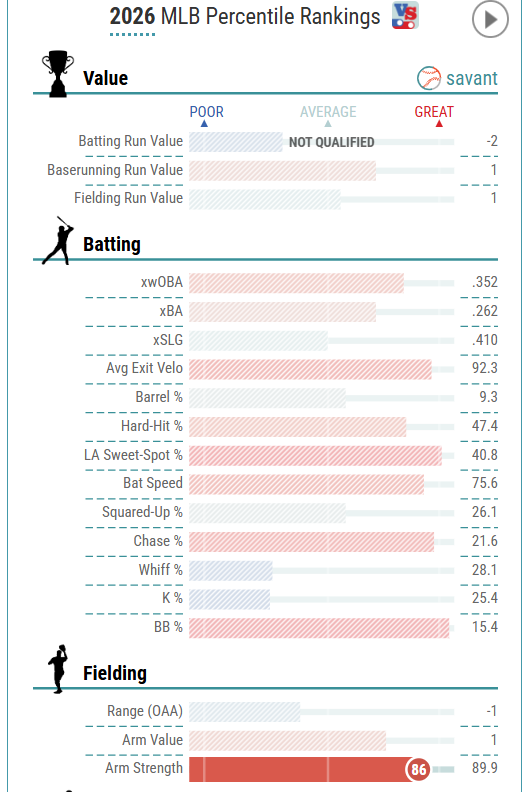
-
Red Sox Acquire Curtis Mead for Connelly Early
mvp 78 replied to TriplePlay8's topic in Boston Red Sox Talk
Bunting is a bad decision in most cases only if you are intentionally sacrificing. If you are trying to reach base, it's not a bad decision. -
Red Sox Acquire Curtis Mead for Connelly Early
mvp 78 replied to TriplePlay8's topic in Boston Red Sox Talk
If anyone is questioning Anthony's ability, they aren't paying attention. He makes good swing decisions and hits the ball very hard. He's not Rafaela or Abreu in the OF, but he's better than Gomes. -
Red Sox Acquire Curtis Mead for Connelly Early
mvp 78 replied to TriplePlay8's topic in Boston Red Sox Talk
Well, if you have only one trick in your bag of tricks, it's what you do. That's why the bunting was so exciting the other day. They need to be more well rounded and try to score in a bunch of different ways.