


Red Sox Video
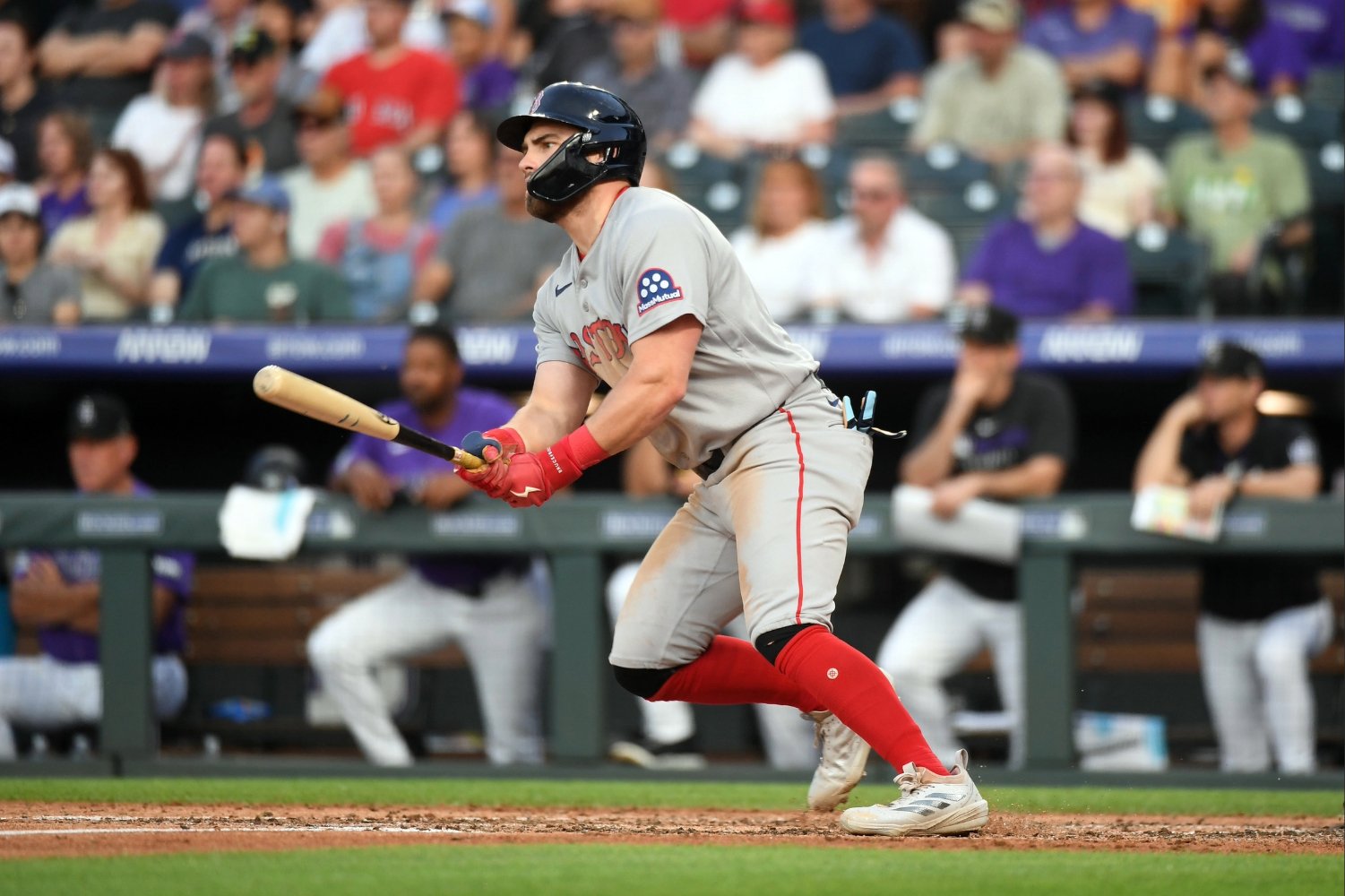
Caleb Durbin’s rise didn’t begin when the hits started falling. It began when the ball stopped ending up on the ground.
That single change helps explain almost everything that has happened over the past month. After spending much of the season making contact without doing much damage, Durbin has transformed the shape of his offensive game. Groundballs have become line drives and fly balls. Extra-base hits have started to follow. For the first time in Boston, he looks remarkably close to the hitter the Red Sox believed they were acquiring.
The results reflected his early struggles. Durbin posted a 45 wRC+ in March and April, followed by a 41 mark in May. He was still putting the ball in play, still showing the bat-to-ball ability that had defined his climb through the minors, but too many plate appearances ended the same way: a ground ball, a routine out, and another missed opportunity.
Then June arrived. Suddenly, the same player looked different. Durbin hit .309 with a .600 slugging percentage and a 146 wRC+ during the month, emerging as one of Boston's most productive hitters. The obvious question is whether this is simply a hot streak, or something he can actually build upon.
Caleb Durbin Has Made Groundballs Disappear
The most important change in Durbin’s profile is found in the type of contact he is producing. Players with his skill set often walk a narrow path offensively. Without elite raw power, they must create value through contact quality, athleticism, and smart swing decisions. Making contact alone is not enough; the contact has to matter.
For much of the season, it did not. During March and April, 61 percent of Durbin’s balls in play were hit on the ground. While ground balls can benefit players with speed, they also limit offensive upside. It is difficult to drive the baseball when most of your contact never leaves the infield dirt.
Luckily, we've started to see a paradigm shift here in June.
|
Month |
GB% |
FB% |
LD% |
HR/FB |
|
Mar/Apr |
61.0% |
25.6% |
13.4% |
4.8% |
|
May |
50.0% |
33.3% |
16.7% |
0.0% |
|
June |
32.7% |
46.9% |
20.4% |
17.4% |
There's nothing hiding in that data. The ground balls steadily disappeared, the line drives increased, and the fly balls nearly doubled. That alone is a change worth celebrating, before we even get into the actual results.
His average launch angle climbed from 5.1 degrees in March and April to 17.9 degrees in June. His barrel rate increased from 1.2 percent to 6.0 percent. His hard-hit rate moved in the same direction. At long last, he's hitting like a major leaguer again.
Better Discipline Begets Better Contact
What makes this breakout particularly intriguing is how it happened. Many hitters attempt to unlock power by swinging harder and accepting more strikeouts as the cost of doing business. Durbin has taken a different path: His strikeout rate actually dropped to 10.3 percent in June.
|
Month |
Z-Swing% |
Swing% |
Contact% |
Bat Speed |
|
Mar/Apr |
56.7% |
41.9% |
86.5% |
67.9 mph |
|
May |
64.1% |
46.7% |
81.7% |
68.2 mph |
|
June |
74.1% |
52.1% |
88.1% |
69.8 mph |
Durbin is swinging more often than he was earlier in the season, but not because he has become reckless (his chase rates have remained under control). Instead, he has become significantly more aggressive against strikes.
You don't need me to tell you this, but more aggressive swings at the right pitches lead to better contact. Better contact leads to more damage. And when a hitter can create that damage without sacrificing contact ability, their offensive outlook changes.
What This Means For Durbin, Red Sox Going Forward
The most important question is not whether Caleb Durbin can maintain a .600 slugging percentage.
Truth be told, he he probably can't. Very few hitters can sustain that level of production over a full season, and his expected metrics suggest some regression is likely. However, Durbin’s improvement is supported by better swing decisions, increased bat speed, a dramatically different batted-ball profile, and expected metrics that are moving in the same direction as the results. Those are precisely the indicators teams trust when evaluating whether a breakout is real.
Durbin has always possessed the contact skills -- he proved it last year in Milwaukee with the Brewers. It took him a while to find his way after that shocking trade in February, but it appears he's finally found a way to marry impact with those innate talents. If he sustains it, that trade may not age quite as poorly as we've all feared.





Recommended Comments
Create an account or sign in to comment
You need to be a member in order to leave a comment
Create an account
Sign up for a new account in our community. It's easy!
Register a new accountSign in
Already have an account? Sign in here.
Sign In Now