


Red Sox Video
Maybe I’m just a sucker for Garrett Popcorn, but I find myself frequently rooting for the Chicago Cubs because of center fielder Pete Crow-Armstrong. The Cubs are an offensive powerhouse, largely thanks to PCA (not to discredit Kyle Tucker and Seiya Suzuki’s contributions). Crow- Armstrong’s breakout season has shown baseball fans that heavy swing-and-miss hitters can be successful, MVP-caliber players.
Now, Crow-Armstrong is an anomaly. He flips back and forth with Seiya Suzuki for the most RBIs in baseball and leads the National League in stolen bases and WAR, but if you check his Baseball Savant page, you'll find a lot of blue. PCA and Ceddanne Rafaela initially profile similarly as speedy, Gold Glove-caliber center fielders with middling plate discipline. On one hand, PCA is an MVP candidate for the Cubs, who are likely making a deep postseason run in the fall. Meanwhile, Rafaela is the free-swinging, defense-first centerfielder for the underperforming Red Sox, who currently hold a 12.6% chance of making the playoffs. However, their Savant pages share striking similarities.
The primary difference between Crow-Armstrong and Rafaela ultimately boils down to launch angle and pull rate. Their batted ball profiles were nearly identical last season. This year? Not so much. Crow-Armstrong has a higher launch angle and pull rate, and a lower ground ball rate than Rafaela.
|
Player |
Year |
Barrel% |
Launch Angle |
GB/FB |
GB% |
Pull% |
Pull GB% |
Pull Air% |
|
Pete Crow-Armstrong |
2024 |
7.4 |
17.2 |
0.88 |
42.5 |
40.7 |
21.4 |
19.3 |
|
Ceddanne Rafaela |
2024 |
7.5 |
14.9 |
1.14 |
42.5 |
37.2 |
20.1 |
17.1 |
|
Pete Crow-Armstrong |
2025 |
13.6 |
23.3 |
0.48 |
27.8 |
44.3 |
14.8 |
29.5 |
|
Ceddanne Rafaela |
2025 |
13.2 |
11.8 |
1.11 |
45.3 |
35.2 |
23.3 |
11.9 |
When Rafaela hits the ball in the opposite direction, it tends to result in an out (.337 xwOBA). The same goes for PCA (.299 xwOBA). Rafaela fares better when he pulls the ball — his xwOBA jumps to .422 in those events. Likewise, PCA’s xwOBA skyrockets to .592. Pulled balls typically result in higher exit velocities than balls hit to the opposite field, but Rafaela is an exception. His 39.4% opposite hard hit rate is 4.4% above the league average. (For pull-side balls, he holds a 51.9% hard hit rate.) As of late, he’s seen more success hitting the ball in the opposite direction. Given that Rafaela’s xwOBA split, exit velocity, and barrel rate are higher than PCA’s batted balls in the opposite direction, I think his overall offensive ceiling could be in the same stratosphere — he just needs to start pulling the ball more.
|
Player |
Batted Ball Direction |
xWOBA |
EV (MPH) |
LA (°) |
Hard Hit% |
Barrle/PA% |
Attack Angle |
Swing Length |
|
Pete Crow-Armstrong |
Opposite |
0.299 |
84.7 |
33 |
30.8 |
10.3 |
10° |
7.1 |
|
Ceddanne Rafaela |
Opposite |
0.337 |
88.6 |
27 |
39.4 |
12.1 |
7° |
7.2 |
|
Pete Crow-Armstrong |
Pull |
0.592 |
93.9 |
19 |
56.3 |
22.5 |
18° |
7.4 |
|
Ceddanne Rafaela |
Pull |
0.422 |
93.2 |
4 |
51.9 |
9.6 |
15° |
7.7 |
As Davy Andrews noted, “The point is that the further out you hit the ball, the more likely you are to pull the ball, because your bat will be angled toward the pull side.” Looking at Statcast’s new swing metrics, it’s apparent that PCA is making contact with the ball in front of the plate more than Rafaela. Since he’s attacking the ball earlier, his launch angle is higher, resulting in a higher pulled fly ball rate and fewer ground balls.


If Rafaela can make contact with the ball in front of the plate, he’ll pull the bar in the air more frequently and hit fewer ground balls. So, how does a player pull the bar in the air? Again, it ties to launch angle, but also swing length. Longer swing lengths correlate with higher pull rates, as batters must make contact with the ball in front of the plate to pull it. Rafaela has the second-longest swing length (7.5) on the Red Sox. His swing length is .3 ft longer than PCA’s, so he doesn’t have to alter his swing to pull the ball. By and large, when players hit the ball in front of the plate, their launch angle increases as they lift the ball on an upward trajectory (assuming they have an ideal swing path).

Image credit to Driveline
Rafaela’s lack of plate discipline could negatively affect his ability to hit the ball in front of the plate. Since last year, he’s made some strides at the plate. His strikeout rate is 19.2% (61st percentile), his whiff rate is 26.3% (38th percentile), and his walk rate is up to 4.7% (12th percentile). While his chase rate (46.4%, 2nd percentile) remains abysmal, he’s made some improvements to his swing decisions. Is there room to improve? Obviously, yes. Rafaela won’t turn into Juan Soto or Seiya Suzuki overnight, but if he can cut down his chase rate to at least around 35%, he’ll be in the same ballpark as Corbin Carroll and Julio Rodríguez.
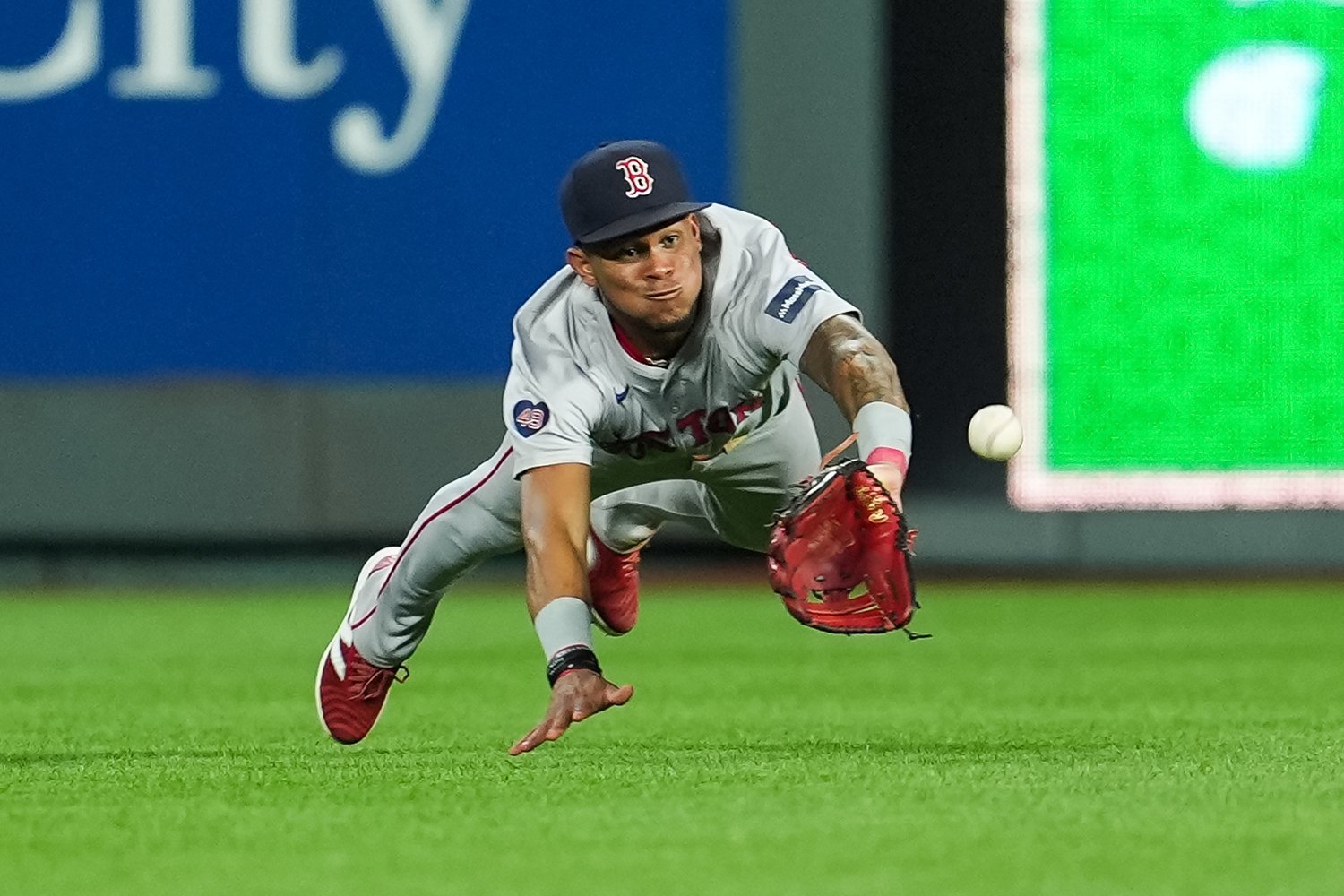
I haven't even touched on Rafaela's elite defense. He's at the top of the leaderboards for various Statcast fielding metrics, including fielding run value (2nd), arm strength (11th), and outs above average (5th). These rankings include other position players; if you separate these metrics by positional split, Rafaela is undoubtedly the best center fielder in the American League. Watch his rookie season defensive highlights. Rafaela was shifted to the infield during his rookie season, so his defensive prowess in center field wasn't fully realized. As a rookie playing out of his natural position, his bat suffered at second base, slashing .059/.059/.059, -86 wRC+ in eight games. It was average at shortstop with a .261/.269/.470, 101 wRC+ slash line across 81 games. Defensively, he was one of the worst defensive shortstops in the league, posting negative seven outs above average. To Rafaela's credit, he handled being moved out of position gracefully. Having him play center field regularly this year, though, is helping his bat.
Ceddanne Rafaela can be a controversial player for Red Sox fans. Roman Anthony, baseball’s number one prospect, has been knocking at the door with a battering ram, and Rafaela is on a short leash for some. Until writing this article, I thought Rafaela should be benched for Anthony. Time is ticking for someone other than Rafael Devers or Alex Bregman to step up and help carry the team’s offense. If Rafaela can be like PCA, I’d rather keep him and try to move Wilyer Abreu. An outfield with Roman Anthony, Jarren Duran, and Ceddanne Rafaela is more competitive than one with Abreu, who remains a streaky platoon player in his sophomore season. Anthony and Rafaela complement each other — Rafaela could help Anthony improve his defense, and Anthony can teach Rafaela a thing or two about plate discipline.
June and July will be telling months for Rafaela's career. He’s dealt with bad luck this year and has recently shown signs of turning a corner. Since June 1st, he’s slashed .433/.433/.867 with four home runs and six RBIs. In the Angels series, he hit three of these home runs, including a two-run walk-off shot. If Ceddanne Rafaela can put everything together, he'll become a household name like Pete Crow-Armstrong.






Recommended Comments
Create an account or sign in to comment
You need to be a member in order to leave a comment
Create an account
Sign up for a new account in our community. It's easy!
Register a new accountSign in
Already have an account? Sign in here.
Sign In Now