Brandon Glick
-
Posts
587 -
Joined
-
Last visited
Content Type
Profiles
Boston Red Sox Videos
2026 Boston Red Sox Top Prospects Ranking
Boston Red Sox Free Agent & Trade Rumors, Notes, & Tidbits
Guides & Resources
2025 Boston Red Sox Draft Pick Tracker
News
2026 Boston Red Sox Draft Tracker: Picks & Bonuses
Forums
Blogs
Events
Store
Downloads
Gallery
Everything posted by Brandon Glick
-
Here's a fun statistical nugget: if the Red Sox win by six tonight, they will have doubled the Jays' run differential on the season. Funny how this sport works sometimes.
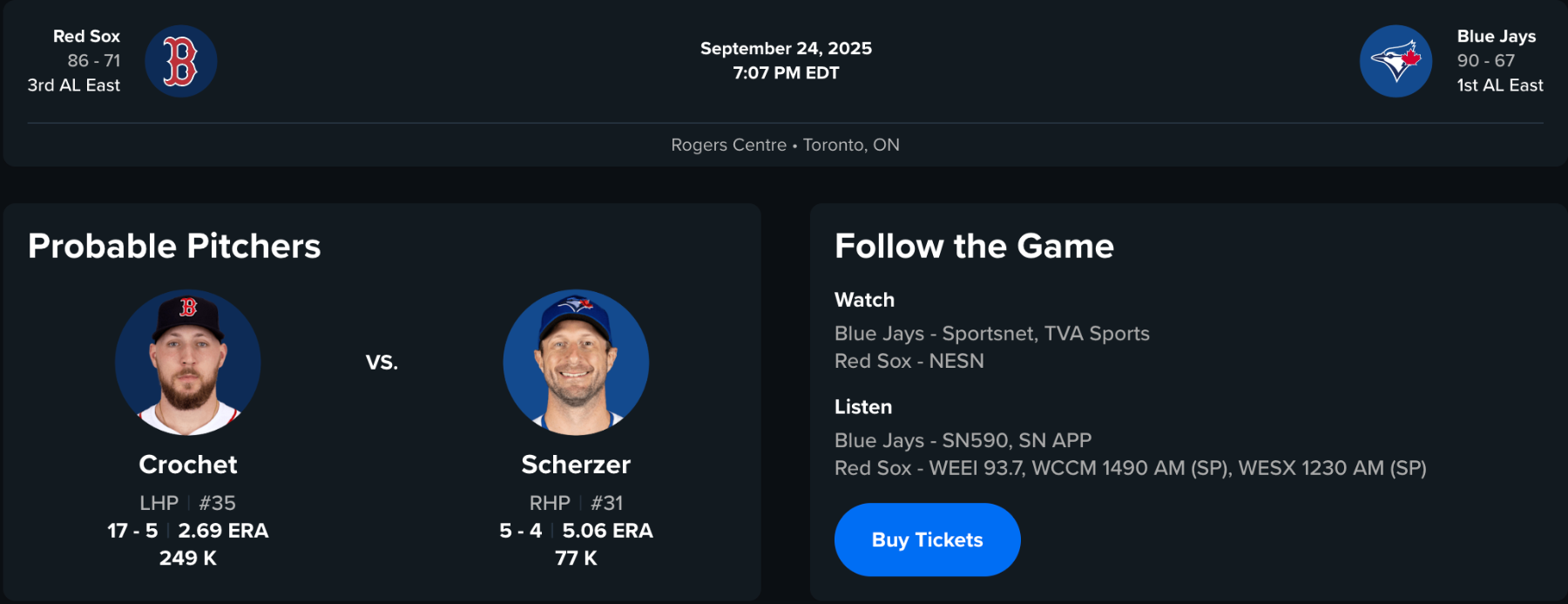
-
I take full responsibility for the Red Sox's upcoming sweep of the Blue Jays
-
Yup, turns out today is actually Monday, and not Tuesday. I'll have to report this to the time keepers.
-
With six to play, the Sox are 5.0 games back in the division... and three upcoming against the Jays. Never say never?
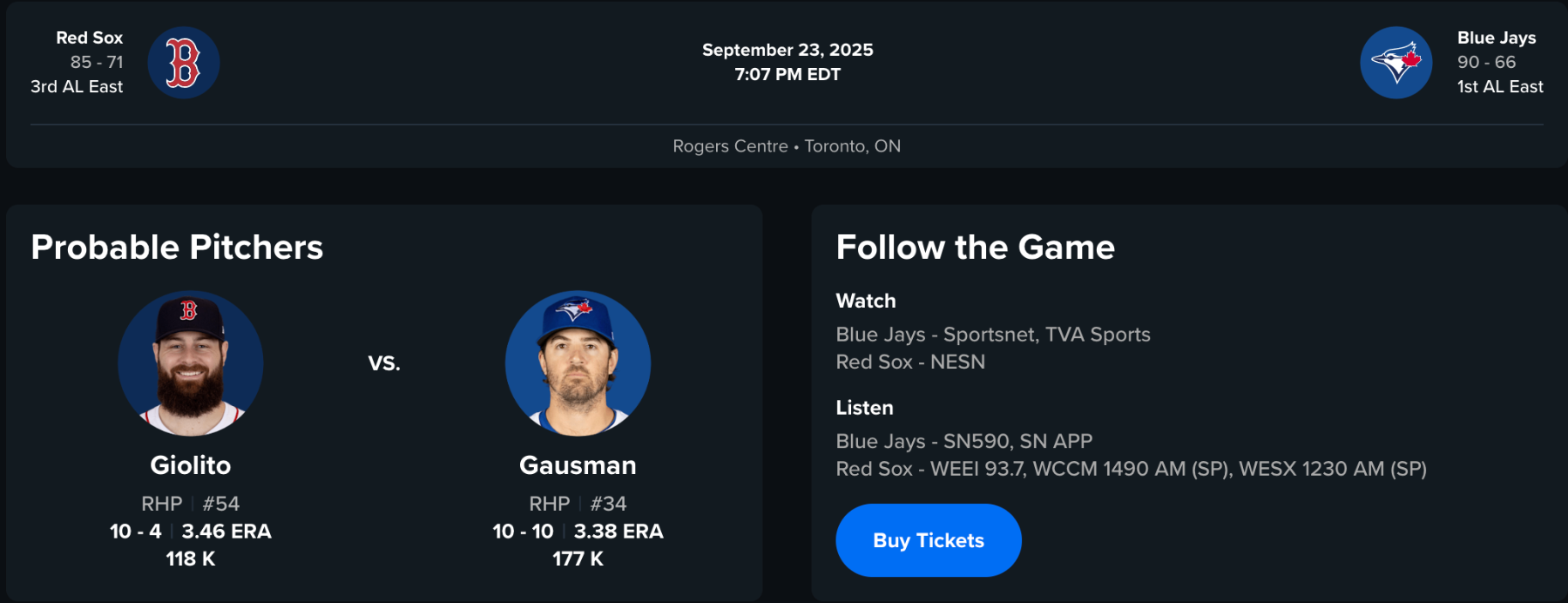
-
What a well-timed sweep this would be...
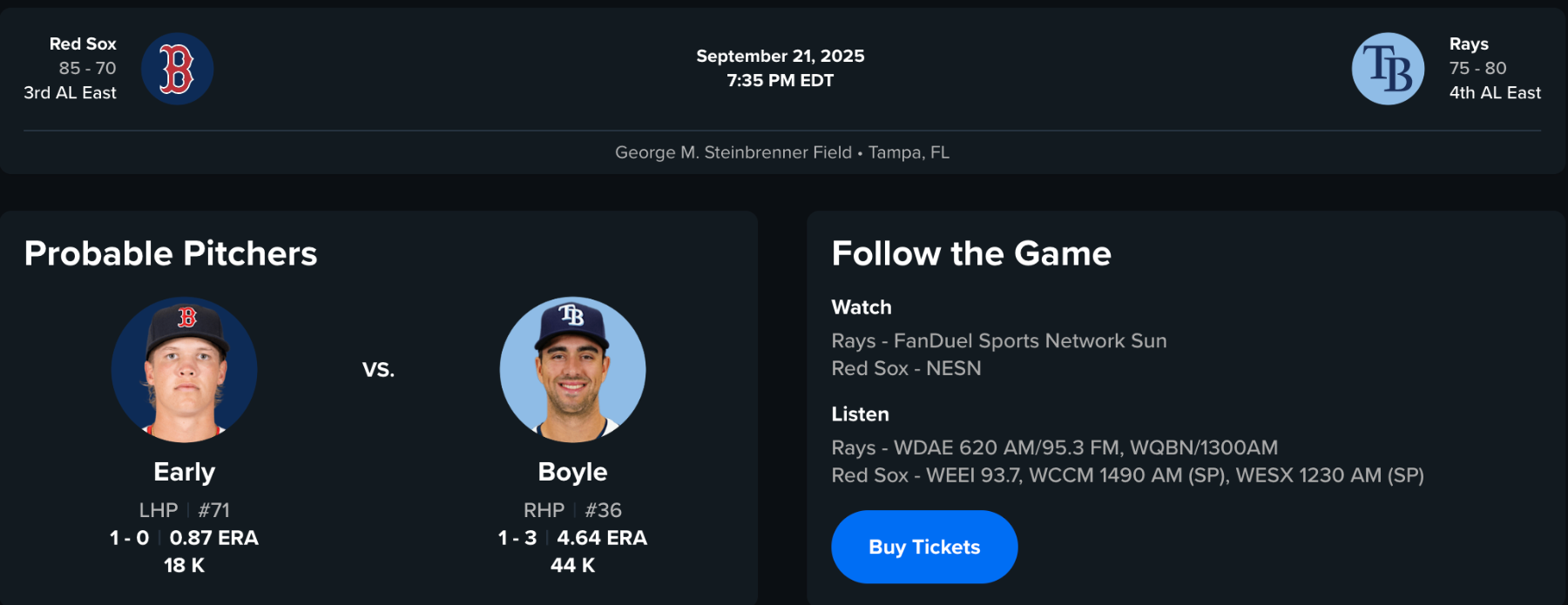
-
Obviously, the goal is to win every possible game from here on out, but let's do a fun would you rather: 1) Win the No. 5 seed, which means you travel to NY to take on the Yankees in the Wild Card (and then, most likely, the Tigers in the ALDS) OR 2) Win the No. 6 seed, which means traveling to (probably) Seattle for Wild Card, and then Blue Jays in ALDS.

-
The Boston Red Sox are barely clinging to their Wild Card spot with less than two weeks left in the regular season. Can the hold off the Guardians make the postseason for the first time since 2021?
-
The Boston Red Sox are barely clinging to their Wild Card spot with less than two weeks left in the regular season. Can the hold off the Guardians make the postseason for the first time since 2021? View full video
-
The final nine games are a gauntlet: Rays, Jays, and Tigers. If the Red Sox are going to make the playoffs, they're going to have to earn it.
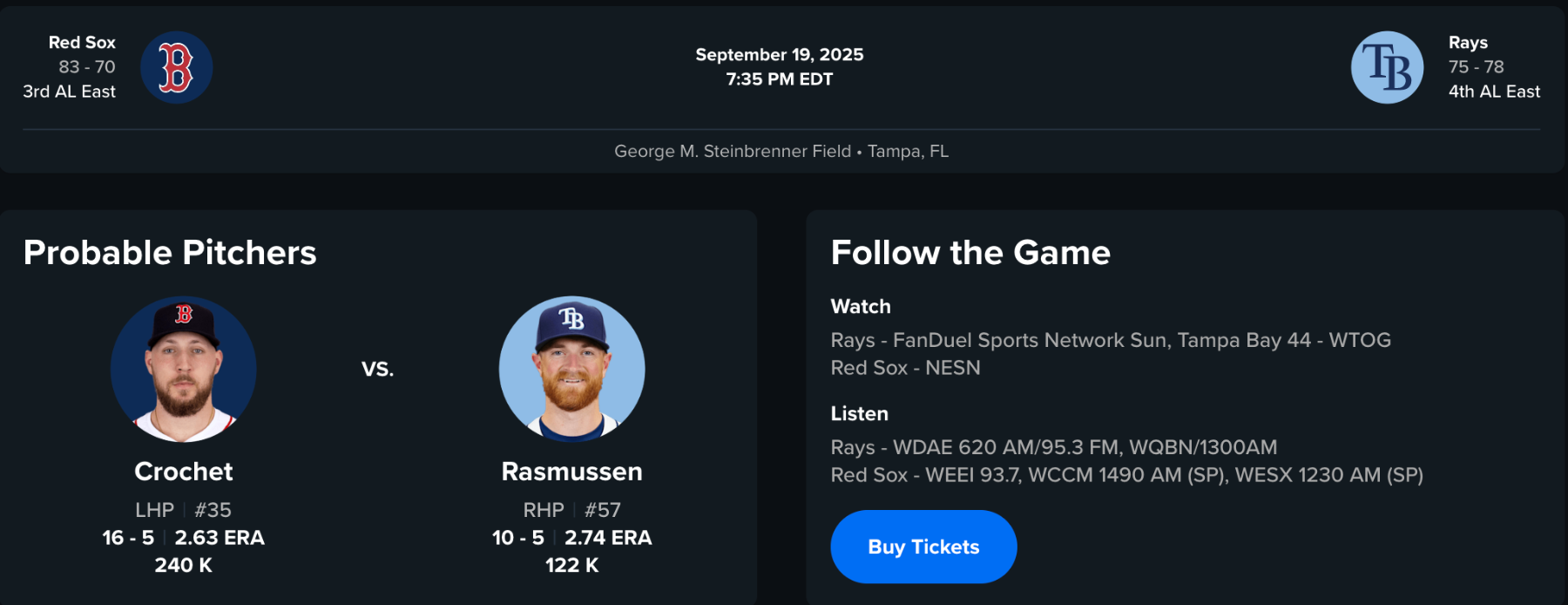
-
10 games left, folks.
-
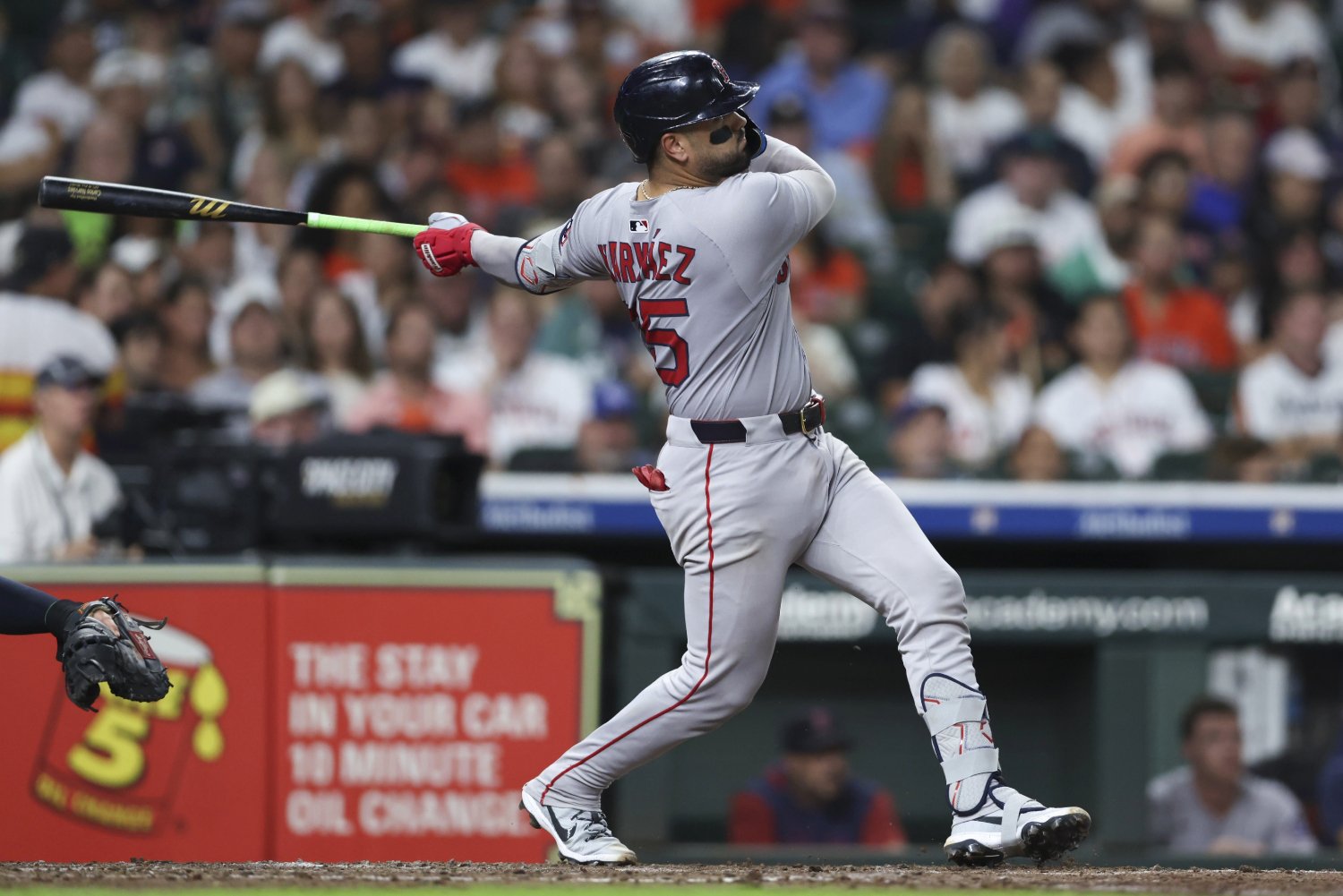
It's been a pretty tumultuous September for the Boston Red Sox, as they've lost series to the Arizona Diamondbacks and New York Yankees while slipping from the top Wild Card seed in the American League to the third. They still hold the second-best run differential in the Junior Circuit at +90 and a 2.5-game lead over the Cleveland Guardians for the final playoff spot in the AL, but this team is hardly making it easy. Still, they've won games when they've absolutely had to, like when they salvaged the finale of the Diamondbacks and Yankees series to avoid being swept. It might not be pretty, but the Red Sox still have the inside track on making the postseason. Part of that is thanks to steady contributions from regulars like Jarren Duran and some brilliant work by Garrett Crochet, Connelly Early, and Lucas Giolito in the rotation, but the truth is the Sox are staying afloat thanks to their suddenly-brilliant catching tandem. Since Sept 1. (13 games), among Red Sox players with at least 10 plate appearances, Carlos Narváez ranks second in OPS (.940), while his much-maligned backup, Connor Wong, ranks fourth (.938). Wong has actually been better in terms of wRC+ (160), ranking second behind only Nate Eaton (Narváez ranks fourth with a 152 wRC+). Narváez is hardly an unknown commodity around these parts, as Talk Sox has been singing the rookie backstop's praises all year long. He was mired in a nasty slump in July (54 wRC+) and August (64 wRC+), but he's seemingly rebounded and found his best form at the plate in September. Considering that he effectively became the catcher of the future after being acquired in a low-stakes deal following the team's decision to part with Kyle Teel in the Crochet blockbuster, it's pretty awe-inspiring how good Narváez has been. This most recent stretch is perhaps his most promising -- he's hitting .294/.351/.588 this month with a team-leading .294 ISO -- especially in the face of the adjustments he's had to make to recover from his months-long cold stretch. Wong, on the other hand, has not been anyone's favorite Red Sox player this year. He's been a mess at the plate (.204/.270/.255) and has been routinely floated as a DFA candidate if the team could ever find a more suitable backup catcher. However, that never came to pass, and now, Boston is reaping the benefits. In an admittedly small sample in September, the five-year MLB veteran is hitting .357/.438/.500 with a 12.5% walk rate. Yes, we're only talking about 16 plate appearances, but his two extra-base hits (both doubles) are already one-third of his total prior to September. Wherever his fence-clearing power has gone, Wong is starting to make this version of himself work in the batter's box. The fun news is that the batted ball metrics generally support the results. Both catchers' slash lines are being carried by unusually high BABIPs (.455 for Wong, .364 for Narváez), but that isn't totally a smoke-and-mirrors act. Wong's ground-ball rate is a comical 54.5% -- and it's been near that rate all year, hence his absentee home run pop -- but he's pulling the ball at a team-leading rate (54.5% as well), and he has yet to make soft contact this month. His 36.4% hard-hit rate is his highest in a month since April, and it helps that he's seeing 4.313 pitches per plate appearance, up from 3.93 in the first half. Sure, it'd be nice to see him elevate the ball once in a while, but a backup catcher playing average defense (-1 DRS in 419.0 innings this season) can get by as a hitter who works the count and gets on base. Narváez has been a tad more impressive down the stretch, despite pulling the ball just 25% of the time this month (last on the Red Sox). His 41.7% hard-hit rate ranks third on the team among all hitters with at least 10 PAs, and his 37.5% fly-ball rate is his best since June. Considering that he might be a Gold Glove finalist as a rookie (12 DRS behind the plate in 889.0 innings), it's hard to complain about the contributions coming from Narváez at the moment. With Roman Anthony out for the rest of the regular season, the Red Sox were always going to need their role players to step up in order to maintain their place in the American League hierarchy. The recent struggles of Alex Bregman, Ceddanne Rafaela, and Nathaniel Lowe aren't helping the cause, but unexpected rebounds from Wong and Narváez certainly are. Can they continue to produce like this in October? Barring a miraculous return from Anthony, the answer to that question could decide the team's postseason fate. View full article
-
Red Sox Catchers Are Stepping Up When They're Needed Most
Brandon Glick posted an article in Red Sox
 It's been a pretty tumultuous September for the Boston Red Sox, as they've lost series to the Arizona Diamondbacks and New York Yankees while slipping from the top Wild Card seed in the American League to the third. They still hold the second-best run differential in the Junior Circuit at +90 and a 2.5-game lead over the Cleveland Guardians for the final playoff spot in the AL, but this team is hardly making it easy. Still, they've won games when they've absolutely had to, like when they salvaged the finale of the Diamondbacks and Yankees series to avoid being swept. It might not be pretty, but the Red Sox still have the inside track on making the postseason. Part of that is thanks to steady contributions from regulars like Jarren Duran and some brilliant work by Garrett Crochet, Connelly Early, and Lucas Giolito in the rotation, but the truth is the Sox are staying afloat thanks to their suddenly-brilliant catching tandem. Since Sept 1. (13 games), among Red Sox players with at least 10 plate appearances, Carlos Narváez ranks second in OPS (.940), while his much-maligned backup, Connor Wong, ranks fourth (.938). Wong has actually been better in terms of wRC+ (160), ranking second behind only Nate Eaton (Narváez ranks fourth with a 152 wRC+). Narváez is hardly an unknown commodity around these parts, as Talk Sox has been singing the rookie backstop's praises all year long. He was mired in a nasty slump in July (54 wRC+) and August (64 wRC+), but he's seemingly rebounded and found his best form at the plate in September. Considering that he effectively became the catcher of the future after being acquired in a low-stakes deal following the team's decision to part with Kyle Teel in the Crochet blockbuster, it's pretty awe-inspiring how good Narváez has been. This most recent stretch is perhaps his most promising -- he's hitting .294/.351/.588 this month with a team-leading .294 ISO -- especially in the face of the adjustments he's had to make to recover from his months-long cold stretch. Wong, on the other hand, has not been anyone's favorite Red Sox player this year. He's been a mess at the plate (.204/.270/.255) and has been routinely floated as a DFA candidate if the team could ever find a more suitable backup catcher. However, that never came to pass, and now, Boston is reaping the benefits. In an admittedly small sample in September, the five-year MLB veteran is hitting .357/.438/.500 with a 12.5% walk rate. Yes, we're only talking about 16 plate appearances, but his two extra-base hits (both doubles) are already one-third of his total prior to September. Wherever his fence-clearing power has gone, Wong is starting to make this version of himself work in the batter's box. The fun news is that the batted ball metrics generally support the results. Both catchers' slash lines are being carried by unusually high BABIPs (.455 for Wong, .364 for Narváez), but that isn't totally a smoke-and-mirrors act. Wong's ground-ball rate is a comical 54.5% -- and it's been near that rate all year, hence his absentee home run pop -- but he's pulling the ball at a team-leading rate (54.5% as well), and he has yet to make soft contact this month. His 36.4% hard-hit rate is his highest in a month since April, and it helps that he's seeing 4.313 pitches per plate appearance, up from 3.93 in the first half. Sure, it'd be nice to see him elevate the ball once in a while, but a backup catcher playing average defense (-1 DRS in 419.0 innings this season) can get by as a hitter who works the count and gets on base. Narváez has been a tad more impressive down the stretch, despite pulling the ball just 25% of the time this month (last on the Red Sox). His 41.7% hard-hit rate ranks third on the team among all hitters with at least 10 PAs, and his 37.5% fly-ball rate is his best since June. Considering that he might be a Gold Glove finalist as a rookie (12 DRS behind the plate in 889.0 innings), it's hard to complain about the contributions coming from Narváez at the moment. With Roman Anthony out for the rest of the regular season, the Red Sox were always going to need their role players to step up in order to maintain their place in the American League hierarchy. The recent struggles of Alex Bregman, Ceddanne Rafaela, and Nathaniel Lowe aren't helping the cause, but unexpected rebounds from Wong and Narváez certainly are. Can they continue to produce like this in October? Barring a miraculous return from Anthony, the answer to that question could decide the team's postseason fate.
 -
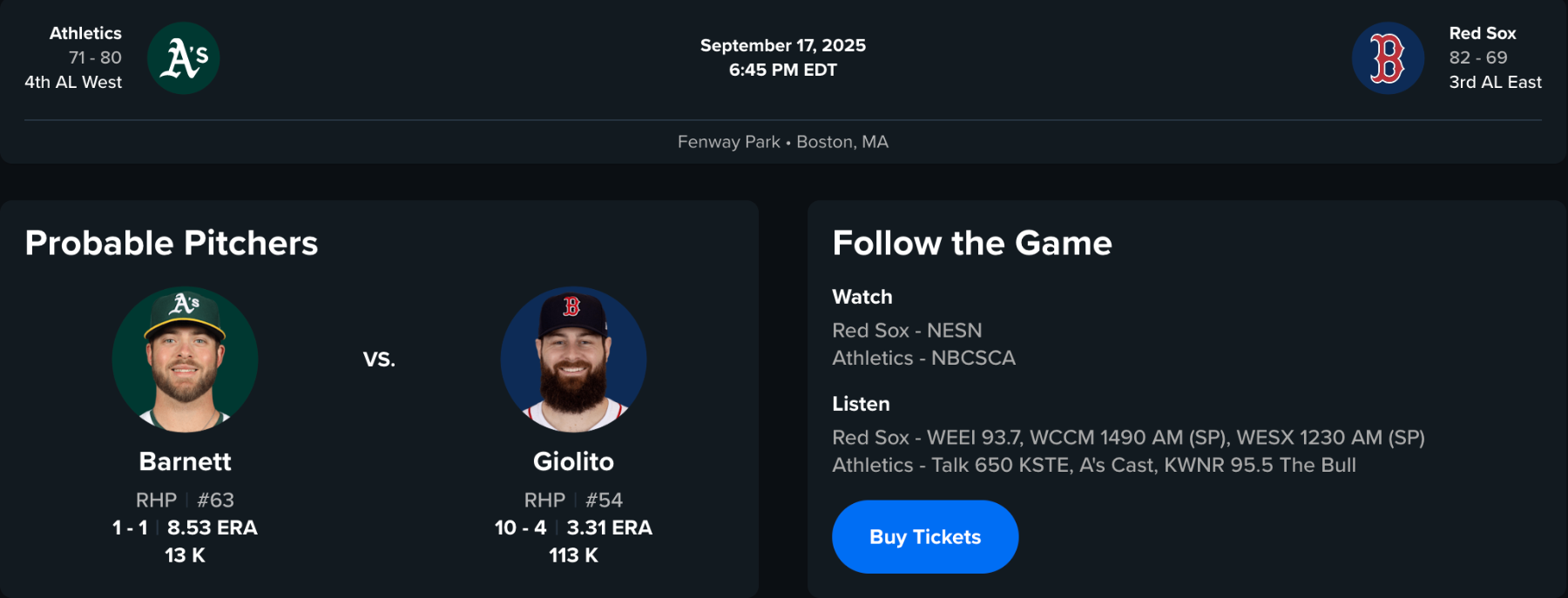
I don't mean to alarm you, but the Blue Jays, Guardians, and Mariners are all en fuego right now. It would really behoove the Red Sox to get back in top gear ASAP.
-
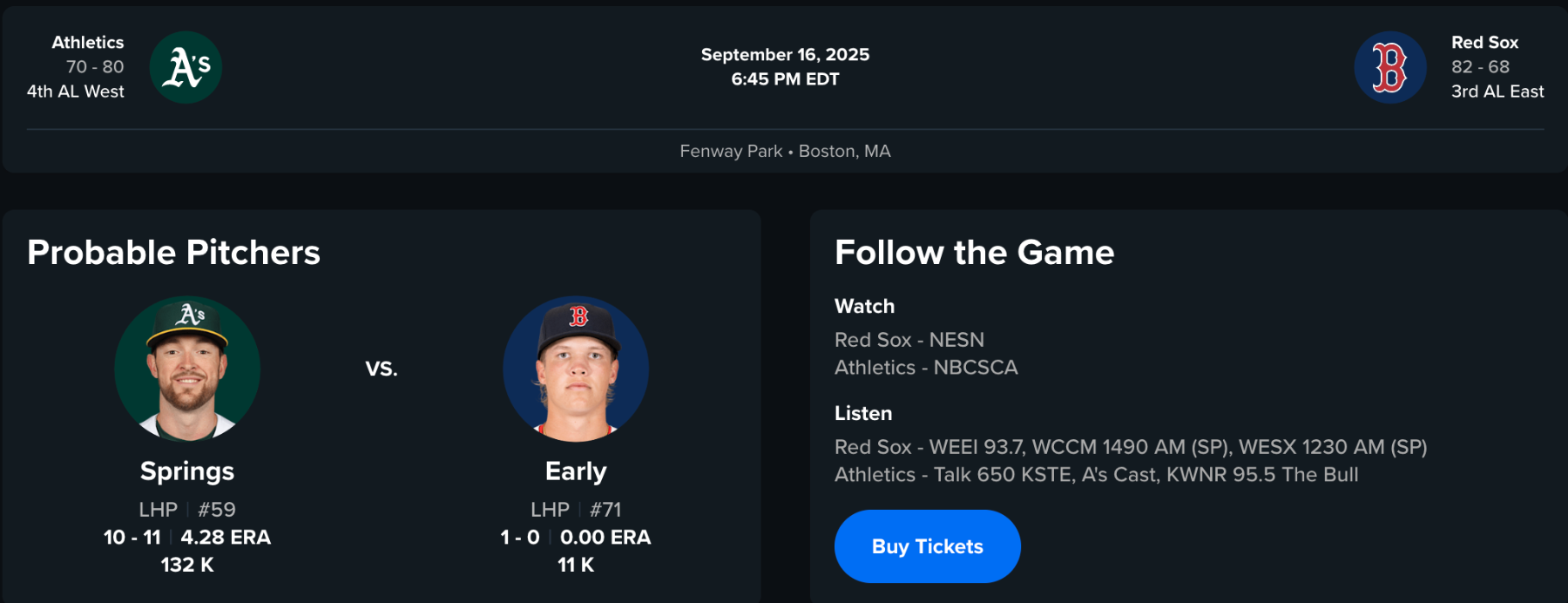
Another start for Early vs the A's. Hopefully this one goes just as smoothly as the last.
-
Another day off. Good for health, bad for the soul. Can at least root for the Rays (vs Jays) and Twins (vs Yankees) to win tonight.
-
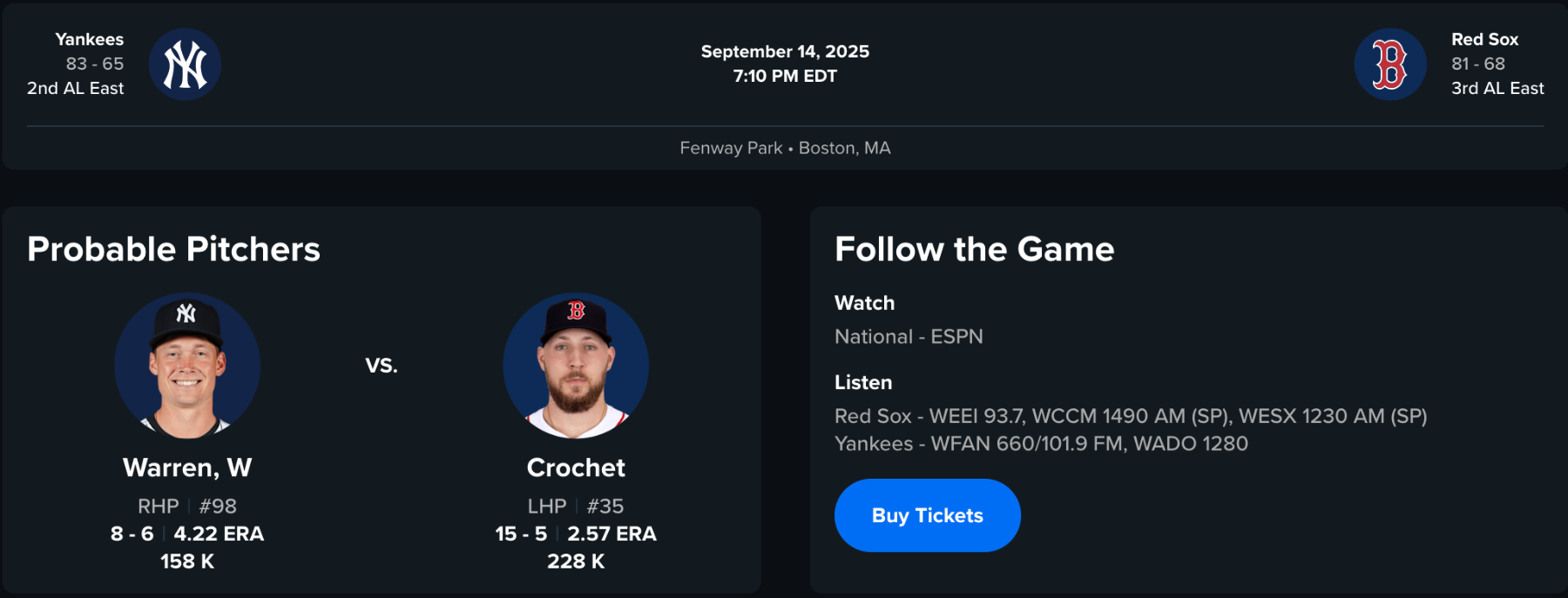
Hi. Please don't get swept by the Yankees on national television. Thank you.
-
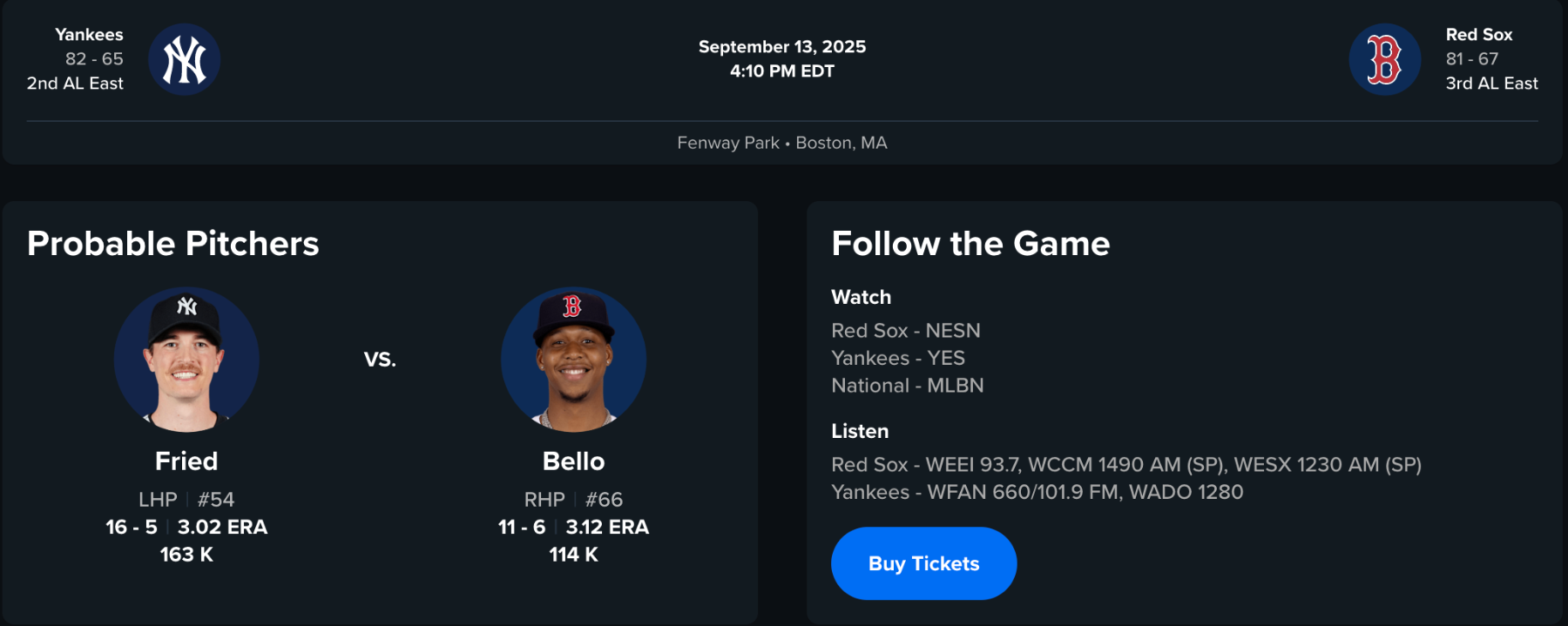
I'm gonna argue these next two games are the most important of the Sox's season. Absolutely crucial for seeding that they get wins here.
-
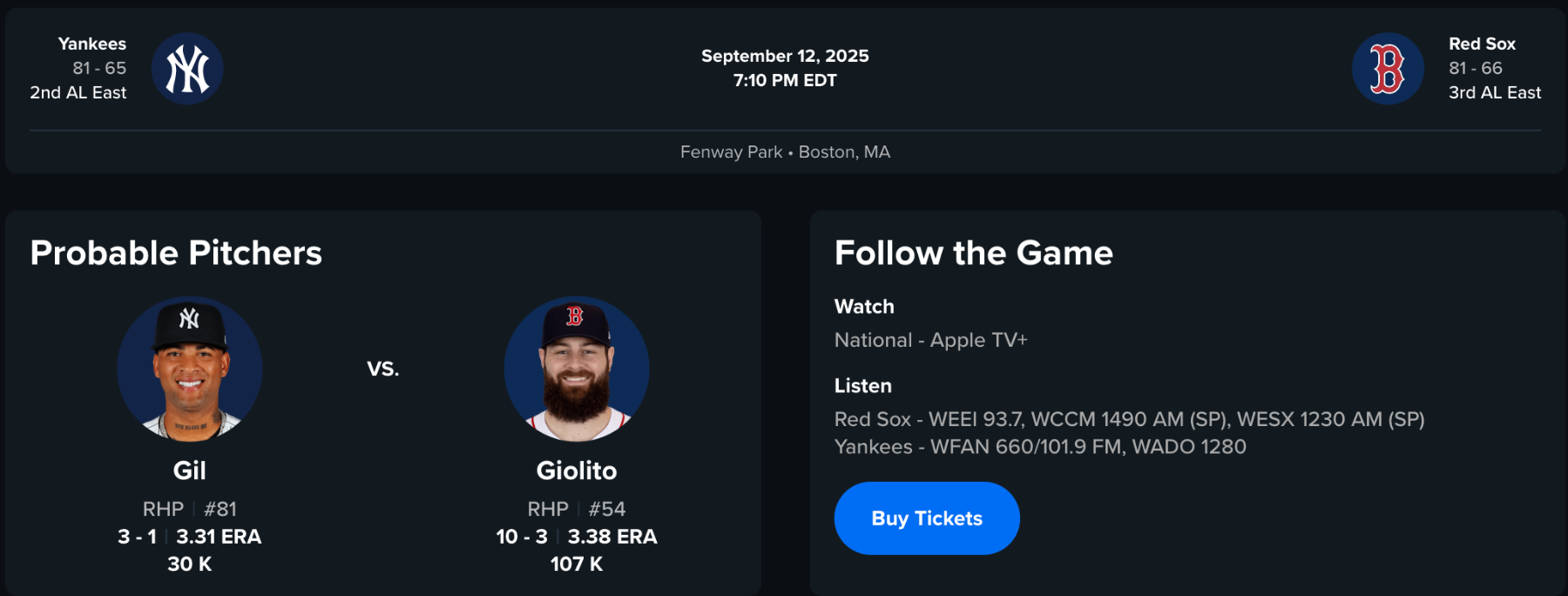
Final Yankees series of the year. Fenway is going to be bumping.
-
What do Red Sox fans have to look forward to in the final weeks of the regular season?
-
What do Red Sox fans have to look forward to in the final weeks of the regular season? View full video
-
Red Sox pitching prospect Connelly Early dominated in his MLB debut, though it came at the cost of Dustin May's roster spot. View full video
-
Red Sox pitching prospect Connelly Early dominated in his MLB debut, though it came at the cost of Dustin May's roster spot.
-
By expected win-loss, the Red Sox would be tied (with the Yankees, Rangers, and Tigers) for the most wins in the AL with 84. How are you feeling about the state of the Sox right now?
-
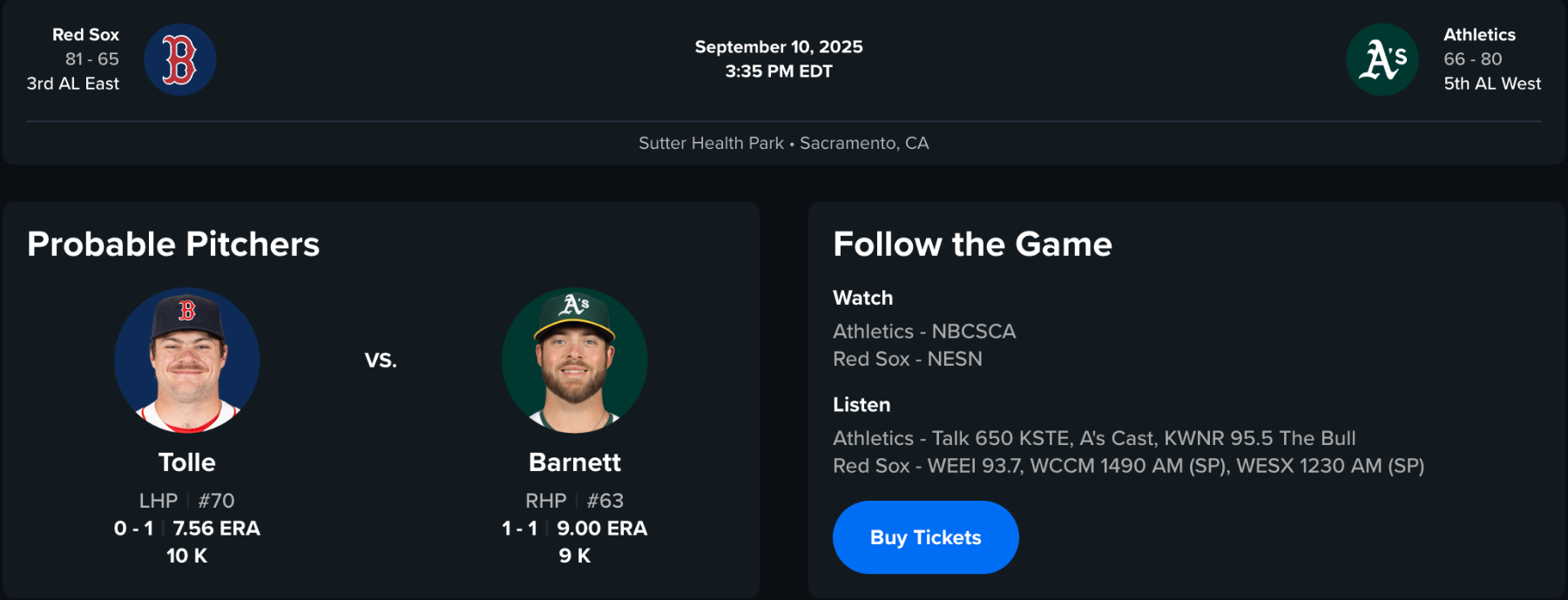
3.0 games back of the Jays in the AL East... 3.0 games back of the best record in the AL. Don't let them get hot!
-
I still believe in Kristian Campbell's bat, and I encourage you to have faith as well. I know things got really, really ugly for a while there -- he slashed .159/.243/.222 (29 wRC+) in 140 plate appearances from May 1 until his demotion in mid-June -- but let's not forget that this is a rookie who had one of the hottest months in baseball this season (.301/.407/.495, 148 wRC+ in April) when he first cracked the major league roster. I'd also be remiss not to remind you that Campbell is just 23 years old and began the 2024 season in High-A Greenville. He had a meteoric ascension to the big leagues; a setback against the best pitchers in the world shouldn't dissuade anyone from buying his long-term potential. But, even if the Red Sox are losing faith in his most prodigious skill, he's not going anywhere. He signed a lucrative eight-year extension back in April, worth $60 million at minimum and as much as $100 million if the team picks up both option years at the end of the contract. That's an investment you can't just sweep under the rug, especially with how purposeful the Red Sox have been with spending money recently. Every dollar on the books matters, and the team's decision to eschew Campbell's cheap years of team control for a sturdy salary reflects a commitment to him and his development, struggles or not. So, that leaves us with a question that seemingly has no right answer: Where will Kristian Campbell play in Boston going forward? Let's put something out there right upfront: Kristian Campbell was awful at second base with the Red Sox this season. He made seven errors in less than 500 innings at the keystone while he was in the big leagues, "earning" -15 Defensive Runs Saved (DRS), -8 Outs Above Average (OAA), and -9 Fielding Run Value (FRV). These stats aren't perfect for "pace analysis" in the same way that home runs or stolen bases are, but extrapolate those numbers over a full season (roughly two-and-a-half times as many innings as Campbell played at second), and you get a player worth -37 DRS, -20 OAA, and -22 FRV. I mean, holy moly. That's how bad Campbell was in the field for the Red Sox this season (and that's not including his below-average time in the outfield). And yes, to answer your biggest question, those would all be the worst marks in baseball this season. Defenders can absolutely improve over time -- Nathaniel Lowe was worth -10 OAA the year before he won his Gold Glove in 2023 -- but it's not the same kind of growth as hitting. Plate approaches are so fickle, and there's so many moving parts to them; any given change could be the thing that fixes or breaks a player's swing and turns them into (or reverts them from being) an All-Star. Fielding is a different beast. You can learn the ins and outs of a position, get more athletic, develop a stronger throwing arm, or just plain get better with more repetitions, but the truth with fielding is that you can either handle a certain position, or you can't. Campbell certainly has the athleticism to stick at second base (he even drew some innings at shortstop and third base last year), but the results are what they are. If the goal is to have him back in the major leagues by Opening Day 2026, then sticking him at a position where he's actively negating a ton of his offensive value isn't going to help Campbell or the team. Over the last few months, the answer to the "Campbell Position Conundrum" (the "CPC", if you will) has been first base. He's been getting a ton of reps in Triple-A Worcester at the position, and there were many who were calling for him to handle the cold corner in Boston before Lowe was brought in after a disappointing trade deadline. However, that spot has never been the best use of his athleticism, and Senior Director of Player Development Brian Abraham all but confirmed that it won't Campbell's long-term defensive home going forward. “First base was an immediate trial to see if that could work," Abraham told the Pesky Report. "That probably will end up not being as much of a focus going forward. I see him being more of a 2B/OF type opportunity." Whatever the reason may be -- the team anticipates Triston Casas being fully healthy, or they expect to re-sign Nathaniel Lowe, or they want to keep the position open for a competition in spring training -- this is the right call for Campbell's future. To be a first baseman in the majors, you have to hit. Campbell can certainly offer that kind of production, but that's a lot of pressure on a guy who lost all semblance of his confidence at the plate before being demoted back to Triple-A. The smoothest fit is obviously second base. That would allow Marcelo Mayer to take over the hot corner for Alex Bregman (assuming he leaves in free agency), or it could push Mayer into a super-utility role where his excellent glove could benefit a multitude of positions (if Bregman sticks around). We've already acknowledged how disastrous Campbell was there, though, and unless he makes marked improvements over the offseason, it's hard to imagine the coaching staff willingly subjecting him to a position he can't play competently. That leaves the outfield, which Abraham made sure to note when discussing the CPC. In fact, Campbell is starting to get some time in right field with the WooSox, perhaps as a "break glass in case of emergency" option if Wilyer Abreu can't return from his injury before the playoffs. The issue, of course, is that the Red Sox have an abundance of slick-fielding outfielders, from all-universe defender Ceddanne Rafaela in center to Abreu, a reigning Gold Glover, in right. If you like what Roman Anthony brings to the table in left (you should), then there's your starting outfield for the next half-decade, and that obviously fails to mention Jarren Duran, who has proven more than capable of handling each outfield spot in a pinch. So, where does that leave Campbell? The Red Sox could stash him in a super utility role, but do you really want to keep moving him around when the primary focus is on his bat? They could task him with learning third base over the offseason if Bregman leaves, but Mayer is a wildly superior defender and has already shown off his defensive prowess at the hot corner. Shortstop is probably off the table if Trevor Story is still around, but that's probably true regardless given Campbell's struggles at second base. Assuming the team doesn't try a Carlos Narvaez-Campell catching tandem, that only leaves one spot for the talented rookie: designated hitter. We already know that Alex Cora hates the idea of stashing one of his über-athletic youngsters in that spot, but given the layout of the team right now, it's hard to imagine where else Campbell fits if it's not first base. That scenario would prevent the team from using one of their four star outfielders at DH, as well as their successful Masataka Yoshida-Romy Gonzalez platoon, but that's genuinely the only spot left if second base doesn't work out. Is that something the Red Sox would be okay with? The CPC has no obvious answer, even as the Red Sox try to throw everything at the wall to see what sticks. It feels like asking for a miracle given that the priority is patching the holes in his plate approach, but Campbell could quell a lot nerves about his long-term future if he can show up to spring training ready to play literally any position on the diamond. View full article