


Red Sox Video
They've bottomed out in 2025, but it wasn't too long ago that the Atlanta Braves were the talk of the baseball world.
The 2021 World Series champions went on to win 205 combined games over the next two seasons, ultimately falling short in the NLDS against the Philadelphia Phillies in both campaigns. In conjunction with their recent performance, that's put a damper on what was once MLB's most exciting core of young stars, though the foundation of that winning culture remains intact.
Ronald Acuna Jr., Michael Harris II, Matt Olson, Austin Riley, Spencer Strider, Sean Murphy, and Ozzie Albies. A veritable list of All-Stars, MVP winners and Cy Young candidates. Those are the core players who signed long-term, team-friendly extensions that greased the wheels for the Braves' run of dominance, as they facilitated external moves like the signing of Marcell Ozuna or the trade for Chris Sale.
Of course, those deals weren't always "team-friendly". The players had to perform well enough to justify that classification. A long-term injury here, or a breakdown in mechanics there could have derailed any one of those deals, which could have sent the whole organization into a tailspin. Spending $21 million per season on Austin Riley at third base is a bargain; spending $36 million combined on, say, Ryan McMahon to cover for an injured Austin Riley at third base is how windows of contention get slammed shut.
That "Braves Model" that was the talk of the town a few years ago never really caught on elsewhere despite the franchise's success because, well, it's not really a model you can just choose to follow. It requires organizational buy-in at every level, from players and coaches to scouts and executives, to execute properly. Look at the Chicago White Sox circa 2021—they won 93 games and the AL Central behind a great farm system and a group of extended youngsters (chiefly Eloy Jimenez and Luis Robert Jr.). Then, they finished 81-81 the next season, and the franchise completely collapsed behind horrid front office decisions, poor managing, and a host of nonstop injuries to their young core.
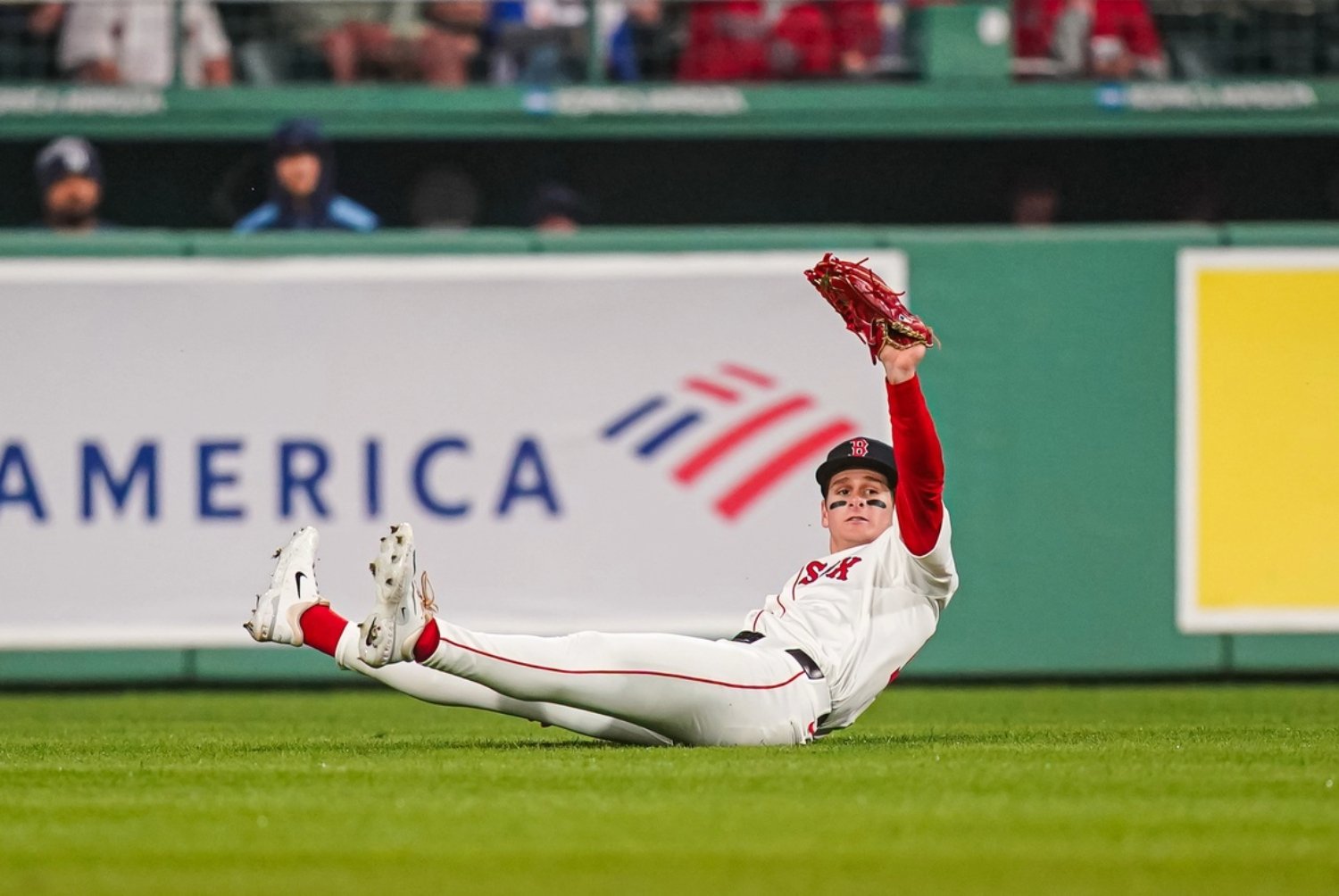
Well, leave it to the Red Sox to take that cautionary tale and brush it aside. The team took the savings from the widely-panned Rafael Devers trade and spent a chunk of them on Roman Anthony, inking the superstar rookie to an eight-year, $130 million extension.
Anthony's contract is by the far the largest of the Red Sox's new core, and the third-largest ever signed by an outfielder under 22 years old (we'll have more on that topic from the excellent @Braden Ramsey later this week). He is now thrust into the face of the franchise role that Acuña assumed with the Braves when he inked his own nine-digit extension as a 21-year-old, and one can only hope he lives up to the MVP and World Series path that Acuña has forged.
As a reminder, in Craig Breslow's tenure, the Red Sox have extended the following pre-arb players:
- Roman Anthony: eight years and $130 million (begins in 2026, club option for 2034)
- Brayan Bello: six years and $55 million (began in 2024, club option for 2030)
- Kristian Campbell: eight years and $60 million (began in 2025, club options for 2033 and 2034)
- Ceddanne Rafaela: eight years and $50 million (began in 2024, club option for 2032)
That list doesn't include ace Garrett Crochet, who signed in arbitration after being acquired via trade. His contract is for six years and $170 million, and comes equipped with a player option for 2031.
So, that's an ace pitcher, a star outfielder, a solid mid-rotation pitcher, a big-hitting infielder, and a stellar defensive center fielder. That's a pretty solid core to build the future of the team around—they are all under contract through the end of the decade at least—and mirrors the Braves' extensions remarkably well. The team has identified the players it plans to build around, and a few others (Wilyer Abreu, Marcelo Mayer, Carlos Narváez) have proven worthy of being added to this growing list of foundational Red Sox players.
If you didn't believe it before, the Anthony extension (and preceding trade deadline) are loud statements from the organization: This era of Boston baseball will be built from within, and the players who check off the internal development boxes will be rewarded. That's certainly not to say there aren't outside additions coming—Crochet himself is proof that the team will splurge where it deems fit to do so—but it is a commitment to what Craig Breslow and company have been building since they stepped foot inside the front office.
There's no telling how this will all pan out. The Braves were unstoppable until they weren't. The White Sox never even got off the ground. Last year's World Series participants (the Yankees and Dodgers) got there primarily from the contributions of big trade acquisitions and free-agent splurges.
It isn't as flashy as what the Dodgers or Yankees do, but the Red Sox are going for something different—something more sustainable (or, at least, more sustainable than the Yankees; the Dodgers are a one-off freak show in terms of consistent dominance). With Anthony now set to lead the charge, it's hard not to start getting excited about what this new era of Red Sox baseball could look like.





Recommended Comments
Create an account or sign in to comment
You need to be a member in order to leave a comment
Create an account
Sign up for a new account in our community. It's easy!
Register a new accountSign in
Already have an account? Sign in here.
Sign In Now