Brandon Glick
-
Posts
587 -
Joined
-
Last visited
Content Type
Profiles
Boston Red Sox Videos
2026 Boston Red Sox Top Prospects Ranking
Boston Red Sox Free Agent & Trade Rumors, Notes, & Tidbits
Guides & Resources
2025 Boston Red Sox Draft Pick Tracker
News
2026 Boston Red Sox Draft Tracker: Picks & Bonuses
Forums
Blogs
Events
Store
Downloads
Gallery
Everything posted by Brandon Glick
-
If Not First Base, Where Will Kristian Campbell's Home be in Boston?
Brandon Glick posted an article in Red Sox
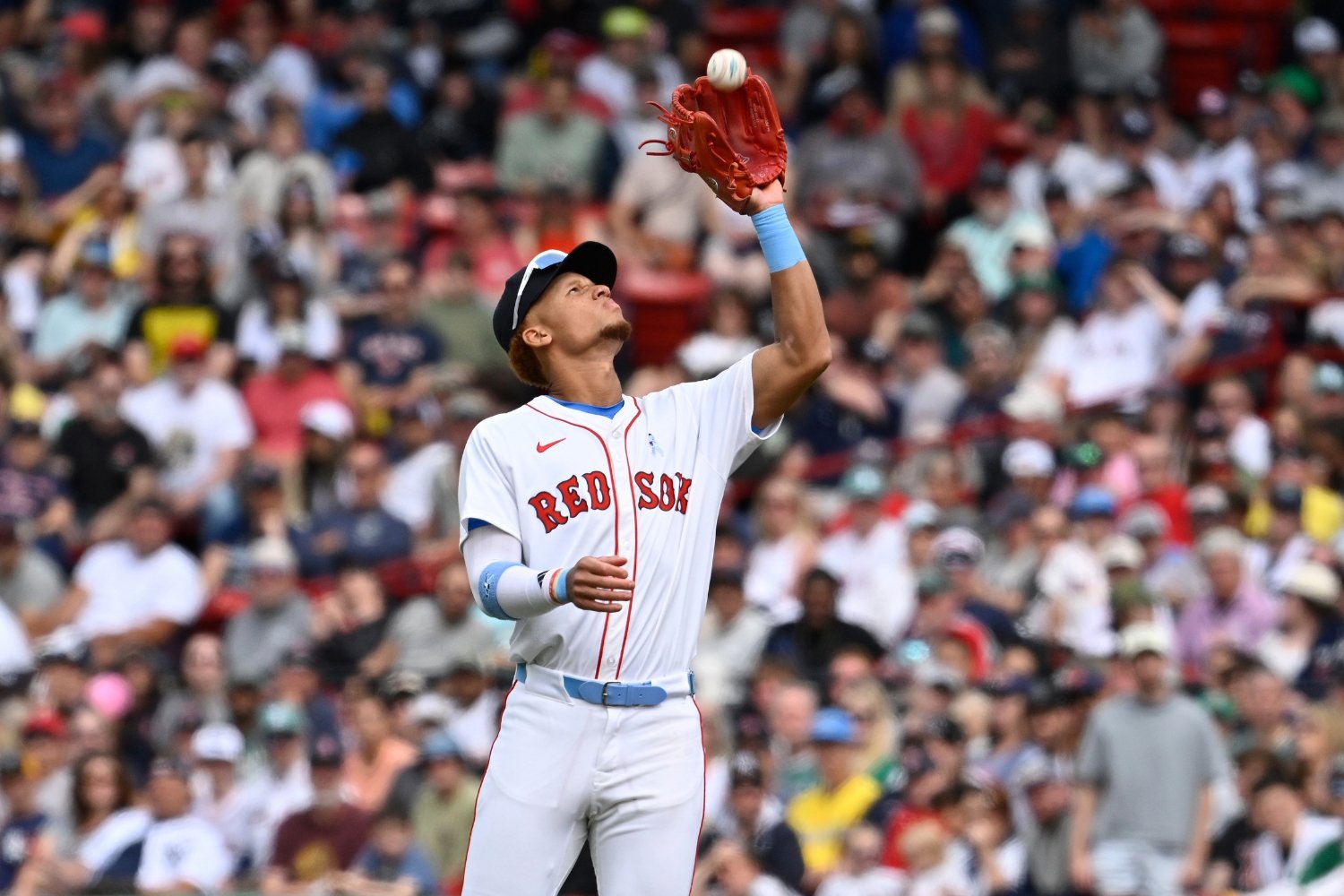 I still believe in Kristian Campbell's bat, and I encourage you to have faith as well. I know things got really, really ugly for a while there -- he slashed .159/.243/.222 (29 wRC+) in 140 plate appearances from May 1 until his demotion in mid-June -- but let's not forget that this is a rookie who had one of the hottest months in baseball this season (.301/.407/.495, 148 wRC+ in April) when he first cracked the major league roster. I'd also be remiss not to remind you that Campbell is just 23 years old and began the 2024 season in High-A Greenville. He had a meteoric ascension to the big leagues; a setback against the best pitchers in the world shouldn't dissuade anyone from buying his long-term potential. But, even if the Red Sox are losing faith in his most prodigious skill, he's not going anywhere. He signed a lucrative eight-year extension back in April, worth $60 million at minimum and as much as $100 million if the team picks up both option years at the end of the contract. That's an investment you can't just sweep under the rug, especially with how purposeful the Red Sox have been with spending money recently. Every dollar on the books matters, and the team's decision to eschew Campbell's cheap years of team control for a sturdy salary reflects a commitment to him and his development, struggles or not. So, that leaves us with a question that seemingly has no right answer: Where will Kristian Campbell play in Boston going forward? Let's put something out there right upfront: Kristian Campbell was awful at second base with the Red Sox this season. He made seven errors in less than 500 innings at the keystone while he was in the big leagues, "earning" -15 Defensive Runs Saved (DRS), -8 Outs Above Average (OAA), and -9 Fielding Run Value (FRV). These stats aren't perfect for "pace analysis" in the same way that home runs or stolen bases are, but extrapolate those numbers over a full season (roughly two-and-a-half times as many innings as Campbell played at second), and you get a player worth -37 DRS, -20 OAA, and -22 FRV. I mean, holy moly. That's how bad Campbell was in the field for the Red Sox this season (and that's not including his below-average time in the outfield). And yes, to answer your biggest question, those would all be the worst marks in baseball this season. Defenders can absolutely improve over time -- Nathaniel Lowe was worth -10 OAA the year before he won his Gold Glove in 2023 -- but it's not the same kind of growth as hitting. Plate approaches are so fickle, and there's so many moving parts to them; any given change could be the thing that fixes or breaks a player's swing and turns them into (or reverts them from being) an All-Star. Fielding is a different beast. You can learn the ins and outs of a position, get more athletic, develop a stronger throwing arm, or just plain get better with more repetitions, but the truth with fielding is that you can either handle a certain position, or you can't. Campbell certainly has the athleticism to stick at second base (he even drew some innings at shortstop and third base last year), but the results are what they are. If the goal is to have him back in the major leagues by Opening Day 2026, then sticking him at a position where he's actively negating a ton of his offensive value isn't going to help Campbell or the team. Over the last few months, the answer to the "Campbell Position Conundrum" (the "CPC", if you will) has been first base. He's been getting a ton of reps in Triple-A Worcester at the position, and there were many who were calling for him to handle the cold corner in Boston before Lowe was brought in after a disappointing trade deadline. However, that spot has never been the best use of his athleticism, and Senior Director of Player Development Brian Abraham all but confirmed that it won't Campbell's long-term defensive home going forward. “First base was an immediate trial to see if that could work," Abraham told the Pesky Report. "That probably will end up not being as much of a focus going forward. I see him being more of a 2B/OF type opportunity." Whatever the reason may be -- the team anticipates Triston Casas being fully healthy, or they expect to re-sign Nathaniel Lowe, or they want to keep the position open for a competition in spring training -- this is the right call for Campbell's future. To be a first baseman in the majors, you have to hit. Campbell can certainly offer that kind of production, but that's a lot of pressure on a guy who lost all semblance of his confidence at the plate before being demoted back to Triple-A. The smoothest fit is obviously second base. That would allow Marcelo Mayer to take over the hot corner for Alex Bregman (assuming he leaves in free agency), or it could push Mayer into a super-utility role where his excellent glove could benefit a multitude of positions (if Bregman sticks around). We've already acknowledged how disastrous Campbell was there, though, and unless he makes marked improvements over the offseason, it's hard to imagine the coaching staff willingly subjecting him to a position he can't play competently. That leaves the outfield, which Abraham made sure to note when discussing the CPC. In fact, Campbell is starting to get some time in right field with the WooSox, perhaps as a "break glass in case of emergency" option if Wilyer Abreu can't return from his injury before the playoffs. The issue, of course, is that the Red Sox have an abundance of slick-fielding outfielders, from all-universe defender Ceddanne Rafaela in center to Abreu, a reigning Gold Glover, in right. If you like what Roman Anthony brings to the table in left (you should), then there's your starting outfield for the next half-decade, and that obviously fails to mention Jarren Duran, who has proven more than capable of handling each outfield spot in a pinch. So, where does that leave Campbell? The Red Sox could stash him in a super utility role, but do you really want to keep moving him around when the primary focus is on his bat? They could task him with learning third base over the offseason if Bregman leaves, but Mayer is a wildly superior defender and has already shown off his defensive prowess at the hot corner. Shortstop is probably off the table if Trevor Story is still around, but that's probably true regardless given Campbell's struggles at second base. Assuming the team doesn't try a Carlos Narvaez-Campell catching tandem, that only leaves one spot for the talented rookie: designated hitter. We already know that Alex Cora hates the idea of stashing one of his über-athletic youngsters in that spot, but given the layout of the team right now, it's hard to imagine where else Campbell fits if it's not first base. That scenario would prevent the team from using one of their four star outfielders at DH, as well as their successful Masataka Yoshida-Romy Gonzalez platoon, but that's genuinely the only spot left if second base doesn't work out. Is that something the Red Sox would be okay with? The CPC has no obvious answer, even as the Red Sox try to throw everything at the wall to see what sticks. It feels like asking for a miracle given that the priority is patching the holes in his plate approach, but Campbell could quell a lot nerves about his long-term future if he can show up to spring training ready to play literally any position on the diamond.
 -
It appears May will not be making his scheduled start.
-
Jeffrey Springs has a history of shoving against the Sox. Hopefully, the ineptitude of the A's has rubbed off on him.

-
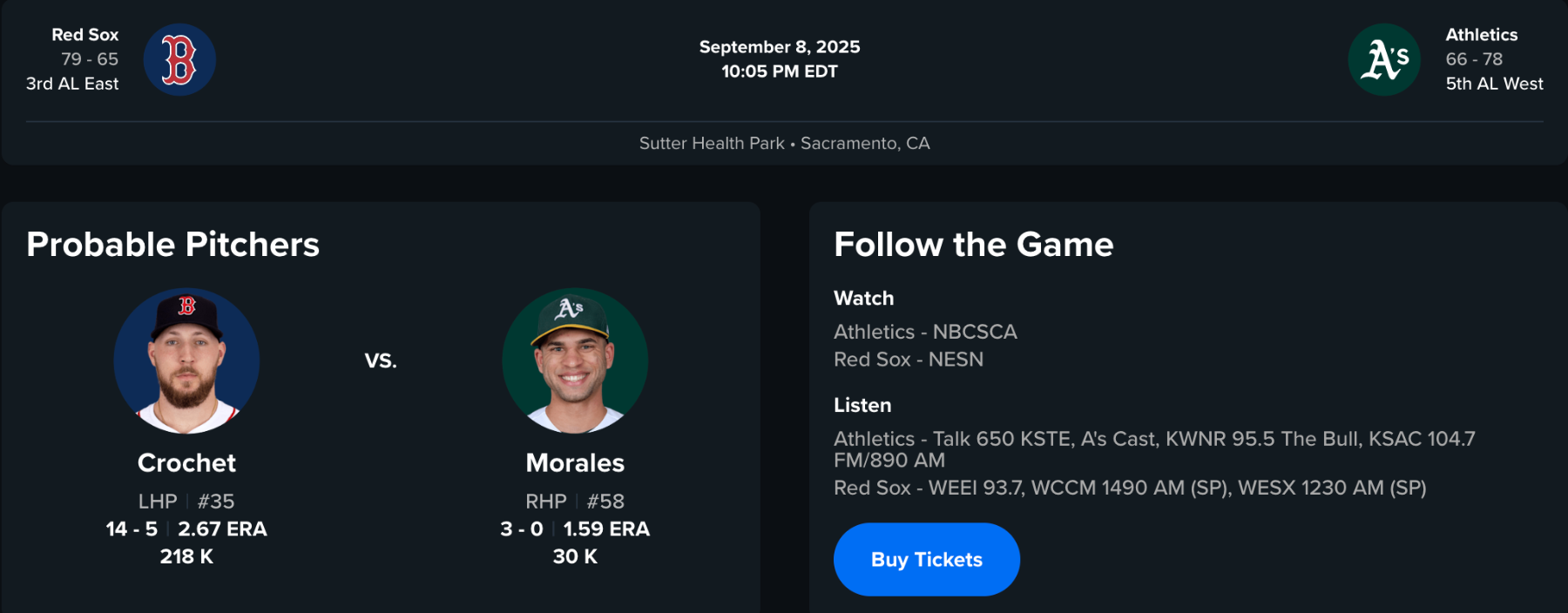
This West Coast trip is brutal. But, I have good news! Every series after this one with the A's is on the East Coast. So... enjoy the last few 10pm starts of the year?
-
Baseball, football, or tennis today?
-
The Red Sox's star rookie injured his oblique against the Guardians. What's to come for Roman Anthony, and can the team make do without him?
-
The Red Sox's star rookie injured his oblique against the Guardians. What's to come for Roman Anthony, and can the team make do without him? View full video
-
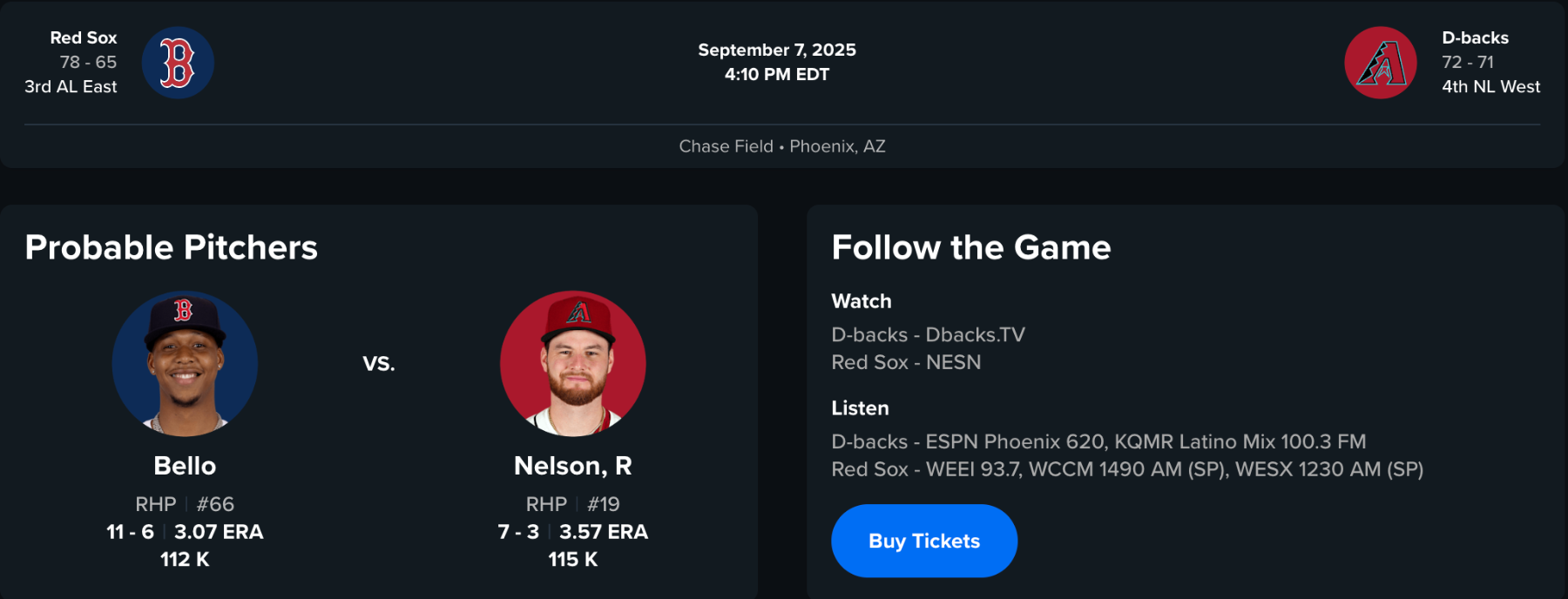
Ugh, the dreaded West Coast road trip in September. But, hey, at least we face old friend E-Rod tonight.

-
How are you feeling about the Red Sox right now?
-
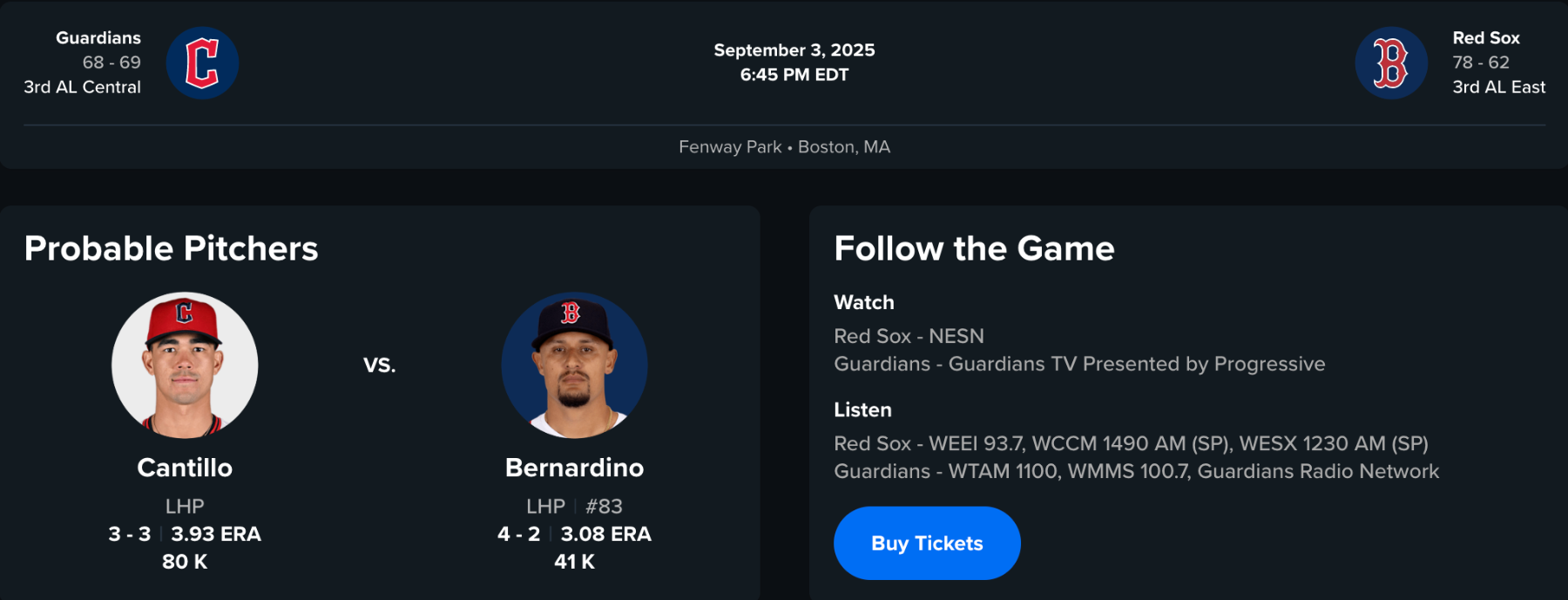
Is it Christmas in September, or did Alex Cora just know I was dying for a bullpen game today?
-
Alex Bregman's Cold Stretch Is Cause for Concern, but It Is Fixable
Brandon Glick posted an article in Red Sox
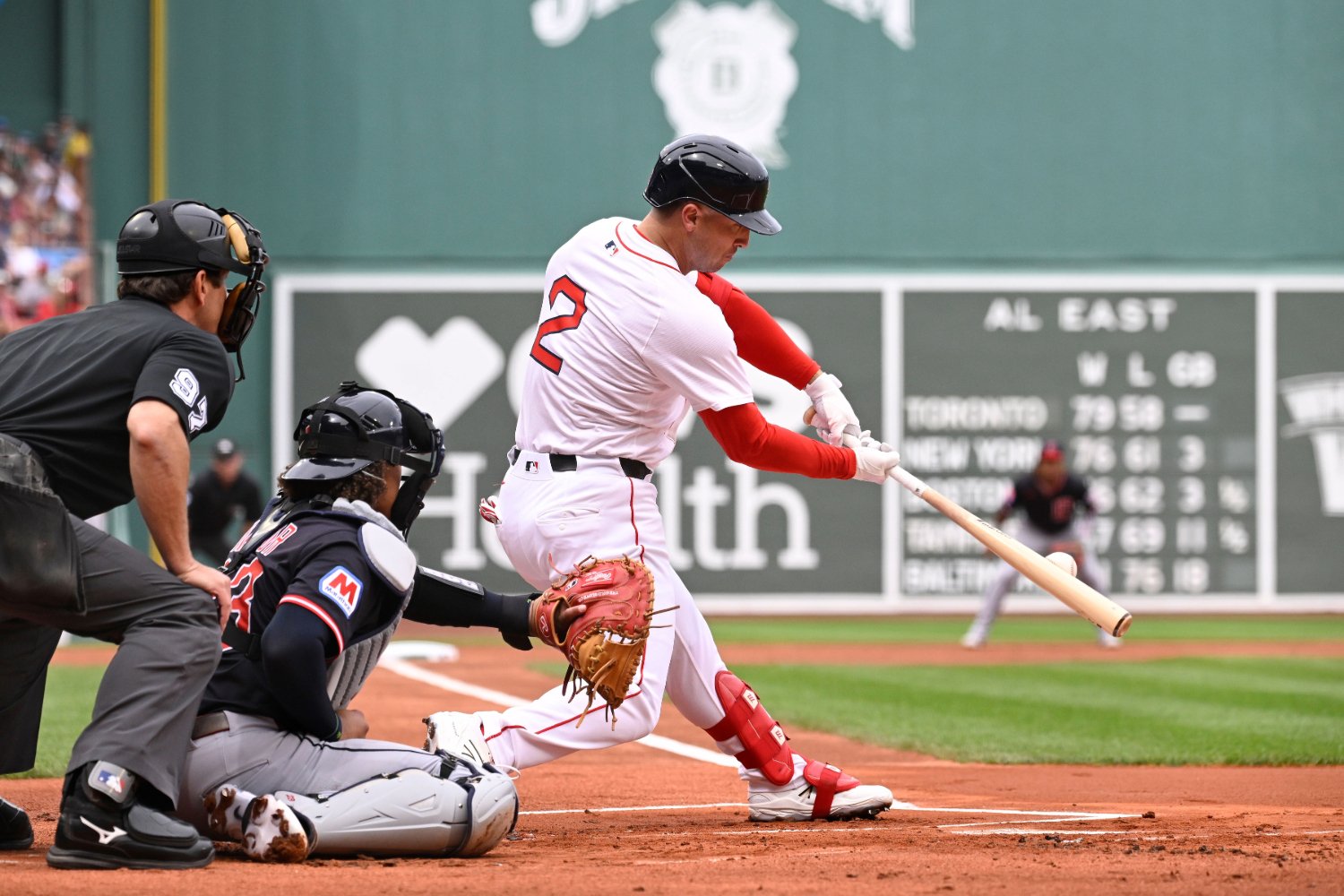 Alex Bregman has been such a model of consistency in Boston since arriving late in the offseason that's it's almost hard to imagine what a 'bad' version of him would look like in a Red Sox uniform. Unfortunately, we don't have to imagine any more. The last few weeks of Bregman have been an unmitigated disaster at the plate, and him turning into a pumpkin could not have come at a worst time. Before we try to figure out what's going, let's look at the numbers. In the scope of the second half, Bregman has been solid: a .269/.355/.421 slash line with a .152 ISO, good for a 113 wRC+. Yes, those figures all mark drastic declines from his first-half performance, but a .776 OPS is hardly a reason to jump ship. Narrow things down to just August, and the problems start to become a little clearer. Bregman hit .260/.375/.360 with a .100 ISO last month, which resulted in a season-low 107 wRC+. Again, not the sign of someone who lost all sense of competence at the dish, but his season-high 13.3% walk rate (and season-low 9.2% strikeout rate) are doing a lot of heavy lifting in propping up those overall numbers. Tighten our sample even further to Bregman's last ten games from Aug. 23 to Sept. 1 -- starting just after his second consecutive three-hit performance against the Yankees -- and the numbers grow truly ugly. In that window, the third baseman is batting .103/.182/.128. He has just four hits in his last 39 at-bats (44 plate appearances), only one of which went for extra bases (a double against the Guardians on Labor Day). His ISO in that span is .026, and his wRC+ is a scale-breaking -15. Yikes. This is about as bad of a stretch as Bregman has ever had in his career, and there doesn't appear to be any (publicly-known) injury that's hampering him. About the only outside factor that we can toss into the equation is his looming free agency (assuming he declines his player option for the 2026 season), though that same circumstance didn't preclude him from hitting .256/.310/.500 (123 wRC+) with the Astros in the final month of the 2024 season. Get your small sample caveats out of the way now. A ten-game sample is hardly conducive to prognosticating a player's future, let alone someone with as strong of a track record as Bregman. However, that doesn't mean what's happening right now isn't problematic, and it also doesn't automatically guarantee a return to form for one of the Red Sox's most important players. In this most recent stretch, Bregman's batting average on balls in play (BABIP) is .114, a 215-point drop from the first half. That's... comical. For reference, Aaron Judge leads all MLB players with a .380 BABIP in 2025; his teammate, Anthony Volpe, is the lowest-ranked qualified hitter with a .242 BABIP. You would need to add another 77 points of average to their difference to explain the gap between first-half Bregman and last-ten-games Bregman. Okay, so we have a culprit, but what's the reason for such a precipitous decline? Yes, Bregman's hard-hit rate is 31.4% since Aug. 23, a steep drop-off from the 37.4% rate he posted in the first half, but it's actually an improvement on his cumulative second half numbers (29.8%). If you can believe it, his soft contact numbers are even better; his soft-hit rate of 8.6% over his last ten games is better than what he did in the first half (12.3%) and his total in the second half (16.6%). That suggests his quality of contact isn't an issue, and quick look at his spray chart offers the same conclusion. So, if he's generally hitting the ball hard, rarely striking out, and still pulling the ball a ton, what on earth is going on? Well, prepare for me to sound like your old middle school coach, but the issue is that Bregman isn't 'elevating and celebrating'. Indeed, his ground-ball rate over these past ten games is an alarming 51.4%, leagues above what he was doing in the first half (35.6%). Naturally, his fly-ball rate has been slashed, as his 28.6% rate recently represents a near-22-point drop from the pre-All-Star-break Bregman. It also doesn't help that one in every five of his fly balls in our sample failed to leave the infield, up sharply from a 12.5% infield fly-ball rate. Bregman's launch angle issues have actually been a problem all year -- his conscious change to try and hit more pulled fly balls to take advantage of the Green Monster has resulted in the lowest launch angle sweet spot rate of his career (33.0%). You can read more about LA SwSP% here, but know that it means the rate at which a player produces a batted ball event with a launch angle between 8-32 degrees. That's generally considered the "ideal range" for a player to produce optimal outcomes, and whereas Bregman was doing that more than 37.0% of the time during his peak from 2018-19, he's not even achieving it one-third of the time this year. Now, none of this means Bregman is "broken". This recent cold stretch is a confluence of bad luck and not squaring up enough balls, and if he can start turning some of those topped groundouts or popped-up fly outs into line drives, the numbers should follow suit. But this is a reminder that even the best players are prone to tough times, especially when they alter their profile to fit more of the extremes. Watch Bregman closely over the next few weeks as he tries to get himself right before the playoffs. This is a veteran player with a long history of success. Expect him to adjust given this data, and hopefully, he'll return to the All-Star version of himself before the games start meaning life or death.
 -
Alex Bregman has been such a model of consistency in Boston since arriving late in the offseason that's it's almost hard to imagine what a 'bad' version of him would look like in a Red Sox uniform. Unfortunately, we don't have to imagine any more. The last few weeks of Bregman have been an unmitigated disaster at the plate, and him turning into a pumpkin could not have come at a worst time. Before we try to figure out what's going, let's look at the numbers. In the scope of the second half, Bregman has been solid: a .269/.355/.421 slash line with a .152 ISO, good for a 113 wRC+. Yes, those figures all mark drastic declines from his first-half performance, but a .776 OPS is hardly a reason to jump ship. Narrow things down to just August, and the problems start to become a little clearer. Bregman hit .260/.375/.360 with a .100 ISO last month, which resulted in a season-low 107 wRC+. Again, not the sign of someone who lost all sense of competence at the dish, but his season-high 13.3% walk rate (and season-low 9.2% strikeout rate) are doing a lot of heavy lifting in propping up those overall numbers. Tighten our sample even further to Bregman's last ten games from Aug. 23 to Sept. 1 -- starting just after his second consecutive three-hit performance against the Yankees -- and the numbers grow truly ugly. In that window, the third baseman is batting .103/.182/.128. He has just four hits in his last 39 at-bats (44 plate appearances), only one of which went for extra bases (a double against the Guardians on Labor Day). His ISO in that span is .026, and his wRC+ is a scale-breaking -15. Yikes. This is about as bad of a stretch as Bregman has ever had in his career, and there doesn't appear to be any (publicly-known) injury that's hampering him. About the only outside factor that we can toss into the equation is his looming free agency (assuming he declines his player option for the 2026 season), though that same circumstance didn't preclude him from hitting .256/.310/.500 (123 wRC+) with the Astros in the final month of the 2024 season. Get your small sample caveats out of the way now. A ten-game sample is hardly conducive to prognosticating a player's future, let alone someone with as strong of a track record as Bregman. However, that doesn't mean what's happening right now isn't problematic, and it also doesn't automatically guarantee a return to form for one of the Red Sox's most important players. In this most recent stretch, Bregman's batting average on balls in play (BABIP) is .114, a 215-point drop from the first half. That's... comical. For reference, Aaron Judge leads all MLB players with a .380 BABIP in 2025; his teammate, Anthony Volpe, is the lowest-ranked qualified hitter with a .242 BABIP. You would need to add another 77 points of average to their difference to explain the gap between first-half Bregman and last-ten-games Bregman. Okay, so we have a culprit, but what's the reason for such a precipitous decline? Yes, Bregman's hard-hit rate is 31.4% since Aug. 23, a steep drop-off from the 37.4% rate he posted in the first half, but it's actually an improvement on his cumulative second half numbers (29.8%). If you can believe it, his soft contact numbers are even better; his soft-hit rate of 8.6% over his last ten games is better than what he did in the first half (12.3%) and his total in the second half (16.6%). That suggests his quality of contact isn't an issue, and quick look at his spray chart offers the same conclusion. So, if he's generally hitting the ball hard, rarely striking out, and still pulling the ball a ton, what on earth is going on? Well, prepare for me to sound like your old middle school coach, but the issue is that Bregman isn't 'elevating and celebrating'. Indeed, his ground-ball rate over these past ten games is an alarming 51.4%, leagues above what he was doing in the first half (35.6%). Naturally, his fly-ball rate has been slashed, as his 28.6% rate recently represents a near-22-point drop from the pre-All-Star-break Bregman. It also doesn't help that one in every five of his fly balls in our sample failed to leave the infield, up sharply from a 12.5% infield fly-ball rate. Bregman's launch angle issues have actually been a problem all year -- his conscious change to try and hit more pulled fly balls to take advantage of the Green Monster has resulted in the lowest launch angle sweet spot rate of his career (33.0%). You can read more about LA SwSP% here, but know that it means the rate at which a player produces a batted ball event with a launch angle between 8-32 degrees. That's generally considered the "ideal range" for a player to produce optimal outcomes, and whereas Bregman was doing that more than 37.0% of the time during his peak from 2018-19, he's not even achieving it one-third of the time this year. Now, none of this means Bregman is "broken". This recent cold stretch is a confluence of bad luck and not squaring up enough balls, and if he can start turning some of those topped groundouts or popped-up fly outs into line drives, the numbers should follow suit. But this is a reminder that even the best players are prone to tough times, especially when they alter their profile to fit more of the extremes. Watch Bregman closely over the next few weeks as he tries to get himself right before the playoffs. This is a veteran player with a long history of success. Expect him to adjust given this data, and hopefully, he'll return to the All-Star version of himself before the games start meaning life or death. View full article
-
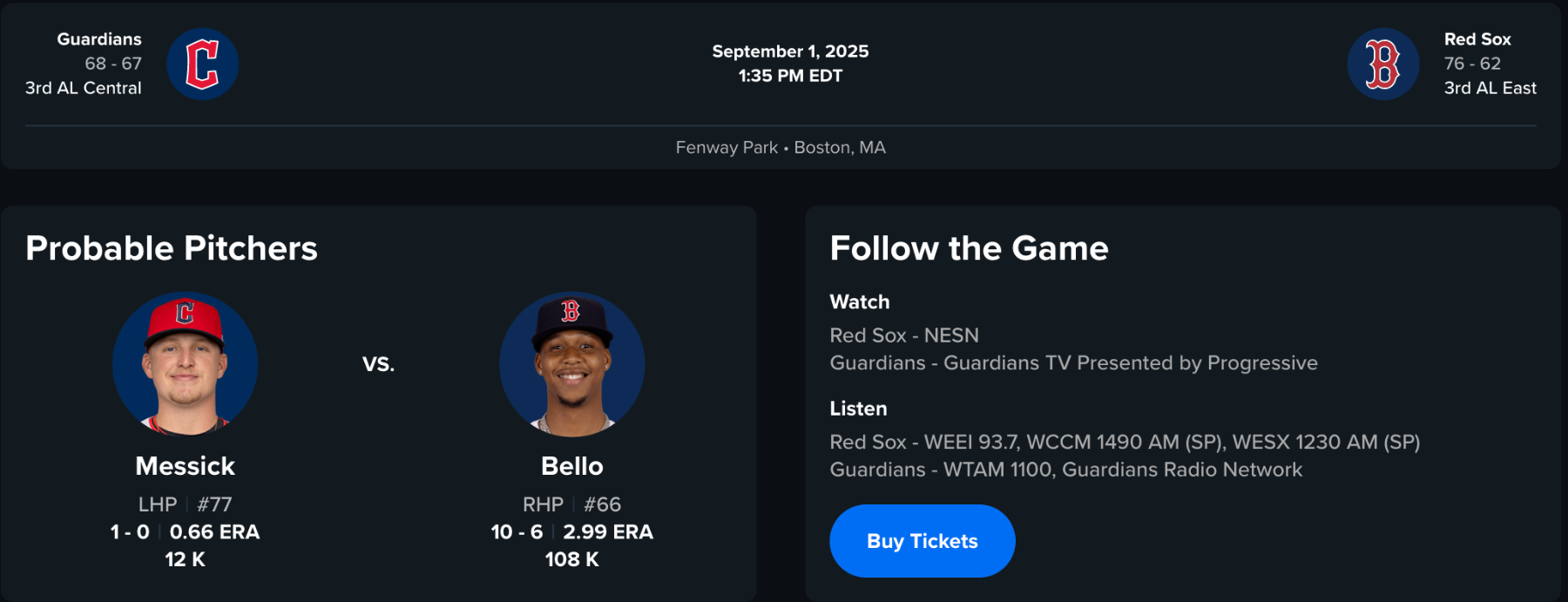
In under-discussed news, the Red Sox are 3.0 games out of the first seed in the AL...
-
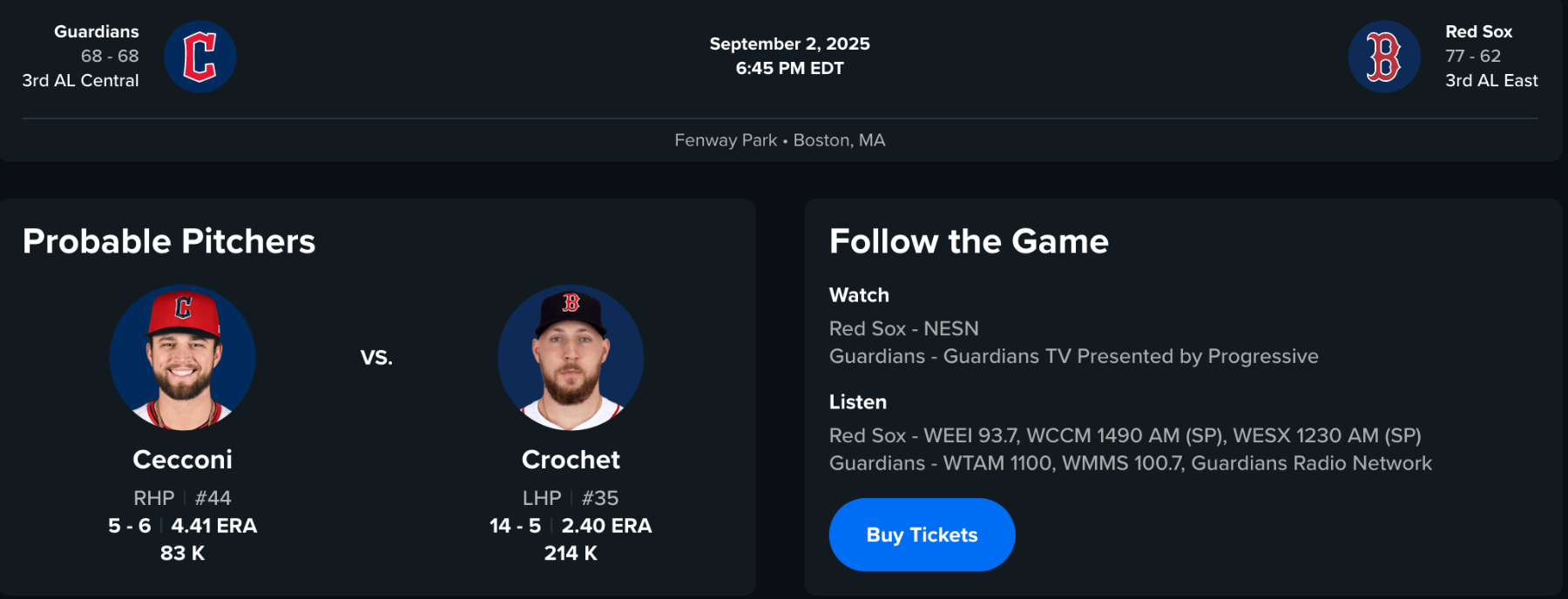
Enjoy Labor Day, all.
-
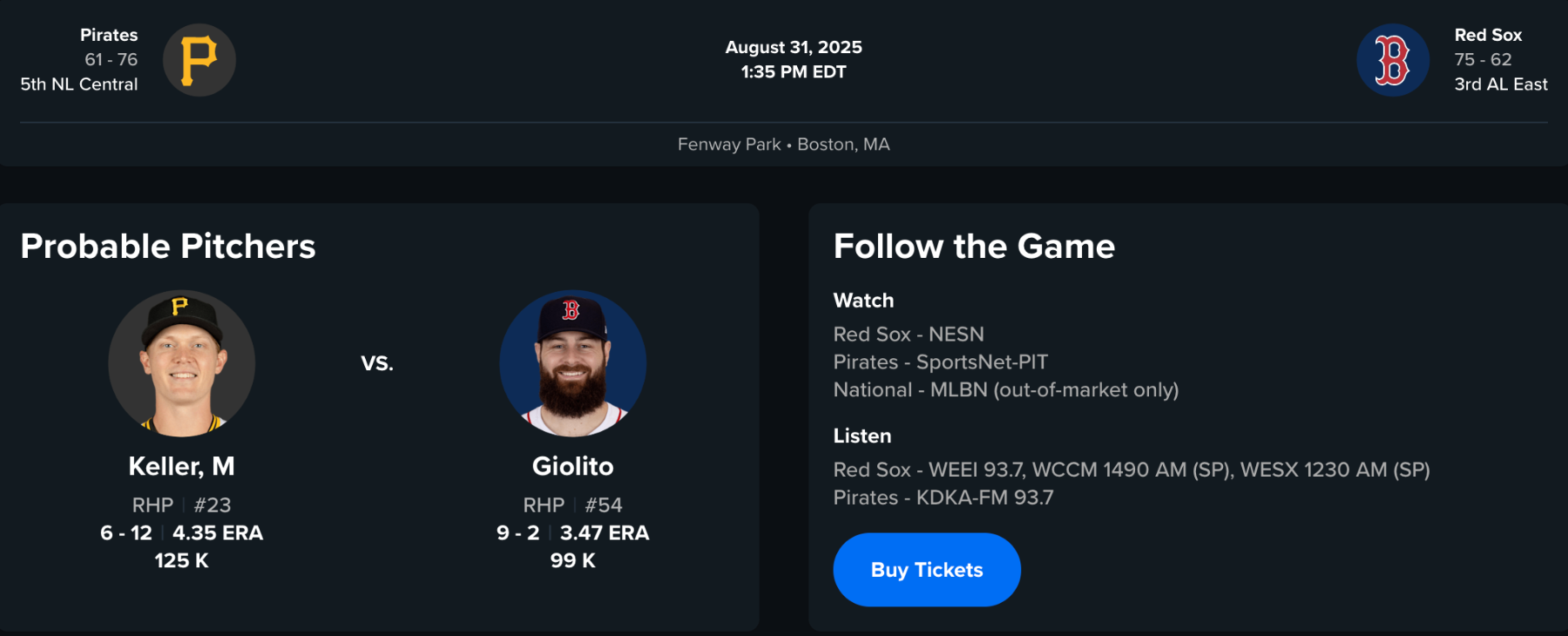
Hi. Uh, don't get swept by the Pirates, please. I hear it's not good for your playoff odds.
-
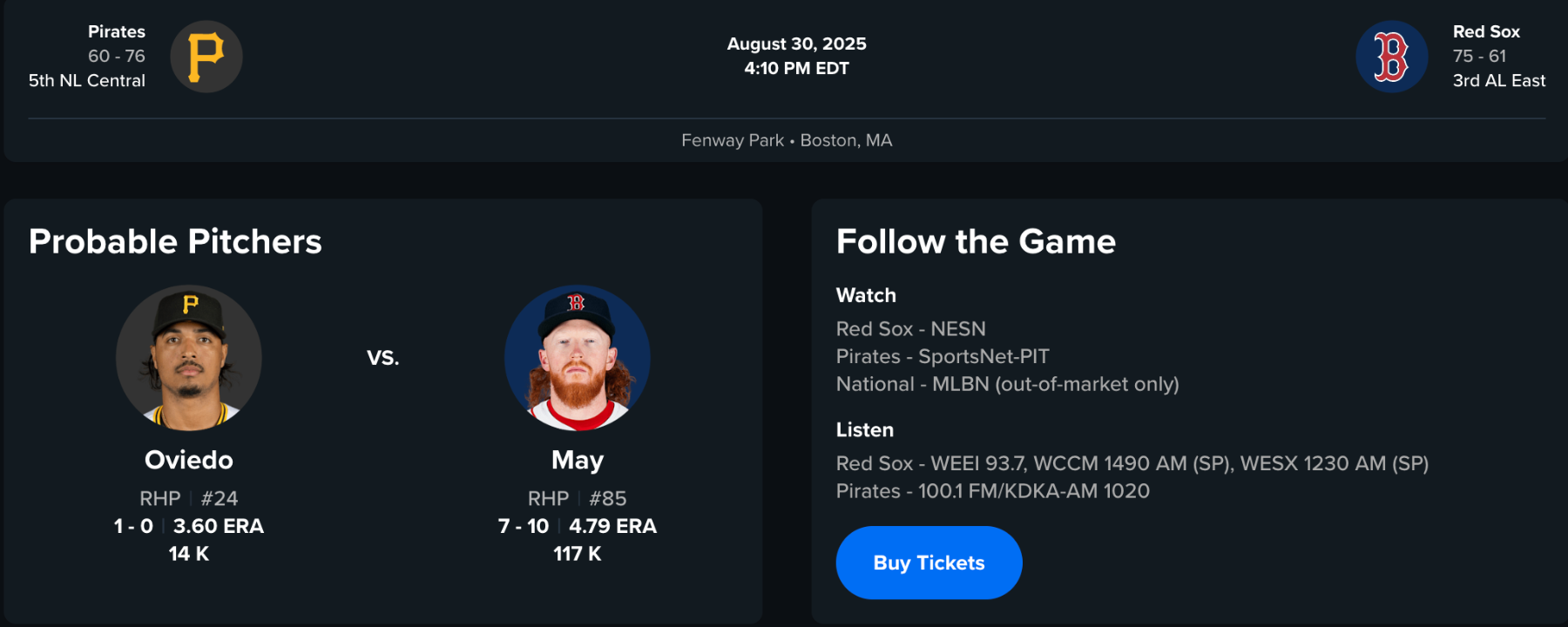
Yesterday's pitching matchup lived up to the hype. Here's hoping Dustin May follows suit.
-
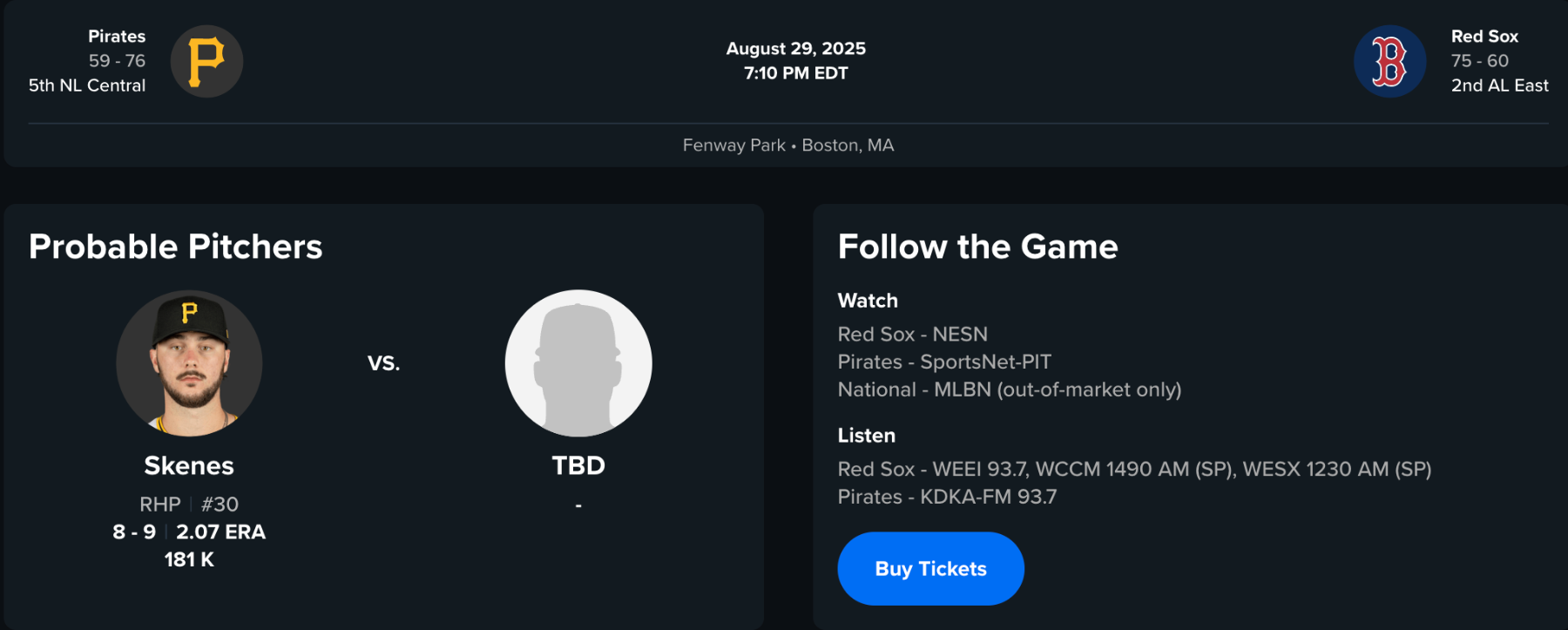
As far as pitching matchups go... oh boy. This is a blockbuster affair.
-
Ethan has finally visited Fenway Park! He shares his thoughts and feelings on the historic stadium and what it was like finally soaking in Boston.
-
Ethan has finally visited Fenway Park! He shares his thoughts and feelings on the historic stadium and what it was like finally soaking in Boston. View full video
-
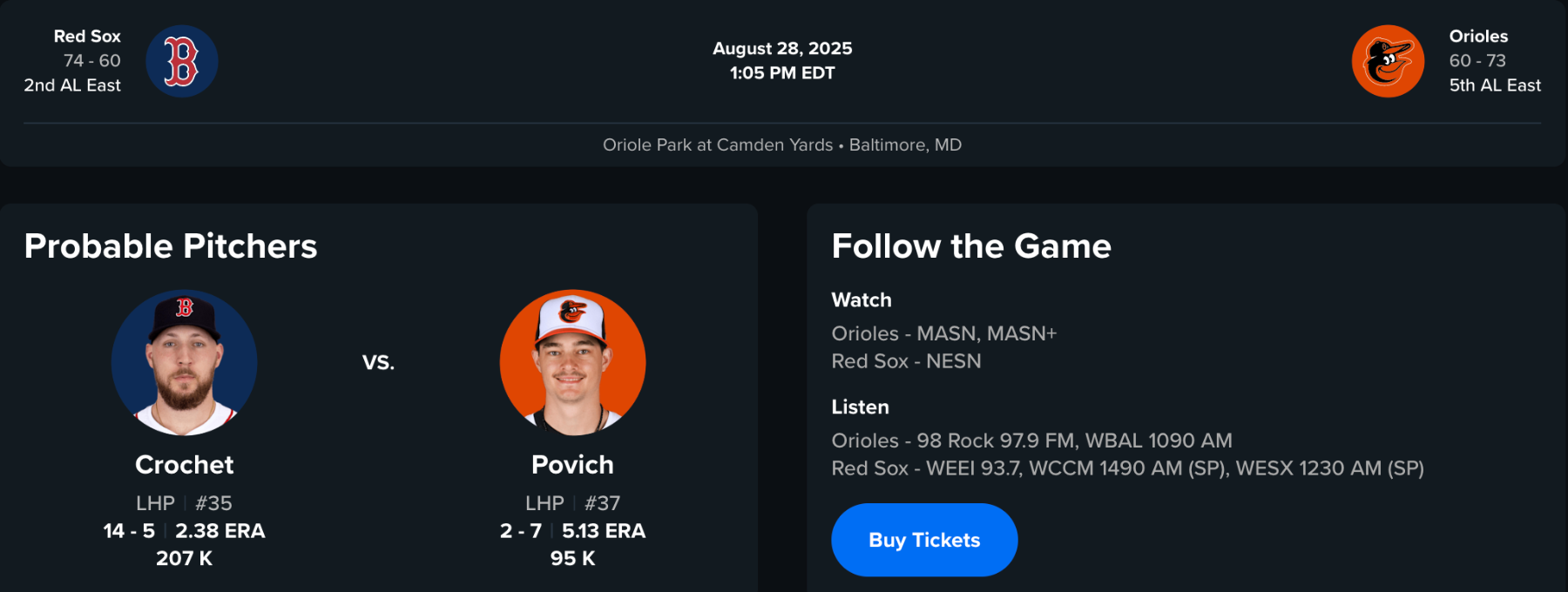
A chance at a four-game sweep to go 15 games above .500 with Garrett Crochet on the mound? Thursday might just be my favorite day of the week.
-
The Red Sox took three of four from the Yankees over the weekend, placing Boston in pole position in the Wild Card chase ahead of September.
-
The Red Sox took three of four from the Yankees over the weekend, placing Boston in pole position in the Wild Card chase ahead of September. View full video
-
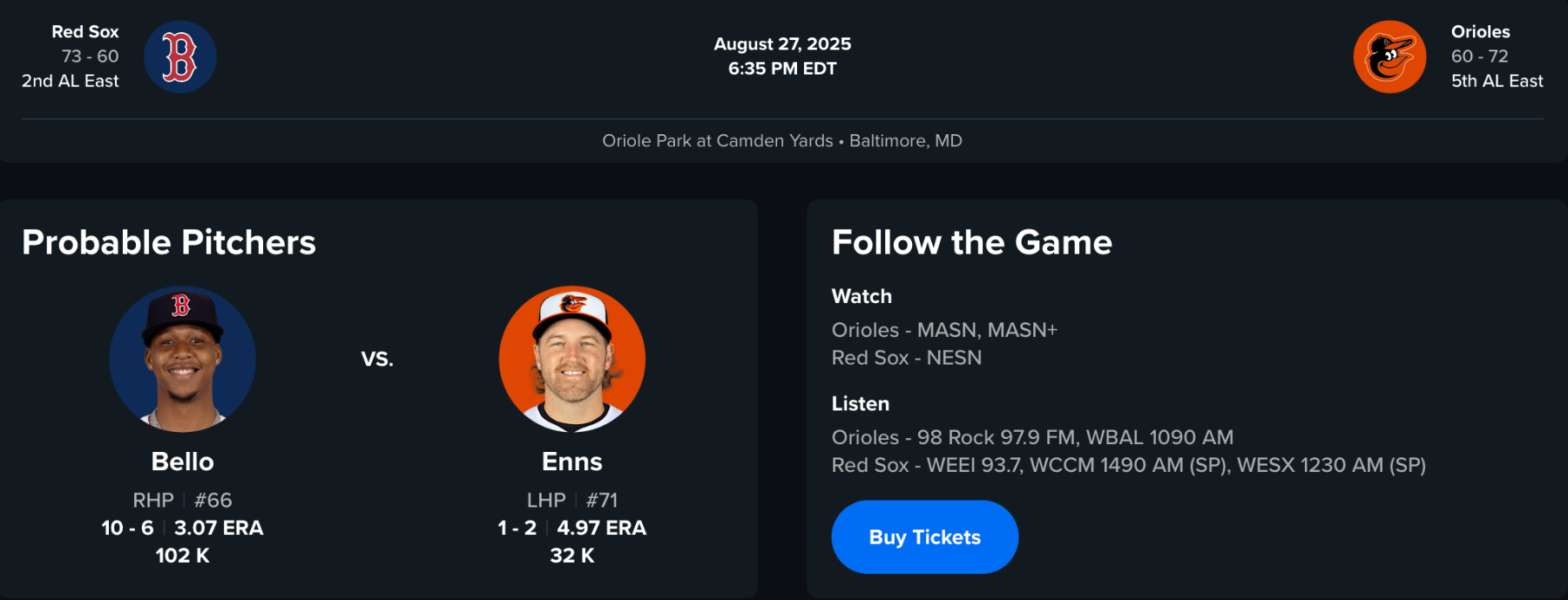
Well, this has been a mighty successful road trip thus far, no? Two more against Baltimore before a favorable six-game homestand (Pirates, Guardians).
-
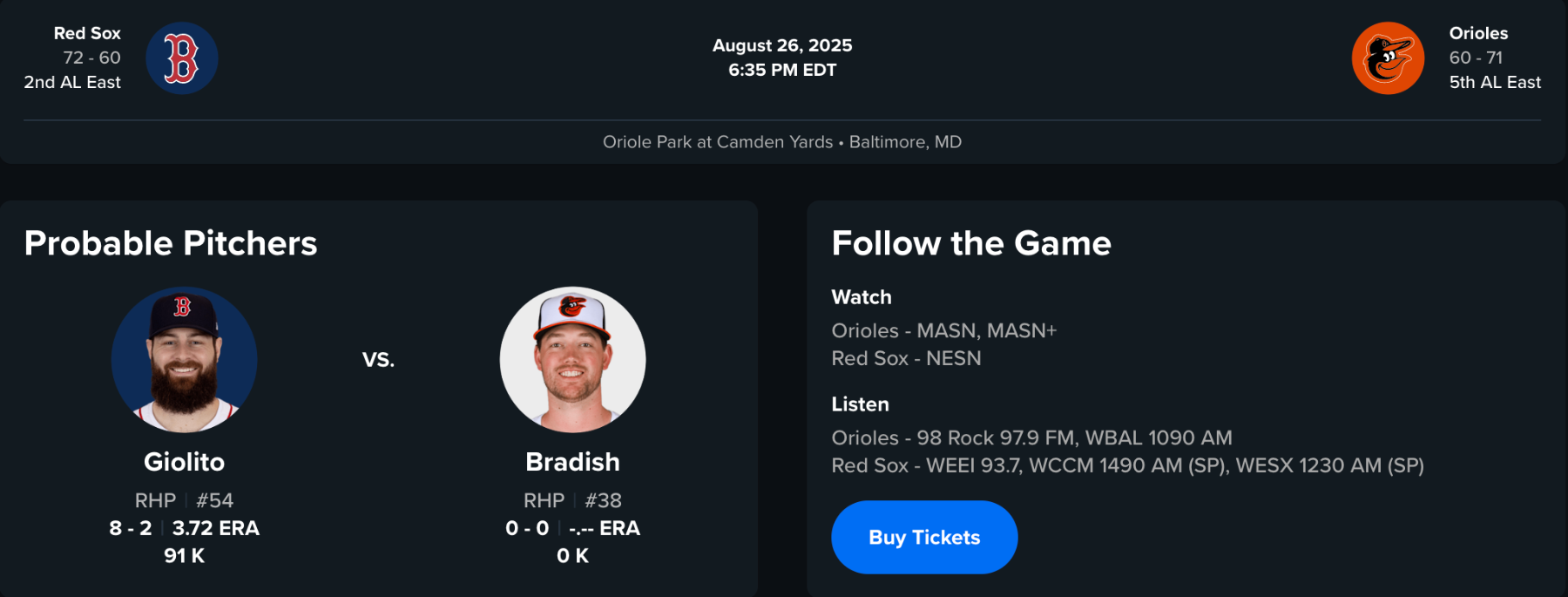
I have returned from my one-day hiatus (I was attending the US Open in NY) to find that the Red Sox actually beat the Orioles? Perhaps they will repeat the feat when I am actually watching tonight...
-
 Hello all! For the 366th day in a row, I welcome you to the renewed Talk Sox website. Today is a special one, as it marks the one-year anniversary of the site's relaunch! It's hard to believe we're already here, but time flies when you're having fun. Thank you all so much for your support over the past year. There's been a lot of changes to the site and our content team over the last 12 months, so we thought it would be wise to do a "meet the staff" piece to get our readers acquainted with our writers again. This isn't an exhaustive list of the contributors on the site (participation was not mandatory for this activity), but it will include the names and bylines you see most often. Of course, I'd be remiss not to give huge shoutouts to @Davy Andrews, our original managing editor who supplied us with top-of-the-line coverage as we got things off the ground, and @Brock Beauchamp, our fearless leader who probably knows too much about too many baseball teams at this point. Without further ado, lets's (re)introduce the staff! @Brandon Glick Title: Site Manager (DiamondCentric), Interim Managing Editor (Talk Sox) Favorite Team Besides Red Sox: Cubs Favorite Piece at Talk Sox: Thank You, Jarren Duran I am a Site Manager across the DiamondCentric suite of sites, which now covers seven teams across Major League Baseball. Talk Sox was the fifth addition to that family (fourth wholly owned and operated by DC), and it’s hard to believe it’s already been a year since the site was relaunched under that banner! I have been a Red Sox fan for quite some time, despite growing up in the New Jersey/New York area. My father is a die-hard Yankees fan, so we squabble quite a bit over the rivalry. We do tend to agree that Aaron Boone is a dunce, though. As many of you may remember, the great Davy Andrews was our managing editor during the early stages of our relaunch, and when he moved to FanGraphs full time, I stepped in as the de facto lead editor at Talk Sox. Most every piece you see on the site has passed by my eyes at least once, so please continue to call me out anytime I let a usage of “the MLB” slip past me. In recent months, I have moved into a quasi-interim managing editor role, though fret not, the search for a true replacement for Davy remains ongoing. Beyond my writing and editing duties on the site, you’ve likely seen my videos with my good friend Ethan Staple, and you’ve surely been annoyed by my presence in the forums, game threads, and blogs at some point or another. When I'm not writing about baseball (or football), I'm generally working in a creative field. I've written and directed two short films (you can check out the first one here), and my first-ever novel is being published next month, exclusively on Amazon and Kindle. Thank you all so much for sticking with us through this first year of the new Talk Sox, and continuing to believe in the work we’re doing. Engaging with all of you on a professional level is a privilege, and the intelligence of Red Sox fans remains unmatched relative to other fanbases. We are excited to continue expanding our coverage and community in Year Two! @Nick John Title: Contributing Writer (Talk Sox) Favorite Team Besides Red Sox: Pittsburgh Pirates Favorite Piece at Talk Sox: 5 Prospects the Red Sox Could Trade if They Decide to be Trade Deadline Buyers I joined the Talk Sox team back in late September of 2024, but didn’t start writing until the end of October. I've written countless articles on both the major league team in Boston and the various prospects across the minor league system. It’s been an enjoyable year working alongside so many talented individuals, and I look forward to continue contributing however I can. I’ve been a Red Sox fan for as long as I can remember, being born in Massachusetts and playing baseball from the time that I could play in my town’s Tee-ball league. Of course, my extreme fascination and need to follow every little thing with the team didn’t truly start until I was around 11 and in fifth grade. My friends and family knew me as a huge Red Sox fan to the point I practically wore Red Sox shirts almost every day to school from sixth to tenth grade. I have so many memories from watching the Red Sox both in person and at home that I could probably write an entire book about them, but that’s what makes baseball so great; you never know what might happen any night. This season, I took my first trip down to Greenville to watch the Drive and it was a fun (but extremely hot) time. The entire Drive organization put on a great experience. Since 2021, I’ve been a season ticket holder for the Worcester Red Sox, so if you go to any games, there’s a good chance you’ve unknowingly seen me there. Outside of baseball and writing for Talk Sox, I work as a history teacher, previously for middle school but now entering my second year of teaching high school. @Alex Mayes Title: Contributing Writer, Co-Host of the Talk Sox Podcast Favorite Team Besides Red Sox: Seattle Mariners Favorite Piece at Talk Sox: It’s Time to Give Brayan Bello His Flowers I’m a Missouri born-and-raised baseball fan, but I have no allegiance to the Cardinals or Royals. Although, my biggest baseball claim to fame was that I was sitting not far behind home plate when Mark McGwire hit his 62nd home run against Sammy Sosa’s Cubs. My love for the Red Sox started when I began to take baseball seriously as a player, but that career didn’t last much past Junior Babe Ruth. I was a catcher for almost every team I played summer ball for, and I sought out catchers to pattern myself after. Enter Jason Varitek. I fell in love with how he handled his pitching staff, called each game, and was an ever-looming presence any time he stepped on the field. Plus, the A-Rod fight was awesome. As a catcher I wanted to be like Tek, so I watched as many Red Sox games as possible, which was difficult in the late 90s and early 2000s. Then, in 2004, my Red Sox showed up the Cardinals in the World Series to break the curse and I became public nuisance number one at school for the remainder of the semester. My love for the Red Sox only grew from there. In my day-to-day life, I’m a Pre-AP/Honors ELA teacher at my local high school. Interestingly enough, my now-best-friend emailed me the first day of my first year and said 'So, you’re a Sox fan too huh?’ and our friendship was born over a love of all things Boston. I’m very grateful for the opportunity to cover the team I love through Talk Sox. The community we’ve built over the last year has been impressive and I enjoy interacting with everyone in the comment sections on each article I can. I had been out of the journalism game for a few years and jumped at the chance to finally chase down a bucket list item of mine, writing about the Red Sox for other people to read. Outside of baseball, I’m a father, teacher, and musician. I enjoy cooking pretty much every night for my family, especially when I can fire up the smoker and make way too much BBQ for everyone. My wife and I consider ourselves to be ‘foodies’ and we often plan vacations around what restaurants we will be going to during the trip before anything else. Our favorite vacation spot is Las Vegas, but we’re currently planning a trip to Boston next summer to finally experience some games at Fenway Park. @Maddie Landis Title: Contributing Writer, Co-Host on the Talk Sox Podcast Favorite Team Besides Red Sox: Wherever Spencer Strider and Shohei Ohtani are playing Favorite Piece at Talk Sox: The Power of Scott Boras, Team-Friendly Extensions, & The Changing Dynamics Of Baseball Business I’ve lived in Pennsylvania for most of my life. As a baby, I was adopted from China. Although we’re not biologically related, my parents have bestowed many of their beliefs and values upon me. Much to their dismay, they couldn’t pass their love for the Phillies onto me. Growing up, I’d visit my relatives in Brookline every summer. In the early 2000s, the Red Sox were right in the heart of Boston, and their presence was felt in every corner of the city. I savored freshly baked Red Sox sugar cookies from Cheryl Ann’s Bakey, which was located across the street from my aunt and uncle’s old home. Coming from rural Pennsylvania, I admired the walkability of Brookline. My uncle and cousin watched the Red Sox every night in their living room. As a young, eager-to-impress child, I wanted to follow along when they talked about baseball, so I joined them. The American League expanded my knowledge of the baseball world. Pitchers didn’t bat; teams had a designated hitter. Jason Varitek fought Alex Rodriguez! Fenway Park had a green 37-foot wall in left field and a cute mascot that lived in it! Immediately, I was hooked. I’m super grateful for the opportunity to be a part of the talented team at Talk Sox. The notion of publishing Red Sox articles on the internet with my name attached to them was very daunting. Reading some of the initial positive feedback from the Talk Sox community was encouraging, and it buried my initial anxieties. I’ll admit my interests outside of baseball support the nerdy baseball fan stereotype. Surprisingly, there’s a frequent amount of overlap between Pokémon fans and baseball fans, so maybe the stereotype has some truth. I love Japanese, Italian, and Dutch culture. In my free time, I enjoy smoking and grilling meat, visiting art museums, biking, and landscape photography. I currently work at a construction management firm. @Jordan Leandre Title: Contributing Writer Favorite Team Besides Red Sox: Diamondbacks Favorite Piece at Talk Sox: Nathaniel Lowe, Recently DFA'd Former World Series Champion, Makes A Lot of Sense for the Red Sox I recently joined the team at Talk Sox in August as a contributing writer and am eager to fit in and contribute to this talented group. My journey to becoming a Red Sox fan was turbulent, yet a super short path at that. My older brother and father actually both grew up Yankees fans—my brother still has a ton of Derek Jeter and Alfonso Soriano memorabilia at his house to this day! However, when I was two years old, I got diagnosed with Ewing’s Sarcoma and thus began my history at the Jimmy Fund. During my treatment, my family and I witnessed firsthand the level of commitment the Red Sox organization had to the Boston community and, in particular, children like myself at the time. That moment made me a Red Sox fan for life and even converted the rest of my family and we’ve never wavered since that day. By the time I reached college, I’d already embarked on a lifetime’s worth of memorable moments at Fenway Park that are both famous and infamous to many—look no further than my ceremonial first pitch in 2017 that hit a photographer in a sensitive area. Writing became a passion of mine in high school, and more so when I realized my only future in baseball would be through covering the sport. This game, and team, has given me so much in my life and my mission in life is to give back to the game through storytelling as best I can. @Jack Lindsay Title: Contributing Writer Favorite Team Besides Red Sox: San Diego Padres Favorite Piece at Talk Sox: Dustin May 2.0: Why the Cutter Could Define His Red Sox Career I’ve been born and raised in the Boston area and played baseball all my life. I currently pitch at Wheaton College and I’m entering my senior year. I’ve always been a Red Sox fan, but I would say I really fell in love with the Sox once an up and coming prospect named Mookie Betts joined the team and have been following with a passion since then. My first Red Sox memory was receiving a Trot Nixon bobblehead for Christmas from my uncle, and my first game was a Sox v. Brewers game at Fenway where the Red Sox smoked them 12-3. I remember my Dad waking me up for the last out of the 2013 World Series, and being able to watch Koji close it out was really special. I just got started here a few weeks ago, but I’m thrilled to be on board. I’ve always had an affinity for writing but never really knew how to use that enjoyment or how to share it with others. When the folks at DiamondCentric reached out, it felt like the perfect opportunity to jump aboard a growing and passionate platform. I’m excited to share my insights with you all and continue to hone my abilities as a writer. Outside of the Sox, I currently pitch at Wheaton College (IL), and I’m entering my senior year as a Communications major with a Media Studies focus. I try to dabble in cooking and refine my abilities on that front, inspired by my mom who is an excellent chef. I also love to play video games and my all-time favorite has got to be Red Dead Redemption 2. As always, we'd love for you all to participate in the comments. Let us know about your Red Sox fandom, other favorite teams, baseball fun facts, and more! Have questions for anyone on the staff? Tag us and we'll respond!