


Red Sox Video
The Boston Red Sox executed a series of roster moves prior to their series against the Houston Astros. Nick Burdi's DFA stands as the most impactful of the bunch by default since it opens up a 40-man roster spot, which was subsequently claimed by catcher Ali Sanchez, who was claimed off waivers from the Toronto Blue Jays earlier in the week. Reliever Chris Murphy was also demoted for Jovani Morani.
The transaction I want to focus on here, though, is the demotion of David Hamilton. We've had varying opinions on this site about Hamilton from out writers—though most have leaned negative in recent months—and I'm here to lay the hammer down on this topic. I don't think he should ever suit up for the big league Boston Red Sox ever again.
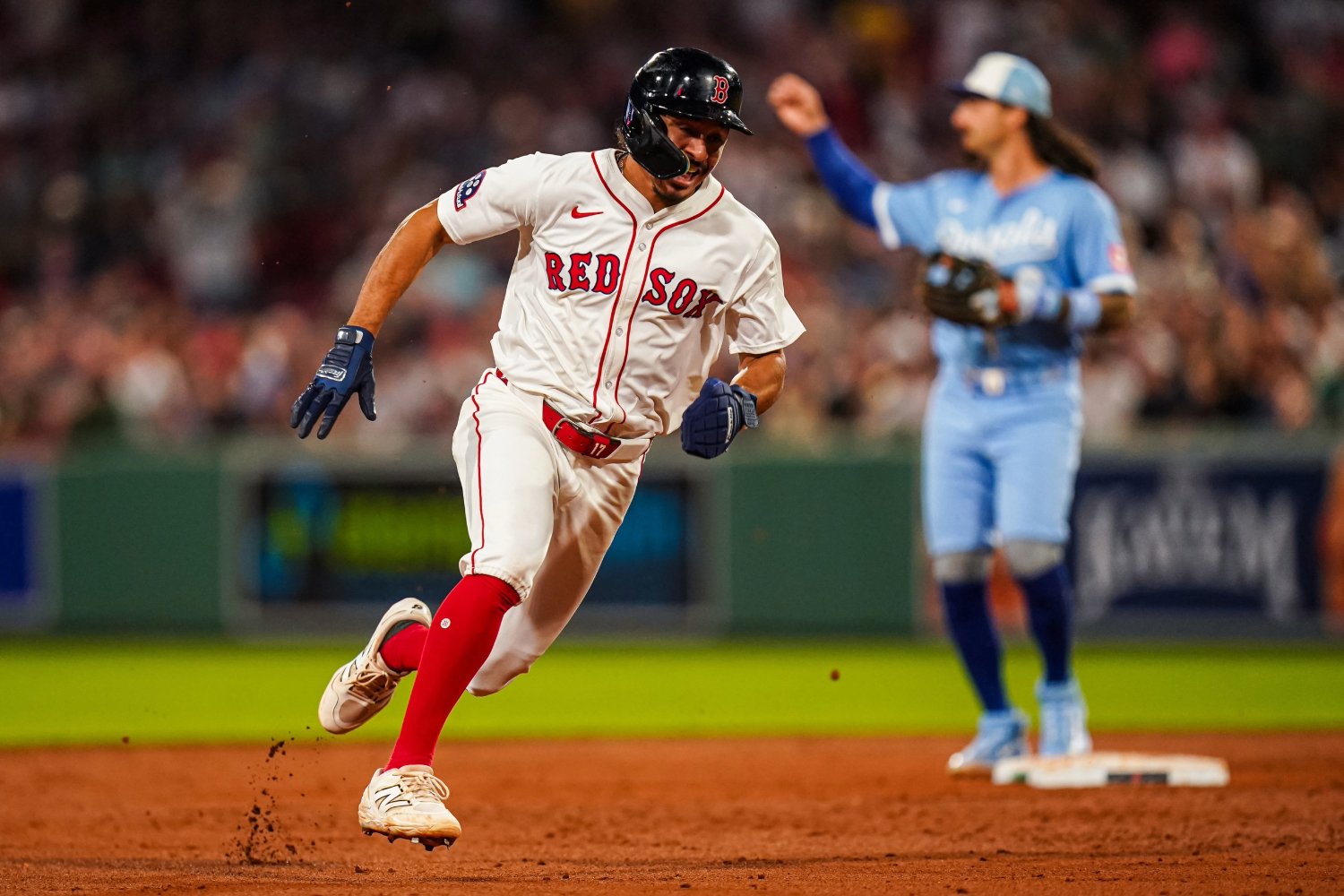
I know that sounds harsh, especially since Hamilton is a player who derives a lot of his value from the "less glamorous" parts of baseball. He's a great runner, having stolen 50 bases in less than 500 plate appearances over the past two seasons combined. That success on the basepaths is due, in part, to his top-notch sprint speed, as he routinely grades out as one of the fastest top-end runners in the sport. Billy Hamilton he is not, though a mighty pinch runner who can get from first to third in a hurry is still a valuable archetype to have in a vacuum.
You know what else is valuable about Hamilton? He's versatile. The 27-year-old has played 575.0 innings at second base and 581 2/3 innings at shortstop over the course of his career (to go along with one solitary frame at third base earlier this season), and he's generally rated as a strong defender at both spots. He's been worth five Outs Above Average (one this year) and 15 Defensive Runs Saved (seven this year) at the keystone, and he's accrued -6 OAA (-1 this year) and -2 DRS (one this year) at the considerably more difficult shortstop position. To have an average shortstop who can play an above-average second base just roaming on your bench is a luxury for any manager, especially one as inclined to give rest to his youngsters and veterans as Alex Cora.
So, by those accounts, it's clear that Hamilton fills his niche pretty well. But, it's at this point we must turn our attention to the batter's box, and rest assured, it's going to get ugly. In 69 games (143 plate appearances) in 2025, Hamilton is slashing .174/.227/.265, which is good for a .492 OPS and 31 wRC+. If you've followed baseball at all in the last 20 years, you don't need me to tell you how bad those latter two figures are, and if you've ever watched a baseball game in your life, you don't need me to tell you how bad that hitting line is.
With all due respect to the spectacularly awful season backstop Connor Wong is having at the plate, it's hard not to say Hamilton has been the worst hitter to step into the batter's box for the Red Sox this year. His batting average (.174), slugging percentage (.265), and wOBA (.221) are all second-worst on the team this season ahead of only Wong, though the catcher has the better of him in on-base percentage, as well as the expected versions of average and wOBA. Though he doesn't have enough at-bats to technically qualify, Hamilton ranks among the worst hitters in nearly every notable batted ball and plate approach metric. According to Baseball Savant, Hamilton would be in the bottom ten percent among all MLB hitters in the following categories: expected wOBA, expected batting average, expected slugging percentage, average exit velocity, hard-hit rate, and barrel rate.
I mean, that's simply untenable. Not every hitter needs to be an. 850 OPS guy who routinely posts a wRC+ in the 130 range, but there's a threshold between "bad" and "un-rosterable". Hamilton has been the latter this season. Despite his aforementioned positive contributions on both defense and the basepaths, he's been worth -0.4 fWAR this season. WAR is a deeply flawed stat that rarely tells the whole story, but it's telling that even a cumulative metric with favorability toward defense pegs Hamilton as a net-negative contributor thanks to his struggles at the plate.
Sure, you could point to the fact that Hamilton was much better last year, producing a .697 OPS and 94 wRC+ in more than double the plate appearances. But even those numbers are below average. Hamilton has never been known for his bat, but that's what makes his bottoming out all the more painful—there's no real floor to his struggles here. In fact, do you know the only batting metric Hamilton has improved in this year?
How often he swings. I'm not kidding. Take a look for yourself.

His overall swing rate is up by a meager 0.2%, which comes from a bump in both his in-zone swing rate (good) and out-of-zone swing rate (bad). By literally every other statistic (and the eye test, for what it's worth), Hamilton has gotten worse in 2025. In the middle of a pennant race, that's not exactly the kind of player you want to be rostering, hence why the Red Sox sent him down to Triple-A Worcester to work on some things with his plate approach.
It's possible we see Hamilton return when rosters expand in September, though if everyone is healthy, I'd wager a return from Kristian Campbell (better bat, can play first base) is more likely. Either way, Hamilton's place on the roster will be in serious jeopardy this offseason, when 40-man roster spots are at a premium. Unless the team truly believes his defensive versatility in the middle infield is valuable enough to justify his porous production at the plate, it seems exceedingly possible that we've seen the last of David Hamilton in a Red Sox uniform.






Recommended Comments
Create an account or sign in to comment
You need to be a member in order to leave a comment
Create an account
Sign up for a new account in our community. It's easy!
Register a new accountSign in
Already have an account? Sign in here.
Sign In Now