


Maddie Landis
-
Posts
268 -
Joined
Content Type
Profiles
Boston Red Sox Videos
2026 Boston Red Sox Top Prospects Ranking
Boston Red Sox Free Agent & Trade Rumors, Notes, & Tidbits
Guides & Resources
2025 Boston Red Sox Draft Pick Tracker
News
2026 Boston Red Sox Draft Tracker: Picks & Bonuses
Forums
Blogs
Events
Store
Downloads
Gallery
Everything posted by Maddie Landis
-
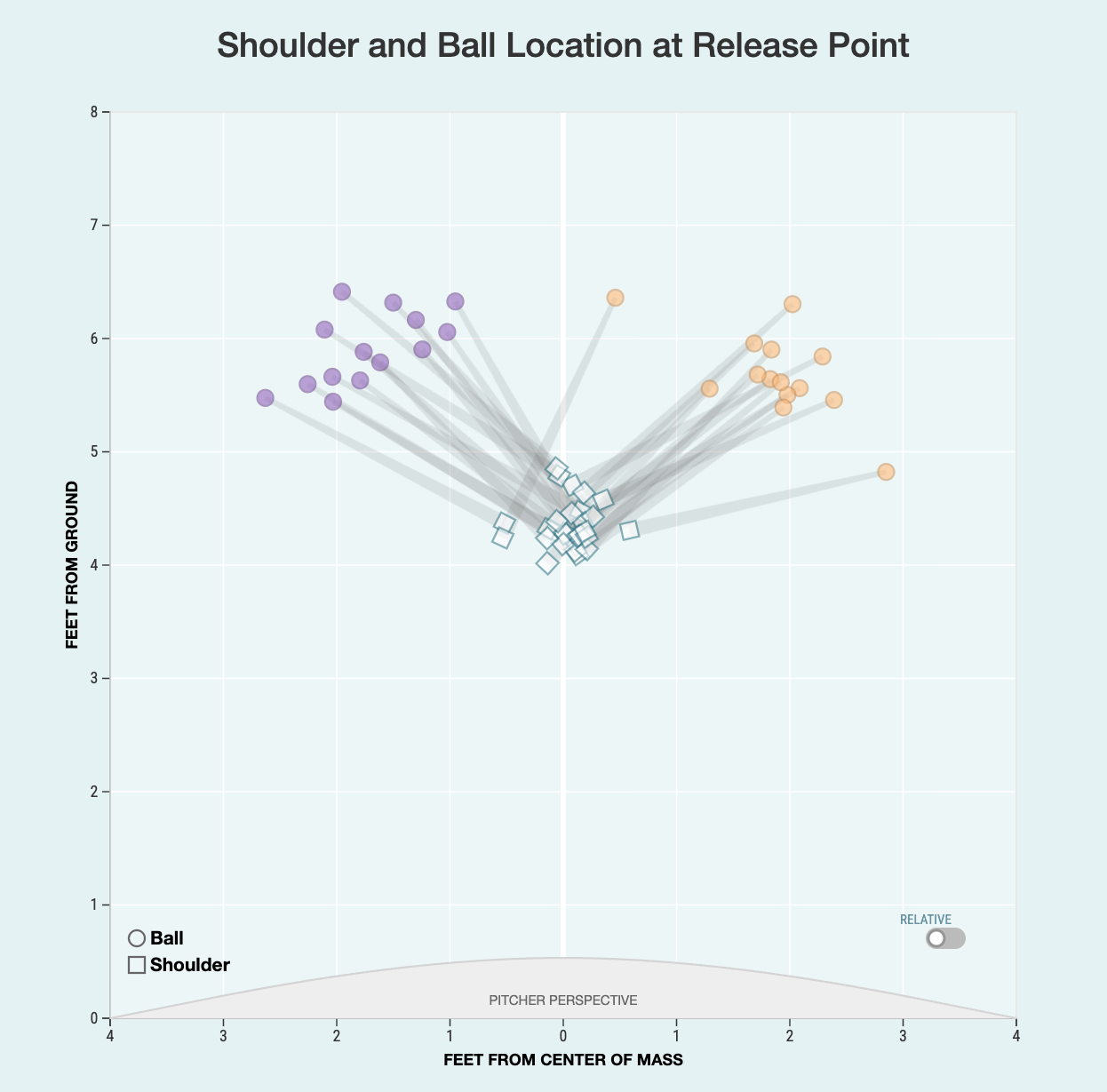
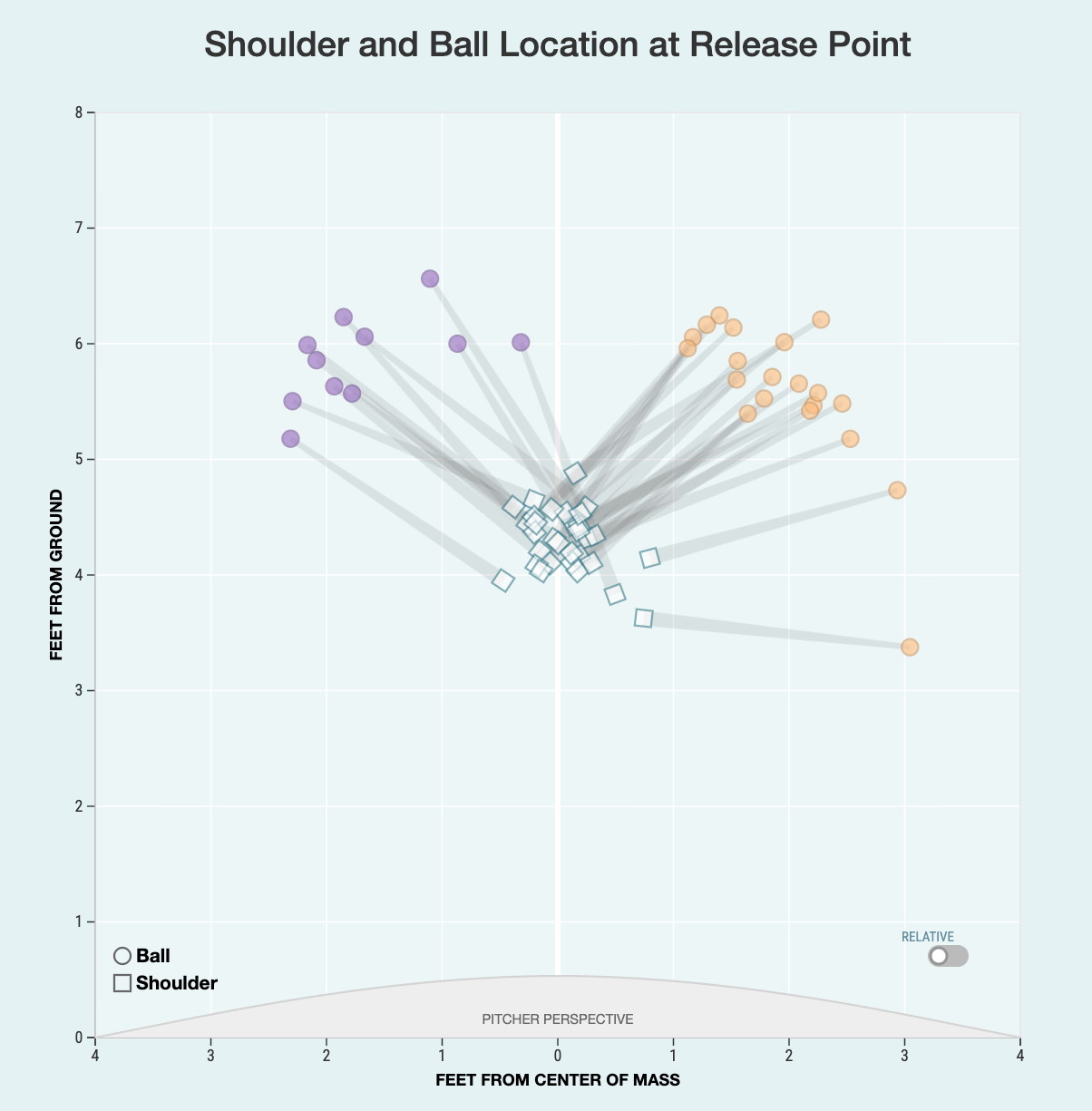
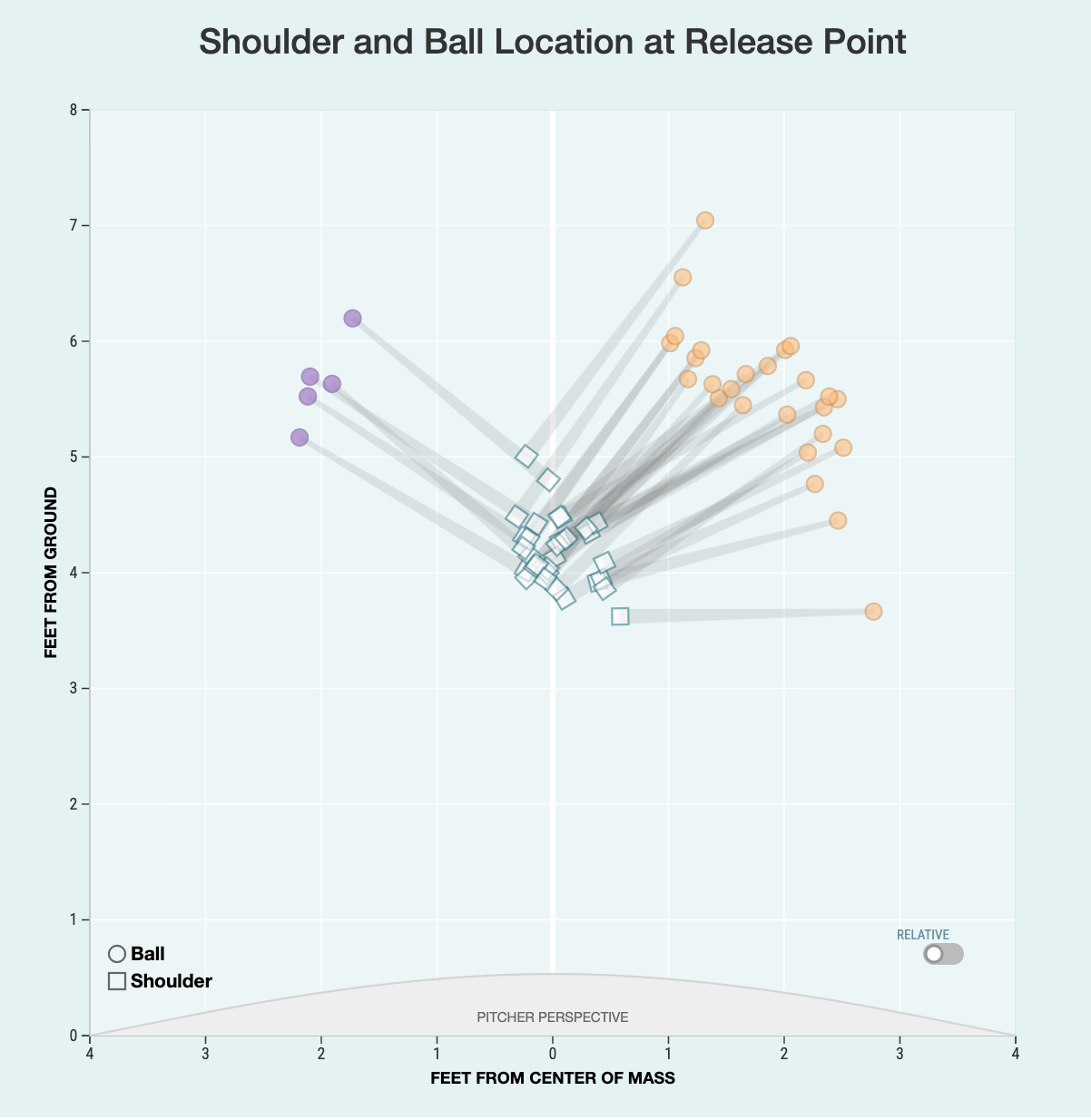
I just think there's too much similarity among the org's pitchers. This is the Red Sox's release point chart (min. 50 pitches): (Ignore Jack Anderson at 65 degrees on the right) This is the Dodgers: This is the Rays:
-
That’s a fair point. None of them were lights-out for the Red Sox. The issue was how quickly the team gave up on them. It’s pretty clear that they target a certain type of pitcher. This past season, Red Sox pitchers ranked third in extension (6.6 ft). It’s also telling that once each pitcher left the org, they adjusted their arm angle and quickly found success. Sometimes newfound success just boils down to a change of scenery… playing in Boston isn’t for the faint of heart. You don’t really hear anything about guys tinkering with their arm angle in Andrew Bailey’s pitching lab.
-
What stood out to me with Durbin was the timing. You typically hear about guys visiting Driveline in the offseason to work on their swings. It was weird that he went to an outside trainer in May. Most players have their entourage of trainers and outside coaches locked in by Opening Day. Maybe it happens more behind-the-scenes than we're aware... I agree with the IG comment. Gradum G-Swing was pumping out posts with Durbin while he was peaking.
-
 I’m still reeling from the Boston Red Sox’s humiliating defeat in the AL Wild Card Series. The following Thursday, I drowned myself in work. Now, as I start this piece over the weekend, I’ve finally gathered some of my thoughts. The Red Sox limped out of September as one of the worst offenses in baseball. Their .219 average (30th), .295 OBP (27th), .356 slugging percent (28th), 81 wRC+ (28th) .291 wOBA (30th) were all among the worst marks in the league. They rolled into the postseason like someone had slipped Xanax in the dugout Gatorade cooler. Slumps happen, of course. The bats went cold at the wrong time, sure. These are the ebbs and flows of baseball. Still, it's clear the team rode on the high of their 32-5 run and used that as a sign that everything was fine, ignoring the lackluster product on the field between April and June and August and September. If you recall, the team’s offense was a glaring issue last postseason too. Who do we blame? Someone constructed the Red Sox’s lineup and decided which players were worth investing in and who left. Ultimately, the Red Sox’s collapse traces back to Craig Breslow and the front office. Here’s where things went wrong. Red Sox's One-Size-Fits-All Development Approach Doesn't Work From what I gather, Craig Breslow runs the Red Sox’s player development program like an overpriced meal-kit subscription. Every player gets handed the same box with the same pre-portioned ingredients. What happens if someone doesn't like the recipe or wants to try something different? Milwaukee or Chicago will happily cook a hearty dinner for you -- from scratch. Consider the following pitchers who are thriving after parting ways with the organization. Kyle Harrison added a changeup to his arsenal, which helped him unlock a new gear with the Brewers. Dustin May finally got healthy and adjusted his arm angle for a breakout first half with the Cardinals before being acquired by the Brewers at the trade deadline. I’ll hedge that the Milwaukee pair hasn’t looked particularly strong in the postseason. After surprisingly making the National League Division Series roster, Harrison didn’t even pitch. May burped up two earned runs across six innings in the Padres’ sole win of the series. Jordan Hicks has undergone a renaissance in Chicago. By raising his arm angle, he became one of the best high-leverage relief pitchers in baseball during the second half. Sean Newcomb has evolved into a Swiss Army knife for the White Sox, starting in Game 3 of the American League Division Series. I sound like a broken record here, but he lowered his arm angle and started leaning more on his sweeper (which Statcast calls a slurve). None of these changes came while these players were on the Red Sox. Andrew Bailey’s pitching lab gave up on them first. If you’re not a hulking guy with a ridiculous extension, best of luck finding your stride in Boston. Harrison, Hicks, and May (indirectly), were all part of the infamous Rafael Devers trade. It’s frustrating to see each of them succeeding less than a year after leaving the Red Sox. Almost three years into his tenure as Chief Baseball Officer, hitters remain elusive to Breslow. One specific player comes to mind, who was another piece in the Rafael Devers trade: James Tibbs III. The outfield prospect lasted a couple months in the Red Sox’s system until he was traded for Dustin May at the trade deadline. In that short window, the organization tried to fix something that wasn’t broken. Tibbs reflected on the different approach in the Dodgers organization, saying: “They’ve just let me be myself… I think the main thing was just coming in here, I just felt like a shell of myself. I was trying to find my swing again, find the thing that made me successful in the past.” This year, the Georgia native led the Pacific League in extra-base hits (65) and walks (108) while slashing .287/.409/.532 across 141 games for the Oklahoma City Comets. Red Sox Coasted On the High of Their 32-5 Run The Red Sox’s season can be divided into three parts: Toward the end of August, Boston threw away a meaningful final series against New York, one that could’ve given them home-field advantage in the Wild Card Series. The Yankees took off from there and went 15-8 for the best record in the American League in September. Meanwhile, the Red Sox went 12-12. There are a lot of ifs and buts here, but if Boston had home field advantage in the Wild Card Series, I imagine they would’ve at least made the first round competitive. Can you imagine the warm welcome Cam Schlittler would’ve received at Fenway? Moreover, the team brazenly announced Breslow and interim manager Chad Tracy’s three-year extensions in the middle of September, which came across as the front office cashing in on a hot streak. The Front Office Echo Chamber I’ve been critical of Craig Breslow’s leadership for a while now. Former Red Sox skipper Alex Cora and Breslow's relationship reached a breaking point this year. Tensions were reportedly high and they didn’t see eye-to-eye on some issues. Healthy tension is fine, but theirs was toxic. In late April, Breslow consolidated power. Cora got Red Wedding’d and replaced by Chad Tracy, who has acted as the human shield between the analytically-minded front office and clubhouse. After the Red Sox’s Game 2 ALWCS loss, Willson Contreras made a pointed comment about the team’s over-reliance on data and analytics. Tracy notably pulled starters Payton Tolle and Sonny Gray after just 4.2 innings in both games. Fans speculated that those decisions were secretly the front office pulling the strings, but Tracy owned up to both calls. This is pure speculation, but Tracy taking the blame looked like he was protecting the people above him. Back to the data point. Every team uses data analytics (minus the Angels, probably), but the biggest separator is how well information is communicated. Sometimes players feel like data is simply bossing them around, rather than actually helping them. After being taken out in Game 2, Gray commented, “I would’ve liked to have been trusted in that moment.” Look at Caleb Durbin. As a new member of the Red Sox, he struggled heavily, slashing .172/.261/.263 through late April. (To be fair, he found his stride around the same time Tracy’s new coaching staff took over.) Still, Durbin went to a private hitting facility at former teammate Carlos Narváez’s suggestion and his performance quickly bounced back from June to August. When a player has to seek outside counsel to find his swing, something is awry inside the organization. I’ll end on this: the Red Sox have four issues to address this offseason. The first is to figure out how to handle premium velocity. Free-agent Seiya Suzuki, who has a career .792 OPS vs pitches 95+ mph, is an intriguing target. The second is to fill the lineup’s power void, preferably by not betting on an internal player to have a career season. (Tyler O’Neill recorded the Red Sox’s most recent 30-plus home run season in 2024.) The third is changing how they develop players. Kyle Harrison, Jordan Hicks, Sean Newcomb, and James Tibbs became their best selves when a team built a development plan specifically tailored to them. The Red Sox should be doing this, not watching it happen somewhere else. The final issue, which is the most complicated, is to optimize strength and conditioning protocols. At the end-of-season press conference, Breslow was asked whether the team would reevaluate its training methods after a year of soft-tissue injuries. His response? Career seasons, huh? The Red Sox have dealt with a weird string of hitting-related injuries going back to 2024. Roman Anthony missed over 100 games in 2026 due to his CMC joint tear. Between tearing the cartilage in his ribs and rupturing his left patellar tendon, first baseman Triston Casas hasn’t been healthy for an entire season since his debut year in 2023. There’s also a flip side.The same strength and conditioning program that’s literally tearing hitters’ bodies apart is letting other players get heavier. Adley Rutschman has put on noticeable weight this past season. Erik Miller, who was acquired at the trade deadline, has had weight issues of his own, potentially affecting his delivery. Whatever the Red Sox are doing in the weight room, it’s failing both groups and must be addressed this offseason. I don’t mean to be a pessimist here, but none of this gets fixed with one miracle signing or trade this offseason. To his credit, Breslow has developed a pitching pipeline that’s produced Payton Tolle and has helped Sonny Gray and Aroldis Chapman rejuvenate their careers. He also landed Garrett Crochet and Adley Rutschman on the trade market as well, which has given the franchise the star power it has been craving. But a great pitching pipeline doesn’t do much for hitters, and right now, the way decisions are made in the front office needs to change. There’s organizational rot within the Red Sox, and that starts with Craig Breslow.
 -
I’m still reeling from the Boston Red Sox’s humiliating defeat in the AL Wild Card Series. The following Thursday, I drowned myself in work. Now, as I start this piece over the weekend, I’ve finally gathered some of my thoughts. The Red Sox limped out of September as one of the worst offenses in baseball. Their .219 average (30th), .295 OBP (27th), .356 slugging percent (28th), 81 wRC+ (28th) .291 wOBA (30th) were all among the worst marks in the league. They rolled into the postseason like someone had slipped Xanax in the dugout Gatorade cooler. Slumps happen, of course. The bats went cold at the wrong time, sure. These are the ebbs and flows of baseball. Still, it's clear the team rode on the high of their 32-5 run and used that as a sign that everything was fine, ignoring the lackluster product on the field between April and June and August and September. If you recall, the team’s offense was a glaring issue last postseason too. Who do we blame? Someone constructed the Red Sox’s lineup and decided which players were worth investing in and who left. Ultimately, the Red Sox’s collapse traces back to Craig Breslow and the front office. Here’s where things went wrong. Red Sox's One-Size-Fits-All Development Approach Doesn't Work From what I gather, Craig Breslow runs the Red Sox’s player development program like an overpriced meal-kit subscription. Every player gets handed the same box with the same pre-portioned ingredients. What happens if someone doesn't like the recipe or wants to try something different? Milwaukee or Chicago will happily cook a hearty dinner for you -- from scratch. Consider the following pitchers who are thriving after parting ways with the organization. Kyle Harrison added a changeup to his arsenal, which helped him unlock a new gear with the Brewers. Dustin May finally got healthy and adjusted his arm angle for a breakout first half with the Cardinals before being acquired by the Brewers at the trade deadline. I’ll hedge that the Milwaukee pair hasn’t looked particularly strong in the postseason. After surprisingly making the National League Division Series roster, Harrison didn’t even pitch. May burped up two earned runs across six innings in the Padres’ sole win of the series. Jordan Hicks has undergone a renaissance in Chicago. By raising his arm angle, he became one of the best high-leverage relief pitchers in baseball during the second half. Sean Newcomb has evolved into a Swiss Army knife for the White Sox, starting in Game 3 of the American League Division Series. I sound like a broken record here, but he lowered his arm angle and started leaning more on his sweeper (which Statcast calls a slurve). None of these changes came while these players were on the Red Sox. Andrew Bailey’s pitching lab gave up on them first. If you’re not a hulking guy with a ridiculous extension, best of luck finding your stride in Boston. Harrison, Hicks, and May (indirectly), were all part of the infamous Rafael Devers trade. It’s frustrating to see each of them succeeding less than a year after leaving the Red Sox. Almost three years into his tenure as Chief Baseball Officer, hitters remain elusive to Breslow. One specific player comes to mind, who was another piece in the Rafael Devers trade: James Tibbs III. The outfield prospect lasted a couple months in the Red Sox’s system until he was traded for Dustin May at the trade deadline. In that short window, the organization tried to fix something that wasn’t broken. Tibbs reflected on the different approach in the Dodgers organization, saying: “They’ve just let me be myself… I think the main thing was just coming in here, I just felt like a shell of myself. I was trying to find my swing again, find the thing that made me successful in the past.” This year, the Georgia native led the Pacific League in extra-base hits (65) and walks (108) while slashing .287/.409/.532 across 141 games for the Oklahoma City Comets. Red Sox Coasted On the High of Their 32-5 Run The Red Sox’s season can be divided into three parts: Toward the end of August, Boston threw away a meaningful final series against New York, one that could’ve given them home-field advantage in the Wild Card Series. The Yankees took off from there and went 15-8 for the best record in the American League in September. Meanwhile, the Red Sox went 12-12. There are a lot of ifs and buts here, but if Boston had home field advantage in the Wild Card Series, I imagine they would’ve at least made the first round competitive. Can you imagine the warm welcome Cam Schlittler would’ve received at Fenway? Moreover, the team brazenly announced Breslow and interim manager Chad Tracy’s three-year extensions in the middle of September, which came across as the front office cashing in on a hot streak. The Front Office Echo Chamber I’ve been critical of Craig Breslow’s leadership for a while now. Former Red Sox skipper Alex Cora and Breslow's relationship reached a breaking point this year. Tensions were reportedly high and they didn’t see eye-to-eye on some issues. Healthy tension is fine, but theirs was toxic. In late April, Breslow consolidated power. Cora got Red Wedding’d and replaced by Chad Tracy, who has acted as the human shield between the analytically-minded front office and clubhouse. After the Red Sox’s Game 2 ALWCS loss, Willson Contreras made a pointed comment about the team’s over-reliance on data and analytics. Tracy notably pulled starters Payton Tolle and Sonny Gray after just 4.2 innings in both games. Fans speculated that those decisions were secretly the front office pulling the strings, but Tracy owned up to both calls. This is pure speculation, but Tracy taking the blame looked like he was protecting the people above him. Back to the data point. Every team uses data analytics (minus the Angels, probably), but the biggest separator is how well information is communicated. Sometimes players feel like data is simply bossing them around, rather than actually helping them. After being taken out in Game 2, Gray commented, “I would’ve liked to have been trusted in that moment.” Look at Caleb Durbin. As a new member of the Red Sox, he struggled heavily, slashing .172/.261/.263 through late April. (To be fair, he found his stride around the same time Tracy’s new coaching staff took over.) Still, Durbin went to a private hitting facility at former teammate Carlos Narváez’s suggestion and his performance quickly bounced back from June to August. When a player has to seek outside counsel to find his swing, something is awry inside the organization. I’ll end on this: the Red Sox have four issues to address this offseason. The first is to figure out how to handle premium velocity. Free-agent Seiya Suzuki, who has a career .792 OPS vs pitches 95+ mph, is an intriguing target. The second is to fill the lineup’s power void, preferably by not betting on an internal player to have a career season. (Tyler O’Neill recorded the Red Sox’s most recent 30-plus home run season in 2024.) The third is changing how they develop players. Kyle Harrison, Jordan Hicks, Sean Newcomb, and James Tibbs became their best selves when a team built a development plan specifically tailored to them. The Red Sox should be doing this, not watching it happen somewhere else. The final issue, which is the most complicated, is to optimize strength and conditioning protocols. At the end-of-season press conference, Breslow was asked whether the team would reevaluate its training methods after a year of soft-tissue injuries. His response? Career seasons, huh? The Red Sox have dealt with a weird string of hitting-related injuries going back to 2024. Roman Anthony missed over 100 games in 2026 due to his CMC joint tear. Between tearing the cartilage in his ribs and rupturing his left patellar tendon, first baseman Triston Casas hasn’t been healthy for an entire season since his debut year in 2023. There’s also a flip side.The same strength and conditioning program that’s literally tearing hitters’ bodies apart is letting other players get heavier. Adley Rutschman has put on noticeable weight this past season. Erik Miller, who was acquired at the trade deadline, has had weight issues of his own, potentially affecting his delivery. Whatever the Red Sox are doing in the weight room, it’s failing both groups and must be addressed this offseason. I don’t mean to be a pessimist here, but none of this gets fixed with one miracle signing or trade this offseason. To his credit, Breslow has developed a pitching pipeline that’s produced Payton Tolle and has helped Sonny Gray and Aroldis Chapman rejuvenate their careers. He also landed Garrett Crochet and Adley Rutschman on the trade market as well, which has given the franchise the star power it has been craving. But a great pitching pipeline doesn’t do much for hitters, and right now, the way decisions are made in the front office needs to change. There’s organizational rot within the Red Sox, and that starts with Craig Breslow. View full article
-
Good morning! We’re recording our weekly Talk Sox Podcast on Sunday. Drop your questions below for @Alex Mayes and me. The cut-off is at 1:00 pm MDT on the 4th.
-
Cam Schlittler’s four-seamer averages 98 mph, almost four miles per hour faster than your typical right-handed pitcher. His 12-6 curveball has maxed out at 90.2 mph this year. In other words, the 6’6” Walpole native throws the ball ridiculously hard. Most analysts will tell you that his large frame gives him a biomechanics advantage to touch triple-digit velocity. I’m convinced some of it is fueled by his perpetual RBF. Schlittler isn’t the only high-octane Yankees pitcher the Boston Red Sox are going to see in the Wild Card Round. For instance, David Bednar anchors New York’s bullpen with a rising four-seamer (18” IVB) that averages 96.1 mph. So, it's probably pertinent to ask: How has the team fared against velocity this season? Mickey Gasper and Eli White feasted on hard pitches this year, posting OPS marks of 1.241 and .971, respectively, against premium velocity. Unfortunately, both players will miss the postseason. Gasper suffered from a right biceps strain, and White tore a ligament in his right foot on the center field garage door at Fenway. Jahmai Jones, who isn’t on the injured list, has handled 95+ just as well with a .977 OPS. Surprisingly, Roman Anthony .373 OPS ranks last among Red Sox batters. This is a significant drop from his .820 last year. Then there’s the weather. Over the Wild Card Series, the Bronx is expected to see a temperature range between 59 degrees and 67 degrees in the evening. As we get further into the week, the temperature starts creeping up. Tuesday night is expected to be the coldest game. If the series extends to Game 3, Thursday night’s game will be the warmest. Image courtesy of the National Weather Service There’s a ton of existing research on how weather impacts baseball and I’m not going to get into the weeds of humidity/temperature affecting pitch movement here. Instead, I want to look at something simpler: the Red Sox’s record across different temperature groups. During the Angels series earlier this month, I theorized that the team played worse in colder temperatures. I had forgotten about it until the Guardians series last week, so I pulled the data. I grouped every game this season by first-pitch temperature: Cold (59°F and below), Mild (60 to 74°F), and Warm (75°F and up). Temperature Bucket G W L Win% Run Diff RS RA Avg Temp Cold (59°F and below) 28 14 14 .500 +25 4.11 3.21 52.3°F Mild (60-74°F) 55 21 34 .382 -57 3.38 4.42 69.0°F Warm (75+°F) 79 52 27 .658 +110 4.91 3.52 81.5°F The Red Sox’s record didn’t support my theory. The “Cold” bucket consisted of 28 games, the fewest of the three and they played .500 ball with a +25 run differential in those games. Unsurprisingly, the team posted a .658 winning percentage and a +110 run differential in the “Warm” bucket, thanks in large part to the team’s historic 30-5 stretch in the middle of the summer. The “Mild” bucket contained the worst results: a .382 winning percentage and a negative run differential of -57. Back to the forecast, two of three games in the Wild Card Series land squarely in the “Mild” range, where they went 21-34. If the Red Sox want to advance to the division series, they need to win in the weather that’s plagued them all year. The Red Sox enter the first round of the playoffs as underdogs with velocity and weather working against them. They’ll face Schlittler’s triple-threat fastball mix tonight, sans Gasper and White. Fortunately, Schlittler is just one pitcher. As @Alex Mayes and I talked about on this week's Talk Sox podcast episode, once they get past Schlittler, Max Fried and a washed-up Gerrit Cole aren’t nearly as imposing. Anything can happen in the playoffs, and the Red Sox have thrived on chaos all season. body { background: #fff; color: #111; font-family: Arial, sans-serif; padding: 24px; } View full article
-
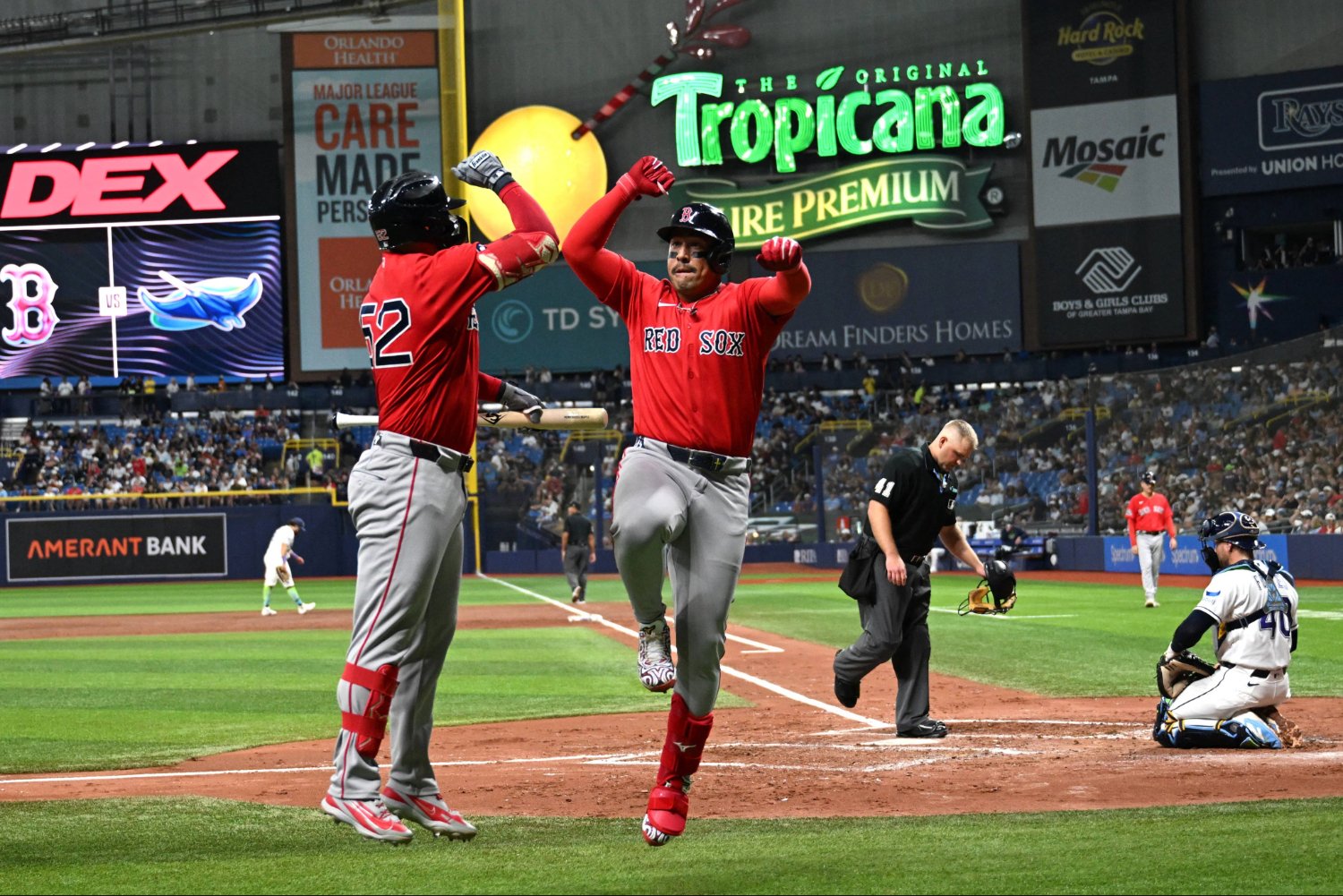 Cam Schlittler’s four-seamer averages 98 mph, almost four miles per hour faster than your typical right-handed pitcher. His 12-6 curveball has maxed out at 90.2 mph this year. In other words, the 6’6” Walpole native throws the ball ridiculously hard. Most analysts will tell you that his large frame gives him a biomechanics advantage to touch triple-digit velocity. I’m convinced some of it is fueled by his perpetual RBF. Schlittler isn’t the only high-octane Yankees pitcher the Boston Red Sox are going to see in the Wild Card Round. For instance, David Bednar anchors New York’s bullpen with a rising four-seamer (18” IVB) that averages 96.1 mph. So, it's probably pertinent to ask: How has the team fared against velocity this season? Mickey Gasper and Eli White feasted on hard pitches this year, posting OPS marks of 1.241 and .971, respectively, against premium velocity. Unfortunately, both players will miss the postseason. Gasper suffered from a right biceps strain, and White tore a ligament in his right foot on the center field garage door at Fenway. Jahmai Jones, who isn’t on the injured list, has handled 95+ just as well with a .977 OPS. Surprisingly, Roman Anthony .373 OPS ranks last among Red Sox batters. This is a significant drop from his .820 last year. Then there’s the weather. Over the Wild Card Series, the Bronx is expected to see a temperature range between 59 degrees and 67 degrees in the evening. As we get further into the week, the temperature starts creeping up. Tuesday night is expected to be the coldest game. If the series extends to Game 3, Thursday night’s game will be the warmest. Image courtesy of the National Weather Service There’s a ton of existing research on how weather impacts baseball and I’m not going to get into the weeds of humidity/temperature affecting pitch movement here. Instead, I want to look at something simpler: the Red Sox’s record across different temperature groups. During the Angels series earlier this month, I theorized that the team played worse in colder temperatures. I had forgotten about it until the Guardians series last week, so I pulled the data. I grouped every game this season by first-pitch temperature: Cold (59°F and below), Mild (60 to 74°F), and Warm (75°F and up). Temperature Bucket G W L Win% Run Diff RS RA Avg Temp Cold (59°F and below) 28 14 14 .500 +25 4.11 3.21 52.3°F Mild (60-74°F) 55 21 34 .382 -57 3.38 4.42 69.0°F Warm (75+°F) 79 52 27 .658 +110 4.91 3.52 81.5°F The Red Sox’s record didn’t support my theory. The “Cold” bucket consisted of 28 games, the fewest of the three and they played .500 ball with a +25 run differential in those games. Unsurprisingly, the team posted a .658 winning percentage and a +110 run differential in the “Warm” bucket, thanks in large part to the team’s historic 30-5 stretch in the middle of the summer. The “Mild” bucket contained the worst results: a .382 winning percentage and a negative run differential of -57. Back to the forecast, two of three games in the Wild Card Series land squarely in the “Mild” range, where they went 21-34. If the Red Sox want to advance to the division series, they need to win in the weather that’s plagued them all year. The Red Sox enter the first round of the playoffs as underdogs with velocity and weather working against them. They’ll face Schlittler’s triple-threat fastball mix tonight, sans Gasper and White. Fortunately, Schlittler is just one pitcher. As @Alex Mayes and I talked about on this week's Talk Sox podcast episode, once they get past Schlittler, Max Fried and a washed-up Gerrit Cole aren’t nearly as imposing. Anything can happen in the playoffs, and the Red Sox have thrived on chaos all season. body { background: #fff; color: #111; font-family: Arial, sans-serif; padding: 24px; }
 -
Good morning! We’re recording our final regular season episode of the Talk Sox Podcast on Sunday. Drop your questions below for @Alex Mayes and me. The cut-off is at 2:00 pm CST on the 26th.
-
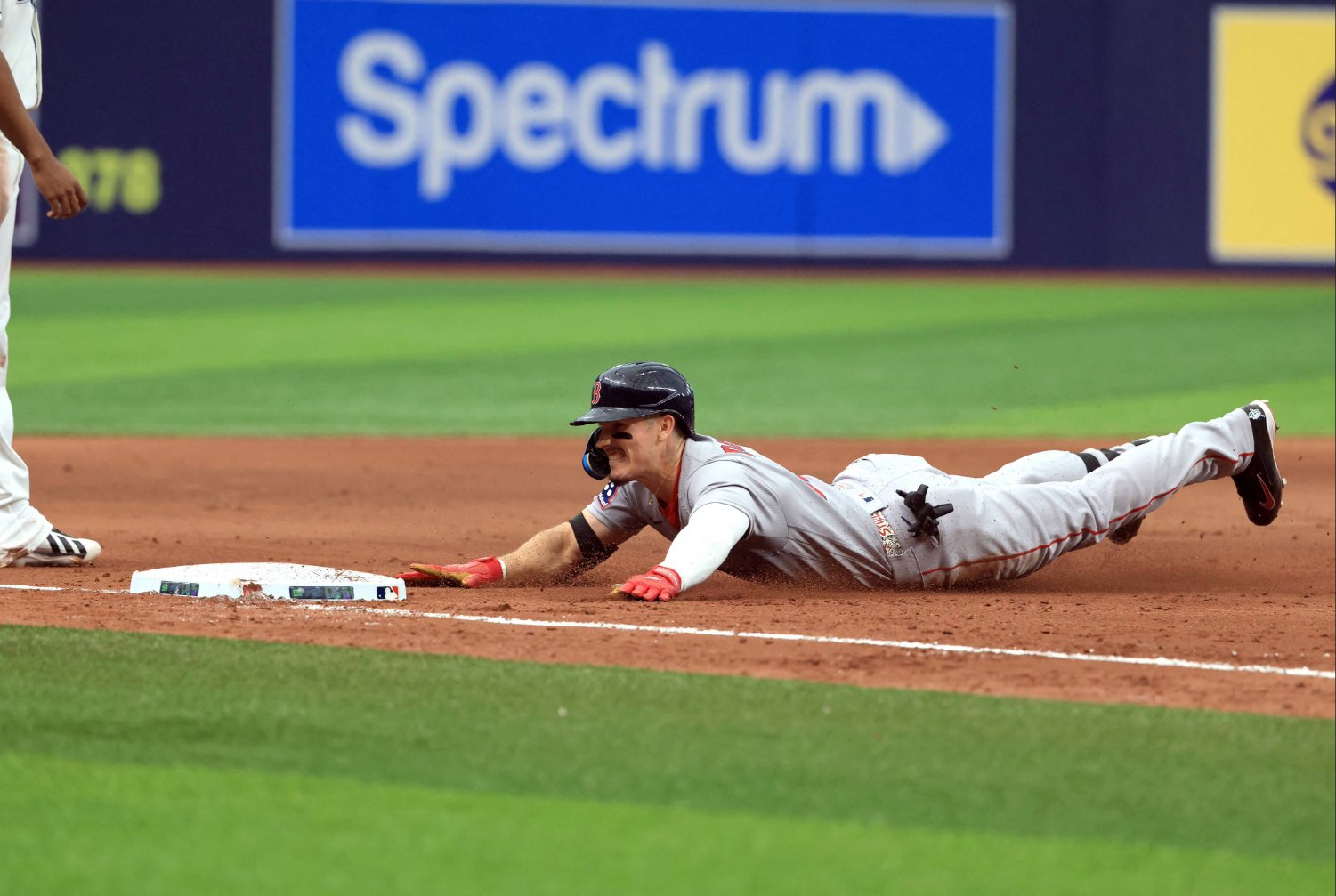 On Wednesday night, Jarren Duran stole second in the bottom of the eighth, marking his 20th stolen base of the season and his second time joining the elite 20 home run, 20 stolen bases club. [He hit his 20th home run on September 7.] But... Jarren Duran? Elite club in 2026? Something isn't right here. A 20-20 season is a historic milestone. You’d expect a player who gets there to be a solid hitter. The kind of guy who instills fear in pitchers, not some dude whose kryptonite is an elevated fastball. Through 147 games this season, Duran has mustered a measly .207/.265/.364 slash line with a 27.5% strikeout rate, 6.5% walk rate, a 69 wRC+, and 0.5 fWAR. Red Sox fans are well aware of Duran’s nosedive since his previous 20/20 season in 2024, but how bad is this one compared to every other 20/20 season in baseball’s live-ball era? Let’s take a look. Where Jarren Duran's 20-20 Season Ranks All-Time Through September 25, 2026, 524 baseball players have achieved 20/20 seasons. The power/speed combo is becoming less rare in the modern game; 2025 saw a record total of 24 players who achieved 20/20 seasons. Duran was the 16th player to join the 20/20 club this year (Carson Benge has since joined him). There’s still a weekend of baseball to be played before the postseason is underway, and Trea Turner (19 HRs, 21 SBs) and Jazz Chisholm Jr. (19 HRs, 41 SBs) are on the verge of breaking into the club. [Back in February, Chisholm Jr. boldly proclaimed that he would be the second member of the elusive 50/50 club. There's always next year.] Since 1920, players in the 20/20 club recorded an average .284/.362/.505 slash line. Turkey Stearns, one of the most prolific hitters in the Negro leagues, posted the highest average (.383) and OPS (1.174) in 1926. Barry Bonds’ 1996 season saw the highest OBP (.461). Larry Walker’s 1997 NL MVP campaign marked the highest slugging percentage (.720). On the extreme end of homers, Ken Griffey Jr. clubbed 56 in 1998. Those guys sit in the upper echelons of the 20/20 club. Now, we pivot to the basement. Last year, Oneil Cruz batted to a tune of .200, so Duran’s .207 mark is safe, but his .265 on-base percentage, .364 slugging percentage, and .629 on-base plus slugging percentage are ranked dead last. Previously, Yankees shortstop Anthony Volpe’s .666 OPS was the lowest in a 20/20 season. Duran undercut Volpe by 37 points of OPS, which is a sizable gap for a record low. Like I said earlier, the season isn't quite over yet. With Ceddanne Rafaela dealing with lingering hamstring tightness, Duran will likely see more playing time as the Red Sox gear up for the postseason as the team rests Rafaela ahead of the AL Wild Card series. At the very least, Duran's 20/20 season is a unique selling point if chief baseball officer Craig Breslow attempts to trade him in the offseason. Also, in Duran's defense, he has been up on the upswing with an .841 OPS in his last seven games. Watching him score from second on Andruw Monasterio's single on Tuesday night was absolutely exhilarating. It was the Red Sox's lone run of the game, and it reminded us of the dynamic player that Duran can be -- when he actually gets on base. It's not exactly the kind of history we wanted to celebrate in 2026, but by all accounts, it looks like we’ve just witnessed the worst 20-20 season in the live-ball era.
 -
On Wednesday night, Jarren Duran stole second in the bottom of the eighth, marking his 20th stolen base of the season and his second time joining the elite 20 home run, 20 stolen bases club. [He hit his 20th home run on September 7.] But... Jarren Duran? Elite club in 2026? Something isn't right here. A 20-20 season is a historic milestone. You’d expect a player who gets there to be a solid hitter. The kind of guy who instills fear in pitchers, not some dude whose kryptonite is an elevated fastball. Through 147 games this season, Duran has mustered a measly .207/.265/.364 slash line with a 27.5% strikeout rate, 6.5% walk rate, a 69 wRC+, and 0.5 fWAR. Red Sox fans are well aware of Duran’s nosedive since his previous 20/20 season in 2024, but how bad is this one compared to every other 20/20 season in baseball’s live-ball era? Let’s take a look. Where Jarren Duran's 20-20 Season Ranks All-Time Through September 25, 2026, 524 baseball players have achieved 20/20 seasons. The power/speed combo is becoming less rare in the modern game; 2025 saw a record total of 24 players who achieved 20/20 seasons. Duran was the 16th player to join the 20/20 club this year (Carson Benge has since joined him). There’s still a weekend of baseball to be played before the postseason is underway, and Trea Turner (19 HRs, 21 SBs) and Jazz Chisholm Jr. (19 HRs, 41 SBs) are on the verge of breaking into the club. [Back in February, Chisholm Jr. boldly proclaimed that he would be the second member of the elusive 50/50 club. There's always next year.] Since 1920, players in the 20/20 club recorded an average .284/.362/.505 slash line. Turkey Stearns, one of the most prolific hitters in the Negro leagues, posted the highest average (.383) and OPS (1.174) in 1926. Barry Bonds’ 1996 season saw the highest OBP (.461). Larry Walker’s 1997 NL MVP campaign marked the highest slugging percentage (.720). On the extreme end of homers, Ken Griffey Jr. clubbed 56 in 1998. Those guys sit in the upper echelons of the 20/20 club. Now, we pivot to the basement. Last year, Oneil Cruz batted to a tune of .200, so Duran’s .207 mark is safe, but his .265 on-base percentage, .364 slugging percentage, and .629 on-base plus slugging percentage are ranked dead last. Previously, Yankees shortstop Anthony Volpe’s .666 OPS was the lowest in a 20/20 season. Duran undercut Volpe by 37 points of OPS, which is a sizable gap for a record low. Like I said earlier, the season isn't quite over yet. With Ceddanne Rafaela dealing with lingering hamstring tightness, Duran will likely see more playing time as the Red Sox gear up for the postseason as the team rests Rafaela ahead of the AL Wild Card series. At the very least, Duran's 20/20 season is a unique selling point if chief baseball officer Craig Breslow attempts to trade him in the offseason. Also, in Duran's defense, he has been up on the upswing with an .841 OPS in his last seven games. Watching him score from second on Andruw Monasterio's single on Tuesday night was absolutely exhilarating. It was the Red Sox's lone run of the game, and it reminded us of the dynamic player that Duran can be -- when he actually gets on base. It's not exactly the kind of history we wanted to celebrate in 2026, but by all accounts, it looks like we’ve just witnessed the worst 20-20 season in the live-ball era. View full article
-
Good morning! We’re recording the next episode of the Talk Sox Podcast on Sunday. Drop your questions below for @Alex Mayes and me. The cut-off is at 2:00 pm CST on the 20th.
-
That double play last night was insane!
-
Emulating Nico Hoerner May Be Nick Sogard's Best Path Forward
Maddie Landis posted an article in Red Sox
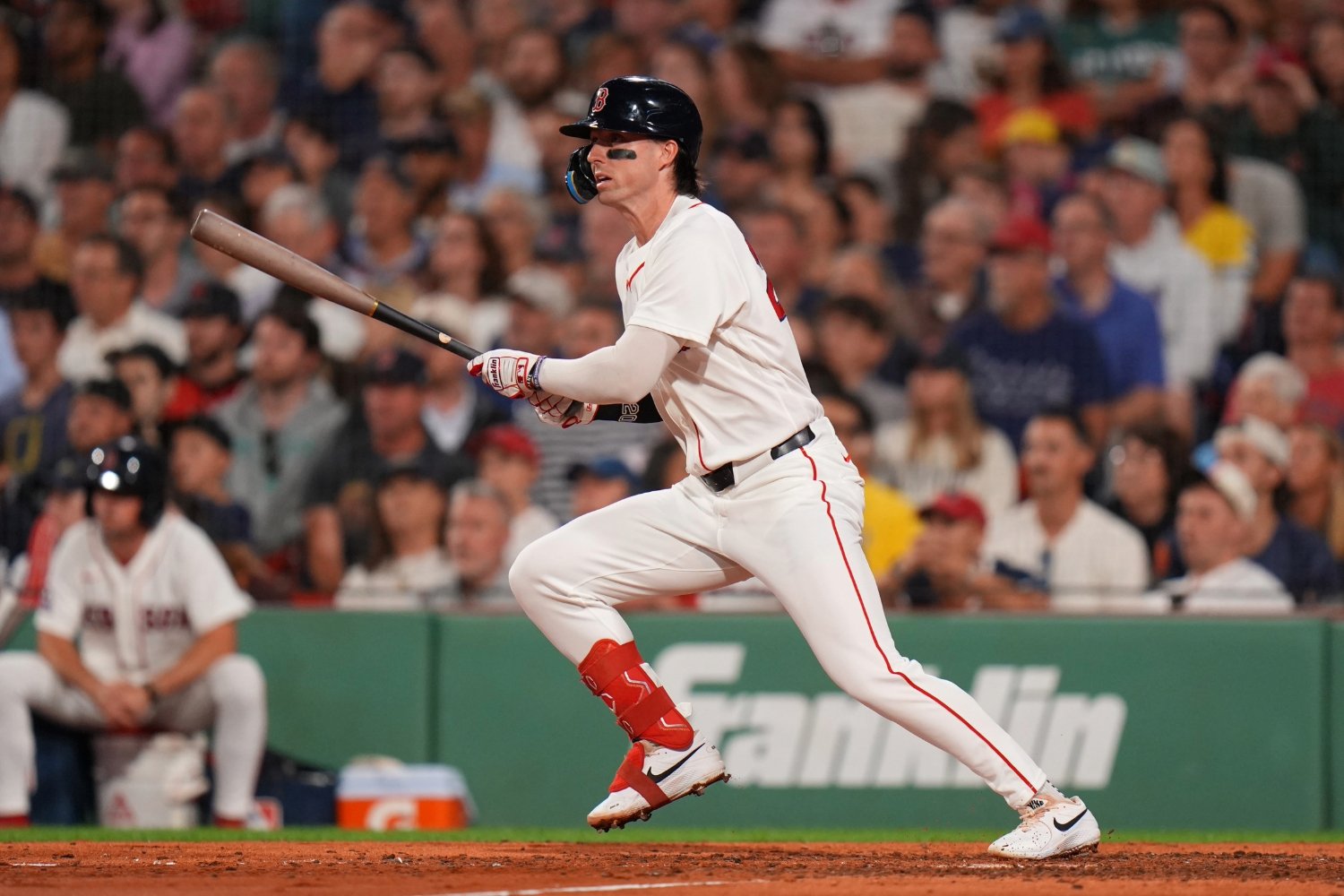 After whiffing on Alex Bregman in free agency, Nico Hoerner was floated as a potential fit for the Boston Red Sox. It turns out they didn’t need Hoerner. Boston has their very own contact-oriented, squared-jawed second baseman with a nice flow. On the surface, Nick Sogard and Nico Hoerner look like very similar hitters. Sogard isn’t a Statcast darling, nor is Hoerner. They don’t hit the ball hard. Their bat speeds grade in the bottom tenth of the league. They won’t turn any heads with their 86.8 and 86 mph exit velocities, nor do they barrel the ball often. Their greatest strengths lie in their plate discipline and contact efficiency. Let’s start with the most obvious difference: Hoerner is a faster player. His 77th percentile sprint speed helps boost his expected batting average to the 99th percentile. He’s also an elite defender and has won two Gold Gloves manning the keystone. It’s a bit of a stretch to say that Sogard will win a Gold Glove sometime during his career. Nonetheless, he’s a serviceable defender. In previous seasons, he filled in wherever infield help was needed, but he’s found a semi-permanent home at second this year, posting a -1 DRS, 1 OAA, and 2 FRV across 260 innings. Two years ago, FanGraphs’ Ben Clemens conducted a deep dive on squared-up rate versus launch angle. Following his methodology, I created a chart comparing Nick Sogard and Nico Hoerner’s contact quality across every ball they’ve hit into play over the past two seasons. Hoerner squares up even when he’s hitting the ball into the dirt. He squares up 75% to 78% of balls hit at negative launch angles, which is nearly the same rate as his line drives (10-25 degrees). It’s rare to see a hitter who maintains their quality of contact that far below the line drive band, but Hoerner is a contact artist with elite bat control. Sogard’s squared-up rate falls roughly 16 percentage points, from 82.5% at 12 degrees to 66.7% at -14 degrees. Hoerner drops five points over the same stretch. In the sweet spot range (8 to 32 degrees), they’re squaring up at nearly identical rates. Their gap never exceeds 3.5 points, and the lead oscillates three times across the range. Hoerner peaks in the 18-22 degree bucket, averaging an 80.6% squared-up rate. Sogard's peak sits lower and wider, squaring up between 80% and 83% of the time from -2 to 14 degrees. Hoerner’s squared-up rate collapses above 38 degrees, whereas Sogard's plateaus around 60%. This is the exact opposite of their grounder gap. Sogard and Hoerner’s swing path tilt numbers are nearly identical at 33 degrees and 32 degrees, respectively. Their attack angles have a nine-degree gap, a byproduct of where they’re pitched. Player Swings Bat Speed Attack Angle Swing Length Tilt Ideal AA% EV LA Nick Sogard 304 69.2 14° 7.1 ft 33° 50.0% 87.1 17° Nico Hoerner 946 68.3 5° 7.3 ft 32° 45.6% 87.0 12° A steeper attack means the bat is traveling upward upon contact. It matches low pitches better, since the ball is descending into the bat path. It produces more lift on contact, resulting in higher launch angles and more fly balls and homers. A flatter attack angle covers the top of the zone better and yields more line drives and grounders. Generally speaking, we see contact hitters utilize flatter attack angles. Statcast divides the strike zone into four areas: the Heart, Shadow, Chase, and Waste Zone. Hoerner has played in more games than Sogard this year, so raw pitch counts aren’t an exact apples-to-apples comparison. Normalized via heat-maps, Hoerner’s seen a higher number of pitches in the Heart. Sogard bats left most of the time. As a lefty, pitchers attack him in the bottom shadow zone (Attack Zone 18). As a righty, Sogard sees more pitches in the heart of the plate (Attack Zones 2, 5, and 8). What happens when they connect with the ball? Hoerner hits more grounders, but as previously mentioned, he squares those up, so they’re not weak dribblers. His speed also bails him out of grounders that would be outs for most hitters. Player GB% FB% LD% PU% Pull Air% Nick Sogard 38.9% 21.5% 29.5% 10.1% 24.2% Nico Hoerner 43.5% 20.8% 28.2% 7.6% 13.0% Sogard doesn’t have elite speed to beat out grounders, but that isn’t a huge factor in his batted ball profile. Pulling the ball in the air reaps benefits for hitters. Over a third of them leave the yard. Sogard’s 24.2% pull-air rate is nearly double Hoerner’s. He’s seen that number jump across both sides of the plate. Last year, he recorded a 19.6% pull-air rate batting left, whereas this year it’s up to 23.5%. On the right side, it jumped from 23.1% to 26.7%. Fenway rewards switch hitters. Batting left, a line drive can sneak into the stands for a ground-rule double. Batting right, a pulled ball in the air connects with the Green Monster. Nick Sogard's Statcast Profile on Pulled Balls Season BBE EV LA Barrel% Hard-Hit% ISO BA xBA SLG xSLG wOBA xwOBA 2025 32 90.2 8 9.4% 46.9% .125 .344 .341 .469 .589 .350 .394 2026 66 88.6 9 7.6% 42.4% .288 .394 .363 .682 .557 .459 .394 Playing in a career-high 52 games in the majors this year, Sogard has sharpened his plate discipline. He’s cut his strikeout rate from 23.1% in 2025 to 19.9% in 2026, while bolstering his walk rate to 12.7% from 4.8%. He’s also not feasting on meatballs from mediocre guys. He’s hit home runs off Max Fried and Yennier Cano, two star pitchers. Looking at Hoerner and Sogard’s spray charts, you see the difference in their batted ball profiles. Hoerner’s is a wall of singles piled up in the infield and shallow outfield, which is exactly where you’d expect a guy with a five-degree attack angle to hit the ball. His home runs cluster down the left field line. Sogard’s damage varies based on his handedness. Nico Hoerner is a veteran second baseman. His profile is what a flat swing and elite bat control produce over six seasons. Heading into his age-30 season in 2027, it’s safe to say he’s hit his ceiling. He probably won’t ever hit more than 15 home runs in a season, which is fine, since the Cubs have plenty of other power hitters in their lineup to drive him home. Unlike Hoerner, Sogard’s still trying to figure out who he is as a hitter. Does he try to tap into his power, or does he stick to a contact-oriented approach? The Red Sox already have the latter in Caleb Durbin. Going forward, Sogard’s future looks murky. The team is loaded with solid, but not elite infielders. Boston traded for Curtis Mead, who fractured his left wrist in his debut. Mead has been on the 10-day IL and hasn’t swung yet. We probably won’t see him take the field for Boston again this year. Mead had a breakout first half with a surge in power, though his defense isn’t on par with Sogard’s. It’ll be interesting to watch the battle for second base whenever spring training occurs next year. Sogard has only appeared in 113 games across three seasons in Boston. This year, he’s blossomed into an X-factor for the team, and it’s safe to say he’s earned his spot on the postseason roster. He provides defensive versatility and elite plate discipline on both sides of the plate. His pull-air rate plays well in Fenway Park, and he has a knack for clutch hits. The Red Sox play better when Sogard is in the lineup, and his presence won’t be overlooked in October.
 -
After whiffing on Alex Bregman in free agency, Nico Hoerner was floated as a potential fit for the Boston Red Sox. It turns out they didn’t need Hoerner. Boston has their very own contact-oriented, squared-jawed second baseman with a nice flow. On the surface, Nick Sogard and Nico Hoerner look like very similar hitters. Sogard isn’t a Statcast darling, nor is Hoerner. They don’t hit the ball hard. Their bat speeds grade in the bottom tenth of the league. They won’t turn any heads with their 86.8 and 86 mph exit velocities, nor do they barrel the ball often. Their greatest strengths lie in their plate discipline and contact efficiency. Let’s start with the most obvious difference: Hoerner is a faster player. His 77th percentile sprint speed helps boost his expected batting average to the 99th percentile. He’s also an elite defender and has won two Gold Gloves manning the keystone. It’s a bit of a stretch to say that Sogard will win a Gold Glove sometime during his career. Nonetheless, he’s a serviceable defender. In previous seasons, he filled in wherever infield help was needed, but he’s found a semi-permanent home at second this year, posting a -1 DRS, 1 OAA, and 2 FRV across 260 innings. Two years ago, FanGraphs’ Ben Clemens conducted a deep dive on squared-up rate versus launch angle. Following his methodology, I created a chart comparing Nick Sogard and Nico Hoerner’s contact quality across every ball they’ve hit into play over the past two seasons. Hoerner squares up even when he’s hitting the ball into the dirt. He squares up 75% to 78% of balls hit at negative launch angles, which is nearly the same rate as his line drives (10-25 degrees). It’s rare to see a hitter who maintains their quality of contact that far below the line drive band, but Hoerner is a contact artist with elite bat control. Sogard’s squared-up rate falls roughly 16 percentage points, from 82.5% at 12 degrees to 66.7% at -14 degrees. Hoerner drops five points over the same stretch. In the sweet spot range (8 to 32 degrees), they’re squaring up at nearly identical rates. Their gap never exceeds 3.5 points, and the lead oscillates three times across the range. Hoerner peaks in the 18-22 degree bucket, averaging an 80.6% squared-up rate. Sogard's peak sits lower and wider, squaring up between 80% and 83% of the time from -2 to 14 degrees. Hoerner’s squared-up rate collapses above 38 degrees, whereas Sogard's plateaus around 60%. This is the exact opposite of their grounder gap. Sogard and Hoerner’s swing path tilt numbers are nearly identical at 33 degrees and 32 degrees, respectively. Their attack angles have a nine-degree gap, a byproduct of where they’re pitched. Player Swings Bat Speed Attack Angle Swing Length Tilt Ideal AA% EV LA Nick Sogard 304 69.2 14° 7.1 ft 33° 50.0% 87.1 17° Nico Hoerner 946 68.3 5° 7.3 ft 32° 45.6% 87.0 12° A steeper attack means the bat is traveling upward upon contact. It matches low pitches better, since the ball is descending into the bat path. It produces more lift on contact, resulting in higher launch angles and more fly balls and homers. A flatter attack angle covers the top of the zone better and yields more line drives and grounders. Generally speaking, we see contact hitters utilize flatter attack angles. Statcast divides the strike zone into four areas: the Heart, Shadow, Chase, and Waste Zone. Hoerner has played in more games than Sogard this year, so raw pitch counts aren’t an exact apples-to-apples comparison. Normalized via heat-maps, Hoerner’s seen a higher number of pitches in the Heart. Sogard bats left most of the time. As a lefty, pitchers attack him in the bottom shadow zone (Attack Zone 18). As a righty, Sogard sees more pitches in the heart of the plate (Attack Zones 2, 5, and 8). What happens when they connect with the ball? Hoerner hits more grounders, but as previously mentioned, he squares those up, so they’re not weak dribblers. His speed also bails him out of grounders that would be outs for most hitters. Player GB% FB% LD% PU% Pull Air% Nick Sogard 38.9% 21.5% 29.5% 10.1% 24.2% Nico Hoerner 43.5% 20.8% 28.2% 7.6% 13.0% Sogard doesn’t have elite speed to beat out grounders, but that isn’t a huge factor in his batted ball profile. Pulling the ball in the air reaps benefits for hitters. Over a third of them leave the yard. Sogard’s 24.2% pull-air rate is nearly double Hoerner’s. He’s seen that number jump across both sides of the plate. Last year, he recorded a 19.6% pull-air rate batting left, whereas this year it’s up to 23.5%. On the right side, it jumped from 23.1% to 26.7%. Fenway rewards switch hitters. Batting left, a line drive can sneak into the stands for a ground-rule double. Batting right, a pulled ball in the air connects with the Green Monster. Nick Sogard's Statcast Profile on Pulled Balls Season BBE EV LA Barrel% Hard-Hit% ISO BA xBA SLG xSLG wOBA xwOBA 2025 32 90.2 8 9.4% 46.9% .125 .344 .341 .469 .589 .350 .394 2026 66 88.6 9 7.6% 42.4% .288 .394 .363 .682 .557 .459 .394 Playing in a career-high 52 games in the majors this year, Sogard has sharpened his plate discipline. He’s cut his strikeout rate from 23.1% in 2025 to 19.9% in 2026, while bolstering his walk rate to 12.7% from 4.8%. He’s also not feasting on meatballs from mediocre guys. He’s hit home runs off Max Fried and Yennier Cano, two star pitchers. Looking at Hoerner and Sogard’s spray charts, you see the difference in their batted ball profiles. Hoerner’s is a wall of singles piled up in the infield and shallow outfield, which is exactly where you’d expect a guy with a five-degree attack angle to hit the ball. His home runs cluster down the left field line. Sogard’s damage varies based on his handedness. Nico Hoerner is a veteran second baseman. His profile is what a flat swing and elite bat control produce over six seasons. Heading into his age-30 season in 2027, it’s safe to say he’s hit his ceiling. He probably won’t ever hit more than 15 home runs in a season, which is fine, since the Cubs have plenty of other power hitters in their lineup to drive him home. Unlike Hoerner, Sogard’s still trying to figure out who he is as a hitter. Does he try to tap into his power, or does he stick to a contact-oriented approach? The Red Sox already have the latter in Caleb Durbin. Going forward, Sogard’s future looks murky. The team is loaded with solid, but not elite infielders. Boston traded for Curtis Mead, who fractured his left wrist in his debut. Mead has been on the 10-day IL and hasn’t swung yet. We probably won’t see him take the field for Boston again this year. Mead had a breakout first half with a surge in power, though his defense isn’t on par with Sogard’s. It’ll be interesting to watch the battle for second base whenever spring training occurs next year. Sogard has only appeared in 113 games across three seasons in Boston. This year, he’s blossomed into an X-factor for the team, and it’s safe to say he’s earned his spot on the postseason roster. He provides defensive versatility and elite plate discipline on both sides of the plate. His pull-air rate plays well in Fenway Park, and he has a knack for clutch hits. The Red Sox play better when Sogard is in the lineup, and his presence won’t be overlooked in October. View full article
-
Good morning! We’re recording the next episode of the Talk Sox Podcast on Sunday. Drop your questions below for @Alex Mayes and me. The cut-off is at 2:00 pm CST on the 13th.
-
Talk Sox Podcast Episode Questions, Labor Day Weekend
Maddie Landis replied to Maddie Landis's topic in Boston Red Sox Talk
No worries. Best of luck to both children in their sports! I remember the cross-country days. :) -
Good morning! Drop your questions below for @Alex Mayes and me. We’ll answer them on the next Talk Sox podcast episode. The cutoff for questions is 2:00 pm CST on the 6th.
-
Hello! We’re recording the next episode of the Talk Sox Podcast on Sunday. Drop your questions below for both myself and @Alex Mayes. We’ll put the cutoff for questions at 2:00 pm CST on the 30th.
-
I vaguely remember hearing about the traveling secretary incident, though I was just eight years old at the time. Manny didn't directly apologize until 2014. Six years later! After learning this, I'd flip Damon/Manny
-
Izzy said he's fine with waiting until September 1st to be taken off the IL. I've whined plenty about him this year, but that comment earned him a lot of respect in my book.
- 11 replies
-
- 1
-

-
- nick sogard
- rafael devers
- (and 1 more)
-
I guess that he lands with the Mets. He doesn't fit the Phillies clubhouse vibe (and their raw-milk-drinking antics).
-
Alex Cora will manage a baseball team again. As of now, his timeline is uncertain. He mused on Karl Ravech’s “Dirt from the Dugout” podcast, “I think at one point, I’m gonna get back. When? We don’t know.” The Boston Red Sox fired Cora on April 25, after starting the 2026 season with a tepid 10-17 record. In his first season with the Red Sox, he led the team to a World Series title. The team made three postseason appearances under Cora. Overall, the skipper posted a 620-541 record (.534 W-L%) across eight seasons with his former team. Cora said he was “upset they didn’t let me finish the job,” but also “happy for my family… relieved I don’t have to go through scouting reports and the matrix and talk to the media twice a day and live in the bubble of ‘We have to do this.’” With more free time on his hands, Cora has enjoyed his summer. He returned to his hometown of Caguas, Puerto Rico, with his fiancée and twin sons. He attended some World Cup matches in Boston and traveled to Europe with his family. Cora is expected to be a popular managerial candidate in the offseason. He turned down an offer to manage the Phillies this season. Since Carlos Mendoza was fired, the Mets are also expected to have a managerial vacancy. Given the impending lockout, teams have a much narrower window to hire a new skipper. The regular season concludes at the end of September, so some teams have more time, but there's only one month between the end of the World Series and the Dec. 1 lockout. The bigger question is: Against all odds, could Boston go back to Cora a third time? I'm leaning no. Interim manager Chad Tracy is a frontrunner for the Manager of the Year Award and shepherded the team to an historic 27-3 stretch this summer. The Red Sox currently hold the second AL Wild Card spot after entering July all but out of the playoff race. Tracy has proved he’s more than capable of managing the team. Red Sox fans will always appreciate Cora’s contributions in the 2007 and 2018 World Series runs, but it's best for both sides to move on. Cora is still regarded as one of the best managers in the game, and he’ll succeed wherever he lands. View full article
-
Alex Cora Plans to Continue Managing After Eight Seasons In Boston
Maddie Landis posted an article in Red Sox
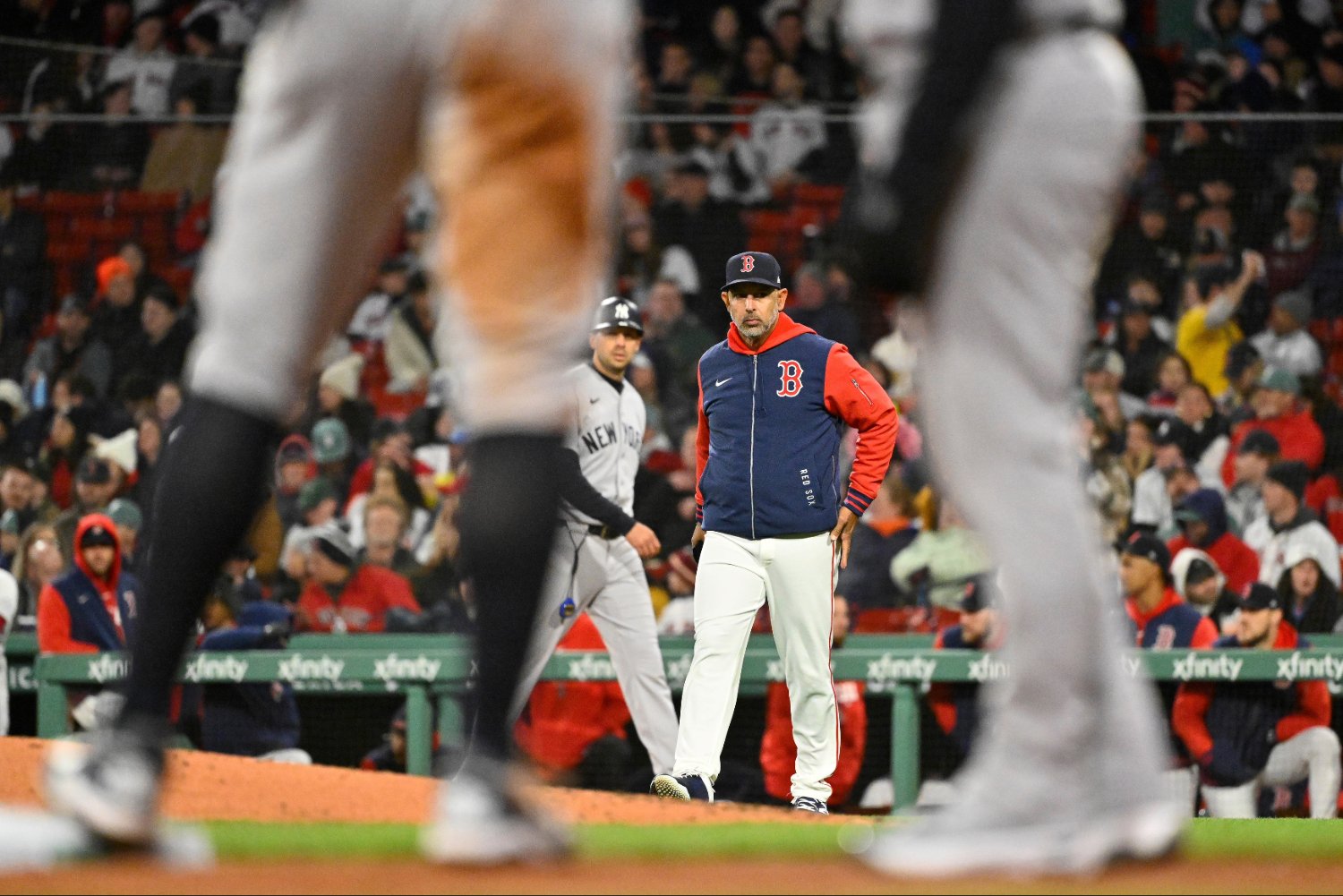 Alex Cora will manage a baseball team again. As of now, his timeline is uncertain. He mused on Karl Ravech’s “Dirt from the Dugout” podcast, “I think at one point, I’m gonna get back. When? We don’t know.” The Boston Red Sox fired Cora on April 25, after starting the 2026 season with a tepid 10-17 record. In his first season with the Red Sox, he led the team to a World Series title. The team made three postseason appearances under Cora. Overall, the skipper posted a 620-541 record (.534 W-L%) across eight seasons with his former team. Cora said he was “upset they didn’t let me finish the job,” but also “happy for my family… relieved I don’t have to go through scouting reports and the matrix and talk to the media twice a day and live in the bubble of ‘We have to do this.’” With more free time on his hands, Cora has enjoyed his summer. He returned to his hometown of Caguas, Puerto Rico, with his fiancée and twin sons. He attended some World Cup matches in Boston and traveled to Europe with his family. Cora is expected to be a popular managerial candidate in the offseason. He turned down an offer to manage the Phillies this season. Since Carlos Mendoza was fired, the Mets are also expected to have a managerial vacancy. Given the impending lockout, teams have a much narrower window to hire a new skipper. The regular season concludes at the end of September, so some teams have more time, but there's only one month between the end of the World Series and the Dec. 1 lockout. The bigger question is: Against all odds, could Boston go back to Cora a third time? I'm leaning no. Interim manager Chad Tracy is a frontrunner for the Manager of the Year Award and shepherded the team to an historic 27-3 stretch this summer. The Red Sox currently hold the second AL Wild Card spot after entering July all but out of the playoff race. Tracy has proved he’s more than capable of managing the team. Red Sox fans will always appreciate Cora’s contributions in the 2007 and 2018 World Series runs, but it's best for both sides to move on. Cora is still regarded as one of the best managers in the game, and he’ll succeed wherever he lands.
 -
Franklin AriasJustin GonzalesFranklin PrimeraHenry GodboutJuan ValeraDorian SotoMarcus PhillipsSadbiel DelzineJohn HolobetzHayden MullinsJohanfran GarciaJake SchaffnerYoeilin CespedesBlake WehuntMikey RomeroYophery RodriguezGerardo RodriguezJack WinnayOwen HullLuke Heyman
