


Red Sox Video
With the 2025 season officially over, it’s time to look back on the roster and see if players lived up to their expectations, exceeded them, or even failed to live up to them. With that, today we’re going to look back upon the season the Red Sox infielders had in 2025.
The infield itself saw a few rotating parts due to either injury or poor performance. In total, the team ended up using 12 different players in the infield, but those who played mostly in the outfield (Ceddanne Rafaela and Nate Eaton) will have their grades omitted since infield was not their main position. Despite injuries and poor play, the Red Sox managed to find workarounds either through their minor league depth or late season acquisitions to keep the infield from collapsing.
You can see our grades for catchers here, and outfielders here.
Trevor Story: B+
To say Story had his best season in Boston in 2025 would be an understatement. After playing in a total of 163 games in his first three seasons with the Red Sox, Story played 157 this season and was a leader both on and off the field.
Offensively, he led the lineup by example, hitting anywhere between second and fourth as he would go on to hit .263/.308/.433 with a .741 OPS. He also brought home 29 doubles, 25 home runs and 96 RBIs, the latter two figures leading the team. But one of his more historic stats was the fact he stole 31 bases and was only caught once on his final attempt of the season, breaking an American League record for most consecutive stolen bases to start a season.
It wasn’t all positive for Story, as the month of May had fans calling for the shortstop to be benched or even released from his contract as he absolutely struggled. In 25 games that month, Story looked finished as a player, hitting just .158/.200/.232 with just one double, two home runs, seven RBIs and 35 strikeouts. After missing nearly two years of baseball, he looked overmatched at the plate, but eventually found his footing again as he would turn things around in June with a .286/.327/.500 stat line where he had six doubles, five home runs and 23 RBIs.
Defensively, it may have been his worst effort since the shortened 2020 season, as he posted a .970 fielding percentage. That number was thanks to 19 errors, a career high that was inflated by a September that saw him commit six errors in his final nine games.
Story finished the season with 3.0 fWAR.
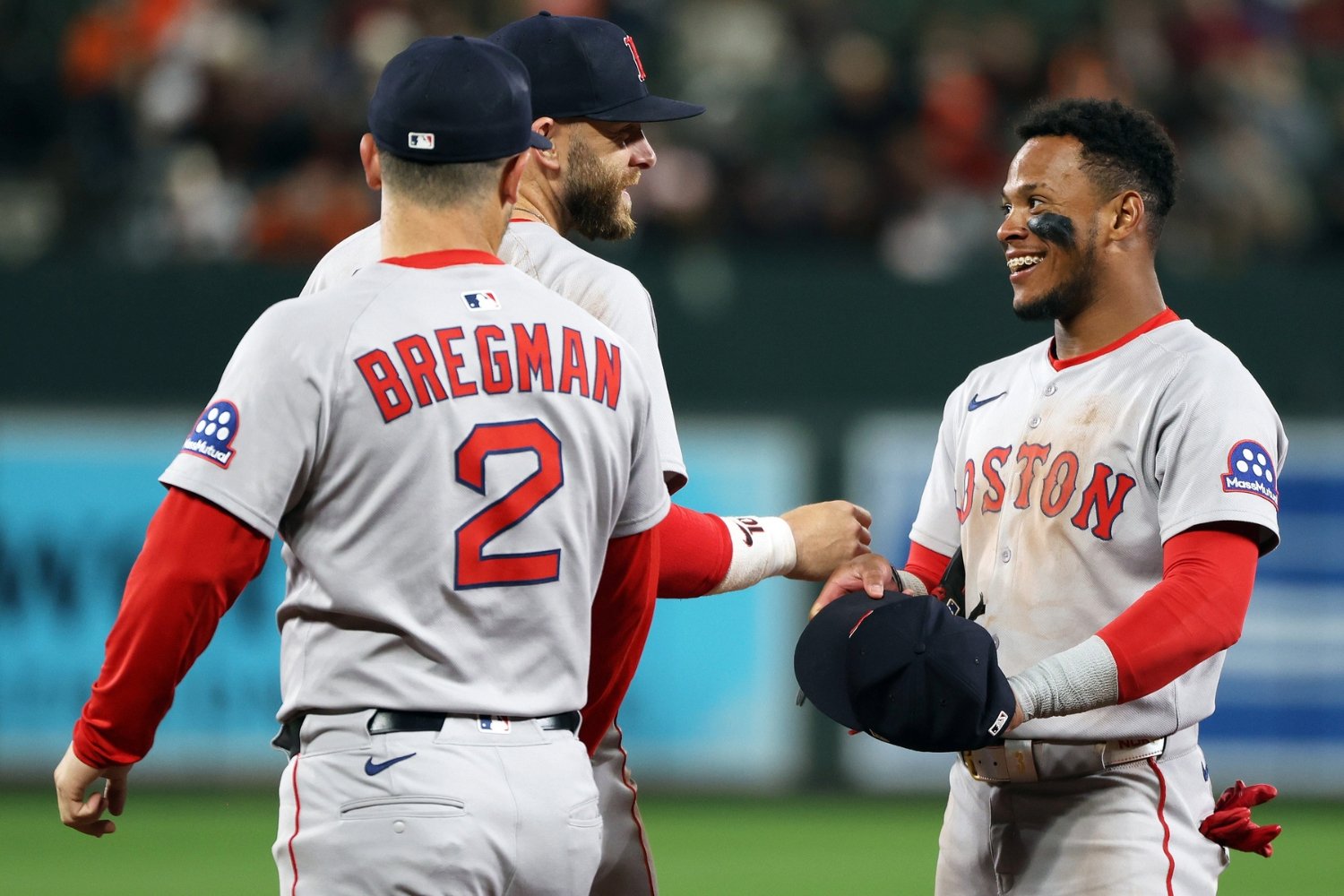
Alex Bregman: B
Bregman was one of two key offseason acquisitions by Craig Breslow and was expected to be a leader both on and off the field. While a second half that saw him deal with the lingering effects of his previously injured quad led to a decline offensively, Bregman was constantly helping the team out however he could.
While only playing in 114 games, there is no debate that Bregman returned earlier than expected from his quad injury, the team doing its best to manage his workload until he was more comfortable and conditioned to play more than two games in a row. Despite that, his first half alone made his signing look like a genius move, as he hit .298/.380/.546 with 18 doubles, 11 home runs and 35 RBIs in his first 53 games. However, after the quad injury, Bregman hit just .250/.341/.386 with an OPS of .727 in 61 games. Across that same span, he had just 10 doubles, seven home runs and 27 RBIs. September was also his worst month of the season, as he appeared in 22 games but hit just .216/.310/.330 with four doubles, two home runs and nine RBIs.
Despite missing time with his injury, Bregman was a constant voice in the clubhouse with the younger players as he provided advice and support that proved invaluable as the Red Sox made their first postseason since 2021.
Defensively, he committed nine errors across 113 games at third base for a fielding percentage of .969. Bregman finished the season with a fWAR of 3.5.
Campbell was the top prospect who broke camp with the team, and everyone immediately viewed him as the future. Within his first week in the majors, he signed an eight-year extension and had put himself in early talks as a Rookie of the Year favorite as he hit .301/.407/.495 with an OPS of .902 in 29 games between March and April. He also had eight doubles, four home runs, and 12 RBIs as he looked every bit of a future offensive star.
Unfortunately, that was the high point of his season. Pitchers began to adjust to Campbell, and the rookie struggled to make the necessary adjustments at the major league level as he hit just .134/.184/.171 in 22 May games, highlighted by a 27:5 strikeout-to-walk ratio. He was ultimately optioned on June 20 and remained in Worcester the rest of the season in an attempt to work on the issues that major league pitching had discovered (while also attempting to learn how to play first base).
Defensively, Campbell appeared at second in 59 games and committed seven errors for a fielding percentage of .968, and he was considered one of the worst defenders in all of baseball during his time in the big leagues (-16 DRS).
For the entire season, Campbell appeared in 67 games and hit .223/.319/.345 with an OPS of .664. He also had 10 doubles, six home runs, and 21 RBIs. He finished the season with a fWAR of -0.2.
Coming into 2025, Casas was expected to be a key offensive piece for the team as the everyday first baseman.
Instead, the plane never got off the runway.
Casas only played in 29 games this season before ultimately ending up injured for the fourth consecutive season. Though Casas believes he’ll be ready for the 2026 season, his injury history is ugly. There's a lot of weight on his shoulders to play a full season in 2026.
Offensively, Casas started cold, hitting .059/.111/.059 in his first five games (four starts) while striking out seven times in 17 at-bats. He would go on to open April by going 5-for-14 with a home run, but after April 4 would not have a multi-hit game again until April 29 against Toronto.
For the entire season, Casas would go on to hit .182/.277/.303 with an OPS of .580 in 29 games. He had three doubles, three home runs and 11 RBIs, as his injury history has now made it hard to rely on him as the everyday first baseman for 2026 and beyond.
Defensively he appeared in 28 games at first base and committed just two errors for a fielding percentage of .991.
For the season, Casas ended the year with a fWAR of -0.6.
Romy González: B+
González played in a career-high 96 games in 2025 where he bounced between first, second and third base as the team needed him to play multiple position once more. Unlike in 2024 where he played every position besides pitcher and catcher, González mostly split time between first and second base.
In 2025, he was a key presence in the lineup, hitting .305/.343/.483 with an OPS of .826. Along with that, he also had 23 doubles, three triples, nine home runs, and 53 RBIs as he formed one half of the “Lefty Killers” duo alongside Rob Refsnyder.
Against left-handed pitching was where he really did damage; he posted a .331/.378/.600 slash with an OPS of .978. He also had seven of his nine home runs against left-handers in 130 at-bats. Though, he was still productive against right-handed pitching as he slashed .286/.318/.400 in 185 at-bats.
Defensively, González stepped up when Casas got injured, forming a platoon with Abraham Toro where he ended up appearing at first base in 58 games. In that span, he committed four errors for a .989 fielding percentage. González would play 42 games at second base and have a .978 fielding percentage after committing three errors. He also appeared at third base for just two games, making an error on the only play he had at the position for a fielding percentage of .000.
González finished the season with a fWAR of 1.5.
Abraham Toro: C
Toro was not the first baseman we wanted, but he was the first baseman who stepped up following Casas’ injury. Despite not being the biggest name to replace the slugging first baseman, Toro showed up to Boston and did what was expected of him: give the team innings at first base and not be a black hole on offense.
In the first half of the season, Toro was a key contributor on offense even if his peripherals showed he was getting rather lucky. In 52 first-half games, the infielder would hit .271/.321/.418 with an OPS of .739. He also had 11 doubles, five home runs and 20 RBIs for the team while providing quality defense at first base.
Unfortunately, July bore the brunt of the expected regression for Toro, as he hit just .221/.295/.279 in 21 games with four doubles and six RBIs. Things got worse in 14 August games where he hit .137/.151/.255 with two home runs and five RBIs.
Defensively, he played 68 games at first base and committed three errors for a fielding percentage of .994. Toro also made 16 appearances at third base and made four errors there for a fielding percentage of .902.
Toro would go on to be designated for assignment on August 21 and outrighted to Worcester on August 23, where he would finish the season. On October 10, he elected free agency.
Toro finished the season with a fWAR of -0.7.
Marcelo Mayer: C+
After being drafted fourth overall in 2021 and dealing with a few injuries in the minor leagues, Mayer finally made his debut for Boston after Bregman went on the injured list. Playing much of his professional career at shortstop, Mayer spent time at Worcester getting more comfortable at both third base and second base, something that would work out in his favor with Boston.
His glove was clearly ready for the major leagues, as he appeared at third base in 39 games and committed just a single error for a fielding percentage of .985. His DRS was zero but he earned two OAA and two FRV, generally grading out positively.
He would also play eight games at second where he didn’t commit an error and would finish two games at shortstop but committed one error in two fielding attempts.
Offensively, Mayer showed he still had some work to do, though he also flashed the potential in his bat that made him the fourth overall pick all those years ago. Overall, he hit .228/.272/.402 with an OPS of .674 in 44 games. He also had eight doubles, a triple, four home runs, and 10 RBIs, but struck out 41 times and walked only eight times. He did fare much better against right-handed pitching more than left-handed, hitting .248/.294/.446 with eight doubles, four home runs and nine RBIs compared to a stat line of .154/.185/.231 with a triple and one RBI against southpaws.
Mayer’s season would end on July 25 when he was placed on the 10-day injured list due to a right wrist sprain.
Mayer ended the season with a fWAR of 0.4.
Coming off of a surprisingly good 2024, there were high expectations for Hamilton in being the team’s utility infielder entering 2025, to the point there were discussions of even having him take reps in the outfield to get more at-bats as well. That never came to be, but 2025 was not the season anyone expected for Hamilton.
Appearing in 91 games, Hamilton would see his time in Boston broken up by stints with the Worcester Red Sox, as he was optioned on July 11 and then again on August 11. Overall, Hamilton would go on to hit .198/.257/.333 with four doubles, a triple, six home runs, 19 RBIs and 22 stolen bases. All of that was a decline from his 2024 numbers of .248/.303/.395 with 17 doubles, a triple, eight home runs, 28 RBIs and 33 stolen bases in just seven more games.
The only real positive offensively is that in 29 second-half games, he started to perform better by hitting .241/.317/.463 with an OPS of .780. Hamilton also had a double, a triple, three home runs, seven RBIs and seven stolen bases in that span as he received more consistent playing time.
Defensively, he appeared at second base in 68 games and committed six errors for a fielding percentage of .973. He also played 12 games at shortstop where he committed one error for a fielding percentage of .972.
Hamilton finished the season with a fWAR of 0.1.
Nathaniel Lowe: B-
Lowe didn’t spend much time with Boston, but did he make it count. He immediately made quite a few fans within his first week with the team when he hit a game-tying, two-run home run in the bottom of the ninth of his first start. While the Red Sox would lose that game, Lowe continued to stay hot and opened his stint with Boston on a five-game hitting streak.
In 34 games with Boston, the left-handed hitter would slash .280/.370/.420 with an OPS of .790 at a time when the lineup was scuffling due to injuries and poor performances. Lowe would also hit six doubles, a triple, two home runs, and have 16 RBIs in that same span
Defensively, Lowe made 31 appearances at first base for Boston and made no errors. On the season, Lowe finished with a fWAR of 0.4 with the Red Sox.
Nick Sogard: C+
Sogard didn’t spend much time in the big leagues, as he was mostly in Worcester for 2025, but he was a key contributor in his short stints on Alex Cora's bench. His final stint proved to be his best, as in his final 15 games, Sogard hit .295/.354/.409 with seven RBIs.
Overall, Sogard hit .260/.317/.344 with eight doubles and nine RBIs. He was much more effective against left-handed pitching, hitting .371/.371/.486 with four doubles and two RBIs compared to .197/.290/.262 with four doubles and seven RBIs against right-handed pitching.
Defensively, Sogard played all over the field for the Red Sox, making appearances at first base, second base, third base, shortstop and right field. He only made a single error at first base.
And while postseason performances don’t add into consideration for the grades, there is no denying just how important Sogard was in the Game 1 victory against the Yankees, with a big hustle double that set up the game-winning hit for Masataka Yoshida.
On the season, Sogard finished with a fWAR of -0.1.





Recommended Comments
Create an account or sign in to comment
You need to be a member in order to leave a comment
Create an account
Sign up for a new account in our community. It's easy!
Register a new accountSign in
Already have an account? Sign in here.
Sign In Now