Jump to content
Talk Sox
  • Create Account
  • Red Sox News & Analysis

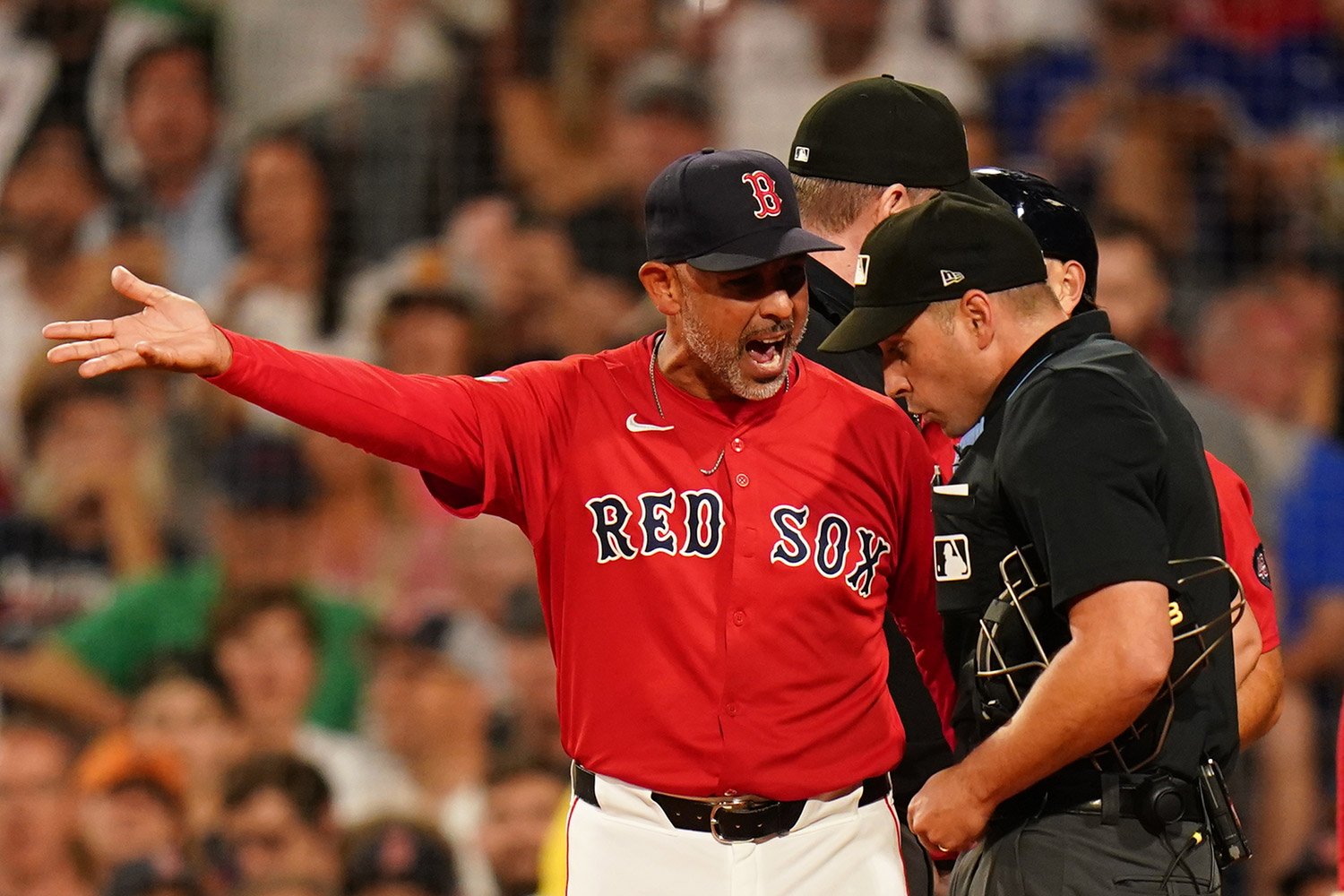
    After A Rough Few Months Is It Time For Alex Cora To Be On The Hot Seat?

    As the Red Sox continue to play consistently inconsistent baseball, might it be time for the organization to look for someone else to manage the club?

    Nick John
    Image courtesy of © David Butler II-Imagn Images

    Red Sox Video

    Since being hired before the 2018 season, Alex Cora has led the Boston Red Sox as manager, excluding his suspension during the 2020 season, but now it may be time for a different voice. Everyone remembers Cora positively for how 2018 ended with the greatest Red Sox team of all time winning the World Series; unfortunately, things have not been as positive since.

    2019 saw the Red Sox under Cora attempt to repeat, but it’s never easy, and the team struggled with injuries and inconsistencies. The team saw injuries to the rotation as Chris Sale, David Price, and Nathan Eovaldi pitched in 25 or fewer games, with Eovaldi bouncing between the rotation and bullpen. Offensively, the team received only six games out of Dustin Pedroia, 29 games from Steve Pearce, and 91 games from Mitch Moreland. And yet they still had career years from Christian Vázquez, Xander Bogaerts, Rafael Devers, Eduardo Rodríguez, and Brandon Workman. There were great seasons from Mookie Betts and J.D. Martinez, while also getting a quality rookie season from Michael Chavis.

    And still, the team only won 84 games that season.

    2020 was a lost season. Cora was suspended and fired before the season even began due to the 2017 Astros’ cheating scandal. Then, the season was shortened due to COVID-19, limiting it to 60 games plus an expanded playoff. The Sox would stumble through that season before Chaim Bloom rehired Cora in 2021.

    Cora seemed to turn the team around, leading a team that had no reason to be only two games away from the World Series. The roster differed from his 2018 championship team as Betts, Andrew Benintendi, Moreland, Price, and Jackie Bradley Jr. were all gone. Chris Sale was returning from Tommy John surgery and made nine starts for the team. And yet Cora managed to keep the team over-performing as they were in contention for the division until the last few weeks of the season. They got into the playoffs as a wild card team and knocked the Yankees out of the playoffs in the Wild Card Game before taking the Tampa Bay Rays out in the Division Series. Eventually, their magic ran out, and they lost in six games during the Championship Series to the Houston Astros.

    Since then, the team has struggled. The Red Sox under Cora have not been above .500 since 2021, the closest being when they went 81-81 in 2024.

    The usual complaints were that the Red Sox dealt with injuries and didn’t have the depth or the players to make a playoff run. There was no debate as the pitching failed to hold up in 2022 and 2023, as both seasons ended with the same record of 78-84. However, the story couldn’t be different. In 2022, the Red Sox had 52 wins heading into the trade deadline and were indecisive on what to do. They sold off Vázquez to the Houston Astros, getting back two prospects in Wilyer Abreu and Enmanuel Valdez. They also brought in Eric Hosmer, Reese McGuire, and Tommy Pham to try and strengthen the team for a playoff run.

    They collapsed down the season, winning only 27 games across August, September, and October as the pitching failed to hold up.

    2023 was much of the same. Gone was veteran Bogaerts, who Red Sox ownership let sign with San Diego for an 11-year, $280 million contract. He was replaced at shortstop by Kiké Hernández, who was awful defensively. Things were still a struggle on the pitching side as not a single starter had an ERA under 4.00. And despite that, the Red Sox were still in contention. With 56 wins entering the trade deadline, the Red Sox were only 2 ½ games out of a playoff spot and, unlike previous seasons, had a farm system with prospects that could either help at the major league level or be packaged in a trade.

    Cora made it known which way he wanted the team to head in as he said to MassLive’s Chris Cotillo, “We’re in a good place. But at the end of the day, the place that we would like to play is in October. It’s not about how many prospects you have or where your farm system is. It might be No. 1 or 30th or whatever. The one that counts is how many games you win in October and how many games you play in October. That’s what we’re shooting for.”

    At the time, Cora had every right to say that, especially as his team was fighting for a playoff spot after missing the postseason the prior season. They needed help, and they wanted it. They wanted the organization to say they believed the 2023 team could make the playoffs and compete for the World Series. Instead, Bloom failed to address the issues on the team, mostly surrounding the pitching, and the Red Sox collapsed down the stretch once more, winning only 22 games from August 1st until the end of the season.

    Bloom would be relieved of his position before the end of the season, and a report from The Athletic’s Ken Rosenthal didn’t come as a surprise when he wrote that “on the surface, the two seemed to co-exist professionally. But friends of Bloom, who spoke on condition of anonymity in exchange for their candor, believe Cora was not as supportive of Bloom as he could have been”. It isn’t a surprise that Cora wanted to win, and while Bloom did too, he didn’t make the moves Cora wanted to improve the roster. Instead, he wanted to build it up from within and support the next core with free agent signings.

    Bloom would not see his vision through, and Craig Breslow was hired as the President of Baseball Operations for the Boston Red Sox. While Breslow made moves by replacing Dave Bush as pitching coach with Andrew Bailey, 2024 turned into more of the same.

    While the team finished with an 81-81 record, the second-half collapse was the same as the past three seasons. At the end of July, the team had 57 wins, yet they finished down the stretch poorly, only winning 24 games, as once again the pitching collapsed. Unlike Bloom, Breslow did make moves. He brought in James Paxton, Luis Garcia, and Lucas Sims to try and bolster the pitching staff while also trading for Danny Jansen to be the backup catcher.

    After missing the playoffs for three straight seasons, the team finally got aggressive in the offseason. They traded for Garrett Crochet and signed Aroldis Chapman, Alex Bregman, and Walker Buehler. They got the big names they hadn’t signed in previous years, and now the roster was ready to compete.

    And yet on May 25th, the Red Sox now sit 27-28 after splitting a four-game series with the 18-34 Baltimore Orioles. In a 10-game homestand against the Atlanta Braves, New York Mets, and Baltimore Orioles, the team only went 5-5, and something has to give.

    While the team has dealt with injuries, this consistent inconsistency has been a staple of the 2025 season and even longer, dating back to 2022. The pitching fails to go deep into games, the bullpen is overtaxed and mismanaged at times, and the offense can completely vanish at times when needed. In this homestand alone, the Red Sox scored two or fewer runs in five games. In May, they’ve scored two or fewer runs in nine games so far.

    And the one constant since 2022 is the manager, Alex Cora. I’m not calling for him to be fired, but you must start discussing it. The Red Sox have not played very well, and many of their mistakes (fielding, baserunning, starters failing to go deep into games) fall on the coaching staff. The team has changed its pitching coach and defense coaches, yet the same mistakes are happening. It’s a sign of the culture within the team, one that the manager sets. One thing that Cora cannot change is that it might be time for a change in managers.

    Cora can be a skilled manager; there’s no debating that. Sometimes he’s shown it by getting the most out of his players and winning games he had no business winning. But then there are times when you can’t help but question what he’s doing by pulling a pitcher early or handling the bullpen poorly in different situations. A key example being when he brought Sean Newcomb, a guy who pitches when the Sox are up or down by a lot, into a close game with runners on the corners. Or having exhausted his bullpen so much that he needs to rely on Brennan Bernardino and Luis Guerrero for high-leverage innings. But ever since winning the World Series in 2018, he’s had numbers that would have fired other managers. A manager who has better numbers than he did gets fired.

    Let’s look at Cora’s numbers since they won in 2018. Since that season, Cora has a .509 winning percentage, one postseason appearance, two last-place finishes, and three losing seasons. John Farrell's predecessor also won it in his first season in Boston in 2013. After that, he managed four more seasons before being replaced by Cora after 2017. In those four seasons, Farrell had a .517 winning percentage, two division titles, two last-place finishes, and three losing seasons.

    If that could get Farrell fired, why hasn’t there been a discussion about Cora being on the hot seat? There is too much talent on this team for them to struggle this consistently through not just 2025 but since 2022. The Red Sox have had three different people run the baseball operations under Cora, with Dave Dombrowski and Bloom being seen as the problems. Should the team keep losing, will Breslow be viewed as the issue? Coaching-wise, Cora has had three bench coaches, two third base coaches, five first base coaches, two hitting coaches, and three pitching coaches, which shows that the team will replace the coaches around Cora should they fail to produce the desired results.

    On the defensive side, José David Flores and Kyle Hudson handle the infield and outfield defense, respectively, the former taking over for Andy Fox, who had been in that position since 2022. Pitching-wise, the team viewed a need to change it up and bring in Bailey, who had done a magnificent job with San Francisco’s pitchers. That hasn’t been replicated in Boston.

    So, who’s to blame this time around? They got Cora the players he wanted, and last year, they changed the coaching staff. Now, the team is still mediocre. Something has to give; either the team starts winning, or John Henry and Breslow must start discussing what to do with Cora and his staff. The Red Sox have too much talent in their organization to let this continue.

    Follow Talk Sox For Boston Red Sox News & Analysis

    Recent Red Sox Articles

    Recent Red Sox Videos


    User Feedback

    Recommended Comments


    Featured Comments

    8 minutes ago, dgalehouse said:

    I think you have made up your mind that you don't want the pitch clock to be a contributing factor to the pitching injuries that we are seeing on a daily basis. And there is nothing that will change your mind.  

    Pitchers used to work at their own pace.  I know I normally pitched very quickly and I never had an arm issue working quickly.  Pitchers like Sale and many others simply are quick workers because they are comfortable with it.  I also took my time when situations dictated especially with runners on base.  To me, that's the impact of the clock.  It removes strategy options from the pitchers but the impact on their arm seems like a huge stretch because most pitchers should have been pitching with a pace faster than the current clock allows.  If they shorten the time from where it is now, I think your point might be more valid for pitchers, especially the ones that are not in shape physically.  Those should not exist (David Wells comes to mind) but I'm sure a more rigorous pace will impact the need for more physical training.  Legs and arms need to be in better shape as the clock gets shorter.

    4 minutes ago, TedYazPapiMookie said:

    I think if you dig into the training techniques that allow a pitcher to jump 3 to 5 mph in a short time period you will find the source of the stress on the elbow.  Without the money incentive, parents and kids would not be using the modern techniques for increasing velocity.  That's not going to happen so expect the injuries to keep expanding until the MLB puts together a guideline that outlines what will hurt your elbow or not hurt your elbow when it comes to training techniques for increasing velocity. 

    One MLB player that I coached when he was younger had TJ surgery in High School because his father was an ex-player and got him hooked up with a program that did aggressive velocity training.  He jumped from the upper 80s to mid 90s in High School.  The player made it to the pros as a reliever and has had a second TJ surgery before 30.  He's made over $6Million in his career so far so was it worth it?  The MLB needs to focus on safer training techniques for youth baseball and beyond. 

    When I was a kid , ( many, many moons ago) they told us that throwing the curve ball would ruin your arm. Try to stick with the fastball and throw it as hard as you could.  Maximum effort for maximum velocity is nothing new. What is new is the pitch clock. The continual need to hurry up . I absolutely think that could very well be a factor in the rash of injuries we are seeing. And others don't agree. So be it. 

    10 minutes ago, notin said:

    Because I’ve looked into this and seen the data.

    The worst year for TJ surgeries was 2021, which was before the pitch clock was implemented in MiLB (2022) and in MLB (2023).  
     

    https://www.leanblog.org/2024/04/theres-no-special-cause-of-common-cause-variation-tommy-john-surgeries/

    This has been pointed out to you before, but somehow you keep indsisting you’re right and the rest of the world is stubborn.  If you have any data that suggests otherwise, please share.  If you have reasons to doubt the claims made by this blogger with medically-questionable credentials (besides those reasons, I mean), again, like to hear it.  But if you’re just going to repeat some unsupported hypothesis as truth because it meets your definition of common sense and label everyone else as obstinate for not seeing this, then you should accept all criticisms because you’re clearly inviting them…

    What I see are the pitching injuries that are happening every day. And a common sense that tells me that a certain recovery time is often needed between exertions. I will never be able to convince you of that , but it does not change my opinion.  

    14 minutes ago, notin said:

    Because I’ve looked into this and seen the data.

    The worst year for TJ surgeries was 2021, which was before the pitch clock was implemented in MiLB (2022) and in MLB (2023).  
     

    https://www.leanblog.org/2024/04/theres-no-special-cause-of-common-cause-variation-tommy-john-surgeries/

    This has been pointed out to you before, but somehow you keep indsisting you’re right and the rest of the world is stubborn.  If you have any data that suggests otherwise, please share.  If you have reasons to doubt the claims made by this blogger with medically-questionable credentials (besides those reasons, I mean), again, like to hear it.  But if you’re just going to repeat some unsupported hypothesis as truth because it meets your definition of common sense and label everyone else as obstinate for not seeing this, then you should accept all criticisms because you’re clearly inviting th 

    Do me a favor. Don't point anything out to me. I have my opinions and I have my basis for them.  And data is easily manipulated and not something I would swear by anyway.  You like the pitch clock. Good for you. 

    On 5/30/2025 at 4:13 PM, Old Red said:

    Shaugnessy said yesterday he wasn’t going to going to have a talk with Cora. Cora also stated something to the likes that the Red Sox are solid enough at 1B with Sogard, and Toro, and Romy was coming back next week not to mention KC also gets a tryout. Also said he wants to keep Raffy healthy. Appears to me that Raffy won’t be donning a 1B glove anytime soon much to the chagrin of all of Devers Forevers loyal followers who have been offering all kinds of encouragement, and well wishes.👍

    kc doesn't have enough bat to be a 1B, sogard has on OPS below .700, so he may not have enough stick either.

    52 minutes ago, dgalehouse said:

    When I was a kid , ( many, many moons ago) they told us that throwing the curve ball would ruin your arm. Try to stick with the fastball and throw it as hard as you could.  Maximum effort for maximum velocity is nothing new. What is new is the pitch clock. The continual need to hurry up . I absolutely think that could very well be a factor in the rash of injuries we are seeing. And others don't agree. So be it. 

    At a minimum, I’d say it’s too early in the pitch clock era to see if it’s a contributing factor.  These injuries are largely ergonomic and don’t happen in a few starts.  The tendon gets stretched like a rubber band with each pitch and tears happen over numerous cycles.  Knocking off a couple seconds for 1-2 seasons worth of starts is a complete unknown as a contributor….

    1 hour ago, notin said:

    Pitchers throw harder than they did 10 years ago. And this all starts at younger ages.  You have kids in high school throwing 98mph (yes, you do).  You don’t need to throw 98 mph to get high school hitters out.  But throwing that hard at that age does get you noticed by Division I college coaches as well as by MLB scouts.  It’s all about scholarships and signing bonuses.

    But by the time these kids get to MLB - a big if in itself - they’ve been straining their tendons with 98mph fastballs for 7-10 years.  Injuries become more likely with every pitch, and at some point, that tendon just snaps from shear overwork…

    This could be the main culprit, and I neglected to even mention it.


    53 minutes ago, dgalehouse said:

    Do me a favor. Don't point anything out to me. I have my opinions and I have my basis for them.  And data is easily manipulated and not something I would swear by anyway.  You like the pitch clock. Good for you. 

    Do me a favor.  Don’t repeatedly tell me about always having to be right when I’m not the one floating unsupported theories and getting angry when they’re openly questioned by people supplying actual data (which was ripe for questioning).

    And while I agree data can be manipulated and misinterpreted, that doesn’t mean the floor is open to any and all crackpot theories being accepted as facts.  Just because you hate the pitch clock doesn’t mean it’s actually causing any issues…

    2 minutes ago, notin said:

    At a minimum, I’d say it’s too early in the pitch clock era to see if it’s a contributing factor.  These injuries are largely ergonomic and don’t happen in a few starts.  The tendon gets stretched like a rubber band with each pitch and tears happen over numerous cycles.  Knocking off a couple seconds for 1-2 seasons worth of starts is a complete unknown as a contributor….

    There is data to shows that the amount of refresh time between exertions is a factor in injuries. That can mean between pitches and between outings, which includes hard throwing sessions, not just appearances.

    Of course, throwing harder or twisting for wrist or arm to add more spin matters, too. Starting at an earlier age matters, as well.

    The throwing harder, throwing harder earlier in life and adding more spin are things that have gradually been increasing over the years. The one thing that happened, overnight, was the pitch clock, and the sudden rash of injuries that started immediately after the rule change does point to it being a significant factor. It's not ironclad proof, but it does seem likely it matters.

    10 minutes ago, notin said:

    Do me a favor.  Don’t repeatedly tell me about always having to be right when I’m not the one floating unsupported theories and getting angry when they’re openly questioned by people supplying actual data (which was ripe for questioning).

    And while I agree data can be manipulated and misinterpreted, that doesn’t mean the floor is open to any and all crackpot theories being accepted as facts.  Just because you hate the pitch clock doesn’t mean it’s actually causing any issues…

    Is it a crackpot theory to believe that a certain recovery time is needed when performing strenuous activities ? And to continually have that clock ticking pitch after pitch is not a potential problem. ?  To constantly be in hurry up mode does not lead to mistakes ?  Pitchers are getting hurt every single game. Not all of them require Tommy John surgery. And I don't hate the pitch clock. I like the quicker games. I am just tying to figure out what the problem is. I am not ready the just accept the party line that velocity is the only cause. 

    28 minutes ago, moonslav59 said:

    There is data to shows that the amount of refresh time between exertions is a factor in injuries. That can mean between pitches and between outings, which includes hard throwing sessions, not just appearances.

    Of course, throwing harder or twisting for wrist or arm to add more spin matters, too. Starting at an earlier age matters, as well.

    The throwing harder, throwing harder earlier in life and adding more spin are things that have gradually been increasing over the years. The one thing that happened, overnight, was the pitch clock, and the sudden rash of injuries that started immediately after the rule change does point to it being a significant factor. It's not ironclad proof, but it does seem likely it matters.

    And while refresh time between exertions can be a factor in injuries, we’re not talking about enormous samples here.  If we limit it to UCL injuries, we see how many per year in MLB? 10? 20?  Out of the maybe 609-700 pitchers who will appear in MLB each year? 

    Not every pitcher had to change their pace for the pitch click.  Are these 10-20 affected pitchers ones that had to change? And by how much? Were they starters throwing 150 IP? Or relievers just throwing 50-60IP?  How much refresh time is safe?  Was 20 seconds ok and 15 unsafe? Does it vary from pitcher to pitcher?  Did just a couple of seasons of using the pitch clock provide enough time for damage?  Especially considering the numbers really haven’t spiked that much?

    Maybe 5-10 years down the road, more will be known.  Right now it’s just looking at correlation and calling it causation.  Might as well observe pitcher injuries increasing since Russia invaded the Ukraine and blame Putin for the rise…

    40 minutes ago, dgalehouse said:

    Is it a crackpot theory to believe that a certain recovery time is needed when performing strenuous activities ? And to continually have that clock ticking pitch after pitch is not a potential problem. ?  To constantly be in hurry up mode does not lead to mistakes ?  Pitchers are getting hurt every single game. Not all of them require Tommy John surgery. And I don't hate the pitch clock. I like the quicker games. I am just tying to figure out what the problem is. I am not ready the just accept the party line that velocity is the only cause. 

    It’s fair to not accept velocity as the cause; it might not be.  But if it isn’t, it doesn’t mean it’s got to be the pitch clock, for which I have no feelings either way.  I never once complained about the pace of games, but I also know it’s been in the rule book for decades…

    53 minutes ago, notin said:

    And while refresh time between exertions can be a factor in injuries, we’re not talking about enormous samples here.  If we limit it to UCL injuries, we see how many per year in MLB? 10? 20?  Out of the maybe 609-700 pitchers who will appear in MLB each year? 

    Not every pitcher had to change their pace for the pitch click.  Are these 10-20 affected pitchers ones that had to change? And by how much? Were they starters throwing 150 IP? Or relievers just throwing 50-60IP?  How much refresh time is safe?  Was 20 seconds ok and 15 unsafe? Does it vary from pitcher to pitcher?  Did just a couple of seasons of using the pitch clock provide enough time for damage?  Especially considering the numbers really haven’t spiked that much?

    Maybe 5-10 years down the road, more will be known.  Right now it’s just looking at correlation and calling it causation.  Might as well observe pitcher injuries increasing since Russia invaded the Ukraine and blame Putin for the rise…

    The amount of 3 hour games has been reduced enormously. There is no doubt that pitchers are taking less time between throwing. Yes, some much less than they used to and others not so much or close to the same. It makes sense that less refresh time between pitches is a factor.

    I'm not sure how much refresh time is safe, and it may vary from person to person or hardly matter to some people. IMO, it made a difference. I'm not sure how much, and it could be coincidental that the rule change happened just at the time injuries appear to have sky-rocketed. I'm not sure it's a major reason, but I'm pretty sure it has made a difference, along with other things that have changed in recent years or over the last 1-2 decades.

    It's not just the pitch clock itself, but the constant pressure to not violate it. There should be a little more leeway if it's a tough situation or a long at bat, etc. The pitcher should be able to step off and take a few breaths without using a mound visit or time out.  Obviously, you don't want them taking 30 seconds or more between every pitch. But the continual need to hurry up is not good for health. 

    45 minutes ago, notin said:

    It’s fair to not accept velocity as the cause; it might not be.  But if it isn’t, it doesn’t mean it’s got to be the pitch clock, for which I have no feelings either way.  I never once complained about the pace of games, but I also know it’s been in the rule book for decades…

    I think people focus too much on the pitch clock because it does not rush a pitcher unless the pitcher is generally a slow mover.  Most pitchers find the pitch clock an annoyance because it applies to every pitch and sometimes you want to think about things and contemplate where you are in the game but the time between pitches is not rushing anyone from a physical exertion standpoint.  Those that talk about recovery time after a pitch are grasping at theories not facts.  Do a study on Sale and see what his average time between pitches have been over his career or deGrom.  They are two of the hardest throwers with minimal recovery time between pitches and they don't experience a jump in injuries because of it compared to a pitcher who throws just as hard but dawdles more between pitches.  I can't think of a hard throwing dawdler off the top of my head but someone who can is in a position to compare the fast worker and slow worker and the recovery time after the pitch is still less way less than the pitch clock imposes on them.

    Injuries come from tons of activities during the off season, Spring Training, the Regular Season and the Post Season.  Training techniques probably cause the most injuries.  Mechanics can cause them.  You name any activity in the preparation of a pitcher, and it could contribute to the problem.  Not enough is known about what causes the injuries.  There are too many factors to isolate them effectively.  

    My vote on the pitch clock is that only slow workers may be impacted, the time between pitches is enough to stay healthy but the pitch clock has limited pitching strategies, especially with runners on base.  Varying times to throw over to 1B and not put yourself at risk of forfeiting a pitch has been eliminated.  The throw-over rule limits holding runners on base.  None of these impact injuries they just give an advantage to the offense. 

    2 hours ago, dgalehouse said:

    It's not just the pitch clock itself, but the constant pressure to not violate it. There should be a little more leeway if it's a tough situation or a long at bat, etc. The pitcher should be able to step off and take a few breaths without using a mound visit or time out.  Obviously, you don't want them taking 30 seconds or more between every pitch. But the continual need to hurry up is not good for health. 

    Good points. Maybe give each SP'er 2 or 3 "step offs" and RP'ers one.

    20 hours ago, moonslav59 said:

    That makes sense. I'm not sure the RP'ing starts and stops have changed all that much in the past decade or two, and the extra roster slot, who is always a 13th pitcher, has helped mitigate the expanded IP'd by relievers, so I'm not sure this has affected them all that much.

    Sp'er treatment has changed radically: I agree. It seems counterintuitive to say not allowing pitchers to go longer into games is causing more injuries, but who knows? There is no denying more major injuries are happening to mostly SP'ers. 

    The common reasons given seem to be based on these two issues:

    The asking them to apply a higher spin rate or add more velocity, because we will pitch you less, and assuming it evens out.

    The pitch clock that hurries their pitches one right after another.

    I'm not disagreeing with your point about babying pitchers might be part of the issue, but I do think that asking for more spin and or more velocity is the opposite of babying.


    Its babying and brutal at the same time. Both serve to take power and responsibility away from the player and give it to the geeks, and to the manager who sides with the geeks. They don't want the players to be crafty and smart, they only want them to throw 100 mph and "we'll do the thinking 'round here." 

    18 hours ago, dgalehouse said:

    I think you have made up your mind that you don't want the pitch clock to be a contributing factor to the pitching injuries that we are seeing on a daily basis. And there is nothing that will change your mind.  

    And that works both ways.

    Back in the day, the pitchers didn't take 60 seconds to throw the ball. Games weren't 4 hours long between the Sox and Yankees. Pitchers knew how to get the ball and throw it back to the catcher. The pitch clock was implemented to make the game watchable and more like how it was decades ago. 

    If injuries spiked prior to pitch clock implementation and haven't gotten worse since, what's the argument that it's making things worse? I don't see it. 

    55 minutes ago, mvp 78 said:

    Back in the day, the pitchers didn't take 60 seconds to throw the ball. Games weren't 4 hours long between the Sox and Yankees. Pitchers knew how to get the ball and throw it back to the catcher. The pitch clock was implemented to make the game watchable and more like how it was decades ago. 

    If injuries spiked prior to pitch clock implementation and haven't gotten worse since, what's the argument that it's making things worse? I don't see it. 

    That it’s new, despite what it’s allegedly causing is not.

    Right now the pitch clock era doesn’t have enough data to make a conclusion about its impact either way…

    23 hours ago, Bellhorn04 said:

    And that works both ways.

    Actually one way.

    If I’m presented with data that disagrees with my theories, my first reaction is not to accuse it of being manipulated.  In fact, that’s not on my list of reactions at all…

    35 minutes ago, notin said:

    That it’s new, despite what it’s allegedly causing is not.

    Right now the pitch clock era doesn’t have enough data to make a conclusion about its impact either way…

    The real reason pitchers arms are falling off is online gambling. They are throwing harder than ever because of all the death threats they are receiving. Every pitch in now life or death for these guys ever since PASPA was overturned. 

    On 5/31/2025 at 3:52 PM, dgalehouse said:

    MLB does not want to consider the pitch clock as a factor in the rash of pitching injuries because the pitch clock is their innovation. Many fans do not want to consider the pitch clock as a factor in the injuries because they like the shorter, faster paced games. The blame is usually put on the increased velocity . But it seems to me that the increased velocity would be all the more reason to not always be in a hurry to beat the ticking clock. Sometimes you need a little breather between reps. 

    I don't know if the pitch clock is a factor in injuries or not (studies have shown no causal relationship), but I am and have always been against the pitch clock.  I like the cat and mouse games that go on between the pitcher and the batter.

    I admit, the shorter game times are good for my bed time, but I'd be just as happy going back to those 3 hour plus games.

    On 5/31/2025 at 6:35 PM, SPLENDIDSPLINTER said:

    Back to the topic; fire Cora's azz.

    I was very surprised that Crochet came back out for the 7th inning yesterday.  I wonder why Cora allows Crochet to go 100+ pitches deep, but will pull his other starters when they are pitching relatively well with a pitch count of 75-80 pitches, especially when the BP could use a breather.  I know Crochet is a much better pitcher than the others, but still.  Let them at least finish 5 innings.

    7 minutes ago, Kimmi said:

    I was very surprised that Crochet came back out for the 7th inning yesterday.  I wonder why Cora allows Crochet to go 100+ pitches deep, but will pull his other starters when they are pitching relatively well with a pitch count of 75-80 pitches, especially when the BP could use a breather.  I know Crochet is a much better pitcher than the others, but still.  Let them at least finish 5 innings.

    None of the other starters have been very good at all.

    fWAR

    Dobbins 0.8

    Newcomb (gone) 0.7

    Giolito 0.2

    Fitts 0.2

    Buehler 0.2

    Bello 0.0

    4 minutes ago, Bellhorn04 said:

    None of the other starters have been very good at all.

    fWAR

    Dobbins 0.8

    Newcomb (gone) 0.7

    Giolito 0.2

    Fitts 0.2

    Buehler 0.2

    Bello 0.0

    For some, thats circular logic, as IP is a factor in WAR…

    6 minutes ago, notin said:

    For some, thats circular logic, as IP is a factor in WAR…

    OK, fWAR may not be the ideal number, but none of these guys have been especially good.  Dobbins has been the one pleasant surprise.  There may be hope for Fitts if he can stay on the field.

    You'd have to go through the game logs to see if there were instances of a guy truly cruising when Cora pulled him.

    The third time through the order analytics stuff plays into it too of course.  

    I don't think any of the great pitchers would appreciate being yanked after 4.2 innings.  I think Cora is just doing what he thinks gives the team their best chance of winning. And he might also be sending a message to Bello and the others. Pitching changes , or lack of same, are the number one cause of managers being second guessed.  

    As far as pitching injuries are concerned, I have neither the time or the desire to do any research on this. But I do find it hard to believe that there were more pitching injuries four years ago than there are these days. Right now , it seems epidemic. At least three more yesterday. 


    Create an account or sign in to comment

    You need to be a member in order to leave a comment

    Create an account

    Sign up for a new account in our community. It's easy!

    Register a new account

    Sign in

    Already have an account? Sign in here.

    Sign In Now

×
×
  • Create New...