


Red Sox Video
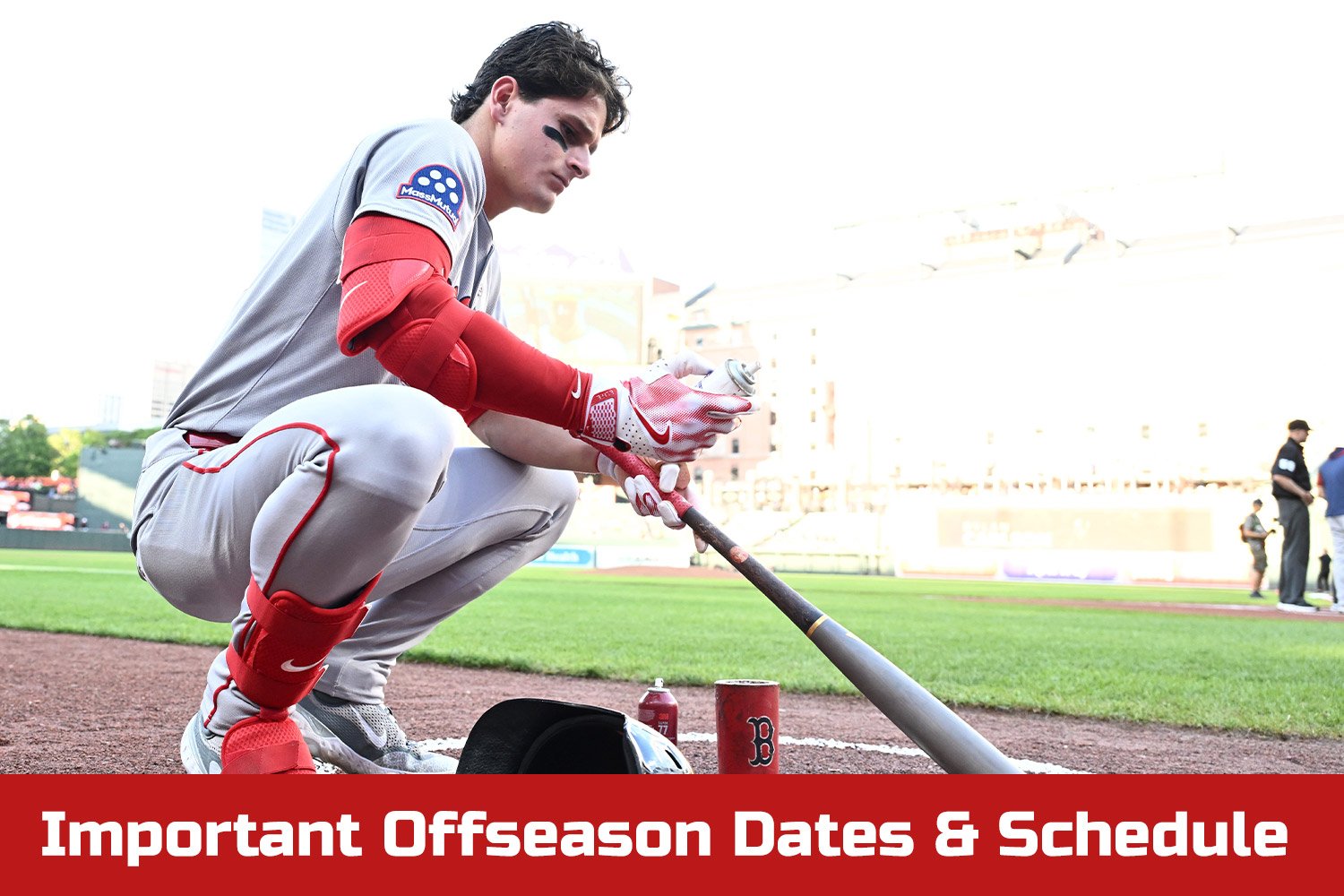
This guide provides a comprehensive overview of the Boston Red Sox's 2025–2026 offseason, highlighting key dates and events across Major League Baseball’s winter calendar. It includes details on the Winter Meetings, MLB Draft Lottery, and the important deadlines when the Red Sox must decide on arbitration-eligible players and those with team or mutual contract options. In the sections that follow, you’ll find a list of pending free agents, players with contract options, and a detailed timeline of the offseason ahead.
To view the current Red Sox 40-man roster, view our roster page, updated nightly.
The Boston Red Sox entered the season with a clear goal in mind: return to the postseason for the first time since 2021. Armed with high expectations and fueled by an aggressive offseason, Boston made waves by signing star infielder Alex Bregman and trading for dynamic left-hander Garrett Crochet. The bold approach paid dividends, as the Red Sox delivered a strong regular season performance that earned them the second Wild Card spot and a long-awaited return to October baseball.
The year wasn’t without drama, however. In June, Boston shocked the baseball world by trading away franchise cornerstone Rafael Devers, signaling a new era for the club. Yet even amid the upheaval, the Red Sox found new heroes. Garrett Crochet blossomed into a Cy Young-caliber ace, anchoring the rotation with dominant stuff, while rookie sensation Roman Anthony burst onto the scene with a breakout campaign that injected excitement and energy into Fenway Park.
Ultimately, the Red Sox’s run came to an end in heartbreaking fashion — a decisive Game 3 loss at Yankee Stadium to their fiercest rivals. Still, after years of frustration, Boston’s return to contention marked a significant step forward. With a young core emerging and key pieces in place, the Red Sox will look to build on this season’s momentum as they prepare for an even bigger push in 2026.
Click any link below to jump to an explanation of that event/date.
2026 Offseason Dates & Calendar
- Oct 24 - Nov 1: World Series
- Immediately After The World Series: Players Become Free Agents, Trade Market Opens
- 5 Days After Conclusion Of World Series: Contractual Options Due, Qualifying Offers Due, League-Wide Free Agency Opens
- Early November: General Manager Meetings
- Nov 13: The MLB Awards
- Nov TBA: Rule 5 Protection Deadline, Qualifying Offer Decisions due
- Nov TBA: Tender Deadline
- Dec TBA: Announcement of Competitive Balance Picks
- Dec 7-10: Winter Meetings (Orlando, FL)
- Dec 10: MLB Draft Lottery
- Dec 10: Rule 5 Draft
- January 2026: BBWAA HOF announcement
- Mid-January: Arbitration agreement deadline
- Jan 15: International Signing Period Opens
- January 10: Fenway Fest
- Late January-Early February: Arbitration Hearings
- Mid-February: Report to Spring Training
- February TBA: First Spring Training Game
- March TBA: MLB Spring Breakout
- March 25: MLB Opening Night (Yankees @ Giants)
- March 26: Opening Day (Red Sox @ Reds)
World Series
Game 1 of the 2025 MLB World Series is set for Friday, October 24, with a potential Game 7 scheduled for Saturday, November 1. The offseason officially begins the moment the final out of the World Series is recorded. Players on expiring contracts immediately become free agents, though certain restrictions apply in the first few days that will be detailed later. The day after the World Series ends, teams can resume making trades for the first time since the midseason deadline — marking the official start of the MLB offseason.
5 Days After The Conclusion Of World Series
As the offseason begins, free agents are permitted to negotiate exclusively with their most recent team for a five-day period. After that window closes, they are free to engage with all 30 MLB clubs.
For the Boston Red Sox, several players are set to reach free agency following the 2025 season, including Dustin May, Rob Refsnyder, Justin Wilson, and Steven Matz. Refsnyder made a solid impact in the lineup, while Wilson and Matz provided steady, positive contributions out of the bullpen. May, meanwhile, struggled to find consistency in limited action. It remains to be seen which of these players the Red Sox will have interest in bringing back as they shape the roster for 2026.
Player/Team/Mutual Options
During the initial offseason period, teams and players must decide whether to exercise or decline any contractual options for the upcoming year. For the Boston Red Sox, several key players hold options that will require attention in the coming weeks.
Trevor Story has a player opt-out available after the 2025 season, with three years and $55 million remaining on his contract. Should Story choose to opt out, the Red Sox retain the ability to opt back in, which would add a seventh year (2028) to the deal. His decision will be an important storyline for Boston’s offseason, as it could shape the club’s long-term infield plans.
Alex Bregman also holds an opt-out clause following the 2025 season. Given his strong performance and market value, Bregman is widely expected to opt out and test free agency in search of a longer-term contract.
Meanwhile, Liam Hendriks has a mutual option for $12 million with a $2 million buyout if the Red Sox decline. Mutual options are relatively rare in Major League Baseball because they require both the team and the player to agree to extend the contract for another season. More often than not, one side declines. In Hendriks’ case, it’s likely the Red Sox will choose that route.
Qualifying Offers
Like contract options, Qualifying Offers must be issued within five days of the World Series’ conclusion. The value of the Qualifying Offer changes annually, as it’s based on the average salary of MLB’s 125 highest-paid players from the previous season. For the upcoming offseason, that figure is projected to be $22 million.
To be eligible, a player must have spent the entire previous season with one team and must never have previously received a Qualifying Offer. Teams have until five days after the World Series ends to extend the offer, and players then have until mid-November to decide whether to accept or decline. If a player rejects the offer and signs elsewhere, their former team receives draft-pick compensation, with the specifics depending on the club’s market size, revenue-sharing status, and the value of the player’s new deal.
For the Boston Red Sox, there are no qualifying offer candidates among their impending free agents. None of Dustin May, Rob Refsnyder, Justin Wilson, or Steven Matz are expected to command contracts near the $22 million threshold, making it unlikely that extending a Qualifying Offer to any of them would be beneficial for the club.
Free Agency
Free agency officially begins the day after the World Series concludes. However, during the initial five-day period, players are only permitted to negotiate with their previous club. Once that window closes, full free agency opens, allowing all 30 teams to contact and negotiate with any available player. Depending on the length of the World Series, league-wide free agency is expected to begin between November 2 and November 6.
As previously noted, the Boston Red Sox have several players set to reach the open market: Dustin May, Rob Refsnyder, Justin Wilson, and Steven Matz. Each offers a different skill set — from Refsnyder’s steady presence in the lineup to Wilson and Matz’s reliable bullpen work, while May looks to rebound after a limited and inconsistent season. The Red Sox front office will evaluate whether to pursue potential reunions or allow these players to move on as they continue shaping the roster for 2026. Free agency will remain active throughout the offseason and into spring training.
General Manager Meetings
Roughly a week after the World Series concludes, all 30 general managers gather for meetings to discuss league business and key offseason matters. While these sessions don’t typically draw much attention from fans, they often help establish the groundwork for trades and other transactions that take place later in the winter.
Rule 5 Protection/Draft
The Rule 5 Draft takes place each winter (with the exception of 2020) and offers every organization a chance to uncover unprotected talent from other clubs. Under Rule 5 regulations, players who signed at age 18 or younger must be protected within five seasons, while those who signed at 19 or older must be protected within four. Teams safeguard eligible prospects by adding them to the 40-man roster — a process that can prove challenging when roster space is limited.
For the Boston Red Sox, several prospects will need to be evaluated for protection ahead of the mid-November deadline to avoid exposure in this year’s Rule 5 Draft, scheduled for December 10. Among the players expected to draw consideration for addition to the 40-man roster are David Sandlin and Hayden Mullins. Both have shown enough promise in the minor leagues to merit serious discussion as the organization weighs who to shield from potential selection.
Players who are not added to the 40-man roster by the deadline can be selected by another team for a $100,000 fee. Any player drafted must remain on the selecting club’s active Major League roster (or MLB injured list) for the entire season. If that player is later designated for assignment and clears waivers, he must be offered back to his original team for $50,000.
While most Rule 5 selections don’t blossom into stars, the process has historically produced its share of hidden gems and late bloomers. For the Red Sox, the draft represents both a risk of losing unprotected talent and an opportunity to find an under-the-radar contributor from another organization.
The MLB Awards
The MLB Awards return to Las Vegas on November 13, taking place at The Chelsea at The Cosmopolitan of Las Vegas.
Among the honors announced will be the Hank Aaron Awards, Comeback Players of the Year, Mariano Rivera and Trevor Hoffman Relievers of the Year, the Edgar Martínez Outstanding Designated Hitter of the Year, and the All-MLB First and Second Team selections. Around the same time, the BBWAA Awards, including Rookie of the Year, Manager of the Year, Cy Young, and Most Valuable Player, will also be revealed.
Non-Tender Deadline & Arbitration
Players with between three and six years of MLB service time automatically qualify for salary arbitration. There’s also the Super Two designation, which allows a select group of players with just under three years of service to become eligible as well. Arbitration gives players still under team control a chance to argue for compensation they feel reflects their on-field performance. If a team believes a player’s projected arbitration salary exceeds their value, they can non-tender the player instead of offering a contract. Although arbitration eligibility depends on service time, any player with fewer than six years in the majors can technically be non-tendered. Doing so immediately makes them a free agent, while also freeing up a spot on the 40-man roster. Teams have until the non-tender deadline (typically in late November) to decide whether to offer contracts to arbitration-eligible players. Once tendered, the two sides can continue negotiating a salary until mid-January. If no agreement is reached, the case proceeds to an arbitration hearing, where both sides submit salary figures, and a neutral arbitrator selects one. Hearings usually take place between late January and mid-February, with pitchers often going first due to their earlier Spring Training report dates.
The arbitrator’s ruling is final, and the player is paid that amount for the upcoming season. While the process ensures fairness, it can sometimes strain relationships between players and teams
Arbitration Eligible Red Sox (Expected $ in parenthesis)
- Nathaniel Lowe: $13.5 Million
- Tanner Houck: $3.95 Million
- Jarren Duran: $8.4 Million (Red Sox hold an $8 Million club option with a $100K buyout)
- Kutter Crawford: $2.75 Million
- Romy Gonzalez: $1.8 Million
- Connor Wong: $1.6 Million
- Triston Casas: $1.7 Million
- Josh Winckowski: $800K
- Brennan Bernardino: $1.1 Million
Competitive Balance Draft Picks
Each offseason, Major League Baseball announces the Competitive Balance Draft picks, designed to help smaller-market and lower-revenue teams maintain parity across the league. These selections, first introduced in 2012, are awarded annually based on a formula that factors in a club’s market size, revenue, and winning percentage. Eligible teams are placed into one of two rounds: Round A, which occurs between the first and second rounds of the MLB Draft, and Round B, which takes place between the second and third rounds. In addition to the extra draft pick, teams that receive a Competitive Balance selection are also granted a larger international signing pool.
Unlike standard draft selections, Competitive Balance picks can be traded once, though they cannot be exchanged solely for cash considerations. For the Boston Red Sox, their large market size and high revenue mean they rarely qualify for Competitive Balance selections. In fact, the Red Sox have not received a Competitive Balance pick since 2014. However, the organization does have some recent history with these selections — notably, when they traded pitcher Quinn Priester to the Milwaukee Brewers, part of the return included a Competitive Balance pick that was later used to select Marcus Phillips.
Given Boston’s market profile, the club is not expected to receive a Competitive Balance pick for the 2026 MLB Draft, with official announcements for next year’s recipients typically coming in early December.
Winter Meetings
Each December, high-ranking executives from all 30 organizations, along with agents, players, and media members, gather for the MLB Winter Meetings, a four-day event that serves as the centerpiece of the offseason. This year’s meetings will take place in Orlando, Florida, from December 7 to 10. The Winter Meetings are where the bulk of offseason business takes shape. Trades, free agent signings, and major rumors often dominate the headlines during this stretch. Juan Soto, who was the central story of the 2023 Winter Meetings when he was traded to the Yankees, once again stole the spotlight this year after signing a 15-year, $765 million contract with the New York Mets. He was joined in the headlines by Max Fried, who signed with the New York Yankees, and Garrett Crochet, who was traded to the Boston Red Sox in one of the biggest deals of the week.
If there is one point on the calendar when the most MLB transactions are likely to occur, this is it. In addition to roster moves, both the MLB Draft Lottery and the Rule 5 Draft take place during the Winter Meetings, adding even more intrigue to one of baseball’s busiest weeks of the year.
MLB Draft Lottery
In 2023, Major League Baseball implemented a draft lottery system designed to discourage teams from intentionally losing games to secure higher draft positions. Under this format, all clubs that miss the postseason are assigned odds to land one of the top six selections in the following year’s draft. While teams with the worst regular-season records still have the best chances, the lottery introduces an element of randomness to what was once determined strictly by reverse standings.
Because the Boston Red Sox reached the postseason, they are not part of the draft lottery. Instead, their draft position will be determined by the order in which playoff teams are eliminated, as well as by factors such as revenue-sharing status and regular-season winning percentage. The 12 postseason clubs select in the following order: Wild Card Series losers, Division Series losers, Championship Series losers, World Series runner-up, and finally, the World Series champion.
Since Boston was eliminated in the Wild Card round, the Red Sox are projected to hold a mid-to-late first-round selection in the upcoming MLB Draft — a placement that reflects both their return to playoff contention and their competitive regular-season performance.
BBWAA HOF Announcement
Every January, the Baseball Writers’ Association of America (BBWAA) announces its voting results for the newest class of the Baseball Hall of Fame. Players become eligible five years after retirement and can remain on the ballot for up to ten years, provided they continue to receive at least five percent of the vote each cycle. Earning election requires appearing on 75 percent of submitted ballots. If a player falls below the five-percent threshold, they are removed from future ballots and can only be reconsidered later by one of the Hall’s era-based committees. This year’s ballot lacks top-end HOF candidates but still showcases several notable names, including Cole Hamels and Ryan Braun, who are making their first appearance, and Manny Ramírez, who is entering his final year of eligibility.
2026 International Signing Period Opens
The international signing period reopens on January 15, providing MLB organizations with one of the most important opportunities to acquire young talent from around the globe. While the majority of signings come from Latin America, teams also scout and sign players from Asia, Europe, and other regions. During this window, clubs can reach agreements with foreign players who are 16 years or older. Signing bonuses vary widely — for example, some prospects sign for modest sums and blossom into stars, while others command millions but never reach their potential. The international market remains one of baseball’s most unpredictable talent pipelines.
Each team operates under a hard spending cap, which varies based on market size and other factors. For 2026, the Boston Red Sox fall into the $5,940,000 bonus pool tier. Bonuses of $10,000 or less do not count against this total. Many agreements are reached informally well before the signing date, as teams invest years in scouting and relationship-building with these young players and their families.
While some international signees advance quickly through the minors and reach the major leagues within five or six years, others take longer or never fully develop. The international signing period runs through December 15, after which clubs immediately turn their attention to scouting and preparing for the next class of international talent.
Fenway Fest
Fenway Fest is returning Saturday, January 10, 2026, at Fenway Park. The annual event gives fans the opportunity to meet their favorite players and coaches, collect autographs, and celebrate the start of a new baseball season. It’s a fun, family-friendly tradition that brings Red Sox fans together for a memorable day of baseball excitement before Spring Training gets underway.
Spring Training 2026!
Red Sox pitchers and catchers will report to JetBlue Park in Fort Myers, Florida in mid-February, with position players arriving a few days later to begin full-squad workouts. Spring Training games in the Grapefruit League will start shortly thereafter and continue for about a month as the team prepares for the upcoming regular season.
Dates for Boston’s first Grapefruit League game and MLB’s Spring Breakout have not yet been announced, but both are expected to take place in the traditional February/March window. The Spring Breakout event will once again showcase each organization’s top prospects in a series of exhibition games against other clubs’ best young talent.
The 2026 MLB regular season is scheduled to officially open on March 25, when the New York Yankees face the San Francisco Giants on Opening Night. Unlike recent years, there will be no international series to begin the season, with all Opening Day games taking place in North America. The Red Sox, along with the rest of Major League Baseball, will open their season the following day, marking the official return of baseball in full force.
Thank you for reading, and I hope this guide helped make sense of the many dates and details that come with the MLB offseason. It can be a lot to keep track of! I’ll continue to provide updates as more specific information becomes available. Enjoy the offseason, and here’s to a great 2026 season ahead!









Recommended Comments
There are no comments to display.
Create an account or sign in to comment
You need to be a member in order to leave a comment
Create an account
Sign up for a new account in our community. It's easy!
Register a new accountSign in
Already have an account? Sign in here.
Sign In Now