


Brandon Glick
-
Posts
587 -
Joined
-
Last visited
Content Type
Profiles
Boston Red Sox Videos
2026 Boston Red Sox Top Prospects Ranking
Boston Red Sox Free Agent & Trade Rumors, Notes, & Tidbits
Guides & Resources
2025 Boston Red Sox Draft Pick Tracker
News
2026 Boston Red Sox Draft Tracker: Picks & Bonuses
Forums
Blogs
Events
Store
Downloads
Gallery
Everything posted by Brandon Glick
-
I like to think the guys I'm rooting for will succeed, yeah. Especially since it was his first playoff start against a team he historically cruises against.
-
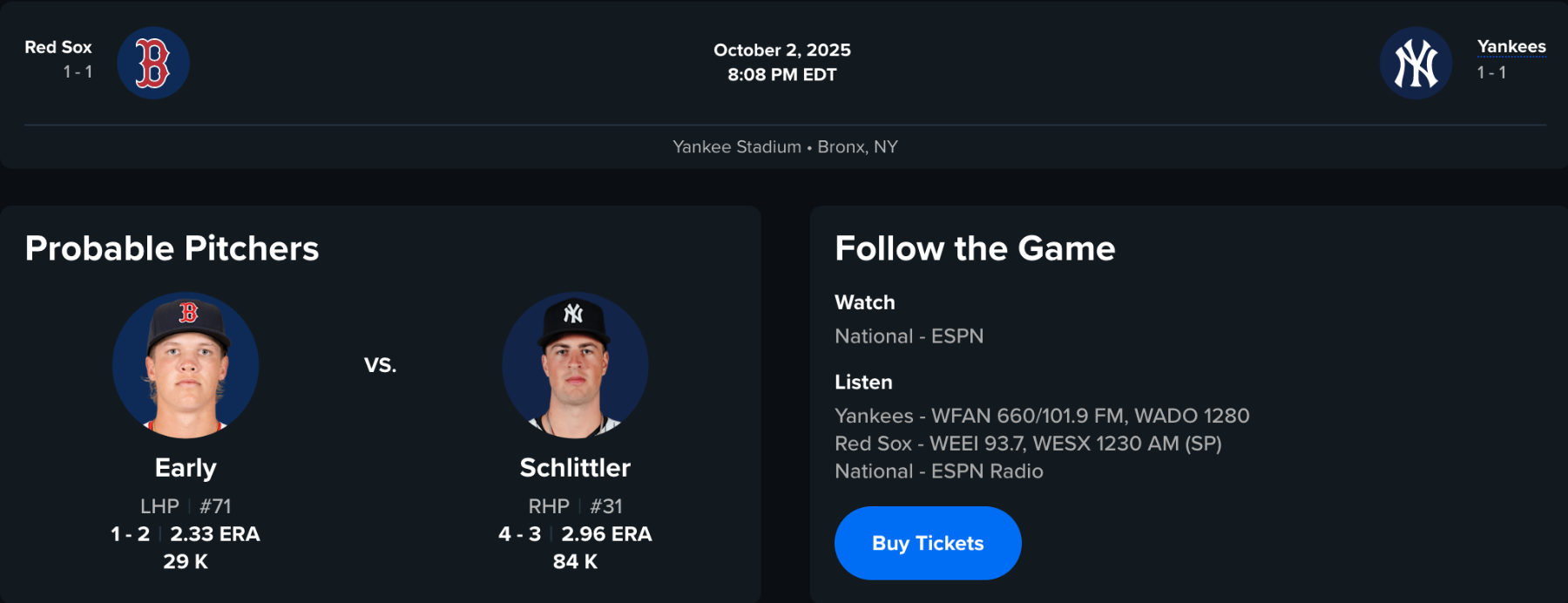
By virtue of an otherworldly start from Garrett Crochet and a subsequently disappointing one from Brayan Bello, the Boston Red Sox and New York Yankees find themselves in a sudden death situation heading into Game 3 of the Wild Card Round. The biggest rivals in baseball will counter each other with rookie starting pitchers, a rather foreboding premise given the stakes at hand. Cam Schlittler will trot out to the mound for New York, while Connelly Early will take the ball for Boston. You can be sure Aaron Boone and Alex Cora will tighten their leashes to the maximum setting; don't be surprised if the bullpens start showing signs of activity the moment the first pitch is thrown. This is normally the point I'd start throwing reams of numbers at you. There's plenty to discuss, from Schlittler's hot streak (2.23 ERA in his final nine starts) to Early's impressive debut (2.33 ERA in September), but the truth is, once the game gets going, you have to throw all of that out. This is a winner-take-all situation; the abstract "intangibles" and leadership that people spend so much time overanalyzing are now set to have their time in the sun. The Sox had the Yanks' number this year, winning the season series 9-4 and taking five of the seven regular season contests in Yankee Stadium. Does that matter now? It's hard to say, especially since a lot of this Yankees team went on a World Series run just last year, and a lot of this Red Sox team hadn't played in the postseason before Tuesday. Does the "championship DNA" inside Alex Bregman, Nathaniel Lowe, Aroldis Chapman, and Alex Cora trump the longstanding October failures of Aaron Boone and Aaron Judge? Does Giancarlo Stanton's penchant for producing in prime moments rear its head in Game 3? Can the rookie starters possibly answer the call and deliver the performance of their lives? It all feels so odd to ask, given that this is just the Wild Card Round. After all, the winner of this game needs to take on the top-seeded Toronto Blue Jays in a best-of-five series, and then they'd need to topple the Seattle Mariners (or the winner of the Cleveland Guardians and Detroit Tigers' own Game 3) in the ALCS just for the right to play in the World Series. The 2025 postseason is still so young, and "Game 3" doesn't have quite the same cachet or roll-off-the-tongue bravado of "Game 7". Even if the Red Sox come out on top, there's nothing -- other than good old Uncle Mo' -- that can possibly guarantee a deeper run into October. Of course, that isn't to say this is for pride. The whole point of the postseason is just to make it to the dance; you never know what can happen once you get there. This iteration of the Red Sox is far from the best on-paper team in the playoffs, and it's almost certainly going to be the weakest version of the roster for years to come. Failure can be learned from, and there's no shame in losing to the reigning AL pennant winners, especially when your nominal Game 3 starter is out indefinitely with an elbow strain. But this is the playoffs, damnit. The Red Sox earned their right to be here, and they've got one more crack at making a lot of New Yorkers really, really angry for the next six months. Connelly Early might not have been anyone's first choice to start a sudden death game in October, but neither was Cam Schlittler. This is all hands on deck. Rookie starting pitchers, taxed bullpens, injured lineups—all of it is in search of the only thing that truly matters in sports: winning. For three glorious hours tonight, the oldest rivalry in America's Pastime will participate in a de facto Game 7 for the right to go to Canada. That might not be how anyone drew it up, but things rarely go to plan in baseball. All the Red Sox can do now is win this game. View full article
-
Rookies and Red Sox and Yankees, Oh My! Welcome to Sudden Death Baseball
Brandon Glick posted an article in Red Sox
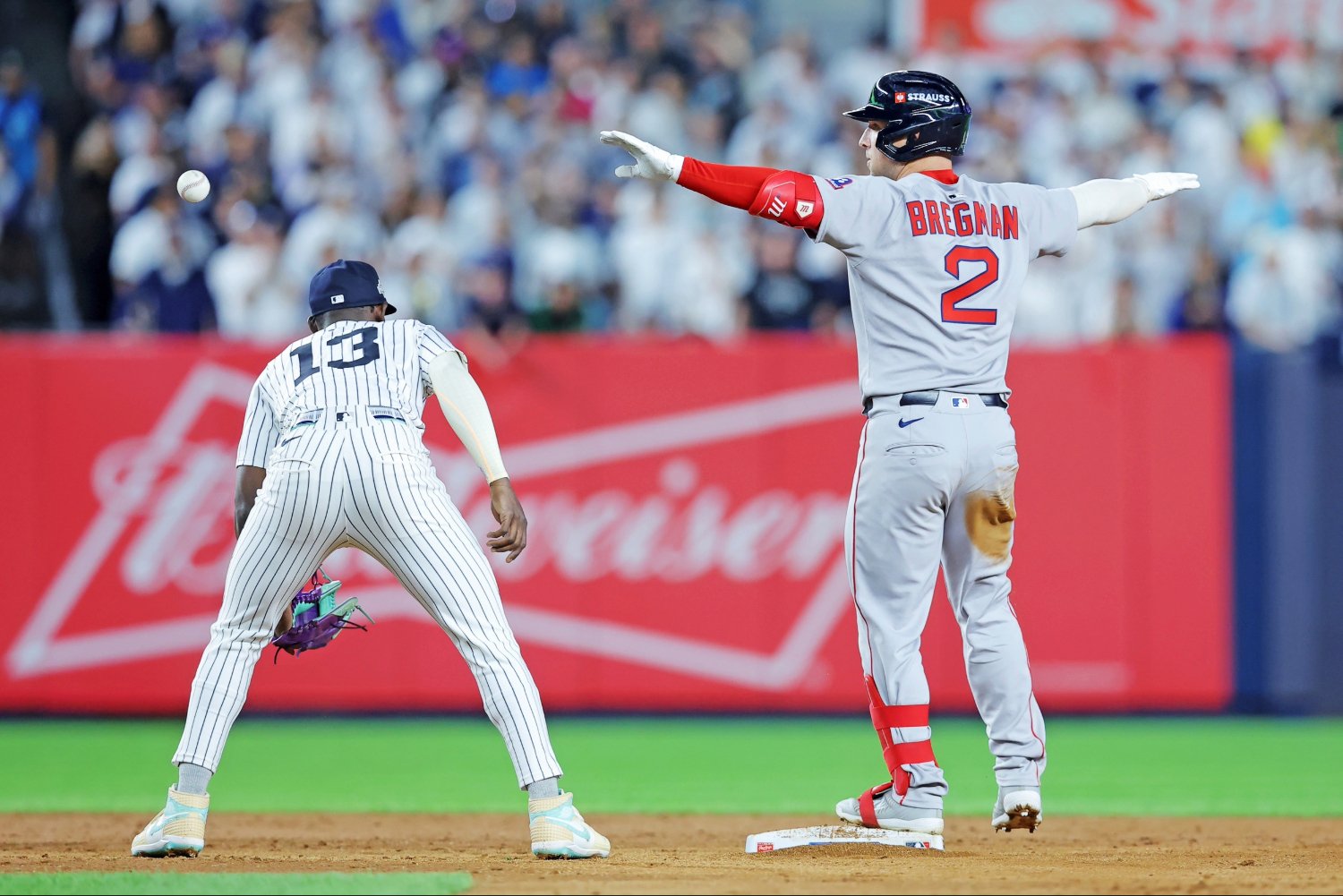 By virtue of an otherworldly start from Garrett Crochet and a subsequently disappointing one from Brayan Bello, the Boston Red Sox and New York Yankees find themselves in a sudden death situation heading into Game 3 of the Wild Card Round. The biggest rivals in baseball will counter each other with rookie starting pitchers, a rather foreboding premise given the stakes at hand. Cam Schlittler will trot out to the mound for New York, while Connelly Early will take the ball for Boston. You can be sure Aaron Boone and Alex Cora will tighten their leashes to the maximum setting; don't be surprised if the bullpens start showing signs of activity the moment the first pitch is thrown. This is normally the point I'd start throwing reams of numbers at you. There's plenty to discuss, from Schlittler's hot streak (2.23 ERA in his final nine starts) to Early's impressive debut (2.33 ERA in September), but the truth is, once the game gets going, you have to throw all of that out. This is a winner-take-all situation; the abstract "intangibles" and leadership that people spend so much time overanalyzing are now set to have their time in the sun. The Sox had the Yanks' number this year, winning the season series 9-4 and taking five of the seven regular season contests in Yankee Stadium. Does that matter now? It's hard to say, especially since a lot of this Yankees team went on a World Series run just last year, and a lot of this Red Sox team hadn't played in the postseason before Tuesday. Does the "championship DNA" inside Alex Bregman, Nathaniel Lowe, Aroldis Chapman, and Alex Cora trump the longstanding October failures of Aaron Boone and Aaron Judge? Does Giancarlo Stanton's penchant for producing in prime moments rear its head in Game 3? Can the rookie starters possibly answer the call and deliver the performance of their lives? It all feels so odd to ask, given that this is just the Wild Card Round. After all, the winner of this game needs to take on the top-seeded Toronto Blue Jays in a best-of-five series, and then they'd need to topple the Seattle Mariners (or the winner of the Cleveland Guardians and Detroit Tigers' own Game 3) in the ALCS just for the right to play in the World Series. The 2025 postseason is still so young, and "Game 3" doesn't have quite the same cachet or roll-off-the-tongue bravado of "Game 7". Even if the Red Sox come out on top, there's nothing -- other than good old Uncle Mo' -- that can possibly guarantee a deeper run into October. Of course, that isn't to say this is for pride. The whole point of the postseason is just to make it to the dance; you never know what can happen once you get there. This iteration of the Red Sox is far from the best on-paper team in the playoffs, and it's almost certainly going to be the weakest version of the roster for years to come. Failure can be learned from, and there's no shame in losing to the reigning AL pennant winners, especially when your nominal Game 3 starter is out indefinitely with an elbow strain. But this is the playoffs, damnit. The Red Sox earned their right to be here, and they've got one more crack at making a lot of New Yorkers really, really angry for the next six months. Connelly Early might not have been anyone's first choice to start a sudden death game in October, but neither was Cam Schlittler. This is all hands on deck. Rookie starting pitchers, taxed bullpens, injured lineups—all of it is in search of the only thing that truly matters in sports: winning. For three glorious hours tonight, the oldest rivalry in America's Pastime will participate in a de facto Game 7 for the right to go to Canada. That might not be how anyone drew it up, but things rarely go to plan in baseball. All the Red Sox can do now is win this game.
 -
Well folks, this is it. The Red Sox or the Yankees' season ends tonight. I know who I'm rooting for.
-
An early home run got Brayan Bello off his groove, and the Red Sox dropped a heartbreaker to the Yankees in Game 2. Now, Connelly Early must step up and save the season. View full video
-
An early home run got Brayan Bello off his groove, and the Red Sox dropped a heartbreaker to the Yankees in Game 2. Now, Connelly Early must step up and save the season.
-
After three obscenely mind-numbing hours of watching the Cubs flail helplessly, I could really use a calm win from the Sox right about now
-
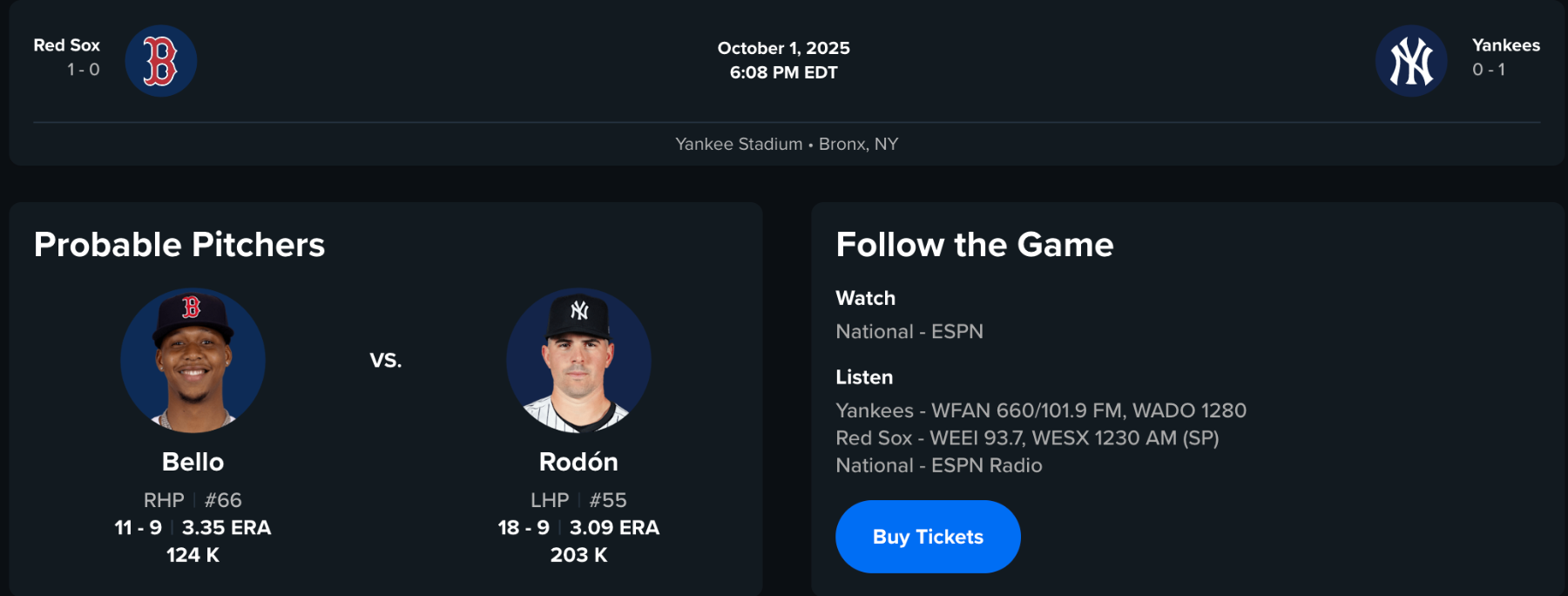
Garrett Crochet just did Brayan Bello the biggest favor imaginable. By firing off nearly eight innings of one-run ball in Game 1 of the Wild Card Round, Crochet handed the ball directly to closer Aroldis Chapman, thereby saving the bullets of every other member of the bullpen. The cavalry is ready to arrive in relief of Bello, meaning the fourth-year starter can empty the tank without any worry of working his way terribly deep into the game. With the New York Yankees' backs pinned against the proverbial wall, you can be sure that their stars will show up ready to play in Game 2. This is a team that made the World series just last year, after all. Paul Goldschmidt (2-for-4), Aaron Judge (2-for-4), Anthony Volpe (2-for-3) and Cody Bellinger (1-for-4) combined for seven hits in 15 at-bats against the Red Sox's best pitchers in Game 1, and it'd be wise to expect that someone else in the lineup will show up in Game 2. However, this is a moment Bello is ready for. In his 11 career starts against the Yankees, Bello has gone 65.0 innings while recording a sterling 2.35 ERA and 53 strikeouts. Notably, he's never allowed a home run in Yankee Stadium in the 31 1/3 frames he's completed there. In his first two starts against the Bronx Bombers in 2025, he was infallible—he completed seven shutout innings both times while racking up 13 combined strikeouts against just six hits and four walks. The Yankees got to him on his Sept. 13 start, with Jazz Chisholm notching three hits and three RBIs off him as Bello got knocked out after five innings and four runs allowed. That's actually a continuation of an odd trend that Bello is facing going into tonight. Against the Yankees' twin sluggers, Judge and Giancarlo Stanton, Bello has been dominant; Judge is batting .095/.296/.143 in 27 plate appearances, while Stanton is at a meager .200/.333/.200 in 12 PAs. On the opposite end of things, Bellinger (1.417 OPS in 12 PAs), Volpe (.941 OPS in 17 PAs), and Chisholm (.945 OPS in 17 PAs) have all had Bello's number. To ensure this series doesn't go to a Game 3 and fall into the lap of rookie Connelly Early, Bello will have to extend his dominance to the entirety of the Yankees' lineup. The good news is Bello has actually been better on the road in 2025. His ERA is about half a run less away from Fenway Park, and opponents have an OPS 33 points lower than they do when they face Bello in Boston. Yankee Stadium is no pitcher's haven, but he shouldn't suffer too much from the short porch in right field. Notably, the 26-year-old is sort of a throwback pitcher, at least in the sense that he improves as his workload increases. Opposing batters' OPS versus Brayan Bello: 1st time through order: .774 2nd time through order: .597 3rd time through order: .617 That's going to give Alex Cora some interesting decisions to make as the game progresses. The bullpen is fresh, meaning Bello shouldn't hold anything back in the early innings. But, his proclivity for settling in could extend his leash, especially if fears of the need for a Game 3 start to set in. No matter what happens, this is the biggest start of Bello's career. It's the first time the Red Sox have made the playoffs since he debuted in 2022, and pitching against your biggest rival on the road under the bright lights of October has a quick way of sorting out who is made for the big moments and who isn't. If there's ever been a chance for Bello to earn his spot as the No. 2 behind Crochet, it's right now. View full article
-
 Garrett Crochet just did Brayan Bello the biggest favor imaginable. By firing off nearly eight innings of one-run ball in Game 1 of the Wild Card Round, Crochet handed the ball directly to closer Aroldis Chapman, thereby saving the bullets of every other member of the bullpen. The cavalry is ready to arrive in relief of Bello, meaning the fourth-year starter can empty the tank without any worry of working his way terribly deep into the game. With the New York Yankees' backs pinned against the proverbial wall, you can be sure that their stars will show up ready to play in Game 2. This is a team that made the World series just last year, after all. Paul Goldschmidt (2-for-4), Aaron Judge (2-for-4), Anthony Volpe (2-for-3) and Cody Bellinger (1-for-4) combined for seven hits in 15 at-bats against the Red Sox's best pitchers in Game 1, and it'd be wise to expect that someone else in the lineup will show up in Game 2. However, this is a moment Bello is ready for. In his 11 career starts against the Yankees, Bello has gone 65.0 innings while recording a sterling 2.35 ERA and 53 strikeouts. Notably, he's never allowed a home run in Yankee Stadium in the 31 1/3 frames he's completed there. In his first two starts against the Bronx Bombers in 2025, he was infallible—he completed seven shutout innings both times while racking up 13 combined strikeouts against just six hits and four walks. The Yankees got to him on his Sept. 13 start, with Jazz Chisholm notching three hits and three RBIs off him as Bello got knocked out after five innings and four runs allowed. That's actually a continuation of an odd trend that Bello is facing going into tonight. Against the Yankees' twin sluggers, Judge and Giancarlo Stanton, Bello has been dominant; Judge is batting .095/.296/.143 in 27 plate appearances, while Stanton is at a meager .200/.333/.200 in 12 PAs. On the opposite end of things, Bellinger (1.417 OPS in 12 PAs), Volpe (.941 OPS in 17 PAs), and Chisholm (.945 OPS in 17 PAs) have all had Bello's number. To ensure this series doesn't go to a Game 3 and fall into the lap of rookie Connelly Early, Bello will have to extend his dominance to the entirety of the Yankees' lineup. The good news is Bello has actually been better on the road in 2025. His ERA is about half a run less away from Fenway Park, and opponents have an OPS 33 points lower than they do when they face Bello in Boston. Yankee Stadium is no pitcher's haven, but he shouldn't suffer too much from the short porch in right field. Notably, the 26-year-old is sort of a throwback pitcher, at least in the sense that he improves as his workload increases. Opposing batters' OPS versus Brayan Bello: 1st time through order: .774 2nd time through order: .597 3rd time through order: .617 That's going to give Alex Cora some interesting decisions to make as the game progresses. The bullpen is fresh, meaning Bello shouldn't hold anything back in the early innings. But, his proclivity for settling in could extend his leash, especially if fears of the need for a Game 3 start to set in. No matter what happens, this is the biggest start of Bello's career. It's the first time the Red Sox have made the playoffs since he debuted in 2022, and pitching against your biggest rival on the road under the bright lights of October has a quick way of sorting out who is made for the big moments and who isn't. If there's ever been a chance for Bello to earn his spot as the No. 2 behind Crochet, it's right now.
 -
We've officially made it to October, and with a 1-0 lead to boot. Brayan Bello, time to earn your place in Red Sox lore. Bryan Bello vs Yankees Roster Brayan Bello vs. New York Yankees: Current Batters Table Rk Player B PA AB H 2B 3B HR RBI BB SO BA OBP SLG OPS SH SF IBB HBP GIDP 1 Aaron Judge R 27 21 2 1 0 0 0 6 8 .095 .296 .143 .439 0 0 0 0 1 2 Jazz Chisholm Jr. L 17 15 5 0 0 1 3 2 3 .333 .412 .533 .945 0 0 0 0 0 3 Anthony Volpe R 17 17 6 1 0 1 1 0 2 .353 .353 .588 .941 0 0 0 0 1 4 Cody Bellinger L 12 10 4 0 0 2 3 1 2 .400 .417 1.000 1.417 0 1 0 0 0 5 Giancarlo Stanton R 12 10 2 0 0 0 0 2 7 .200 .333 .200 .533 0 0 0 0 0 6 Trent Grisham L 11 9 3 2 0 0 1 1 1 .333 .455 .556 1.010 0 0 0 1 0 7 Ben Rice L 11 11 3 1 0 0 0 0 2 .273 .273 .364 .636 0 0 0 0 1 8 José Caballero R 10 9 4 0 0 0 3 1 3 .444 .500 .444 .944 0 0 0 0 0 9 Jasson Domínguez B 10 8 0 0 0 0 0 2 2 .000 .200 .000 .200 0 0 0 0 0 10 Ryan McMahon L 8 8 0 0 0 0 0 0 5 .000 .000 .000 .000 0 0 0 0 0 11 Austin Wells L 8 8 1 0 0 0 0 0 3 .125 .125 .125 .250 0 0 0 0 0 12 J.C. Escarra L 3 2 0 0 0 0 0 1 1 .000 .333 .000 .333 0 0 0 0 0 13 Paul Goldschmidt R 3 3 1 0 0 0 1 0 1 .333 .333 .333 .667 0 0 0 0 0 14 Amed Rosario R 3 3 0 0 0 0 0 0 1 .000 .000 .000 .000 0 0 0 0 1 Provided by Stathead.com: Found with Stathead. See Full Results. Generated 10/1/2025. Carlos Rodon vs Red Sox Roster Carlos Rodón vs. Boston Red Sox: Current Batters Table Rk Player B PA AB H 2B 3B HR RBI BB SO BA OBP SLG OPS SH SF IBB HBP GIDP 1 Rob Refsnyder R 21 17 6 3 0 1 1 4 3 .353 .476 .706 1.182 0 0 0 0 0 2 Alex Bregman R 19 16 4 1 0 0 1 3 1 .250 .368 .313 .681 0 0 0 0 0 3 Jarren Duran L 17 16 2 1 0 0 0 1 5 .125 .176 .188 .364 0 0 0 0 0 4 Ceddanne Rafaela R 15 14 3 0 0 1 1 1 3 .214 .267 .429 .695 0 0 0 0 0 5 Romy González R 14 13 1 1 0 0 1 1 1 .077 .143 .154 .297 0 0 0 0 1 6 Trevor Story R 12 10 2 2 0 0 1 1 4 .200 .333 .400 .733 0 0 0 1 0 7 Connor Wong R 11 10 4 1 0 1 2 1 1 .400 .455 .800 1.255 0 0 0 0 0 8 Carlos Narváez R 8 6 3 1 0 1 3 2 2 .500 .625 1.167 1.792 0 0 0 0 1 9 Masataka Yoshida L 6 6 1 0 0 0 0 0 0 .167 .167 .167 .333 0 0 0 0 0 10 Nathaniel Lowe L 5 3 0 0 0 0 0 2 2 .000 .400 .000 .400 0 0 0 0 0 11 Nate Eaton R 2 2 0 0 0 0 0 0 0 .000 .000 .000 .000 0 0 0 0 0 Provided by Stathead.com: Found with Stathead. See Full Results. Generated 10/1/2025.
-
Garrett Crochet, Masataka Yoshida, and Aroldis Chapman played hero in Game 1 of the Wild Card Round, giving the Red Sox a tactical edge over the Yankees heading into Game 2.
-
Garrett Crochet, Masataka Yoshida, and Aroldis Chapman played hero in Game 1 of the Wild Card Round, giving the Red Sox a tactical edge over the Yankees heading into Game 2. View full video
-
I need the Secret Council of Italians to recall Anthony Volpe to their HQ immediately
-
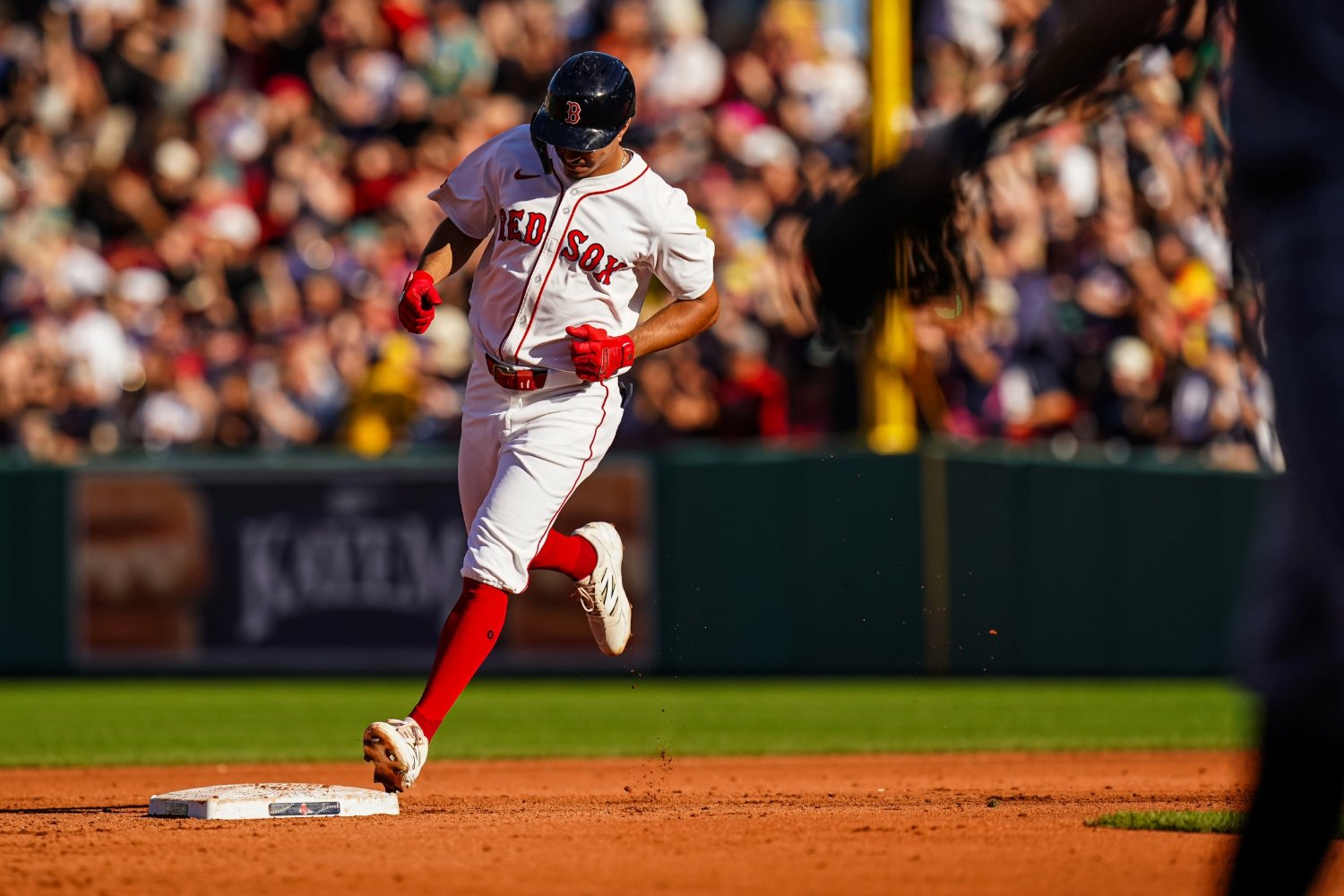
Sometimes when playoff rosters are announced, there's a surprise or two that gets the fans buzzing. The Red Sox have opened no such door for us this time around. Their Wild Card Round roster was just announced prior to Game 1 against the New York Yankees, and it's gone to chalk. PITCHERS (12): Brayan Bello, Aroldis Chapman, Garrett Crochet, Connelly Early, Kyle Harrison, Zack Kelly, Steven Matz, Justin Slaten, Payton Tolle, Greg Weissert, Garrett Whitlock, Justin Wilson CATCHERS (2): Carlos Narváez, Connor Wong INFIELDERS (4): Alex Bregman, David Hamilton, Nathaniel Lowe, Trevor Story OUTFIELDERS (4): Wilyer Abreu, Jarren Duran, Rob Refsnyder, Masataka Yoshida INFIELDER/OUTFIELDERS (4): Nate Eaton, Romy Gonzalez, Ceddanne Rafaela, Nick Sogard The big name missing is Lucas Giolito, though it was already previously announced that he'd miss the series with an elbow issue. The fallout will be if a Game 3 is necessary, as the Red Sox will need to figure out who will start that contest. What do you think of the Red Sox's playoff roster? Are you surprised by any decisions made by Alex Cora and the front office? View full rumor
-
 Sometimes when playoff rosters are announced, there's a surprise or two that gets the fans buzzing. The Red Sox have opened no such door for us this time around. Their Wild Card Round roster was just announced prior to Game 1 against the New York Yankees, and it's gone to chalk. PITCHERS (12): Brayan Bello, Aroldis Chapman, Garrett Crochet, Connelly Early, Kyle Harrison, Zack Kelly, Steven Matz, Justin Slaten, Payton Tolle, Greg Weissert, Garrett Whitlock, Justin Wilson CATCHERS (2): Carlos Narváez, Connor Wong INFIELDERS (4): Alex Bregman, David Hamilton, Nathaniel Lowe, Trevor Story OUTFIELDERS (4): Wilyer Abreu, Jarren Duran, Rob Refsnyder, Masataka Yoshida INFIELDER/OUTFIELDERS (4): Nate Eaton, Romy Gonzalez, Ceddanne Rafaela, Nick Sogard The big name missing is Lucas Giolito, though it was already previously announced that he'd miss the series with an elbow issue. The fallout will be if a Game 3 is necessary, as the Red Sox will need to figure out who will start that contest. What do you think of the Red Sox's playoff roster? Are you surprised by any decisions made by Alex Cora and the front office?
 -
For the first time in four years, the playoffs tomorrow will include the Sox. How ya feeling? Can Crochet-Bello wrap this thing up in two? Is Aroldis Chapman gonna lock down a four-inning save just to piss off all Yankees fans everywhere?
-
There's a ton on the line today: With a Red Sox win: Sox clinch No. 5 seed, Guardians clinch Central, Tigers clinch No. 6 seed With a Red Sox loss: Sox clinch No. 6 seed, Tigers clinch No. 5 seed (with Guardians win) or Tigers clinch Central (with Guardians loss)

-
The Red Sox have made the playoffs for the first time since 2021, setting up a first-round clash with a divisional rival. View full video
-
The Red Sox have made the playoffs for the first time since 2021, setting up a first-round clash with a divisional rival.
-
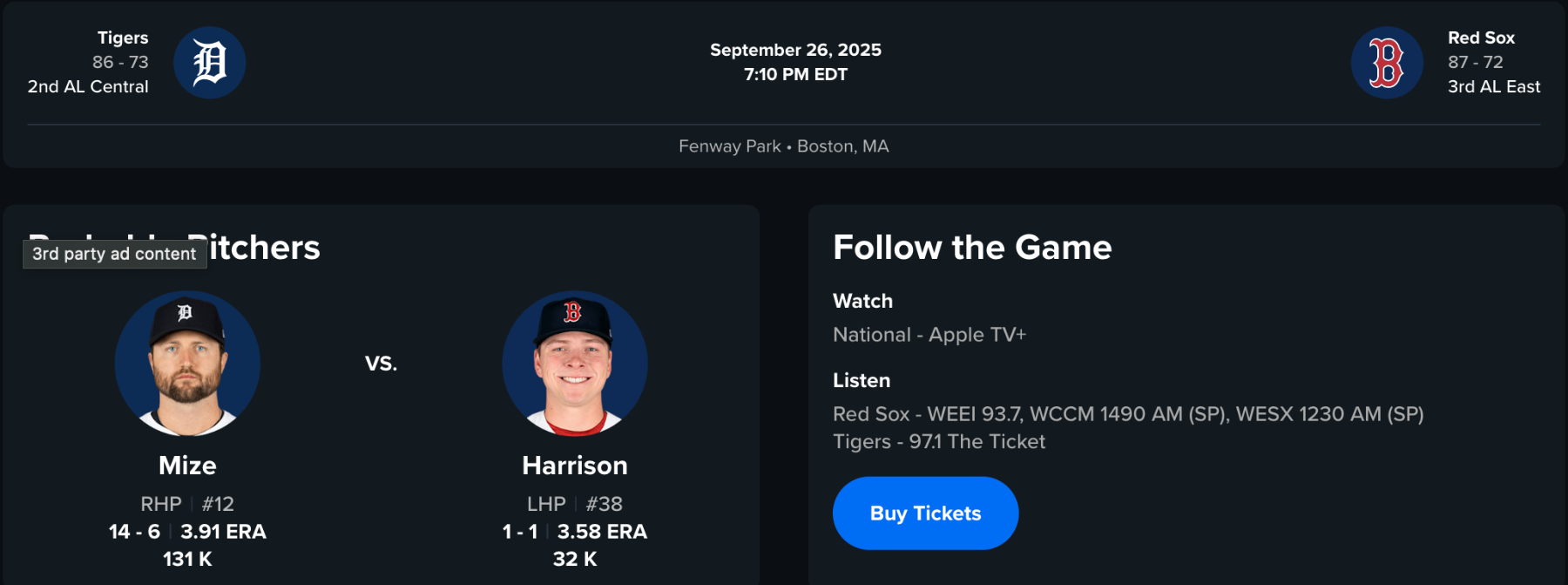
This series matters for playoff seeding; the Red Sox's magic number remains at one, with the Tigers currently occupying the No. 6 seed behind them. Of course, Detroit is in absolute free fall over the last few weeks. Because the Tigers swept them earlier in the year, the Sox need to win two of three to lock in the No. 5 seed.
-
With the fifth seed practically in hand, which division rival do the Red Sox match up better with in the Wild Card Round: the Blue Jays or the Yankees? View full video
-
With the fifth seed practically in hand, which division rival do the Red Sox match up better with in the Wild Card Round: the Blue Jays or the Yankees?
-
By virtue of their 4-2 head-to-head record over the Astros this year, the Red Sox's magic number is down to 1! Clinch day!

-
Garrett Crochet makes his final start of the regular season tonight against the Toronto Blue Jays, and there are some... odd implications to consider. If the Boston Red Sox do win, they could propel the New York Yankees into first place in the AL East, which would mean they'd have to travel back to Toronto for their expected No. 4 vs. No. 5 Wild Card Round matchup. If they lose, though, they could be leapfrogged by the Detroit Tigers or Cleveland Guardians for the No. 5 seed, meaning they'd have to travel to face whichever of those two teams wins the AL Central in the first round of the playoffs. Of course, the whole point right now is just to win as many as possible. Make the dance first, and worry about the opponent later. With Crochet on the mound, it feels like a pretty safe bet that the Red Sox will come out victorious tonight, just as they have in each of his last six starts. Except, Crochet hasn't been the same wholly dominant force he was earlier in the season. In his four September starts, he's rocking a 4.68 ERA over 25.0 innings, courtesy of the .221/.253/.505 batting line he's allowed to opposing hitters. For the first time all season, the southpaw is surrendering a wOBA over .300 this month (.320), mostly due to the fact that he's allowed one-third of his season total of home runs since September began. Now, calling him "mortal" is a relative term; most of the damage done to Crochet came during a seven-run outing against the white-hot Cleveland Guardians on Sept. 2. He followed that up with seven shutout innings against the Athletics, and then back-to-back quality starts against the Yankees and Rays. If he fires off another one against the Blue Jays tonight, he'll be up to a team-leading 22 on the year. However, for as great as he's been, Crochet has been susceptible to a blow-up outing here or there. He's allowed five or more earned runs in a start four times, all of which have come since June began. Funnily enough, the Red Sox have won three of those games, but that kind of run support isn't a guarantee in October (especially without Roman Anthony). In a prospective Wild Card Round matchup with the New York Yankees and Max Fried, Crochet needs to resemble his first-half self. Garrett Crochet (1st Half): 2.23 ERA, .210/.262/.310. 14 home runs, 31.2% strikeout rate, 6.6% walk rate, 2.46 FIP Garrett Crochet (September): 4.68 ERA, .221/.253/.505, eight home runs, 35.4% strikeout rate, 4.0% walk rate, 4.99 FIP Again, it's the home runs that stand out. Three of his four outings this month have yielded multi-home-run efforts by opposing lineups, including four by the Guardians in that aforementioned disaster. Most importantly, six of those eight home runs came at home, continuing an ugly tend for Crochet this season. Garrett Crochet HR/9 allowed at Fenway Park: 1.51 Garrett Crochet HR/9 allowed at all other stadiums: 0.75 Yes, he's allowing literally double the amount of home runs at home as he is on the road this season. That's part of the nature of being a left-handed pitcher at Fenway Park—right-handed batters have hit 13 home runs against Crochet in 295 plate appearances at Fenway, compared to just eight home runs in 345 plate appearances on the road. The Green Monster giveth, and the Green Monster taketh away. The good(?) news on this front is that, like his start in Toronto tonight, Crochet won't be pitching at home in the playoffs. At least not in the early rounds, anyway. He'll certainly pitch in Game 1 of the Wild Card Round, and then (should the Red Sox advance) in Game 1 and Game 5 in the ALDS. All of those starts, should they be necessary, would be on the road by virtue of the Red Sox holding the No. 5 seed. Considering that Crochet's ERA is 0.60 lower outside of Fenway (2.42 on the road, 3.02 at home), that's probably a boon for Boston. There's plenty of reasons for this statistical oddity -- a cutter-sweeper-heavy arsenal that runs inside on right-handed batters naturally induces more pulled balls to left field -- but it's too late in the season to introduce any "fixes". Crochet is under contract for a while; there's plenty of time for him to figure out how to pitch more effectively around the odd dimensions of Fenway. For now, Alex Cora and company have done the right thing by lining up his starts to take place outside of Boston. As for tonight's appearance, it's important that Crochet tangibly tries something to limit damage via the long ball. This is his final tune-up before his first-ever playoff start. Seeing as he remains elite in most other aspects of pitching (even during this relative slump), figuring out that one weak point could restore him to the impervious force he was earlier in the season. View full article
-
 Garrett Crochet makes his final start of the regular season tonight against the Toronto Blue Jays, and there are some... odd implications to consider. If the Boston Red Sox do win, they could propel the New York Yankees into first place in the AL East, which would mean they'd have to travel back to Toronto for their expected No. 4 vs. No. 5 Wild Card Round matchup. If they lose, though, they could be leapfrogged by the Detroit Tigers or Cleveland Guardians for the No. 5 seed, meaning they'd have to travel to face whichever of those two teams wins the AL Central in the first round of the playoffs. Of course, the whole point right now is just to win as many as possible. Make the dance first, and worry about the opponent later. With Crochet on the mound, it feels like a pretty safe bet that the Red Sox will come out victorious tonight, just as they have in each of his last six starts. Except, Crochet hasn't been the same wholly dominant force he was earlier in the season. In his four September starts, he's rocking a 4.68 ERA over 25.0 innings, courtesy of the .221/.253/.505 batting line he's allowed to opposing hitters. For the first time all season, the southpaw is surrendering a wOBA over .300 this month (.320), mostly due to the fact that he's allowed one-third of his season total of home runs since September began. Now, calling him "mortal" is a relative term; most of the damage done to Crochet came during a seven-run outing against the white-hot Cleveland Guardians on Sept. 2. He followed that up with seven shutout innings against the Athletics, and then back-to-back quality starts against the Yankees and Rays. If he fires off another one against the Blue Jays tonight, he'll be up to a team-leading 22 on the year. However, for as great as he's been, Crochet has been susceptible to a blow-up outing here or there. He's allowed five or more earned runs in a start four times, all of which have come since June began. Funnily enough, the Red Sox have won three of those games, but that kind of run support isn't a guarantee in October (especially without Roman Anthony). In a prospective Wild Card Round matchup with the New York Yankees and Max Fried, Crochet needs to resemble his first-half self. Garrett Crochet (1st Half): 2.23 ERA, .210/.262/.310. 14 home runs, 31.2% strikeout rate, 6.6% walk rate, 2.46 FIP Garrett Crochet (September): 4.68 ERA, .221/.253/.505, eight home runs, 35.4% strikeout rate, 4.0% walk rate, 4.99 FIP Again, it's the home runs that stand out. Three of his four outings this month have yielded multi-home-run efforts by opposing lineups, including four by the Guardians in that aforementioned disaster. Most importantly, six of those eight home runs came at home, continuing an ugly tend for Crochet this season. Garrett Crochet HR/9 allowed at Fenway Park: 1.51 Garrett Crochet HR/9 allowed at all other stadiums: 0.75 Yes, he's allowing literally double the amount of home runs at home as he is on the road this season. That's part of the nature of being a left-handed pitcher at Fenway Park—right-handed batters have hit 13 home runs against Crochet in 295 plate appearances at Fenway, compared to just eight home runs in 345 plate appearances on the road. The Green Monster giveth, and the Green Monster taketh away. The good(?) news on this front is that, like his start in Toronto tonight, Crochet won't be pitching at home in the playoffs. At least not in the early rounds, anyway. He'll certainly pitch in Game 1 of the Wild Card Round, and then (should the Red Sox advance) in Game 1 and Game 5 in the ALDS. All of those starts, should they be necessary, would be on the road by virtue of the Red Sox holding the No. 5 seed. Considering that Crochet's ERA is 0.60 lower outside of Fenway (2.42 on the road, 3.02 at home), that's probably a boon for Boston. There's plenty of reasons for this statistical oddity -- a cutter-sweeper-heavy arsenal that runs inside on right-handed batters naturally induces more pulled balls to left field -- but it's too late in the season to introduce any "fixes". Crochet is under contract for a while; there's plenty of time for him to figure out how to pitch more effectively around the odd dimensions of Fenway. For now, Alex Cora and company have done the right thing by lining up his starts to take place outside of Boston. As for tonight's appearance, it's important that Crochet tangibly tries something to limit damage via the long ball. This is his final tune-up before his first-ever playoff start. Seeing as he remains elite in most other aspects of pitching (even during this relative slump), figuring out that one weak point could restore him to the impervious force he was earlier in the season.


