


Red Sox Video
However you feel about the Rafael Devers saga and who is at fault, there is no getting around the massive hole he leaves in the lineup.
In each of the Red Sox’s first 73 games this season, Alex Cora has slotted Devers into the second slot in the lineup, and after a historically awful start, Devers has been one of the best hitters in baseball. Though he is in the midst of a 14-for-74 stretch that coincided with not having Alex Bregman batting behind him, Devers still ranks third in MLB in RBIs while placing seventh in OBP and 12th in OPS.
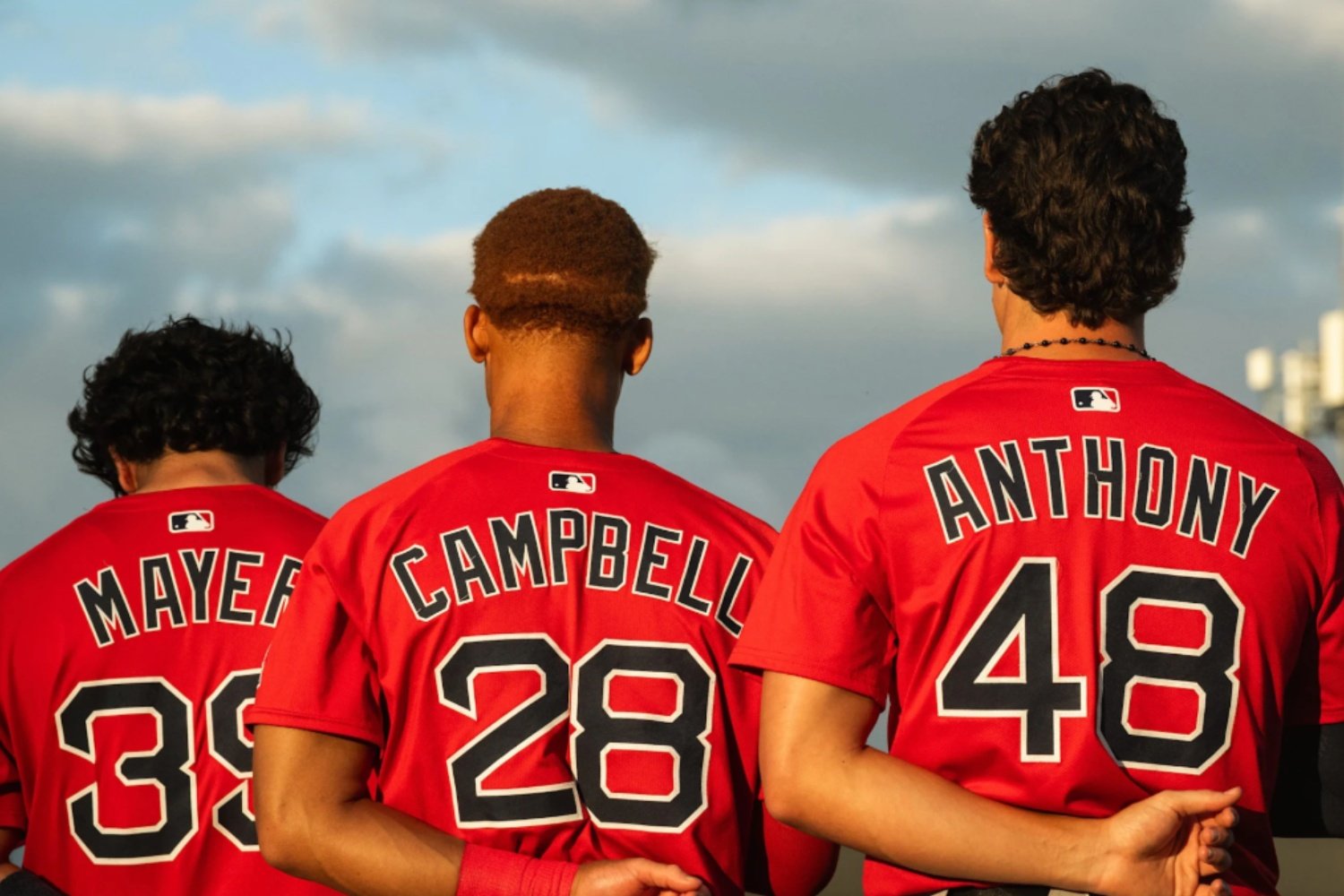
Simply put, there is nobody in the Red Sox lineup that is capable of replicating Devers' combination of power and patience — at least not yet. The trade of Devers thrusts the Red Sox's “Big 3” farther into the spotlight, something the organization explicitly said they didn’t want to do. While Roman Anthony, Marcelo Mayer, and Kristian Campbell (once he returns from the minors) will be given clear runway to everyday at-bats, they do so with the pressure of having to propel a weak supporting cast. The lineup was already thin when Devers was still here, and now it is downright abysmal.
Unsurprisingly, the Red Sox scored just five runs in the Mariners series after dealing Devers (though they did win two games). However, there is a pathway for the Red Sox to remain at least a top-10 offense for the rest of the season. Here are four things that could help the Red Sox survive the departure of Devers.
1. The kids need to grow up fast
The only hope the Red Sox have lies in their collection of 24-and-under youngsters. The Red Sox are going to give Ceddanne Rafaela, Roman Anthony, Kristian Campbell and Marcelo Mayer free runway to play every day at the big-league level, and how quickly they turn their raw talent into on-field production will likely be the difference between the Red Sox staying in the race and their fourth straight postseason miss.
The Red Sox can only hope that the Big 3 learns as quickly as Rafaela, who, despite a chase rate still over 43%, has taken strides in every facet of his offensive game:
Walk Rate
- 2024: 2.6% (1st percentile)
- 2025: 5.4% (19th percentile)
Strikeout Rate
- 2024: 26.4 % (22nd percentile)
- 2025: 21.2% (54th percentile)
Whiff Rate
- 2024: 33% (9th percentile)
- 2025: 27.6% (30th percentile)
Average Exit Velocity
- 2024: 86.6 mph (12th percentile)
- 2025: 90.4 mph (56th percentile)
Hard Hit Percentage
- 2024: 36.9% (31st percentile)
- 2025: 44.9% (59th percentile)
While there is still a lot of work to do, Rafaela is no longer the automatic out he was during long stretches of the 2024 season. He now looks like an average offensive performer which, along with his platinum-level glove, makes him an extremely valuable player. The same cannot be said about Campbell, who has not only been one of the worst defenders in baseball at -8 Outs Above Average, but has been among the worst hitters as well. Since April 30, Campbell has posted a dismal .157/.241/.220 slash line as pitchers have attacked his glaring weaknesses. The 22-year-old has been overmatched by off-speed pitches (.160 batting average, 45% whiff rate) and breaking pitches (.181 batting average, 35.6% whiff rate) while getting tormented by inside sinkers.
During his meteoric prospect rise that earned 2024 Minor League Hitter of the Year, Campbell was lauded for his ability to drive the ball to the opposite field with authority, but it is becoming clear that what was working for him in the minor leagues isn’t working in the majors. Among 250 qualified hitters, Campbell has the second-highest opposite field ground ball rate and 12th-highest overall ground ball rate while ranking in the bottom 10% in both pull and pull air percentage. What’s worse is the fact that Campbell has not shown any signs of making an adjustment, as his last pull-side extra-base hit came on April 16.
The good news for Campbell and the Red Sox is that, even in the midst of a prolonged struggle period, his swing decisions are still well above-average and borderline elite for a rookie. His 11.2% walk rate ranks in the 75th percentile while his 23.4% chase percentage is in the 77th percentile. Unlike many young players, Campbell’s problem isn’t with selectivity but rather doing damage with the pitches he does choose to swing at. Though his .269/.406/.423 line over his last ten games may spark optimism of a turnaround, Campbell is never going to be a consistent offensive performer until he is able to pull the ball with authority, and he has shown no signs of turning the corner in that aspect. The best the Red Sox can hope for is that he continues to work deep counts and draw walks as he refines his approach, but it is clear that he has a long way to go.
The second of the Big 3 to arrive in the majors this season, Mayer, is almost the complete opposite of Campbell. While Campbell’s violent swing is reminiscent of a young Hunter Pence, Mayer is as smooth as they come. It’s easy to see why he was the fourth overall pick of the 2021 draft; when he is hot, such as his two-homer game against the Tampa Bay Rays last week, it seems like the sky's the limit. Mayer is the kind of player who even looks good striking out, but unfortunately, he has been doing quite a lot of that in his first month in the major leagues. His 31.1% rate would rank near the bottom of the league if he had enough at-bats to qualify, and he has major swing-and-miss problems against off-speed (46.4% whiff rate) and breaking pitches (54.8%). Given that he only stuck out around 20% of the time in Triple-A, we can expect each of that number to drop as he gets more comfortable with big-league pitching, but it’s clear there will need to be an adjustment period for a guy who had only 193 career at-bats at the Triple-A level.
Each of the three players I have mentioned thus far has shown flashes of star potential but has enough warts in their game that their expectations for the rest of the 2025 season should be tempered. The same cannot be said about Anthony, the last of the Big 3 to be called up and the one with the greatest chance of being an immediate difference-maker. While you can nitpick certain things Anthony should improve on, such as being more aggressive in the zone and pulling the ball in the air, his flaws pale in comparison to Rafaela, Campbell and Mayer. The 21-year-old walked nearly as much as he struck out in Triple-A while posting an OPS over .900 against fellow left-handed pitchers and showing no susceptible to breaking or off-speed stuff.
Though he has begun his career in a 2-for-25 stretch, there have already been signs of special things to come from Anthony. He hit his first MLB home run on Monday on a perfectly executed up-and-away sinker from Logan Gilbert, one of the best pitchers in baseball. His first career hit was a two-run double against Ryan Pepiot in which he flicked a down-and-away changeup, a pitch that opposing batters hold a .198 average against, down the left-field line. And though his batting average and OPS would suggest otherwise, Anthony has been far from overmatched: His 93.0 mph average exit velocity and 35.5% squared-up percentage would rank near the top of the league, while his 25% chase rate is also solidly above-average.
While Anthony is sure to go through his ups and downs, his polished approach and top-end exit velocities make him less susceptible to prolonged dry spells like his fellow youngsters. If Anthony is able to be an above-average hitter out of the gate, it will take some of the pressure off the volatile Mayer, Rafaela and Campbell, allowing them to work through their struggles and hopefully become better hitters by the end of the season than they were at the beginning of the season.
2. Continued production from surprise breakouts
You would have won a lot of money if you bet that Abraham Toro and Carlos Narvaez would be batting 3-4 in the Red Sox order by the middle of June. Though this is mostly due to a combination of injuries, trade, and ineffectiveness, the two have been a pleasant surprise in what has been an extremely frustrating offense.
The 28-year-old Toro was called up from Triple-A following the Triston Casas injury and has arguably been the Red Sox's best bat over that span. He is currently batting .308 with five home runs in 106 plate appearances, proving especially effective against right-handed pitching (.321/.360/.593). His track record, average batted ball metrics, lack of plate discipline, and .333 BABIP point to incoming regression, but even if he doesn’t hit .300 for the rest of the season, he can still provide value at the strong side of a first base platoon thanks to his elite bat-to-ball skills.
Even more surprising than Toro has been the performance of Carlos Narvaez. Acquired from the Yankees to be a glove-first back-up catcher, Narvaez has not only proved to be one of the best defensive catchers in baseball, but he has been the Red Sox’s second-best right-handed hitter behind Bregman. With a .277 batting average and six home runs, Narvaez is making a strong case to be the American League reserve catcher in the All-Star game, an incredible development for a 26-year-old with 13 career at-bats entering this season. Even more shocking is that all of this looks sustainable: He ranks in the 85th percentile in average exit velocity while turning in a 12% walk rate and an acceptable 24% strikeout rate. The Red Sox look to have struck gold, and the only question is whether he will wear down from the largest workload of his career.
Neither player should be counted on to maintain their current level of production, but both have proven capable of stringing together quality at-bats and putting the ball in play, two traits that are desperately needed in this lineup.
3. Key contributions from returning injured players
While the current Red Sox lineup may be difficult to fathom, it’s important to note that this is not going to be their starting nine forever. The Red Sox will hopefully get three players back in the coming weeks that could immediately slot into the middle of the order and provide an instant boost to an unproven and inconsistent offense.
The first player expected to return is Wilyer Abreu, who is set to be activated off the injured list on Friday after missing the previous seven games with an oblique strain. Now, Abreu is far from a perfect player: He struggles mightily against velocity, he is a non-factor against left-handers, and he goes through prolonged slumps, such as the 10-for-62 stretch he was in before his injury. With all that being said, his power-patience combination from the left side is desperately needed in the wake of Devers trade, as despite his recent slide, Abreu was still on pace for a 30-homer season to go along with a walk rate over 10%.
Moreover, Abreu has shown signs of progress in his second full MLB season, most notably cutting his strikeout rate by nearly five percent and his whiff rate by over eight percent. Abreu has shown the capability of carrying an offense when he is truly locked in, but even if he just performs as he did for the first 64 games of the season, he will provide a much-needed lift for a lineup that does not currently have a single player with over 10 home runs.
The second impact player expected to return is Alex Bregman, whose recovery from a quad strain on May 24 has reportedly been ahead of schedule and could be back before the All-Star game. There is no understated how good Bregman was before he got injured: With a .299 batting average, 11 home runs, and a .938 OPS to go along with Gold Glove defense, Bregman was probably the second most valuable player in the American League behind Aaron Judge.
Putting aside what Bregman’s return would mean from a leadership and defensive perspective, it has almost been forgotten just how spectacular Bregman was at the plate in his first two months with the Red Sox. Thanks to some tweaks made by Pete Fatse and the coaching staff, Bregman was able to boost his average exit velocity by three miles per hour and his hard-hit percentage by eight points while maintaining his top-end chase and whiff rates. Even if Bregman takes a while to regain his form upon his return from the injured list, he will immediately become the Red Sox’s best hitter and, at the very least, drag the offense back to the point it was right before Devers was dealt.
The final player set to return is a guy who most Red Sox fans have completely forgotten about: Masataka Yoshida. There is simply no other way to describe Yoshida’s Red Sox tenure than a rollercoaster, from his second-half swoon and defensive struggles in 2023 to his mysterious thumb injury in 2024 to his bizarre recovery from shoulder surgery this season. Through it all, however, Yoshida has proven that he can handle major-league pitching: In two full seasons, Yoshida has batted .285/.343/.443 (112 OPS+), ranking among the best in baseball in strikeout and whiff rates. And, despite dealing with a shoulder injury through most of last year, Yoshida still managed to improve both his walk and strikeout rate while adding seven percentage points to his sweet-spot percentage.
Due to his ill-advised contract, much of the focus on Yoshida will always center around what he can’t do, but what he can do should not be overlooked. The Red Sox currently rank 28th in MLB with 687 strikeouts, a figure that should only continue to climb with all the rookies who will now be receiving everyday at-bats. Adding a hitter with one of the lowest strikeout rates in baseball will be a tremendous change of pace, and the Red Sox can further maximize his value by limiting him to only facing righties, who he has a career .300/.351/.459 slash line against.
Perhaps none of these players alone will replace the production of Devers, but there is no denying the impact of adding three above-average hitters to the middle of the order in a span of a month. How quickly these players can return and find their form could be the key difference in how effectively the Red Sox can withstand the loss of Devers.
4. Some outside reinforcements
Even if all the first three pillars hit — even if the rookies continue to grow, the surprises continue to exceed expectations, and the injured players return to form — it probably won’t be enough, specifically in the power department. Devers was the only Red Sox player with over 15 home runs, and while Abreu and Bregman weren’t far behind, they have combined for just two 30 home-run seasons, both by Bregman in the juiced ball days of 2018 and 2019.
With how much the Red Sox strike out, they can’t afford to have so little power in their lineup. Therefore, if they are serious about making a playoff push, they will need to add some thump. One name I have been keyed in for a while is first baseman Ryan O’Hearn. With the Orioles sporting a 31-42 record and O’Hearn set to be a free agent after the 2025 season, he could be a perfect solution for the Red Sox at a reasonable price. Not only does he rank in the top 20% of the league in xSLG and hard hit percentage, O’Hearn also has well above-average strikeout and walk rates and plays a terrific first base. Though he is pretty abysmal against lefties, that wouldn’t be a problem for the Red Sox with Romy Gonzalez, and it would allow them to transition Abraham Toro to a utility infield role that he could play far more effectively than David Hamilton.
Even if the Red Sox don’t acquire O’Hearn, they still need to be at the forefront of the market for a power hitter. Maybe the Diamondbacks fall out of the race and are willing to move Josh Naylor or Eugenio Suarez. Maybe the Guardians are willing to pull the plug on Carlos Santana. Maybe the Brewers put Rhys Hoskins on the market. As long as they are serious about making a playoff push, which they should be in a weak American League, adding a legitimate power threat to this lineup is a must.






Recommended Comments
Create an account or sign in to comment
You need to be a member in order to leave a comment
Create an account
Sign up for a new account in our community. It's easy!
Register a new accountSign in
Already have an account? Sign in here.
Sign In Now