


Red Sox Video
I’m still reeling from the Boston Red Sox’s humiliating defeat in the AL Wild Card Series. The following Thursday, I drowned myself in work. Now, as I start this piece over the weekend, I’ve finally gathered some of my thoughts. The Red Sox limped out of September as one of the worst offenses in baseball. Their .219 average (30th), .295 OBP (27th), .356 slugging percent (28th), 81 wRC+ (28th) .291 wOBA (30th) were all among the worst marks in the league. They rolled into the postseason like someone had slipped Xanax in the dugout Gatorade cooler. Slumps happen, of course. The bats went cold at the wrong time, sure. These are the ebbs and flows of baseball.
Still, it's clear the team rode on the high of their 32-5 run and used that as a sign that everything was fine, ignoring the lackluster product on the field between April and June and August and September. If you recall, the team’s offense was a glaring issue last postseason too. Who do we blame? Someone constructed the Red Sox’s lineup and decided which players were worth investing in and who left. Ultimately, the Red Sox’s collapse traces back to Craig Breslow and the front office. Here’s where things went wrong.
Red Sox's One-Size-Fits-All Development Approach Doesn't Work
From what I gather, Craig Breslow runs the Red Sox’s player development program like an overpriced meal-kit subscription. Every player gets handed the same box with the same pre-portioned ingredients. What happens if someone doesn't like the recipe or wants to try something different? Milwaukee or Chicago will happily cook a hearty dinner for you -- from scratch.
Consider the following pitchers who are thriving after parting ways with the organization. Kyle Harrison added a changeup to his arsenal, which helped him unlock a new gear with the Brewers. Dustin May finally got healthy and adjusted his arm angle for a breakout first half with the Cardinals before being acquired by the Brewers at the trade deadline. I’ll hedge that the Milwaukee pair hasn’t looked particularly strong in the postseason. After surprisingly making the National League Division Series roster, Harrison didn’t even pitch. May burped up two earned runs across six innings in the Padres’ sole win of the series.
Jordan Hicks has undergone a renaissance in Chicago. By raising his arm angle, he became one of the best high-leverage relief pitchers in baseball during the second half. Sean Newcomb has evolved into a Swiss Army knife for the White Sox, starting in Game 3 of the American League Division Series. I sound like a broken record here, but he lowered his arm angle and started leaning more on his sweeper (which Statcast calls a slurve).
None of these changes came while these players were on the Red Sox. Andrew Bailey’s pitching lab gave up on them first. If you’re not a hulking guy with a ridiculous extension, best of luck finding your stride in Boston. Harrison, Hicks, and May (indirectly), were all part of the infamous Rafael Devers trade. It’s frustrating to see each of them succeeding less than a year after leaving the Red Sox.
Almost three years into his tenure as Chief Baseball Officer, hitters remain elusive to Breslow. One specific player comes to mind, who was another piece in the Rafael Devers trade: James Tibbs III. The outfield prospect lasted a couple months in the Red Sox’s system until he was traded for Dustin May at the trade deadline. In that short window, the organization tried to fix something that wasn’t broken. Tibbs reflected on the different approach in the Dodgers organization, saying: “They’ve just let me be myself… I think the main thing was just coming in here, I just felt like a shell of myself. I was trying to find my swing again, find the thing that made me successful in the past.”
This year, the Georgia native led the Pacific League in extra-base hits (65) and walks (108) while slashing .287/.409/.532 across 141 games for the Oklahoma City Comets.
Red Sox Coasted On the High of Their 32-5 Run
The Red Sox’s season can be divided into three parts:
Toward the end of August, Boston threw away a meaningful final series against New York, one that could’ve given them home-field advantage in the Wild Card Series. The Yankees took off from there and went 15-8 for the best record in the American League in September. Meanwhile, the Red Sox went 12-12. There are a lot of ifs and buts here, but if Boston had home field advantage in the Wild Card Series, I imagine they would’ve at least made the first round competitive. Can you imagine the warm welcome Cam Schlittler would’ve received at Fenway?
Moreover, the team brazenly announced Breslow and interim manager Chad Tracy’s three-year extensions in the middle of September, which came across as the front office cashing in on a hot streak.
The Front Office Echo Chamber
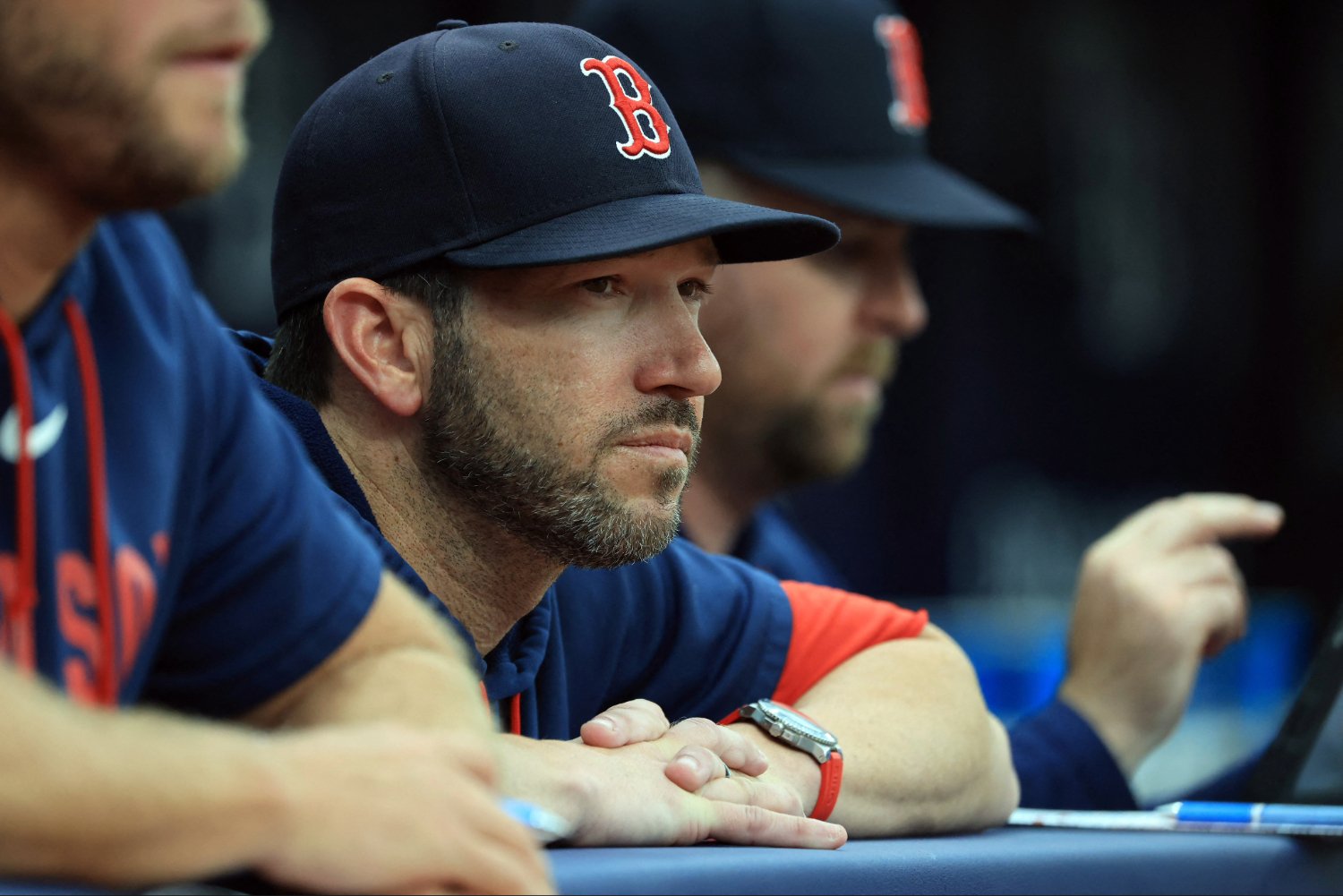
I’ve been critical of Craig Breslow’s leadership for a while now. Former Red Sox skipper Alex Cora and Breslow's relationship reached a breaking point this year. Tensions were reportedly high and they didn’t see eye-to-eye on some issues. Healthy tension is fine, but theirs was toxic. In late April, Breslow consolidated power. Cora got Red Wedding’d and replaced by Chad Tracy, who has acted as the human shield between the analytically-minded front office and clubhouse.
After the Red Sox’s Game 2 ALWCS loss, Willson Contreras made a pointed comment about the team’s over-reliance on data and analytics. Tracy notably pulled starters Payton Tolle and Sonny Gray after just 4.2 innings in both games. Fans speculated that those decisions were secretly the front office pulling the strings, but Tracy owned up to both calls. This is pure speculation, but Tracy taking the blame looked like he was protecting the people above him.
Back to the data point. Every team uses data analytics (minus the Angels, probably), but the biggest separator is how well information is communicated. Sometimes players feel like data is simply bossing them around, rather than actually helping them. After being taken out in Game 2, Gray commented, “I would’ve liked to have been trusted in that moment.”
Look at Caleb Durbin. As a new member of the Red Sox, he struggled heavily, slashing .172/.261/.263 through late April. (To be fair, he found his stride around the same time Tracy’s new coaching staff took over.) Still, Durbin went to a private hitting facility at former teammate Carlos Narváez’s suggestion and his performance quickly bounced back from June to August. When a player has to seek outside counsel to find his swing, something is awry inside the organization.
I’ll end on this: the Red Sox have four issues to address this offseason. The first is to figure out how to handle premium velocity. Free-agent Seiya Suzuki, who has a career .792 OPS vs pitches 95+ mph, is an intriguing target. The second is to fill the lineup’s power void, preferably by not betting on an internal player to have a career season. (Tyler O’Neill recorded the Red Sox’s most recent 30-plus home run season in 2024.) The third is changing how they develop players. Kyle Harrison, Jordan Hicks, Sean Newcomb, and James Tibbs became their best selves when a team built a development plan specifically tailored to them. The Red Sox should be doing this, not watching it happen somewhere else.
The final issue, which is the most complicated, is to optimize strength and conditioning protocols. At the end-of-season press conference, Breslow was asked whether the team would reevaluate its training methods after a year of soft-tissue injuries. His response?
QuoteI would be very hesitant to draw conclusions that would connect training methods to injuries... I’m reluctant to say, hey, the solution here is to change what we’re doing that has led to career years for so many players.
Career seasons, huh? The Red Sox have dealt with a weird string of hitting-related injuries going back to 2024. Roman Anthony missed over 100 games in 2026 due to his CMC joint tear. Between tearing the cartilage in his ribs and rupturing his left patellar tendon, first baseman Triston Casas hasn’t been healthy for an entire season since his debut year in 2023.
There’s also a flip side.The same strength and conditioning program that’s literally tearing hitters’ bodies apart is letting other players get heavier. Adley Rutschman has put on noticeable weight this past season. Erik Miller, who was acquired at the trade deadline, has had weight issues of his own, potentially affecting his delivery. Whatever the Red Sox are doing in the weight room, it’s failing both groups and must be addressed this offseason.
I don’t mean to be a pessimist here, but none of this gets fixed with one miracle signing or trade this offseason. To his credit, Breslow has developed a pitching pipeline that’s produced Payton Tolle and has helped Sonny Gray and Aroldis Chapman rejuvenate their careers. He also landed Garrett Crochet and Adley Rutschman on the trade market as well, which has given the franchise the star power it has been craving. But a great pitching pipeline doesn’t do much for hitters, and right now, the way decisions are made in the front office needs to change. There’s organizational rot within the Red Sox, and that starts with Craig Breslow.





Recommended Comments
There are no comments to display.
Create an account or sign in to comment
You need to be a member in order to leave a comment
Create an account
Sign up for a new account in our community. It's easy!
Register a new accountSign in
Already have an account? Sign in here.
Sign In Now