


Red Sox Video
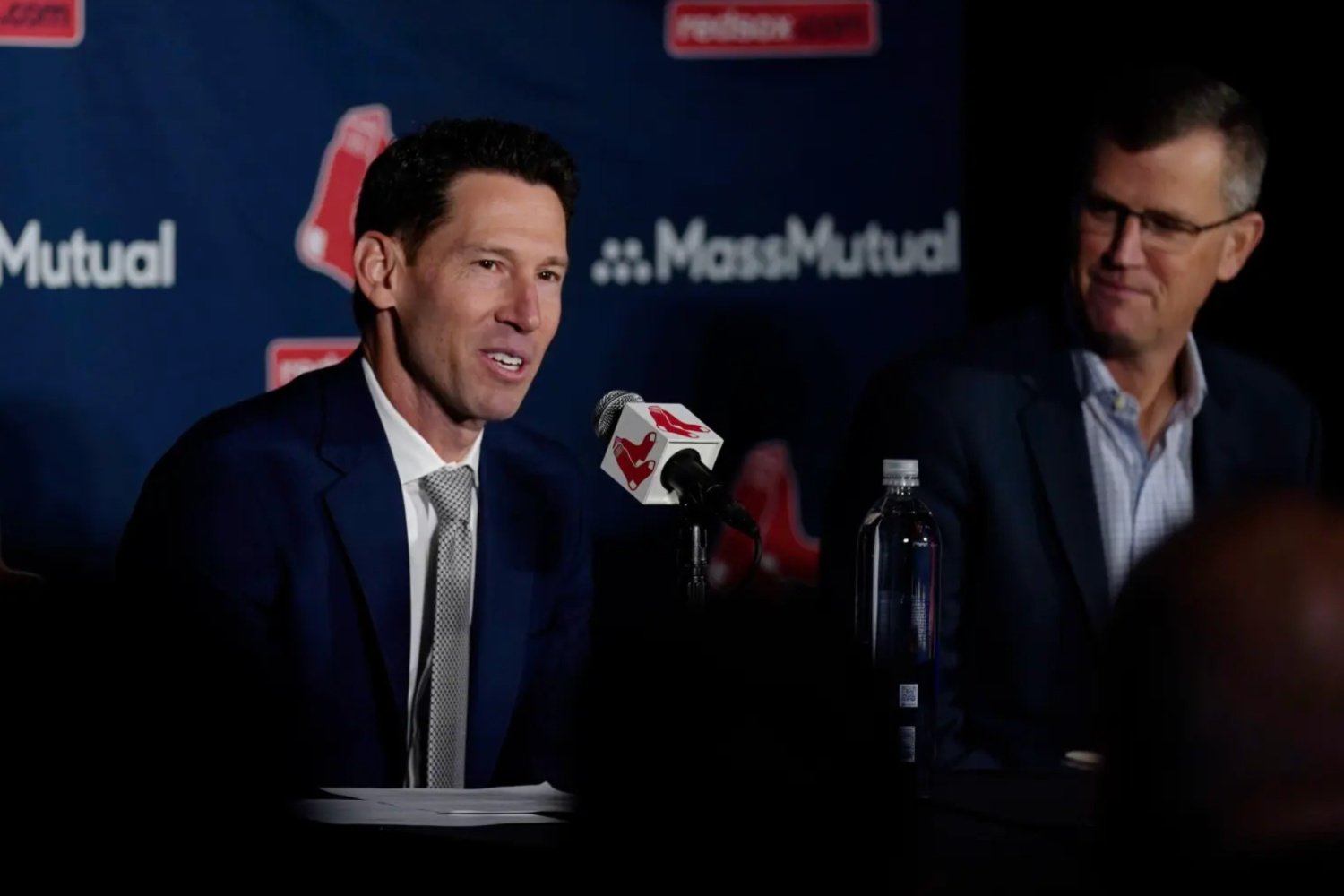
“This decision was not taken lightly,” Fenway Sports Group’s Sam Kennedy stated in his opening remarks. “Nor did it come suddenly. We obviously, over the last week or so, reached an inflection point. And as difficult as that inflection point was, um, as the hallmark of this organization, I guess over the last 24 years, we acted boldly and decisively. And we came to the very difficult decision to make a deal that serves the best interest of the Boston Red Sox in both the short-term and the long-term.”
It has now been over 24 hours since Rafael Devers was traded to the San Francisco Giants in a move that has left all of Red Sox nation speechless. A trade that seemingly came out of nowhere as the team was coming off a weekend sweep of the New York Yankees and looked to carry momentum into their west coast trip. Other than announcing the trade officially, there were no remarks from upper management in regard to the trade, instead reserving them for an eight o'clock Zoom meeting with the media on Monday night.
In what amounted to nearly 39 minutes of questions, both Sam Kennedy and Craig Breslow answered them to the "best of their ability" as they tried to justify trading a player of Devers’ caliber.
The first question from Ian Browne of MLB.com brought up an excellent point, mentioning how all of their previous moves were with a focus on 2025, but how did trading Devers help the team for the season? Breslow answered how one would expect him to, admitting that “When you move a player of Raffy’s caliber, how can I sit here and say that, you know, we’re a better team? And I acknowledge that, on paper, we’re not going to have the same lineup that we did.”
Breslow continued his answer, pointing out that, “This isn’t about the game that is played on paper, this is about the game that’s played on the field. And, ultimately, about winning the most games that we can. And in order to do that, trying to put together the most functional and complete team we can.”
One key thing Breslow mentioned was the flexibility of the lineup as they now planned to rotate players through the designated hitter spot in the lineup to allow all three of their left-handed outfielders to be in the game without moving Ceddanne Rafaela to the bench. Another key point that he made with the trade was that they managed to bring back a few interesting pieces that would both help the 2025 Red Sox while also helping them continue to build for the future in the likes of Kyle Harrison, Jordan Hicks and minor-league outfielder James Tibbs III along with minor-league righty Jose Bello.
While Tibbs and Bello are some ways away (Tibbs will report to Double-A Portland, while Bello has yet to pitch above the Arizona Complex League for the Giants), both Harrison and Hicks provide interesting options for pitching. Harrison, a former first-round pick, will report to Triple-A Worcester to begin working with Boston’s pitching lab to try and unlock the potential that made him a once-highly-touted prospect. It’s similar to Quinn Priester last year, where the Sox hope to work with him and unlock a new level of skill.
Hicks, on the other hand, was a dominant reliever before signing with the Giants, where they attempted to make him a starting pitcher due to his stuff. The attempt appears to have ended as he was shipped to Boston. Breslow himself stating in the interview that Hicks will be used as a reliever as he had before signing with San Francisco entering the 2024 season.
Now, what may have been Breslow’s strangest comment was his belief that the Red Sox may be better without Devers than with him, going as far as to say “I do think there is a real chance at the end of the season, we’re looking back, and we’ve won more games than we otherwise would have.”
It’s something interesting to believe in, that trading your best player would make you better. Of course, both himself and Kennedy repeated that the team is more than a single player and while correct, in baseball and any professional sport, it’s the star players who put a team over the top. If the 2004 Red Sox didn’t have the exceptional hitting of David Ortiz and Manny Ramirez or the pitching of Curt Schilling and Pedro Martinez, they don’t win the World Series. In 2007 if they didn’t have a Cy Young-caliber season from Josh Beckett to go along with offensive outputs from Ortiz, rookie Dustin Pedroia and Kevin Youkilis, along with an all-star in closer Jonathan Papelbon, they don’t win the World Series either.
2013 may be the exception, as there weren’t many players who were considered “stars” on that roster, but they had many quality veterans who had successful careers ranging from Mike Napoli, Shane Victorino and Stephen Drew in the field to John Lackey, Jon Lester and Jake Peavy in the rotation. Not to mention the always-clutch Ortiz leading the way for the lineup, aided by Pedroia, Jacoby Ellsbury and Napoli.
And, of course, 2018 was guided by a combination of big name stars and homegrown players who quickly became stars. The team was filled with players of All-Star-caliber, such as Chris Sale, David Price, Craig Kimbrel, Mitch Moreland, Mookie Betts and Xander Bogaerts. The point is: you need stars who are already stars to help guide a team, something that the 2025 iteration of the team currently lacks as they attempt to thrust the young core into the spotlight.
Throughout the media availability, many asked questions relating to how things with Devers could have gone differently and what went wrong, but one of the most interesting answers might have come from Kennedy, when he was asked what was "missing" from Devers as a person and as a player. The President of the Boston Red Sox answered with, “In terms of what was missing, it just was that alignment in terms of what we felt we needed from him that would be in the absolute best interest of the ballclub. That’s a non-starter for us. We have to have that. We couldn’t get there.”
Notice how he failed to actually state just what was considered the best interests of the ballclub. Was it that they wanted him to play first base? Could it have been that he wasn’t being a vocal leader in the clubhouse? Was he not available enough to the media, or perhaps the team's young core? All of these possible issues were things they knew previously about Devers. He was never going to be the media darling they wanted, he isn’t comfortable enough to speak in front of reporters in the same way the likes of Betts, Bogaerts, Sale and especially Ortiz were able to do before him.
Another interesting moment came when Mike McCarthy of 98.5 the Sports Hub asked a few questions, especially opening up with the fact that the team traded Betts just five years ago and now Devers, two players who very well could be Hall of Famers by the end of their respective careers. McCarthy asked why the organization kept doing it — what are the organizational factors that have created an environment where the Red Sox are repeatedly trading away Hall of Fame talent? Kennedy appeared a little uncomfortable by it, stumbling over his words at the beginning before finally saying that each and every player decision is “A whole, individual decision.”
He tried to state that it’s really hard when they can’t line up with their players who become free agents or those that they can’t agree to extensions with both being different circumstances. He did say, “I’ll put our record up against anybody else’s’ in major league baseball over the last 24 years. We’re incredibly proud of what we’ve built here. We’ve got more trophies and banners to show for it than any other organization in major league baseball. We are so proud of that. And this clubhouse believes in itself and we believe in them and I think our players, are, uh, going to be pretty vocal over the next couple months about the belief in themselves.”
Kennedy continued to ramble on with his answer, stating that Breslow knows what it means to be a champion in Boston as he won in 2013, and his tenure as the Chief Baseball Officer has been defined by bold, decisive, aggressive moves. Kennedy said they’ll never stop being bold in their decisions and hopes that it leads to them being right more often than wrong. McCarthy was quick to follow up by pointing out all the stars they have lost in previous years, mentioning Betts, Devers, Lester and Sale as players the team has either lost or moved on from and asked if they were afraid if losing star players was becoming part of the organization’s culture.
And later, Jeff Passan of ESPN asked Breslow to explain what they want the Red Sox culture to be that it wasn’t with Devers. Breslow responded with the idea, “The whole is greater than the sum of the parts. That each individual is contributing and finding a way to help a team win, whether that’s in the batter’s box, on the pitcher’s mound, on the bases, on defense, in the clubhouse, on the bench. It’s the willingness to step up and sacrifice at times of need and essentially do whatever is necessary to help the team win. And I think that’s the identity, this relentless pursuit of winning that we’re looking for, it’s the identity that the World Series championship teams have had in the past.”
To imply that Devers never stepped up or sacrificed at times is disingenuous at best and shameful by Breslow considering what he had seen of Devers since being hired before the 2024 season. Devers played through the entire 2024 season with reoccurring shoulder issues and still attempted to carry the offense as they fought for a playoff spot until the end of August. You could see Devers wincing in pain with each swing he took, doing his best to stay in an already-depleted Red Sox lineup until their chances of making the playoffs were all but gone. And even this season, Devers stepped up and carried the offense once again, as he drove in 33 runs in May alone, keeping the offense afloat while many regulars struggled and Alex Bregman got hurt.
Passan followed up by asking which of those roles was Devers not fulfilling and Breslow refused to answer, skirting around the topic completely by stating that “I don’t think, um, it makes sense at this point to kind of be overly pointed or critical. Um, I think we failed to reach that alignment. It was a really strong fit for a really long time and then became evident that it has started to diverge and so you know, I think, best to identify it, own it, and act decisively to fix it.”
Again, neither Breslow nor Kennedy actually answered the question, skirting around it with an answer that, when read into, tells you that Breslow had personal issues with Devers. Breslow’s inability to properly communicate and be honest with his star player led to this, and instead of trying to remedy his mistake, he instead shipped him out of town.
The press conference helped to really sell that perhaps it was a mutual breakup, but that Breslow himself was a cause behind a lot of the issues, his ego being the key reason why any issues between himself and Devers could not be mended. Had he just been truthful to Devers and admitted they were looking for a new third baseman, maybe he would have been more welcoming to playing first base after Triston Casas went down.
Now, however, it’s just a sad end to what should have been a lifetime in a Red Sox uniform for Devers. The Red Sox will look to move on with the currently constructed roster and attempt to make the playoffs for the first time since 2021. This time, however, they’ll need others in the lineup to step up and carry the offensive burden.





Recommended Comments
Create an account or sign in to comment
You need to be a member in order to leave a comment
Create an account
Sign up for a new account in our community. It's easy!
Register a new accountSign in
Already have an account? Sign in here.
Sign In Now