


Red Sox Video
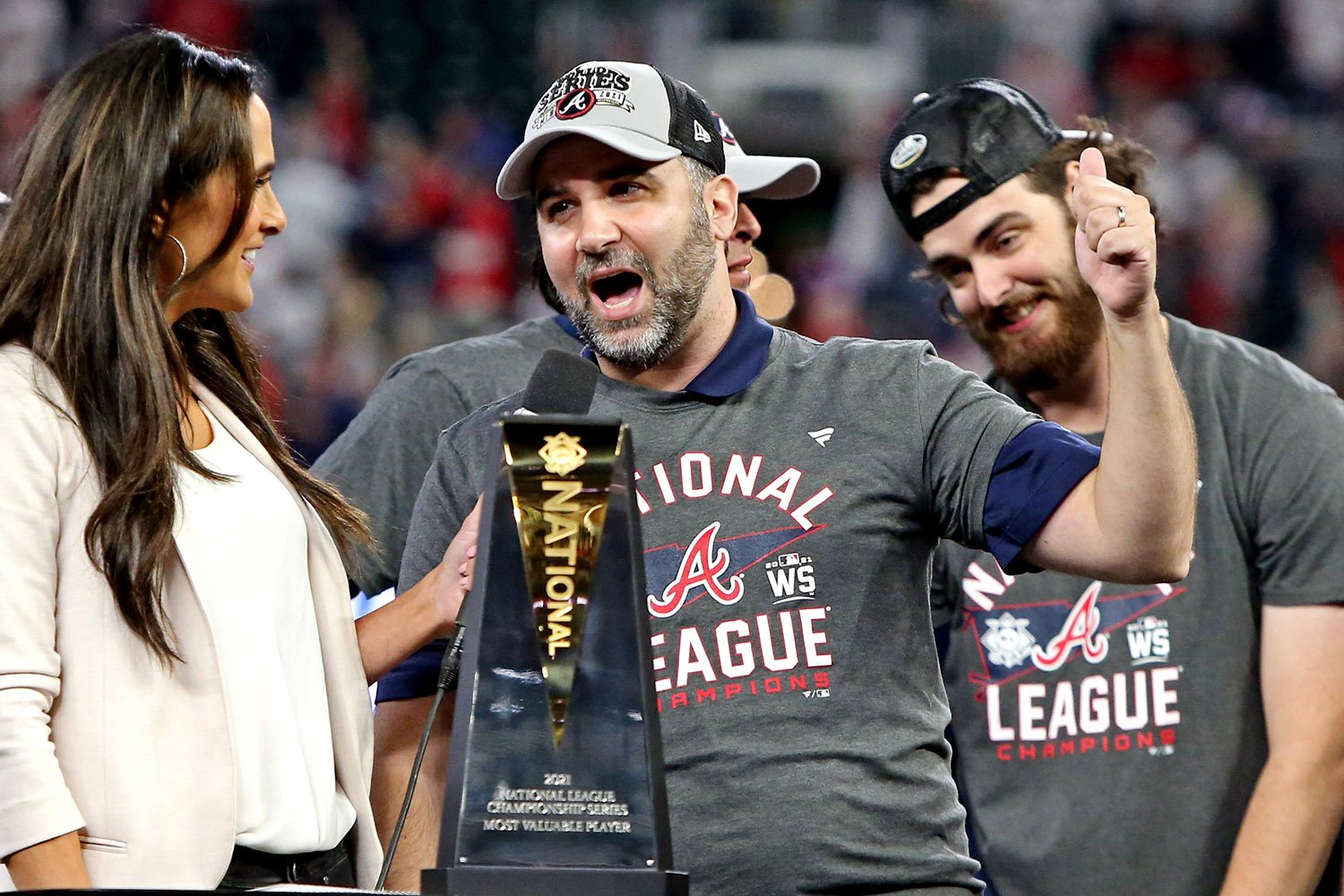
Thanks to team-friendly extensions and a willingness to move on when before fan favorites hit their decline phase, Atlanta is now six years into a sustained run of excellence. Can the Red Sox follow their lead?
From 2014 to 2017, the Braves were a mediocre team, mustering losing records in four consecutive seasons. The 2017 Atlanta Braves finished third in the National League East with a 72-90 record. The following season, they reversed their record to 90-72 and claimed their first division title in five years. Under the helm of their new general manager, Alex Anthopolous, the Braves ushered in a new era of sustained success, netting six division titles from 2018 to 2023, including back-to-back 100-win seasons in 2022 and 2023.
The Braves have utilized three key strategies to achieve sustainable success:
- A strong core of prospects emerging in subsequent seasons.
- Sustainable financial management.
- A demonstrated willingness to part ways with homegrown talent.
Talent Pipeline
The Braves have built a consistent pipeline of talent that’s been a key factor in their sustained success.
- In 2017, Ozzie Albies and Max Fried made their big league debuts.
- In 2018, the league witnessed Ronald Acuña Jr.'s meteoric rise to stardom.
- In 2019, Austin Riley broke into the major leagues.
- In 2022, Spencer Strider and Michael Harris II joined the Braves roster.
- In 2024, Spencer Schwellenbach stepped up and made his mark in the big leagues, contributing to the Braves injury-laden rotation.
Looking at 2026 and beyond, Jose Perdomo (SS), Hurston Waldrep (RP), and Drake Baldwin (C) are amongst the next wave of prospects to contribute to the team. The steady influx of homegrown impact talent gives the team valuable internal resources, reduces the need for free-agent signings, and provides financial flexibility.
Financial Sustainability
Despite being a large market team, the Braves spend their money wisely. According to Cot's Contracts, Atlanta's 2025 payroll is currently the ninth-highest in baseball. The Braves' core has been built around buying out their homegrown players' arbitration years and retaining them during their prime.
Only 2.1% of the Braves' 2025 roster is arbitration-eligible, the lowest percentage in the league.
- 2B: Ozzie Albies (28), seven years, $35 million from 2019-2025 with 2026-27 club options
- 3B: Austin Riley (27), 10 years, $212 million from 2023-2032 with 2033 club option
- OF: Ronald Acuña Jr. (27), eight years, $100 million from 2019-2026 with 2027-28 club options
- OF: Michael Harris II (23), eight years, $72 million from 2023-2030 with 2031-32 club options
- SP: Spencer Strider (26), six year, $75 million from 2023-2028 with 2029 club option
When you consider these players' performances, their contracts look like bargains. Generally speaking, MLB players reach their peak performance between the ages of 27 and 29, with a typical decline starting around age 30. The Braves' core is secured through their prime years, and their extensions also account for potential aging curves. Factoring in club options, Albies' contract ends at age 30, Acuña's at age 30, Harris's at age 31, and Strider's at age 30.
Moreover, the Braves are quick to pounce on extensions with players they acquired via trade.
- 1B: Matt Olson (30), eight years, $168 million from 2022-2029
- C: Sean Murphy (30), six years, $73 million from 2023-2028 with a 2029 club option
- SP: Reynaldo López (31), three years $30 million from 2025-2027
- RP: Raisel Iglesias (35), four years, $58 million from 2022-2025
Aside from shortstop and one or two outfield positions, their starting nine and rotation have been set since 2022. Since their core is retained throughout the next decade, the Braves aren’t connected to premier free agents in the offseason. Who needs Juan Soto when you have Acuña at home?
The Braves have shown a demonstrated willingness to part ways with homegrown talent either via free agency or trades. Consider the following moves:
- March 2022: Traded Cristian Pache, Shea Langeliers, Joey Estes, and Ryan Cusick for Matt Olson (27)
- March 2022: Freddie Freeman (33), signed a six-year, $162-million contract with the Dodgers
- December 2022: Dansby Swanson (29), signed a seven-year, $177-million contract with the Cubs
- December 2022: William Contreras (25), acquired Sean Murphy
- November 2024: Travis d’Arnaud (35): signed a two-year, $12-million contract with the Angels
- December 2024: Max Fried (30): signed an eight-year, $218-million contract with the Yankees
The Braves have a history of letting homegrown talent walk, but they consistently fill those spots with younger, often comparable (if not better) players. They were happy to let Freddie Freeman walk with the younger, cheaper Matt Olson available. Dansby Swanson was another key departure, but the Braves were able to redirect resources toward extending players like Olson, Austin Riley, and Sean Murphy. In December 2022, the Braves moved William Contreras, who they viewed more as a designated hitter, for Sean Murphy, a defense-first catcher. Subsequently, the Braves had the best catching tandem in the league with Travis d’Arnaud and Sean Murphy.
Going into the 2024 season, the Braves needed an everyday outfielder. They traded Jackson Kowar and Cole Philips to the Mariners for Jarred Kelenic, Marco Gonzalez, and Evan White. This wasn’t the flashiest move for the Braves, but it filled a need for the team, and they secured a young, cost-controlled outfielder for the future. This offseason the Braves chose not to pursue Travis d’Arnaud and Max Fried. Both players are aging, and they have a considerable number of pitching prospects and Drake Baldwin who can take over d’Arnaud’s role as backup catcher in the future.
Is it possible for other teams, like the Red Sox, to mimic the Braves' sustained success? The Red Sox' current roster construction model closely aligns with the Braves' strategies, suggesting that a similar approach could lead to long-term success.
Talent Pipeline
Roman Anthony and Kristian Campbell are expected to make their major league debuts this year. If he has an outstanding year in Worcester, Marcelo Mayer could also see some big-league action later in the season. Beyond 2025, David Sandlin (friend of the Talk Sox podcast) and Jhostynxon Garcia could join the team in 2026. Though he isn’t a homegrown prospect, Grissom is akin to a new player for the Red Sox this year.
While conducting research for this piece, I noticed that Braves infielders usually have one to two “bad” seasons before finding their stride:
- Dansby Swanson slashed .246/.322/.348, 77 OPS+, and 0.9 bWAR during his first two seasons.
- Ozzie Albies’ WAR jumped from 1.3 in 2017 to 4.1 in 2018.
- Austin Riley had a negative WAR from 2019 to 2020 before he produced a 6.3 WAR season in 2021.
Given the trend of Braves infielders taking a couple of seasons to fully develop, Grissom could be the key difference-maker, potentially turning the team from a .500 record into a wild-card contender. At the very least, he should have a shot to be the starting second baseman this year. He partook in the annual Story camp and looks healthier than he did last year. Some players face growing pains at the major league level. Many Red Sox fans wrote off Jarren Duran before his breakout 2024 season. During his rookie year, Casas looked like a lost cause before posting monster numbers during the second half of the season.
Sustainable Financials
The Red Sox currently have a cost-controlled core to build around.
- Rafael Devers (28): 10-year, $313.5 million from 2024-2033
- Brayan Bello (25): 6-year, $55 million from 2024-2029 with a 2030 club option
- Ceddane Rafaela (24) - 8-year, $50 million from 2024-2031, with a 2032 club option
Factoring in club options, Devers' contract ends at age 37, Bello’s contract ends at age 31, and Rafaela’s at age 32, so the Red Sox have control of these players through their prime.
The team has a plethora of young talent that can be signed to reasonable cost-controlled deals. Triston Casas, Tanner Houck, and Garret Crochet are extension targets. If Roman Anthony hits the ground running after he’s called up, he’s also in the mix for an extension. Since the Red Sox haven’t gone after premier free agents, such as Corbin Burnes and Max Fried, this offseason, they have money to allocate toward extending Crochet.
The Red Sox spent money for the sake of it and are now stuck with Masataka Yoshida, who doesn’t fit with the team’s current roster construction. Signing Alex Bregman might lead to another Yoshida conundrum. The Red Sox have a lot of right-handed second-base depth with Vaughn Grissom, Romy Gonzalez, and Kristian Campbell. All of whom hit left-handed pitchers better than Bregman in recent years.

Money is finite, and I’d rather see the Red Sox leverage their second base depth for the 2025 season rather than commit to a long-term contract with Bregman. The funds for his contract could be better spent on player extensions.
Parting Ways With Homegrown Talent
The Red Sox traded Kyle Teel, Braden Montgomery, Chase Meidroth, and Wikelman González to the White Sox for Crochet. Amongst this group of prospects, Teel is the closest to his major league debut. Meidroth was blocked by the aforementioned group of second baseman and Montgomery and González’s major league ETA isn’t imminent. Starting pitching, especially a left-handed option, was a known need for the team, and the Red Sox nabbed the frontline trade target of the 2024-2025 offseason. On the same day the Red Sox traded Teel, they acquired Carlos Narváez, a defense-first catcher, to help offset the loss.
Jarren Duran is set to become a free agent in 2033, at the age of 33. The Red Sox should keep him during his arbitration years, but let him walk once he hits free agency. As he ages, his speed is likely to decline, and it's a huge piece of his game. It’s more prudent to invest in younger players instead.
The Braves are the perfect model for roster construction, demonstrating controlled, sustainable success, and the Red Sox have the opportunity to emulate their approach. There’s a wave of prospects ready to join the Red Sox in the upcoming years. They have the financial flexibility to extend young talent like Crochet, Casas, and Anthony, allowing them to build upon their core of Devers, Bello, and Rafaela.
The Red Sox should continue to spend their money wisely and avoid large free-agent signings when they have a ton of talent knocking at the door. However, that doesn’t mean they should refrain from investing in the team. After all, they’re one of the most valuable sports franchises. Locking up their young talent and filling roster holes with shrewd free agent signings is the best way to follow the Braves.





Recommended Comments
Create an account or sign in to comment
You need to be a member in order to leave a comment
Create an account
Sign up for a new account in our community. It's easy!
Register a new accountSign in
Already have an account? Sign in here.
Sign In Now