Jump to content
Talk Sox
  • Create Account
  • Red Sox News & Analysis

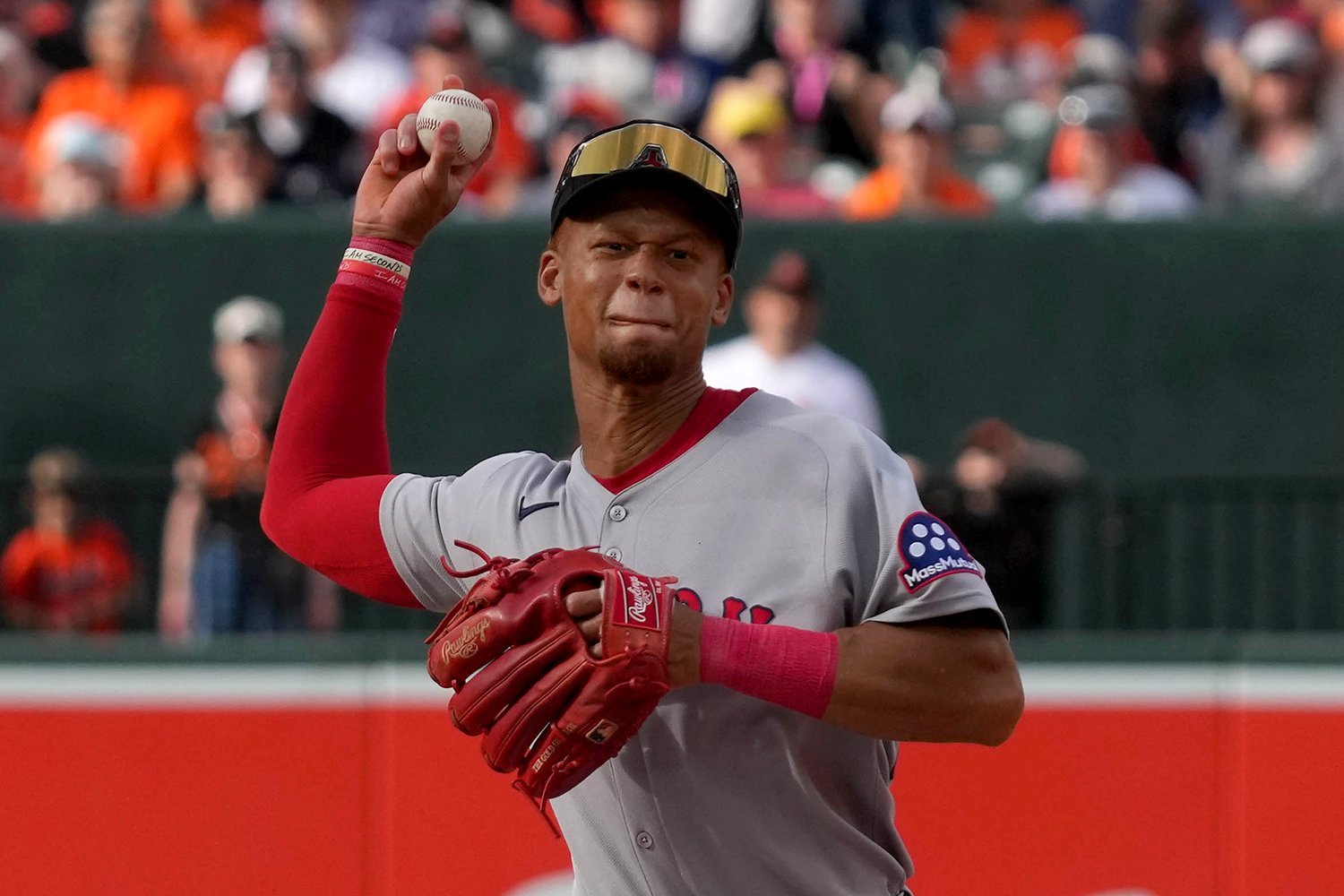
    Kristian Campbell Could Use Some Time In Worcester

    Kristian Campbell started the season strong, but weeks of struggling prove that he needs a bit more seasoning. A trip back to Worcester could be just what the doctor ordered.

    Alex Mayes
    Image courtesy of © Mitch Stringer-Imagn Images

    Red Sox Video

    At the start of the 2025 season, rookie Kristian Campbell lit the league on fire. Through March and April, Campbell slashed .301/3407/.495. Once the calendar changed to May, though, Campbell began his downward slide. In May, he slashed .134/.184/.171. His early June numbers are slightly better, .182/.250/.273, but it’s obvious he’s still struggling.

    Where Campbell shined early in the season was being able to take walks, 19 combined in March and April, good for a 15.4% walk rate. He was patient, and that allowed for him to work with his plate discipline and get into hitter’s counts. In May, Campbell worked a 5.7% walk rate with only five walks in the month. His strikeout rate also jumped up from 26% to begin the season to 31% in May. He was the worst qualified hitter in the sport for May in batting average (.134), OBP (.184), slugging .171), OPS (.355), BABIP (.185), wRC+ (-5), and WAR (-0.9).

    Woof. 

    Campbell was penciled in by some as a likely Rookie of the Year candidate, and with a hot June and July, he could be back in the conversation, but the month of May has done a lot of damage to that campaign. It likely doesn’t help that Campbell has played three different positions so far this season: second base, center field, and left field. He has been preparing to play first base as well, and was scheduled to make his debut there on June 1 until Alex Cora announced before the game that he would be starting Abraham Toro at first again to keep his bat in the lineup. Campbell likely wouldn’t see time there in the near future with Romy Gonzalez activated off the injured list as well. That has to make trying to figure your way out of a slump difficult. Maybe the Red Sox should turn to Craig Breslow’s former team for some inspiration for what to do with Campbell.

    The Cubs’ top prospect Matt Shaw was expected to be the starting third baseman in Chicago for the 2025 season. Shaw was demoted after 68 plate appearances, slashing just .172/.294/.241 with a 26.5% strikeout rate. Those numbers seem incredibly similar to Campbell’s current stretch. Shaw was sent to Triple-A Iowa in mid-April to try and figure things out. It seemed to have worked. Once he was brought back to Chicago in May, he slashed .359/.419/.487. That’s a stark improvement. Like Campbell, Shaw was expected to adjust to the majors quickly and he struggled. The path for Campbell’s return to being a daily contributing member of the team seems pretty clear.

    If the Red Sox were to send Campbell back to Triple-A Worcester, something Alex Cora kept the door open for (despite remaining committed to keeping him in the majors), then it would allow the rookie to do a mental reset. He'll be able to slow the game down at a level he should confidently dominate. Polar Park is a hitter’s dream, so playing there should allow him to rediscover his power swing and give him more confidence when he gets called back up. Unrelated to offense, sending him back to Worcester for a while would let him refocus on playing second base. The Red Sox touted Campbell as the second baseman of the future and then moved him around the field while putting him at different spots in the lineup. It’s no wonder that he began to struggle quickly — he didn’t know where he was playing or hitting from game to game. Baseball is already a hard game, and it's made even more difficult when you’re not able to hold a typical pre-game routine for the position you’re supposed to be playing. 

    Kristian Campbell is still a rookie, and all rookies go through growing pains. There’s no shame in having to go back to Triple-A to figure things back out. It worked wonders for Matt Shaw this season, and we saw it do the same for Jackson Holliday in 2024. If Campbell is going to step into his everyday role that the front office expects of him, he likely needs some more time in the minors to figure everything back out. As the Red Sox continue to spiral down, there’s no reason to further discourage him. Send him down, let him grow away from the spotlight and call him back up so he can finish the season strong. 

    Follow Talk Sox For Boston Red Sox News & Analysis

    Recent Red Sox Articles

    Recent Red Sox Videos


    User Feedback

    Recommended Comments


    Featured Comments

    3 hours ago, Old Red said:

    Not all errors are the same. You could look at the box score from last nights game, and see that Duran was charged with an error, but if you watched the game the good old eye test told you what happened. The eye test can tell you so much such as Bregman could very easily have two more throwing errors charged to him that the eye test showed you, but the official scorer awarded the batter a hit that even had the Yuckers in the NESN booth befuddled, so  I agree fielding percentage isn’t all it’s cracked up to be, and there different kind of errors that the eye test if available can differentiate.

    Just about everything in baseball can be second guessed.  It should still all come back to the simple concept of what percentage of the time did the fielder get the out.  By hitting the runner, there was no out.  When Bregman or Devers in the old days didn't get an out on a ball hit to them and the score keeper gave the batter a hit, they created a floor fielding percentage. 

    There are three possible results on a play:

    1 - An out

    2 - An Error

    3 - A misplay that is considered a hit

    Fielding percentage is the accepted stat calculated by dividing OUTS over Total Chances.

    That number represents the BEST success rate of the player at his position.

    If you subtract misplays from OUTS and divide it by Total Chances you have the player's worst fielding percentage because you assume EVERY ball hit to him should have been an out. 

    Until someone starts reviewing every play where no out is made all we can do is assume a range that represents the fielding percentage of a player.  This can easily be corrected with today's technology and the error review process would render more accurate fielding percentages.  As of today, the best case is you can conclude that the fielding percentage in the books is over estimated.  To what degree, we won't know until the MLB defines standards for errors and assesses all historical and future plays determining errors against a standard set of rules.  That's why when you see a guy like Devers make 38 misplays and 14 errors in 2022 you laugh at the fact that he got 38 favorable calls by the score keepers and still didn't finish as a league average defender.  If 50% of the misplays were measured against a standard and found to be errors his fielding percentage in 2022 would drop from .964 to .920.  Most players don't have as many misplays as Devers did so the ceiling fielding percentage and the floor fielding percentage does not have as great of a span as it did with Devers.  

    You are 100% correct that fielding percentage is not recorded as accurately as possible and I hope someday that the inefficiency in recording it is corrected by the MLB. 

    On the other side of the coin, you have metrics which fabricate components of the estimates, and they are sold to the public as if they are stats not just guesses.  Normalization techniques are used throughout society to estimate lots of things.  As long as people understand that the estimates have no certainty, they are simply one person's (company's) guess at trying to create data that might represent what a player did but not necessarily.  If the public understand that these are guesses then metrics are kept in perspective.  The second someone thinks the estimates stand for a certainty, metrics become a myth.  They are estimates. 

    Fans can believe them or not.  With Fielding Percentage there is a range of accuracy based on the out/no out criteria.  In metrics, there is complete uncertainty since a major portion of the calculation is based on averages that may or may not fairly represent actual game situations.  Therefore, there is far LESS certainty in metrics than the range of the stat Fielding Percentage.  Nothing is perfect and fans can support either, but they should at least know that all metrics are guesses, predictions not certainties.


    1 hour ago, TedYazPapiMookie said:

    Firecracker?  Here is some free advice.  Stop with all the insults and start writing about baseball.  It will be sign of maturity.  If you disagree, just say so without an insult.  That's how adults discuss baseball.

    FYI... I do what I need to do to slow the cyber bullying that goes on here.

    This site is only as good as the participants who write about baseball here.  Clearly, the anonymity makes many very brave and aids in the ignorance with which they respond.  Thanks for being a prime example.

    I just want to say thank you for providing some comedic relief via your recent posts; it’s been a tough go for many of us while the team is struggling.

    1 hour ago, TedYazPapiMookie said:

    Just about everything in baseball can be second guessed.  It should still all come back to the simple concept of what percentage of the time did the fielder get the out.  By hitting the runner, there was no out.  When Bregman or Devers in the old days didn't get an out on a ball hit to them and the score keeper gave the batter a hit, they created a floor fielding percentage. 

    There are three possible results on a play:

    1 - An out

    2 - An Error

    3 - A misplay that is considered a hit

    Fielding percentage is the accepted stat calculated by dividing OUTS over Total Chances.

    That number represents the BEST success rate of the player at his position.

    If you subtract misplays from OUTS and divide it by Total Chances you have the player's worst fielding percentage because you assume EVERY ball hit to him should have been an out. 

    Until someone starts reviewing every play where no out is made all we can do is assume a range that represents the fielding percentage of a player.  This can easily be corrected with today's technology and the error review process would render more accurate fielding percentages.  As of today, the best case is you can conclude that the fielding percentage in the books is over estimated.  To what degree, we won't know until the MLB defines standards for errors and assesses all historical and future plays determining errors against a standard set of rules.  That's why when you see a guy like Devers make 38 misplays and 14 errors in 2022 you laugh at the fact that he got 38 favorable calls by the score keepers and still didn't finish as a league average defender.  If 50% of the misplays were measured against a standard and found to be errors his fielding percentage in 2022 would drop from .964 to .920.  Most players don't have as many misplays as Devers did so the ceiling fielding percentage and the floor fielding percentage does not have as great of a span as it did with Devers.  

    You are 100% correct that fielding percentage is not recorded as accurately as possible and I hope someday that the inefficiency in recording it is corrected by the MLB. 

    On the other side of the coin, you have metrics which fabricate components of the estimates, and they are sold to the public as if they are stats not just guesses.  Normalization techniques are used throughout society to estimate lots of things.  As long as people understand that the estimates have no certainty, they are simply one person's (company's) guess at trying to create data that might represent what a player did but not necessarily.  If the public understand that these are guesses then metrics are kept in perspective.  The second someone thinks the estimates stand for a certainty, metrics become a myth.  They are estimates. 

    Fans can believe them or not.  With Fielding Percentage there is a range of accuracy based on the out/no out criteria.  In metrics, there is complete uncertainty since a major portion of the calculation is based on averages that may or may not fairly represent actual game situations.  Therefore, there is far LESS certainty in metrics than the range of the stat Fielding Percentage.  Nothing is perfect and fans can support either, but they should at least know that all metrics are guesses, predictions not certainties.


    There are other outcomes. A fielder’s choice where the runner is safe, for example.  Happens every day.

    Errors are more about explaining baserunners runners  or runners taking extra bases.  They’re not really about fielding.  A fielder can misplay two identical grounders, but Hitter A is much faster than Hitter B and beats the throw. So the misplay is only an error because Hitter A can run faster? That’s not a good way to assess fielding…

    2 hours ago, moonslav59 said:

    Equating someone's spelling ability to baseball knowledge is worse than childish.

    The weird thing is, he seemed to be set off by the fact I put ROTY in there instead of ROY (God forbid), more than my spelling per se. My spelling is pretty damn good. 😎 My dyslexia, however, is about as bad as it gets. Not so good.

    9 minutes ago, Hitch said:

    The weird thing is, he seemed to be set off by the fact I put ROTY in there instead of ROY (God forbid), more than my spelling per se. My spelling is pretty damn good. 😎 My dyslexia, however, is about as bad as it gets. Not so good.

    It does seem weird that they include the "O" of of, but not the "T" for the.


    Create an account or sign in to comment

    You need to be a member in order to leave a comment

    Create an account

    Sign up for a new account in our community. It's easy!

    Register a new account

    Sign in

    Already have an account? Sign in here.

    Sign In Now

×
×
  • Create New...