


Red Sox Video
The rookie right-hander's setup makes him very nearly unique among today's pitchers.
By any measure, Justin Slaten had an outstanding rookie season. The 27-year-old right-hander, scooped up from the Rangers organization in the Rule 5 Draft last December, threw 55 1/3 big-league innings over 44 appearances. He ran a 2.93 ERA, and as his 2.61 FIP indicates, the underlying numbers loved him as well. He limited hard contact, especially in the air, and got plenty of chases and whiffs. His 35% chase rate, 4% walk rate rate, and 4% barrel rate all put him in the 96th percentile or better. He was also just plain fun to watch.
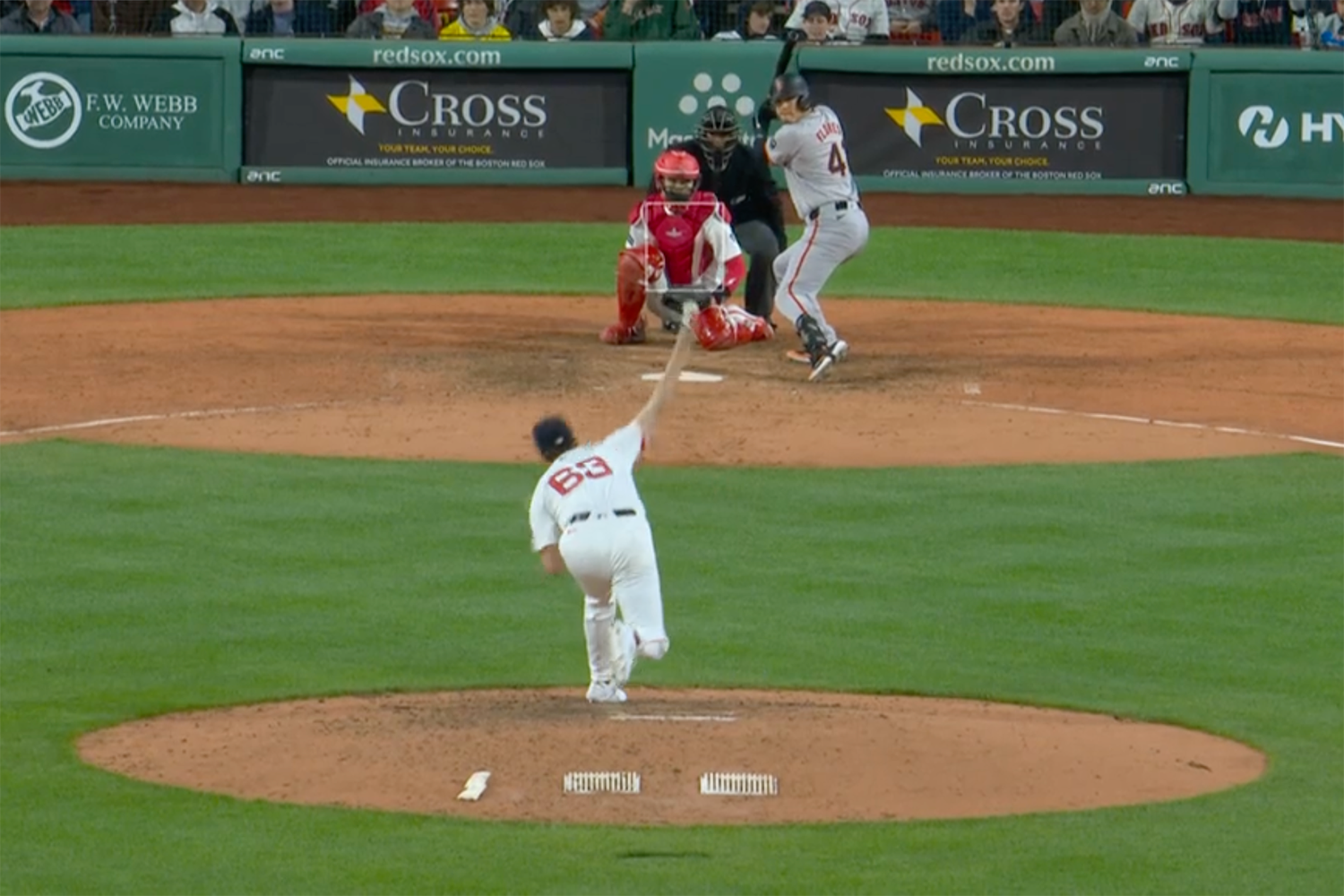
I don’t just mean that it was fun to watch him carve up opposing lineups. I loved watching him because he pitched a little differently than everyone else on the Boston staff, and in fact, everyone else in baseball. Before you look at the picture below, scroll back up and take another look at the picture at the top of this article to see if you notice anything special about it.
Give up? Okay, I’ll help you out. Below is the same picture, but this time I’ve added Greg Weissert into it as well. Weissert’s screengrab is from the same game and camera angle, and also from the moment he releases the ball.

It's not just that Weissert is a side-armer and Slaten throws over the top. It’s that Weissert is all the way over to the third base side of the rubber, while Slaten is all the way over to the first base side. Slaten’s spot is particularly unusual for a right-handed pitcher, and when you combine it with his 6-foot-4 height and relatively steep arm angle, the result is a release point that’s even more unusual. In that picture, Slaten is releasing the ball almost exactly in the middle of the rubber and the plate. His release point is just 2.16 inches from dead center. Here’s how his average release point stacks up on the Red Sox. Slaten is the red dot.

There’s nobody particularly close to him. He’s the only player on the team whose release point is within one foot of the middle of the rubber. And just to be clear, this is almost entirely a result of his spot on the rubber. The graphic below comes courtesy of Statcast. Take a look at how Slaten’s arm angle stacks up compared to the rest of the team’s pitchers.

He has one of the steeper arm angles, but he doesn’t really stand out at all. It’s his positioning that makes him such an outlier, and not just on the team. Even if you zoom out to the entire league, Slaten’s release point is still extremely rare. Here’s the average release point of every single pitcher who faced at least 30 batters this season. Once again, Slaten is in red, and once again, he’s found his own niche.
 Keep in mind, there are 699 pitchers on this chart. Very, very few of them have a release point similar to Slaten’s. Look how many of them overlap in the traditional righty or lefty blob, while Slaten is all the way off to the edge. His average horizontal release point is -0.82 feet, or just under 10 inches from the center of the pitching rubber. Among right-handed pitchers, that puts his horizontal release point in the 94th percentile, and because he achieves it with a higher-than-average release point, he still stands out, even when compared to every other pitcher in the league. This isn’t exactly a new phenomenon either. In July, Eric Longenhagen noted that Slaten had moved over on the rubber more this season, but here’s Slaten pitching for the University of New Mexico back in 2019. Even back then, he was pretty far over.
There’s a chance Slaten’s extreme release point may hurt his performance against right-handed hitters slightly. I’ve done a bit of research on horizontal release point, specifically looking at the small number of extremely fun pitchers who scooch from one side of the rubber to the other depending on the handedness of the batter. It’s a lot harder to hit a ball that starts out way behind you, which is one of the reasons that batters struggle against same-handed pitchers. The opposite is also true though: pitches that come from an extreme horizontal release point are hard for same-handed hitters, while pitches that come from close to the middle of the rubber are more platoon neutral. Slaten’s platoon splits were fairly even in 2024, and thanks to his reliance on his cutter, a pitch that often works well against same- and opposite-handed batters, we should probably expect more of the same going forward. That should be helpful in a bullpen that currently skews right-handed.
There’s one more benefit to Slaten’s setup. Generally speaking, pitchers want their pitches to look unusual to hitters. Major league batters boast excellent vision and hand-eye coordination, and some of their skill comes from elite pattern recognition. They’ve learned over thousands and thousands of reps what to expect from a pitch. Any time you can show them something surprising, you’re starting out a bit ahead of the game, and smart pitching analysts are working hard to quantify what they call – in open defiance of the English language – pitch uniqueness. Pitching from an unusual spot is helping Slaten throw something new at a hitter. Literally.






Recommended Comments
Create an account or sign in to comment
You need to be a member in order to leave a comment
Create an account
Sign up for a new account in our community. It's easy!
Register a new accountSign in
Already have an account? Sign in here.
Sign In Now