


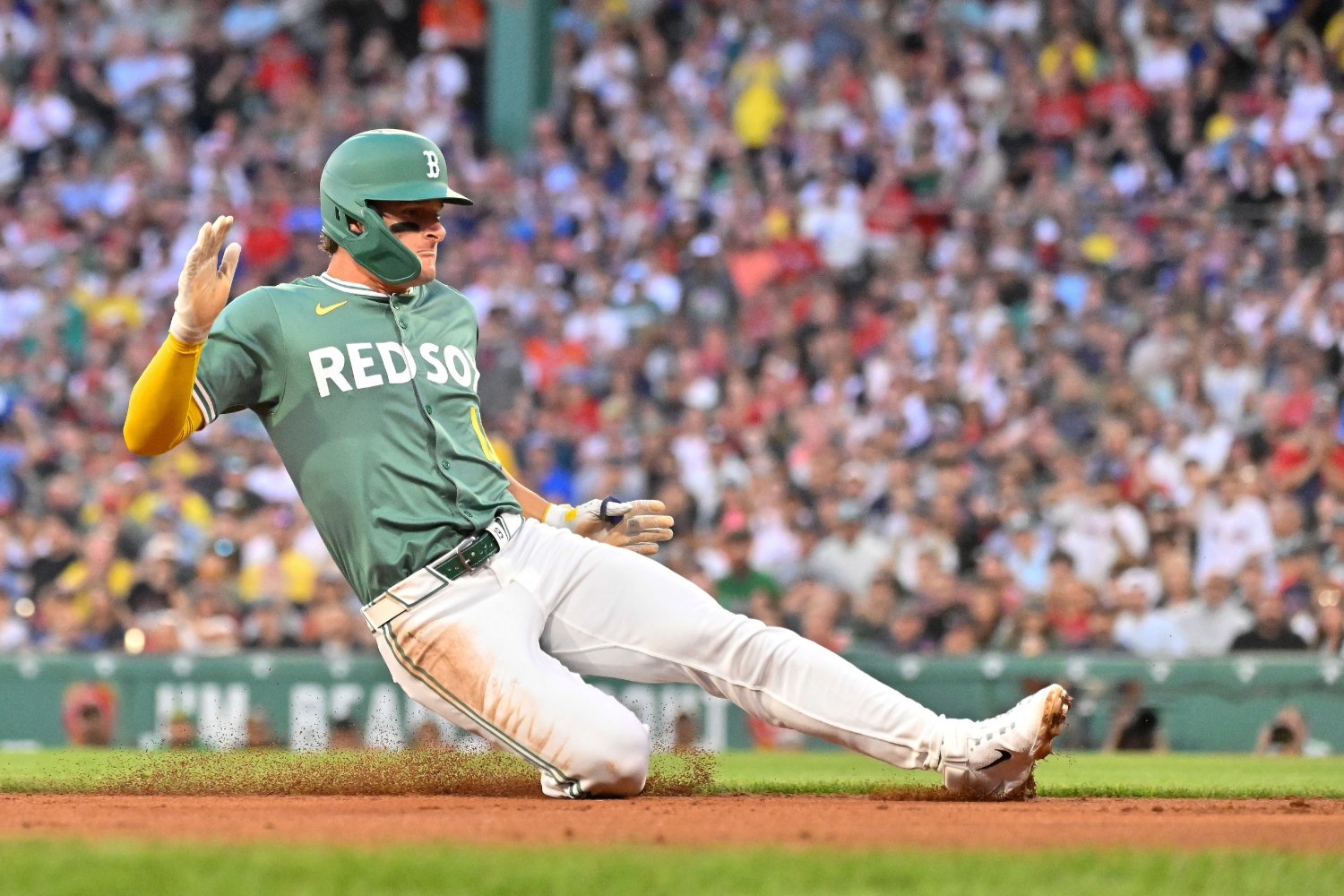
Red Sox Video
Today, the Boston Red Sox signed rookie sensation Roman Anthony to an eight-year, $130 million contract that could increase to $230 million based on various escalators within the contract. The deal itself means that Anthony should remain a Boston Red Sox through the 2033 season, with a club option to keep him through 2034.
While everyone is celebrating the huge moment (rightfully so), there seems to be an avoidance of the possible downsides of this contract should anything go wrong. From a fanbase viewpoint, no one wants to think of such an outcome, but there’s a reason a lot of these contracts for young players are signed early in their careers instead of waiting to cash in once they get to free agency. Typically, it's to make sure the young player gets guaranteed money before a possible injury occurs; sometimes, they’re leaving money on the table, and other times it works out.
An example would be David Wright of the New York Mets, a former superstar who saw injuries derail his career. The former third baseman originally signed a six-year, $55 million extension in August of 2006 and played up to that contract. It was the following extension that proved to be the bad gamble. Coming off of a season that saw Wright hit .306/.391/.492 with 41 doubles, two triples, 21 home runs and 93 RBIs, the Mets not only picked up the option for the 2013 season but also added on seven years and $122 million through an extension. After 2013 when that extension kicked in, Wright would go on to only play 211 games between 2014 and 2018, including missing all of the 2017 season. Wright would be released from the contract following 2018 and retired.
Wright made his debut at 21 years old in 2004, playing in 69 games where he hit .293/.332/.525 with 17 doubles, a triple, 14 home runs and 40 RBIs. From 2005 through 2013, he was a force in the lineup, only failing to hit 20 or more home runs in 2009. Notably, 2011 and 2013 which were the only seasons he failed to play in more than 150 games before his huge extension kicked in. He had five seasons of over 100 RBIs, four straight years of 40 or more doubles, and not only won two Silver Slugger awards but also two Gold Gloves and made the All-Star team seven times.
The Red Sox hope Anthony can become a player like Wright was before his unfortunate string of injuries. But there’s no denying that with an extension like that comes to the worry of a potential injury (or underperformance) derailing a season or even more. Fortunately, Anthony has shown no signs of injury concern so far in his career both in the minor leagues and with Boston, and should remain healthy in the outfield compared to the more physically demanding position of third base that Wright previously played.
Of course, there’s also the chance of Anthony just not working out. This probability seems very unlikely based on how Anthony has looked and performed so far, but there’s always that chance. A team signs a player to a long-term extension in hopes of locking them up for the future and instead are left with an awful contract. This happened to the Philadelphia Phillies back in 2018 when they signed Scott Kingery to a six-year, $24 million contract that included three options that would have brought the deal up to $65 million. All of that was awarded because of his unbelievable 2017 season between Double-A and Triple-A before hitting close to .400 in spring training and winning a big league roster spot.
It didn’t work out in the end for the Phillies as Kingly struggled. In fact, from 2018-22, he played in just 325 games (273 of those were in his first two seasons), and he spent most of 2021, 2022 and all of 2023 either hurt or playing in Triple-A.
Eloy Jiménez is another example of a contract that didn’t really work out for various reasons. Jiménez signed a six-year, $43 million contract before playing a single game in the major leagues. It quickly looked like a smart investment, as he hit .267/.315/.513 with 18 doubles, two triples, 31 home runs and 79 RBIs in his rookie season. Unfortunately, he never played more than 122 games in a season again. Ignoring the Covid-shortened 2020 campaign, Jiménez only appeared in more than 100 games one more time during the span of that contract in 2023, where in 120 games he hit .272/.317/.441 with 23 doubles, 18 home runs and 64 RBIs, a rather league-average offensive showing.
Right now, Jiménez isn’t even in major league baseball at the moment, instead a free agent after playing for Triple-A Durham in the Tampa Bay organization before getting released on July 12. He might have to settle for another minor league deal for next season or attempt to rebuild his value overseas in either the NPB or KBO.
That's a rather length preamble to this whole conversation, but it's important to remind ourselves that even the most surefire deals don't always work out. That being said, despite all the aforementioned issues with long-term extensions for young players, especially those who were mostly unproven, there really shouldn’t be much concern for Anthony. Unlike the other players, his metrics back up how well he’s played. It isn’t like he’s gotten extremely lucky at the plate; he's actually performing very similar to his minor league self. He isn’t being overwhelmed by major league pitching and is staying true to himself; working counts and getting the pitch he wants to swing at.
Anthony hasn’t tried to sell out for more power in the majors despite showcasing some of the hardest hit baseballs in the league thanks to impressive bat speed and the ability to square up the baseball at high rates. Offensively, he’s shown he is exactly the kind of player you would invest this amount of money into, as his numbers are very similar if not higher than Rafael Devers following his 2022 season (the one before he signed the extension).
In fact, at this point in time, Anthony has a higher xwOBA, average exit velocity, hard-hit rate, launch angle sweet spot, bat speed, squared-up rate, chase rate and walk rate than Devers had before his extension. And everyone knew the kind of offensive player that Devers was, so there should be no worries in regard to the gamble the Red Sox just took on with Anthony. If anything, it might be a steal considering the type of player Anthony is projected to become.
The Red Sox have wagered that this is all going to work out, and things right now point to the fact that Anthony should continue progressing into a middle-of-the-order, All-Star-caliber hitter who plays great defense. He’s exactly the type of player you should want to gamble on, because his floor is just so high. Obviously, if all goes according to plan, peak Anthony will make this extension a bargain, but even if it doesn't, he should still play well enough throughout his 20s to justify this kind of expenditure.
In today’s game where locking up young players is becoming more common, the Red Sox may have just gambled on their scouts and development system. Anthony was under team control for another five or six years at relatively cheap rates. If his early success is to be believed, though, Boston just secured its future at an extremely affordable price.





Recommended Comments
Create an account or sign in to comment
You need to be a member in order to leave a comment
Create an account
Sign up for a new account in our community. It's easy!
Register a new accountSign in
Already have an account? Sign in here.
Sign In Now