


Davy Andrews
-
Posts
196 -
Joined
-
Last visited
Content Type
Profiles
Boston Red Sox Videos
2026 Boston Red Sox Top Prospects Ranking
Boston Red Sox Free Agent & Trade Rumors, Notes, & Tidbits
Guides & Resources
2025 Boston Red Sox Draft Pick Tracker
News
2026 Boston Red Sox Draft Tracker: Picks & Bonuses
Forums
Blogs
Events
Store
Downloads
Gallery
Everything posted by Davy Andrews
-
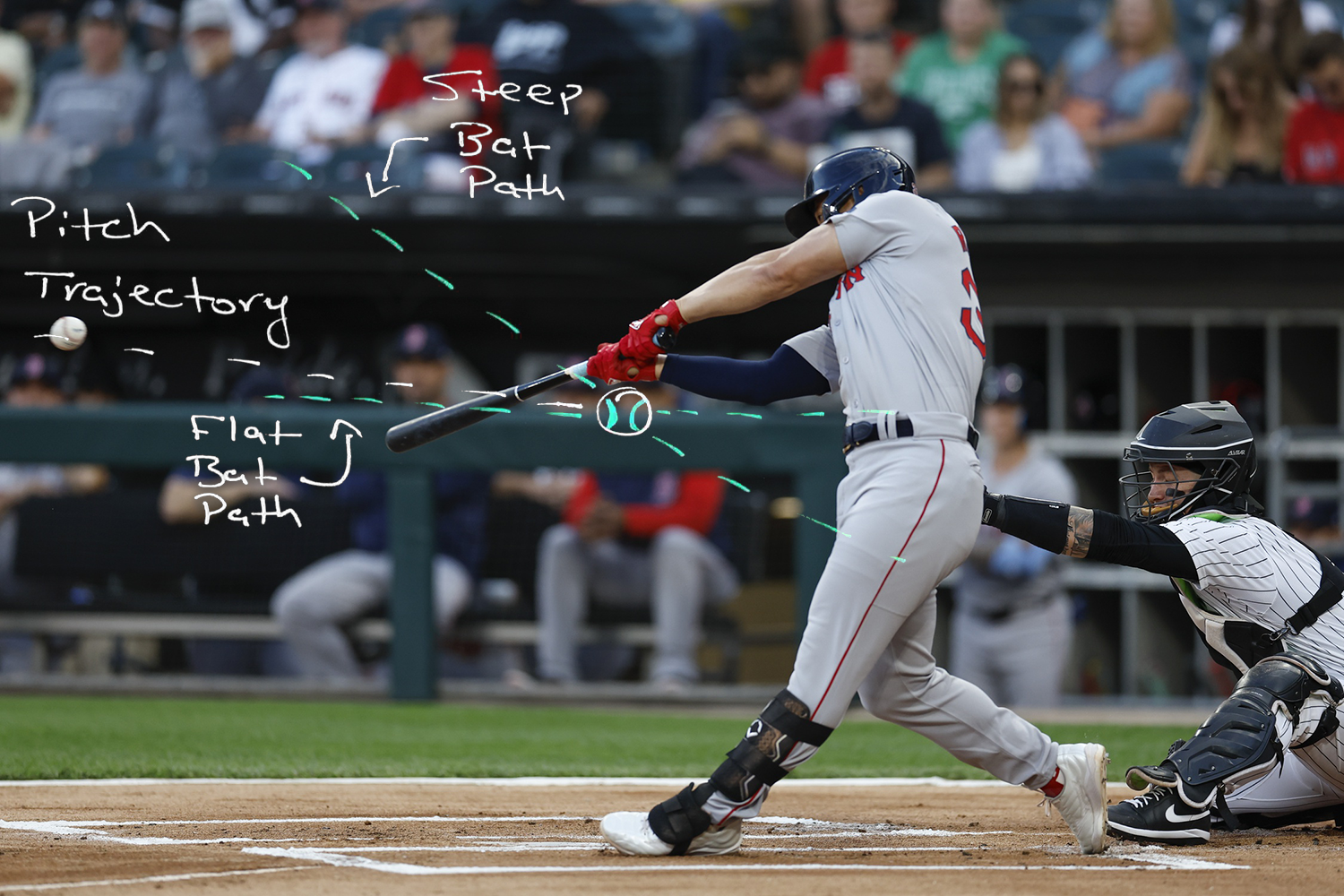 Through Rob Refsnyder’s first six seasons as a big-league ballplayer, he’d run a really good walk rate, and, well, that’s about it. From 2015 to 2021, Refsnyder got just 614 plate appearances, the equivalent of one full season, spread over six years. He batted .224 with six home runs (and that sparkling 10.7% walk rate), for a wRC+ of 71. Combined with roughly average defense, that gave him a WAR of -1.0. Over those six seasons, 554 different position players made at least 600 PAs. Out of that group, Refsnyder’s WAR ranked 533rd. By any measure, he had been one of the worst players in baseball. Then Refsnyder signed with the Red Sox, and something happened. In 2022, Refsnyder made a career-high 177 PAs and he put up a 146 wRC+. That’s right, he more than doubled his career wRC+, and he was the best hitter on the entire team. He batted .307, kept his wonderful walk rate, and all of a sudden, he was a slugger. He doubled his career total with six homers, and despite running a career slugging percentage of .308 to that point, he put a .497 mark. Despite taking a step back in 2023, Refsnyder raked again in 2024. He has been a completely different hitter since he came to Boston. Over the past three years, he’s got a 122 wRC+, and he’s turned into a left-masher, going from an 83 wRC+ against left-handed pitching to a ridiculous 153. What happened that instantly turned Refsnyder into a great hitter, and can he keep it going in 2025? Those questions just took on renewed urgency, because, as MassLive’s Chris Cotillo reported last week, the Red Sox are widely expected to pick up Refsnyder’s one-year, $2-million club option and Refsnyder is eager to return. Since he arrived in Boston, Refsnyder’s chase rate stayed exactly, but he added nearly four percentage points to his swing rate on pitches inside the zone. He still takes his walks, but he’s now more aggressive when he sees something he can hit. I know that sounds small, but it’s actually made a huge difference. According to Statcast, on pitches right over the heart of the plate, Refsnyder’s swing decisions cost him 37 runs before he joined the Red Sox. In the past three years, those decisions have gained him three runs. That’s a swing of 40 runs! Plate discipline isn’t just about laying off bad pitches; it’s also about making the most of good ones, and Refsnyder has been much better at that. Refsnyder has been hitting the ball harder too. His hard-hit rate has climbed from 37.7% to 40.3%, and his best speed, which measures his average exit velocity on the hardest 50% of his batted balls, has climbed from 90.7 mph to 91.9. Neither of those jumps is enormous, but they do take Refsnyder from solidly below average to solidly above average. But it’s not just about how he hits the ball; it’s also about where he hits it. Refsnyder’s swing is more geared toward line drives and fly balls, the balls on which a hitter can do real damage. Here are the numbers on those air balls: Year BIP% EV HH% wOBA xwOBA Pull% 2015-2021 45.1 91.8 41.9 .413 .506 25.8 2022-2024 50.9 93.6 54.5 .582 .590 34.5 As you can see, Resfnyder hit them much more often, and when he did, he hit them a lot harder. Their hard-hit rate jumped nearly 13 percentage points. He also started pulling them much more often. That helps explain why his wOBA started catching up to his expected wOBA. Expected stats don't account for spray angle, and since ballparks are deeper in center field, balls hit to center tend to underperform their expected stats. Pulling the ball will lead to better results, all the more so when you’re a right-handed hitter who just moved to Fenway Park. Take a look at Refsnyder’s spray charts from before and after he joined the Red Sox. Look at the difference in left and center field. Before he joined the Red Sox, Refsnyder rarely hit the ball deep to left. Now he’s driving the ball into the gap and ripping doubles down the line. Refsnyder is lifting the ball and pulling it like he never did before. Amazingly, all it took for him to start lifting the ball was…to stop trying to lift the ball. Back in 2022, David Laurila interviewed Refsnyder for FanGraphs about what had changed during his breakout season. It’s a really insightful interview, and I encourage you to read the whole thing, but I’m going to pull some quotes. “In 2016, I had about 150 [big-league] at-bats without a home run,” Refsnyder said. “That was kind of when a lot of get-the-ball-in-the-air stuff was going on, so I saw a hitting coach and we worked on getting more loft. That backfired. In 2017, I was pretty much dog crap. I felt really off in the box. I had no chance up there.” Refsnyder explained that selling out for a power approach had messed up his swing. “Basically, I was out of sequence,” he told Laurila. “I was too tilted back — my head was behind my core — and I was entering the zone way underneath plane, which made my room for error miniscule. I couldn’t stay on the off-speed. My barrel was rolling up through the hitting zone. My swing wasn’t flat, at all. I think if you look at guys of my stature, they usually need to have a flat-through-the-zone swing.” Refsnyder was trying so hard to lift the ball that he was off balance, and his bat was coming through the hitting zone at such a steep angle that he had to time everything up perfectly in order to hit the ball hard. Let me show you what he’s talking about. If you have a flatter bat path, your bat will match the trajectory of the ball. Because you’re swinging along the same plane, you have a lot more margin for error. You could time your swing so that it hits the ball’s trajectory behind the plate or way out in front, and you’d still hit the ball. With a steeper swing (or swing that’s steep in the other direction, chopping down on the ball), your bat is only on plane for a short amount of time, so you absolutely have to time it up perfectly. As Refsnyder mentioned, his swing was way too steep, which meant that he had to be perfectly on time for the fastball, which meant that he was always too geared up to be able to lay off a breaking ball. These days, the ideal swing is somewhere between these two extremes. You want to be able to get on plane with the baseball, but you also want to be able to lift it. Refsnyder’s swing was so out of whack that once he stopped trying to lift the ball so much, he actually lifted it much more. His barrel rate more than doubled, from 3.4% to 8%. “I really don’t know why [it’s taken so long],” Refnsyder said. “I mean, I’ve never stopped working along the way.” However, it makes plenty of sense. Refsnyder started adjusting his swing in 2018, but he bounced from team to team and didn’t get consistent playing time, so he was forced to make incremental changes with a series of new hitting coaches. Things started to click in 2021, and before the 2022 season, he went to Driveline Baseball to work on his bat speed. Ever since, he really has been a different hitter. There’s one more factor that we need to address, and that’s batted ball luck. Over the past three years, Refsnyder has run a BABIP of .352, fifth-highest in baseball (minimum 700 PAs). While he does seem like a different hitter since he joined the Red Sox, we probably shouldn’t assume that he’s going to get quite so many bounces. On the other hand, his xwOBA over that period is just five points below his wOBA, so Statcast doesn’t think he’s gotten that lucky. We should also keep in mind that for all of Refnsyder’s career, we’re still talking about a pretty small sample size. He’s 33 years old with nine years in the majors, but there are more than a dozen players with more plate appearances in the last two years alone than Refsnyder has over his entire career. Refsnyder’s always going to be a bit of a mystery, but as long as he’s able to keep hitting line drives in the gap – and getting his walks, of course – he’ll do just fine.
 -
 The Boston Red Sox need some right-handed hitters. You know it, I know it, everybody knows it. But their splits during the 2024 season make that conversation a little more complicated. I’m not trying to offer up some contrarian take here. The Red Sox need to go out and get a right-handed hitter. Rafael Devers bats from the left side, as do Jarren Duran, Triston Casas, Wilyer Abreu, Masataka Yoshida, Roman Anthony, Marcelo Mayer, and Kyle Teel. Now that Tyler O’Neill is a free agent, those are arguably the organization’s five best big-league hitters and three best prospects. Throw in David Hamilton at second base, and you’ve got a full left-handed lineup, complete with designated hitter. That’s not just imbalanced; it’s 10 guys all crammed onto one side of the seesaw wondering why they never seem to leave the ground. The Red Sox ran a wRC+ of 104 this season, which ranked 11th in baseball. If we break that down by handedness, we can see that against righties, they were at 105, which ranked 12th, and against lefties, they were 101 wRC+, which ranked 14th. In other words, against both lefties and righties, they were just a hair above league average. And you know what? That’s fine for this .500 team and this tune-up of a season, but going forward, the team wants more and will therefore need to improve. However, I need to remind you of something. I know it feels like the Red Sox ran out a lineup stacked with lefties all season long. And it’s true, 57% of their plate appearances came from lefties this season, third-most in baseball. But keep in mind that across the league, right-handed pitchers threw 73% of all PAs. In other words, if you want to have the platoon advantage in every at-bat, you’re going to have to play a lot more left-handed hitters anyway. The Red Sox found themselves with the platoon advantage 59% of the time, which ranked seventh in baseball. They weren't just good at getting the platoon advantage; they were one of the best teams in the league at it. So sure, they need a right-handed bat or two, but because the ideal lineup isn’t perfectly balanced, you could argue that they weren’t that far out of whack. However, that argument misses some critical context. The first piece of context is that Casas and Yoshida missed large chunks of the season, while Abreu mostly sat against lefties. That gave a lot more PAs to right-handed hitters like Rob Refsnyder and Romy Gonzalez than the ideal lineup would have. The second piece of context is the imminent arrival of all those left-handed prospects mashing their way up the farm system. The third is Boston’s performance against lefties. This season, across the league, left-handed batters put up a 106 wRC+ against righties and 89 against lefties. That’s a 17-point difference. However, looking at the entire league smooths things out a bit. If you break things down on a player-by-player basis, there were 97 left-handed hitters who got at least 50 PAs against left-handed pitchers this season. Those players saw their wRC+ drop by an average of 26 points when they faced lefties rather than righties. Now let’s look at the Boston lefties we mentioned in the first paragraph. To get the biggest and most accurate sample, these are career numbers. Player vs. RHP vs. LHP Difference Triston Casas 129 114 -15 Jarren Duran 124 75 -49 Rafael Devers 137 98 -39 Wilyer Abreu 130 41 -89 Masataka Yoshida 121 84 -37 Casas is the only player whose delta looks anything like the rest of the league’s. Duran sees a roughly 50-point drop-off, while Yoshida and Devers are around 40. We’re only talking about 71 career PAs against lefties for Abreu, be even so, but he goes from 130 to 41, a shocking 91-point swing. Some of that drop-off is surely due to the small sample size – many of his numbers, such as hard-hit rate and strikeout rate are comparable against lefties and righties – but it explains why Abreu got just six starts against lefties all season. In all, when Boston’s left-handed hitters had to face left-handed pitchers, they ran a 73 wRC+, tied for 22nd in baseball. Ranking 22nd isn’t great, but once again, the context makes it even worse. Remember, Boston’s lefties took tons of plate appearances; their 843 PAs against left-handed pitchers ranked second-most in baseball. In other words, that 73 wRC+ was bad, but running it for so long was really bad. According to Weighted Runs Above Average, when Boston’s lefties had to face left-handed pitchers, they cost the team 22 runs, the most in baseball. I’m throwing all of these numbers at you to make a simple point: It’s not just that the Red Sox need a right-handed bat to replace O’Neill; it’s that their current lefties are particularly vulnerable to big, scary platoon splits. Casas and Devers are the only lefties whose bats are anywhere near league-average against lefties. Duran’s glove and baserunning make him an everyday player no matter what, but Abreu got platooned for a reason. As for Yoshida, the designated hitter has to add serious thump to a team’s lineup, so the fact that the Red Sox started Yoshida and his career 84 wRC+ in more than a third of their games against left-handed starters is just plain ugly. Rosters are limited, and you can only platoon so many spots. All in all, you'd rather assemble a roster full of good players and worry about their handedness later. However, if you're platooning two spots, then the right-handed bats that make up the small sides of those platoons need to be very good, or the team is going to stay lopsided. Some of the team's most important players are themselves quite imbalanced, and that makes the job of balancing both the lineup card and the roster even more difficult. View full article
 -
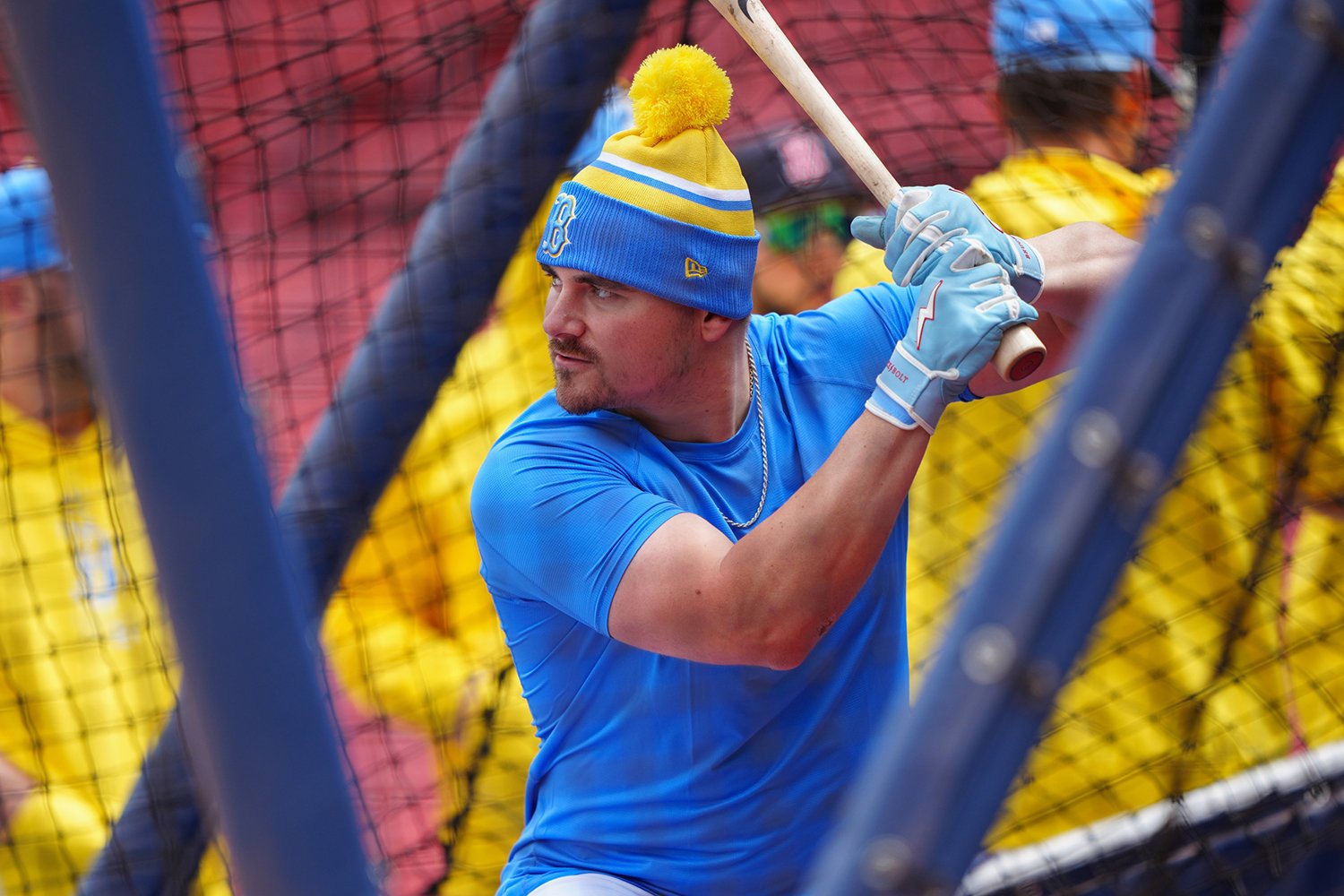 I’m not trying to offer up some contrarian take here. The Red Sox need to go out and get a right-handed hitter. Rafael Devers bats from the left side, as do Jarren Duran, Triston Casas, Wilyer Abreu, Masataka Yoshida, Roman Anthony, Marcelo Mayer, and Kyle Teel. Now that Tyler O’Neill is a free agent, those are arguably the organization’s five best big-league hitters and three best prospects. Throw in David Hamilton at second base, and you’ve got a full left-handed lineup, complete with designated hitter. That’s not just imbalanced; it’s 10 guys all crammed onto one side of the seesaw wondering why they never seem to leave the ground. The Red Sox ran a wRC+ of 104 this season, which ranked 11th in baseball. If we break that down by handedness, we can see that against righties, they were at 105, which ranked 12th, and against lefties, they were 101 wRC+, which ranked 14th. In other words, against both lefties and righties, they were just a hair above league average. And you know what? That’s fine for this .500 team and this tune-up of a season, but going forward, the team wants more and will therefore need to improve. However, I need to remind you of something. I know it feels like the Red Sox ran out a lineup stacked with lefties all season long. And it’s true, 57% of their plate appearances came from lefties this season, third-most in baseball. But keep in mind that across the league, right-handed pitchers threw 73% of all PAs. In other words, if you want to have the platoon advantage in every at-bat, you’re going to have to play a lot more left-handed hitters anyway. The Red Sox found themselves with the platoon advantage 59% of the time, which ranked seventh in baseball. They weren't just good at getting the platoon advantage; they were one of the best teams in the league at it. So sure, they need a right-handed bat or two, but because the ideal lineup isn’t perfectly balanced, you could argue that they weren’t that far out of whack. However, that argument misses some critical context. The first piece of context is that Casas and Yoshida missed large chunks of the season, while Abreu mostly sat against lefties. That gave a lot more PAs to right-handed hitters like Rob Refsnyder and Romy Gonzalez than the ideal lineup would have. The second piece of context is the imminent arrival of all those left-handed prospects mashing their way up the farm system. The third is Boston’s performance against lefties. This season, across the league, left-handed batters put up a 106 wRC+ against righties and 89 against lefties. That’s a 17-point difference. However, looking at the entire league smooths things out a bit. If you break things down on a player-by-player basis, there were 97 left-handed hitters who got at least 50 PAs against left-handed pitchers this season. Those players saw their wRC+ drop by an average of 26 points when they faced lefties rather than righties. Now let’s look at the Boston lefties we mentioned in the first paragraph. To get the biggest and most accurate sample, these are career numbers. Player vs. RHP vs. LHP Difference Triston Casas 129 114 -15 Jarren Duran 124 75 -49 Rafael Devers 137 98 -39 Wilyer Abreu 130 41 -89 Masataka Yoshida 121 84 -37 Casas is the only player whose delta looks anything like the rest of the league’s. Duran sees a roughly 50-point drop-off, while Yoshida and Devers are around 40. We’re only talking about 71 career PAs against lefties for Abreu, be even so, but he goes from 130 to 41, a shocking 91-point swing. Some of that drop-off is surely due to the small sample size – many of his numbers, such as hard-hit rate and strikeout rate are comparable against lefties and righties – but it explains why Abreu got just six starts against lefties all season. In all, when Boston’s left-handed hitters had to face left-handed pitchers, they ran a 73 wRC+, tied for 22nd in baseball. Ranking 22nd isn’t great, but once again, the context makes it even worse. Remember, Boston’s lefties took tons of plate appearances; their 843 PAs against left-handed pitchers ranked second-most in baseball. In other words, that 73 wRC+ was bad, but running it for so long was really bad. According to Weighted Runs Above Average, when Boston’s lefties had to face left-handed pitchers, they cost the team 22 runs, the most in baseball. I’m throwing all of these numbers at you to make a simple point: It’s not just that the Red Sox need a right-handed bat to replace O’Neill; it’s that their current lefties are particularly vulnerable to big, scary platoon splits. Casas and Devers are the only lefties whose bats are anywhere near league-average against lefties. Duran’s glove and baserunning make him an everyday player no matter what, but Abreu got platooned for a reason. As for Yoshida, the designated hitter has to add serious thump to a team’s lineup, so the fact that the Red Sox started Yoshida and his career 84 wRC+ in more than a third of their games against left-handed starters is just plain ugly. Rosters are limited, and you can only platoon so many spots. All in all, you'd rather assemble a roster full of good players and worry about their handedness later. However, if you're platooning two spots, then the right-handed bats that make up the small sides of those platoons need to be very good, or the team is going to stay lopsided. Some of the team's most important players are themselves quite imbalanced, and that makes the job of balancing both the lineup card and the roster even more difficult.
 -
 We are going to spend a lot of time this offseason talking about what the Red Sox need. They’re a team on the rise, with an exciting young core at the big-league level and a promising prospect corps ready to burst onto the scene. Now is the time to make a bona fide push for contention, and it just so happens that the team has a ton of money coming off the books. RosterResource estimates that Boston’s current 2025 commitments add up to a luxury tax payroll of just under $139 million, down from $222.5 million this season, and well below the first threshold of $237 million. In other words, the team can and should go out there and spend some real money. One thing that you’ve been reading both on this website and others is that the first priority should be securing a legit ace to lead the rotation. What would Boston’s season look like if they’d been the ones to reap the benefit of Chris Sale’s miraculous turnaround? Well, Sale’s having a six-win season and the Red Sox are currently three-and-a-half games out of the last Wild Card spot, so the math is pretty easy. If the Red Sox had gotten just four extra wins out of Sale, we wouldn’t be talking about the bright future; we’d be talking about the brilliant present. However, I’d like to take a moment to challenge the notion that Boston must go out and land an ace. First, let’s remember just how good the team’s starters have been this season. As of Wednesday morning, they’re running a 3.76 ERA, sixth-best in baseball. Their 4.11 FIP ranks 18th, and I’d say their true talent is somewhere in the middle. According to FanGraphs, Boston’s starters have put up 11.7 WAR this season, more than five of the 12 teams currently in playoff position. That gives them at the very least an above-average rotation. I’m not trying to tell you that the Red Sox have an elite rotation and that we should expect them to be another step forward in 2025 even without any reinforcements. First, they’ll need to replace Nick Pivetta regardless. Second, history tells us that we should probably expect them to take a small step backward, if for no other reason than that it would be foolish to expect all three of Tanner Houck, Brayan Bello, and Kutter Crawford to stay healthy and effective enough to make 30 starts for a second consecutive season. But it’s not as if the starters are holding the team back. Rotation depth is extremely important. It’s a long season, and people get hurt, which is why it really matters that of the 11 pitchers who started multiple games for the Red Sox this season, not a single one has an ERA above 4.50. Boston may not have a pitcher who can be relied upon to go out there and dominate, but it has a whole stable of pitchers who can keep the game close and give the offense a chance. On a team like that, a great bullpen can punch above its weight. When every game is close, you can steal wins by having a group of relievers who can be trusted to put up zero after zero. I’d also like to remind you that while Tanner Houck may not be an ace, he’s not that far off either. Since his debut in 2020, Houck has ranked 34th among starters in ERA and 26th by FIP. Here’s a list of teams in the playoff hunt that don’t have a pitcher who can match Houck’s 3.9 fWAR this season: Astros, Brewers, Dodgers, Guardians, Mets, Orioles, Twins. And here’s a list of teams that aren’t in contention at all, but do have a pitcher who’s put up more WAR than Houck: Giants, Pirates, White Sox. Furthermore, aces get hurt, or suddenly lose their effectiveness. Concentrating value in one player can help you win the big game, but that makes it hurt all the more when things go wrong. No one needs to be reminded of that fact less than the Red Sox, who rode Chris Sale to a playoff berth, then watched him disintegrate, and are now paying him $17 million to win a Cy Young Award for Atlanta. Having an ace is huge advantage, and that advantage grows in the playoffs, where you can throw your best pitchers more often and each game carries more weight. But it’s not the only way to succeed. We’ll write more in the coming months about the arms available in free agency, but I’d remind you that the two biggest names out there, Max Fried and Corbin Burnes, will be 31 and 30 next season and both have higher FIPs and fewer fWAR than Houck right now. The Red Sox need help in several spots. Catcher, second base, at least one starter, and several bullpen pieces are all on the menu. They’ll also be able to trade from significant outfield and prospect depth. They could sign Willy Adames and move Trevor Story to second. If they decide that Rafael Devers’ defense at third base is no longer acceptable, then they could sign Alex Bregman and trade from newfound depth at DH and first base. They could sign Juan Soto and figure out the rest later. What I'm trying to say is that the Red Sox have the chance to add in just about any way they like. Their window of contention is opening right now, so they need to think about winning both in 2025 and beyond. Landing an ace would be huge, but focusing solely on doing so might not make the most sense given the current landscape. Without many top-end starters on the market, the team needs to keep their eye on what will give them the chance to win. It doesn’t have to be an ace.
 -
There's more than one way to build a team, and Boston's starting pitching has been a bright spot. Reading the market this offseason is more important than a monomaniacal search for a number one starter. We are going to spend a lot of time this offseason talking about what the Red Sox need. They’re a team on the rise, with an exciting young core at the big-league level and a promising prospect corps ready to burst onto the scene. Now is the time to make a bona fide push for contention, and it just so happens that the team has a ton of money coming off the books. RosterResource estimates that Boston’s current 2025 commitments add up to a luxury tax payroll of just under $139 million, down from $222.5 million this season, and well below the first threshold of $237 million. In other words, the team can and should go out there and spend some real money. One thing that you’ve been reading both on this website and others is that the first priority should be securing a legit ace to lead the rotation. What would Boston’s season look like if they’d been the ones to reap the benefit of Chris Sale’s miraculous turnaround? Well, Sale’s having a six-win season and the Red Sox are currently three-and-a-half games out of the last Wild Card spot, so the math is pretty easy. If the Red Sox had gotten just four extra wins out of Sale, we wouldn’t be talking about the bright future; we’d be talking about the brilliant present. However, I’d like to take a moment to challenge the notion that Boston must go out and land an ace. First, let’s remember just how good the team’s starters have been this season. As of Wednesday morning, they’re running a 3.76 ERA, sixth-best in baseball. Their 4.11 FIP ranks 18th, and I’d say their true talent is somewhere in the middle. According to FanGraphs, Boston’s starters have put up 11.7 WAR this season, more than five of the 12 teams currently in playoff position. That gives them at the very least an above-average rotation. I’m not trying to tell you that the Red Sox have an elite rotation and that we should expect them to be another step forward in 2025 even without any reinforcements. First, they’ll need to replace Nick Pivetta regardless. Second, history tells us that we should probably expect them to take a small step backward, if for no other reason than that it would be foolish to expect all three of Tanner Houck, Brayan Bello, and Kutter Crawford to stay healthy and effective enough to make 30 starts for a second consecutive season. But it’s not as if the starters are holding the team back. Rotation depth is extremely important. It’s a long season, and people get hurt, which is why it really matters that of the 11 pitchers who started multiple games for the Red Sox this season, not a single one has an ERA above 4.50. Boston may not have a pitcher who can be relied upon to go out there and dominate, but it has a whole stable of pitchers who can keep the game close and give the offense a chance. On a team like that, a great bullpen can punch above its weight. When every game is close, you can steal wins by having a group of relievers who can be trusted to put up zero after zero. I’d also like to remind you that while Tanner Houck may not be an ace, he’s not that far off either. Since his debut in 2020, Houck has ranked 34th among starters in ERA and 26th by FIP. Here’s a list of teams in the playoff hunt that don’t have a pitcher who can match Houck’s 3.9 fWAR this season: Astros, Brewers, Dodgers, Guardians, Mets, Orioles, Twins. And here’s a list of teams that aren’t in contention at all, but do have a pitcher who’s put up more WAR than Houck: Giants, Pirates, White Sox. Furthermore, aces get hurt, or suddenly lose their effectiveness. Concentrating value in one player can help you win the big game, but that makes it hurt all the more when things go wrong. No one needs to be reminded of that fact less than the Red Sox, who rode Chris Sale to a playoff berth, then watched him disintegrate, and are now paying him $17 million to win a Cy Young Award for Atlanta. Having an ace is huge advantage, and that advantage grows in the playoffs, where you can throw your best pitchers more often and each game carries more weight. But it’s not the only way to succeed. We’ll write more in the coming months about the arms available in free agency, but I’d remind you that the two biggest names out there, Max Fried and Corbin Burnes, will be 31 and 30 next season and both have higher FIPs and fewer fWAR than Houck right now. The Red Sox need help in several spots. Catcher, second base, at least one starter, and several bullpen pieces are all on the menu. They’ll also be able to trade from significant outfield and prospect depth. They could sign Willy Adames and move Trevor Story to second. If they decide that Rafael Devers’ defense at third base is no longer acceptable, then they could sign Alex Bregman and trade from newfound depth at DH and first base. They could sign Juan Soto and figure out the rest later. What I'm trying to say is that the Red Sox have the chance to add in just about any way they like. Their window of contention is opening right now, so they need to think about winning both in 2025 and beyond. Landing an ace would be huge, but focusing solely on doing so might not make the most sense given the current landscape. Without many top-end starters on the market, the team needs to keep their eye on what will give them the chance to win. It doesn’t have to be an ace. View full article
-
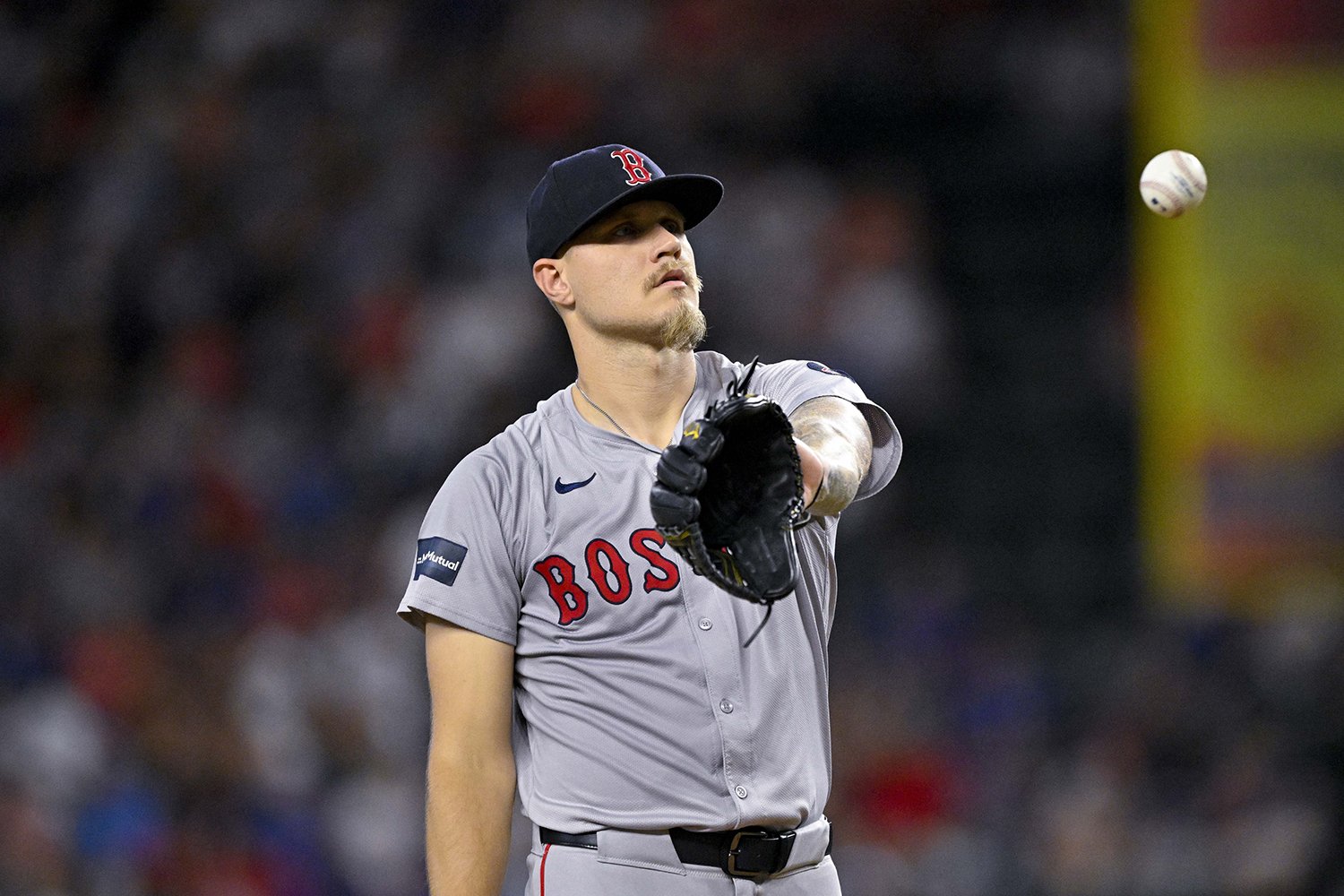 Last night, Tanner Houck made his second start since returning from a two-week absence due to arm fatigue, and for the second start in a row, he was absolutely brilliant. Houck threw five scoreless innings, and was perfect through four. Even after surrendering a single and a walk in the fifth inning, he needed just 57 pitches to carve up a struggling Toronto lineup. The Blue Jays have little left to play for this season, and their date with Houck hammered the futility of their situation home even harder. While Toronto starter Chris Bassitt issued a career-high seven walks, Houck averaged just 3.4 pitches per plate appearance. "It's great," he said after the game, "super efficient." He didn’t strike out a single Blue Jay; he didn’t need to. In fact, he was only credited with making one Blue Jay swing and miss all night, but if you listen closely, you can hear that it wasn't a whiff after all. Vladimir Guerrero Jr. very definitely got a tiny piece of it. Houck also allowed five hard-hit balls, but that didn’t matter much either because all the Blue Jays could manage to do with his pitches was pound them harmlessly into the Rogers Centre turf (though it might not have seemed so harmless to the Toronto groundskeepers, who were left with some major divots to deal with). "Sky's the limit," said Houck, which was ironic considering that 10 of his 15 outs came on groundballs. The outing allowed him to transpose the numbers in his ERA: He started the night at 3.21 and ended at 3.12. The outing also marked Houck's 30th start of the season, the second time he's hit that mark. The Red Sox are building Houck back up slowly. Last week, he shut down the Rays in a four-inning outing, allowing one earned run with four strikeouts and no walks. Despite checking in with four hits against Houck, the Rays managed an average exit velocity of just 77 mph. Here’s how unusual that was: This season, MLB pitchers had made 4,639 different outings in which they faced at least 10 batters. Houck’s gem against the Rays ranked 4,629th in terms of exit velocity; 11th from the bottom. It was an extremely rare feat. This is the age of exit velocity and swing-and-miss stuff, and contact managers like Houck are an increasingly endangered species. Despite his dominant performance against the Rays, Houck’s exit velocity numbers aren’t particularly inspiring this season; according to Baseball Savant, his 42.1% hard-hit rate ranks in the 21st percentile. In other words, 79% of MLB pitchers allow fewer hard-hit balls than Houck does. But Houck has learned his own lessons from the launch angle revolution. Houck has increased his groundball rate in every season of his big-league career. This season, it sits at 55.5%, which ranks sixth among all qualified pitchers. And while his 20.7% strikeout rate puts him in the bottom third of the league, the combination of the two is still impressive. I threw together a quick stat that added together a pitcher’s strikeouts, groundballs, and popups, and then divided it by the total number of batters they faced. In other words, this stat shows the percentage of plate appearances in which the batter registers either a certain out or a batted ball that can’t do anything worse than end up as a single. I set the minimum at 100 batters faced, (which means that this list includes fireballing closers like Mason Miller, who strikes out nearly 42% of the batters he faces). Even amongst that huge sample, Houck checks in at 62.3%, which puts him in the 85th percentile. On the rare occasion when Houck does allow a fly ball or a line drive – the kinds of batted balls on which batters can do real damage – those balls have an average launch angle of just 24 degrees. This season, 251 pitchers have thrown at least 1,000 pitches, and that launch angle ranks fifth-lowest among them. As a result, the air balls that Houck surrenders travel an average of just 277 feet, putting him in the 82nd percentile. In other words, even if you manage to hit the ball hard against Houck, and even if you somehow manage to avoid hitting a grounder, he still makes it extremely hard to actually lift the ball enough to put it over the fence. The exciting this is that Houck’s 3.12 ERA thus far this season has come while inducing all of those grounders in front of the second-worst infield in baseball. According to Statcast’s Fielding Run Values, Boston’s infield has been worth -23 runs this season. Only the Angels have been worse, at -27. If the team can improve its infield defense at all next season – and it would be hard for it to get much worse – a groundball specialist like Houck could benefit in a big way. According to FanGraphs, Houck’s 3.9 WAR ranks 13th among all pitchers. According to Baseball Prospectus, he’s at 3.6, which ranks 22nd. Houck doesn’t light up the radar gun and he doesn’t blow batters away. Somehow, he’s a sinkerballer whose sinker is his worst pitch. And yet all season long, even while battling through a dead arm, he’s been one of the best pitchers in baseball, simply because he can make batters do just about the most boring thing possible: chop the ball straight into the ground.
 -
Houck doesn't light up the radar gun or rack up whiffs. He just gets outs; glorious, boring outs. Last night, Tanner Houck made his second start since returning from a two-week absence due to arm fatigue, and for the second start in a row, he was absolutely brilliant. Houck threw five scoreless innings, and was perfect through four. Even after surrendering a single and a walk in the fifth inning, he needed just 57 pitches to carve up a struggling Toronto lineup. The Blue Jays have little left to play for this season, and their date with Houck hammered the futility of their situation home even harder. While Toronto starter Chris Bassitt issued a career-high seven walks, Houck averaged just 3.4 pitches per plate appearance. "It's great," he said after the game, "super efficient." He didn’t strike out a single Blue Jay; he didn’t need to. In fact, he was only credited with making one Blue Jay swing and miss all night, but if you listen closely, you can hear that it wasn't a whiff after all. Vladimir Guerrero Jr. very definitely got a tiny piece of it. Houck also allowed five hard-hit balls, but that didn’t matter much either because all the Blue Jays could manage to do with his pitches was pound them harmlessly into the Rogers Centre turf (though it might not have seemed so harmless to the Toronto groundskeepers, who were left with some major divots to deal with). "Sky's the limit," said Houck, which was ironic considering that 10 of his 15 outs came on groundballs. The outing allowed him to transpose the numbers in his ERA: He started the night at 3.21 and ended at 3.12. The outing also marked Houck's 30th start of the season, the second time he's hit that mark. The Red Sox are building Houck back up slowly. Last week, he shut down the Rays in a four-inning outing, allowing one earned run with four strikeouts and no walks. Despite checking in with four hits against Houck, the Rays managed an average exit velocity of just 77 mph. Here’s how unusual that was: This season, MLB pitchers had made 4,639 different outings in which they faced at least 10 batters. Houck’s gem against the Rays ranked 4,629th in terms of exit velocity; 11th from the bottom. It was an extremely rare feat. This is the age of exit velocity and swing-and-miss stuff, and contact managers like Houck are an increasingly endangered species. Despite his dominant performance against the Rays, Houck’s exit velocity numbers aren’t particularly inspiring this season; according to Baseball Savant, his 42.1% hard-hit rate ranks in the 21st percentile. In other words, 79% of MLB pitchers allow fewer hard-hit balls than Houck does. But Houck has learned his own lessons from the launch angle revolution. Houck has increased his groundball rate in every season of his big-league career. This season, it sits at 55.5%, which ranks sixth among all qualified pitchers. And while his 20.7% strikeout rate puts him in the bottom third of the league, the combination of the two is still impressive. I threw together a quick stat that added together a pitcher’s strikeouts, groundballs, and popups, and then divided it by the total number of batters they faced. In other words, this stat shows the percentage of plate appearances in which the batter registers either a certain out or a batted ball that can’t do anything worse than end up as a single. I set the minimum at 100 batters faced, (which means that this list includes fireballing closers like Mason Miller, who strikes out nearly 42% of the batters he faces). Even amongst that huge sample, Houck checks in at 62.3%, which puts him in the 85th percentile. On the rare occasion when Houck does allow a fly ball or a line drive – the kinds of batted balls on which batters can do real damage – those balls have an average launch angle of just 24 degrees. This season, 251 pitchers have thrown at least 1,000 pitches, and that launch angle ranks fifth-lowest among them. As a result, the air balls that Houck surrenders travel an average of just 277 feet, putting him in the 82nd percentile. In other words, even if you manage to hit the ball hard against Houck, and even if you somehow manage to avoid hitting a grounder, he still makes it extremely hard to actually lift the ball enough to put it over the fence. The exciting this is that Houck’s 3.12 ERA thus far this season has come while inducing all of those grounders in front of the second-worst infield in baseball. According to Statcast’s Fielding Run Values, Boston’s infield has been worth -23 runs this season. Only the Angels have been worse, at -27. If the team can improve its infield defense at all next season – and it would be hard for it to get much worse – a groundball specialist like Houck could benefit in a big way. According to FanGraphs, Houck’s 3.9 WAR ranks 13th among all pitchers. According to Baseball Prospectus, he’s at 3.6, which ranks 22nd. Houck doesn’t light up the radar gun and he doesn’t blow batters away. Somehow, he’s a sinkerballer whose sinker is his worst pitch. And yet all season long, even while battling through a dead arm, he’s been one of the best pitchers in baseball, simply because he can make batters do just about the most boring thing possible: chop the ball straight into the ground. View full article
-
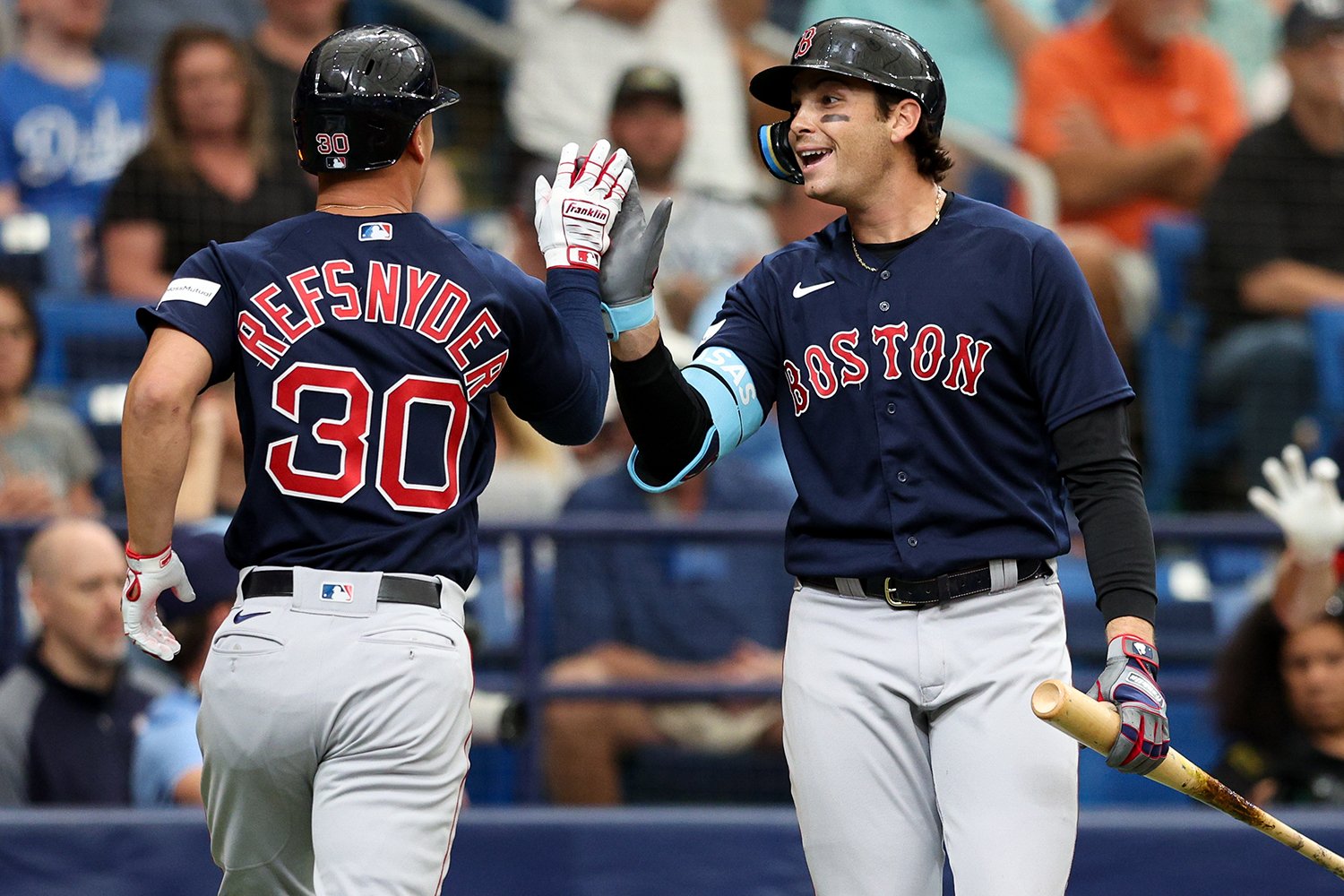 From: Red Sox HR Date: Mon, Sep 23, 2024 at 9:01 AM Subject: Bathroom meetings (again) To: Refsnyder, Rob Hey Rob!! Jerry here. What a day! The HR team had a little get-together on Sunday, and everybody loved watching you grind the Twins down into a paste and bulldoze their dreams. I don't know if I've mentioned this before, but I grew up in Minnesota. When you guys put up that nine-spot in the second game, I thought about all the people I used to know back home who were surely crying into their hot dish at that very moment, and I have to tell you, my soul just brimmed with joy. Anyhow, I’m writing because I heard that you gave Triston a pep talk before his third home run, and that it really boosted his confidence. That’s wonderful. However, I heard that this pep talk took place while he was going to the bathroom, and, well, we’ve talked about this, Rob. We’ve talked about it kind of a lot. I am sure that you had the best of intentions, but the bathroom is where people like their privacy. You cannot just walk up to a teammate while he’s using the urinal and start an “impromptu meeting.” Bathrooms are not for meetings, regardless of whether you’ve sent a calendar invite. I’m sorry for all that negativity. We’re all about fostering a positive culture here, and I so love that you’re putting yourself out there. The Red Sox never want to put a damper on the enthusiasm of any member of our community. But please be mindful that everyone has different boundaries. I know that you don’t consider the bathroom to be a private zone, but by now you really should really be able to remember that your teammates feel differently (as do your coaches, the analytics department, Eric from marketing, and that one hot dog vendor). I'm sure Triston didn't feel threatened. You've got the wholesome good looks of the rom-com protagonist who's such a supportive friend that it takes the female lead a full 90 minutes to realize that he's also a total biscuit. However, we have rules for a reason. Whenever you want to start a conversation with someone, it’s always a good idea to take a moment and ask yourself: If this person didn’t want to talk to me, would they be physically capable of running away? If the answer is no, you should probably wait for them to initiate the conversation. You are a leader in the clubhouse, and that is such an important role. Just try to keep in mind that the team is not under any circumstances looking for a leader in the bathroom. That is not a position that needs filling. It is not a position at all. I should also make it clear that Triston was not the person who informed me about the situation. When something like this happens, I'm required to ask the affected parties if they wish to register a formal complaint, and he said no. Well, I think he was saying no. What he actually said was, "Reffy's a regal raccoon in a world of possums, and I won't be the one who shaves his tail." If you have any insight into what he meant by that, please let me know--both so that I can update the incident report and because if I don't find out, I will spend every day for the rest of my life with that phrase echoing around my head on an endless loop. Unfortunately, this latest slip-up means that you have to watch that sensitivity training video again. I know that you’re not a fan, but as you requested last time, I checked with legal and they confirmed that “Even employees who have displayed the ability to recite the entire script from memory (including hand gestures) are required to watch the video and score a 70% or higher on the multiple-choice quiz following each incident.” Yuck. sorry for all the corporate speak. Not my favorite part of the job! But it’s so important to make sure that everyone is comfortable. I hope you don’t feel like I’m singling you out, because you’re certainly not the only person who makes mistakes. Back in the 2000s, Johnny Damon had the exact opposite problem from yours. I’ve got an entire filing cabinet full of disciplinary memos about it (not to mention a couple dozen contractor invoices for all the times we had to replace the carpet in the conference room). I know you can do this, Rob. Just remember that slogan we came up with: Going to the bathroom is NOT a team sport. And any time you want a refresher on the rules, I am more than happy to talk about it (not in the bathroom). Best regards, Jerry This is satire.
 -
A totally real, not at all fabricated email about the events of Sunday's header. From: Red Sox HR Date: Mon, Sep 23, 2024 at 9:01 AM Subject: Bathroom meetings (again) To: Refsnyder, Rob Hey Rob!! Jerry here. What a day! The HR team had a little get-together on Sunday, and everybody loved watching you grind the Twins down into a paste and bulldoze their dreams. I don't know if I've mentioned this before, but I grew up in Minnesota. When you guys put up that nine-spot in the second game, I thought about all the people I used to know back home who were surely crying into their hot dish at that very moment, and I have to tell you, my soul just brimmed with joy. Anyhow, I’m writing because I heard that you gave Triston a pep talk before his third home run, and that it really boosted his confidence. That’s wonderful. However, I heard that this pep talk took place while he was going to the bathroom, and, well, we’ve talked about this, Rob. We’ve talked about it kind of a lot. I am sure that you had the best of intentions, but the bathroom is where people like their privacy. You cannot just walk up to a teammate while he’s using the urinal and start an “impromptu meeting.” Bathrooms are not for meetings, regardless of whether you’ve sent a calendar invite. I’m sorry for all that negativity. We’re all about fostering a positive culture here, and I so love that you’re putting yourself out there. The Red Sox never want to put a damper on the enthusiasm of any member of our community. But please be mindful that everyone has different boundaries. I know that you don’t consider the bathroom to be a private zone, but by now you really should really be able to remember that your teammates feel differently (as do your coaches, the analytics department, Eric from marketing, and that one hot dog vendor). I'm sure Triston didn't feel threatened. You've got the wholesome good looks of the rom-com protagonist who's such a supportive friend that it takes the female lead a full 90 minutes to realize that he's also a total biscuit. However, we have rules for a reason. Whenever you want to start a conversation with someone, it’s always a good idea to take a moment and ask yourself: If this person didn’t want to talk to me, would they be physically capable of running away? If the answer is no, you should probably wait for them to initiate the conversation. You are a leader in the clubhouse, and that is such an important role. Just try to keep in mind that the team is not under any circumstances looking for a leader in the bathroom. That is not a position that needs filling. It is not a position at all. I should also make it clear that Triston was not the person who informed me about the situation. When something like this happens, I'm required to ask the affected parties if they wish to register a formal complaint, and he said no. Well, I think he was saying no. What he actually said was, "Reffy's a regal raccoon in a world of possums, and I won't be the one who shaves his tail." If you have any insight into what he meant by that, please let me know--both so that I can update the incident report and because if I don't find out, I will spend every day for the rest of my life with that phrase echoing around my head on an endless loop. Unfortunately, this latest slip-up means that you have to watch that sensitivity training video again. I know that you’re not a fan, but as you requested last time, I checked with legal and they confirmed that “Even employees who have displayed the ability to recite the entire script from memory (including hand gestures) are required to watch the video and score a 70% or higher on the multiple-choice quiz following each incident.” Yuck. sorry for all the corporate speak. Not my favorite part of the job! But it’s so important to make sure that everyone is comfortable. I hope you don’t feel like I’m singling you out, because you’re certainly not the only person who makes mistakes. Back in the 2000s, Johnny Damon had the exact opposite problem from yours. I’ve got an entire filing cabinet full of disciplinary memos about it (not to mention a couple dozen contractor invoices for all the times we had to replace the carpet in the conference room). I know you can do this, Rob. Just remember that slogan we came up with: Going to the bathroom is NOT a team sport. And any time you want a refresher on the rules, I am more than happy to talk about it (not in the bathroom). Best regards, Jerry This is satire. View full article
-
Ceddanne Rafaela still needs to develop, and he doesn't look like a middle infielder. But as an everyday center fielder, he still has a real chance to be a bona fide star. On Sunday, our Daniel Fox took a look at Ceddanne Rafaela’s Plate “Discipline,” and the quotation marks were not an accident. Rafaela chases more and walks less than any qualified player in baseball. It’s hard to overstate how disastrous that is. Plate discipline is the problem that can either cause or solve all the other problems. You whiff too much? Well, if you only swing at hittable pitches, you’re going buoy your contact rate by cutting out lots of whiffs on balls in the dirt and fastballs above the zone. You don’t swing very hard? Well, if you only swing at pitches you can really crush, you’ll send your hard-hit rate and exit velocity skyrocketing, because you’ll be cutting out all those mis-hits that come from chasing sliders and getting jammed on high cutters. For a player like Rafaela, who can struggle in both categories, it’s all the more important. Rafaela’s saving grace as a hitter is that he’s pretty good at copying the Isaac Paredes playbook — pulling the ball in the air — and he also benefits from playing in a ballpark well suited to that gambit. He doesn’t necessarily have to crush the ball to lift it over the Green Monster, and when he bounces an even softer-hit ball off it, his speed ensures extra bases in cases where other batters would have been forced to settle for a single. Here's a classic Rafaela double. Rafaela launched it at just 81.7 mph, nowhere near the 95-mph threshold for hard-hit balls, but he’s got so much speed that the left fielder never even considers trying to throw him out. Still, these skills have combined to bring him just an 82 wRC+, meaning that he’s 18% below league-average as a hitter, which makes him the fifth-worst qualified batter in baseball. That’s a big problem, especially because plate disciple is very sticky year-over-year. Sports Info Solutions has been tracking plate discipline data since 2002. Over that timeframe, I compared the rookie and veteran chase rates of every player who made at least 250 plate appearances as a rookie and at least 1500 in total. What you’re seeing is an extremely strong correlation. Once they graduated from rookie status, the average player saw their chase rate improve by just 1.7 percentage points. Evan Gattis, the player with the biggest drop, knocked 8.2 percentage points off his rookie chase rate. But keep in mind that there’s almost nobody on this graph with a chase rate as high as Rafaela’s 46% mark. Even if he were to somehow knock a literally unprecedented 10 points off it, he’d still have one of the highest chase rates in the league. All of this is to confirm what Daniel said on Sunday, that Rafaela “only really has average offensive upside.” His upside as an all-around player, however, is much higher, if he’s put in the right position. There were plenty of reasons to celebrate the early return of Trevor Story last week. Story has spent so much of his time with the Red Sox on the IL, and he deserves some good news. Rafaela’s defensive performance at shortstop is another reason to celebrate the return. In Story’s absence, the advanced metrics rated Rafaela extremely poorly at short. DRS indicated that he cost the Sox just one run, but both DRP and FRV saw him as losing five runs. That ranked him in the bottom five in baseball, even though he spent fewer than 700 innings at the position. I’m sure that he’d improve if he got more time there, but I think one of the big lessons of this season is that shortstop is not Rafaela’s future. It’s time to get him in center field and let him cook. Jarren Duran didn’t just handle center field while Rafaela was in the infield, he absolutely crushed it. However, this is where we need to trust what scouts have been telling us for years: Rafaela can be – in fact, might already be – one of the greatest defensive center fielders in the world. Versatility is great, but with his offensive upside capped right around league-average, he’s just not going to be as valuable to the Sox as a middle infielder. In center field, he can be a legitimate weapon, and with Duran manning a corner, the Boston outfield becomes one of the most fearsome defensive units in all of baseball. This season, Statcast has them saving 16 defensive runs; imagine what that number would be with Rafaela and Duran getting everyday reps in the same position. According to FanGraphs, since 1990, there have been 36 seasons when a position player put up a 4.0-WAR season (which is generally considered All-Star performance) despite being a below-average hitter. Sixteen of those 36 seasons came from center fielders, way more than any other position. In other words, if you’re a player with an iffy bat, playing a fantastic center field represents your best chance by far of playing like a star. Even before the team decides what to do with Tyler O’Neill, the outfield looks mighty to be crowded next season. Duran and Wilyer Abreu demand a place, and Roman Anthony is doing his best to bust down the door as soon as humanly possible. Still, Rafaela’s contract ensures all but ensures that he’ll be on the roster and in the starting lineup for a long, long time. He should get a chance to make the most of it. View full article
-
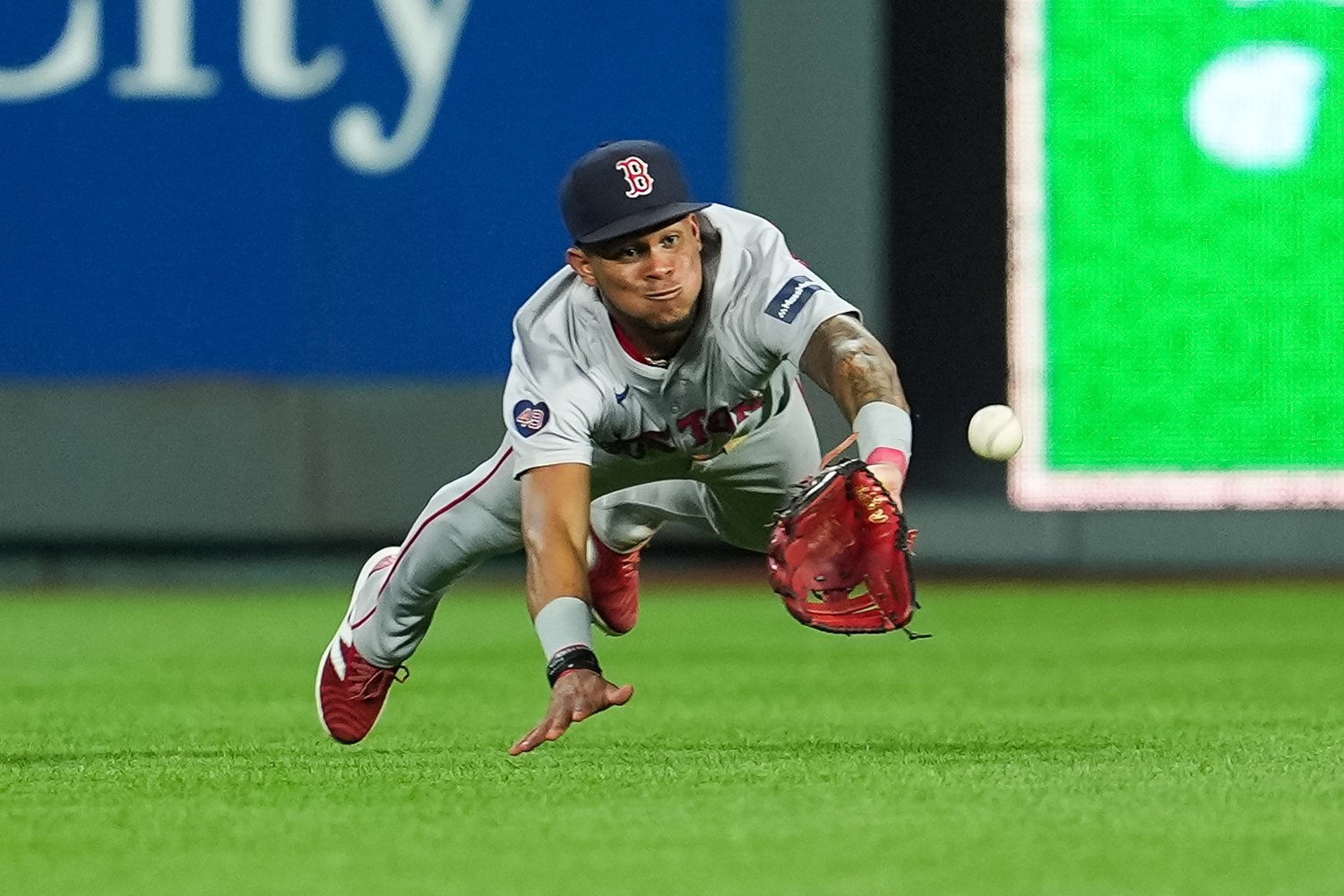 On Sunday, our Daniel Fox took a look at Ceddanne Rafaela’s Plate “Discipline,” and the quotation marks were not an accident. Rafaela chases more and walks less than any qualified player in baseball. It’s hard to overstate how disastrous that is. Plate discipline is the problem that can either cause or solve all the other problems. You whiff too much? Well, if you only swing at hittable pitches, you’re going buoy your contact rate by cutting out lots of whiffs on balls in the dirt and fastballs above the zone. You don’t swing very hard? Well, if you only swing at pitches you can really crush, you’ll send your hard-hit rate and exit velocity skyrocketing, because you’ll be cutting out all those mis-hits that come from chasing sliders and getting jammed on high cutters. For a player like Rafaela, who can struggle in both categories, it’s all the more important. Rafaela’s saving grace as a hitter is that he’s pretty good at copying the Isaac Paredes playbook — pulling the ball in the air — and he also benefits from playing in a ballpark well suited to that gambit. He doesn’t necessarily have to crush the ball to lift it over the Green Monster, and when he bounces an even softer-hit ball off it, his speed ensures extra bases in cases where other batters would have been forced to settle for a single. Here's a classic Rafaela double. Rafaela launched it at just 81.7 mph, nowhere near the 95-mph threshold for hard-hit balls, but he’s got so much speed that the left fielder never even considers trying to throw him out. Still, these skills have combined to bring him just an 82 wRC+, meaning that he’s 18% below league-average as a hitter, which makes him the fifth-worst qualified batter in baseball. That’s a big problem, especially because plate disciple is very sticky year-over-year. Sports Info Solutions has been tracking plate discipline data since 2002. Over that timeframe, I compared the rookie and veteran chase rates of every player who made at least 250 plate appearances as a rookie and at least 1500 in total. What you’re seeing is an extremely strong correlation. Once they graduated from rookie status, the average player saw their chase rate improve by just 1.7 percentage points. Evan Gattis, the player with the biggest drop, knocked 8.2 percentage points off his rookie chase rate. But keep in mind that there’s almost nobody on this graph with a chase rate as high as Rafaela’s 46% mark. Even if he were to somehow knock a literally unprecedented 10 points off it, he’d still have one of the highest chase rates in the league. All of this is to confirm what Daniel said on Sunday, that Rafaela “only really has average offensive upside.” His upside as an all-around player, however, is much higher, if he’s put in the right position. There were plenty of reasons to celebrate the early return of Trevor Story last week. Story has spent so much of his time with the Red Sox on the IL, and he deserves some good news. Rafaela’s defensive performance at shortstop is another reason to celebrate the return. In Story’s absence, the advanced metrics rated Rafaela extremely poorly at short. DRS indicated that he cost the Sox just one run, but both DRP and FRV saw him as losing five runs. That ranked him in the bottom five in baseball, even though he spent fewer than 700 innings at the position. I’m sure that he’d improve if he got more time there, but I think one of the big lessons of this season is that shortstop is not Rafaela’s future. It’s time to get him in center field and let him cook. Jarren Duran didn’t just handle center field while Rafaela was in the infield, he absolutely crushed it. However, this is where we need to trust what scouts have been telling us for years: Rafaela can be – in fact, might already be – one of the greatest defensive center fielders in the world. Versatility is great, but with his offensive upside capped right around league-average, he’s just not going to be as valuable to the Sox as a middle infielder. In center field, he can be a legitimate weapon, and with Duran manning a corner, the Boston outfield becomes one of the most fearsome defensive units in all of baseball. This season, Statcast has them saving 16 defensive runs; imagine what that number would be with Rafaela and Duran getting everyday reps in the same position. According to FanGraphs, since 1990, there have been 36 seasons when a position player put up a 4.0-WAR season (which is generally considered All-Star performance) despite being a below-average hitter. Sixteen of those 36 seasons came from center fielders, way more than any other position. In other words, if you’re a player with an iffy bat, playing a fantastic center field represents your best chance by far of playing like a star. Even before the team decides what to do with Tyler O’Neill, the outfield looks mighty to be crowded next season. Duran and Wilyer Abreu demand a place, and Roman Anthony is doing his best to bust down the door as soon as humanly possible. Still, Rafaela’s contract ensures all but ensures that he’ll be on the roster and in the starting lineup for a long, long time. He should get a chance to make the most of it.
 -
With free agency looming, the 36-year-old Jansen is pitching through injury. The Red Sox seem pretty much fine with that. In case you hadn’t noticed, Kenley Jansen has quietly put up an extremely solid season. His 52.2 innings pitched rank second among Boston relievers. His 3.42 ERA and 3.04 FIP rank second as well. He’s put up 1.4 fWAR, most among Boston’s relievers, and less than a third of a win behind any starter except for Brayan Bello. Those 1.4 WAR also rank 21st among all relievers this season. I’m going to say that again because it bears repeating: 632 pitchers have thrown at least one inning in relief this season, and Jansen has put up more value than 611 of them. The Twins, the Orioles, the Diamondbacks – these are just a couple of the playoff teams that would kill for a reliable pitcher like Jansen right now. However, I don’t get the sense that the Red Sox are particularly concerned right now about whether or not they bring him back next season. I say that not because I have a source or any inside information about the situation. I don’t. I say that simply because they’re not necessarily using him the way a team normally uses a pitcher whose long-term health is a priority. Jansen pitched a scoreless ninth inning against the Rays on Wednesday, earning his 27th save of the season in the process. He also injured his shoulder. Jansen quickly retired his first two batters, then grimaced repeatedly while facing the third, prompting a visit from Alex Cora and a trainer after Jansen issued a walk. The visit didn’t last long. Jansen walked another batter, putting the winning run on base, then went to a three-ball count on the next before fighting back for a strikeout to end the game. “He’s been dealing with some shoulder stuff,” Cora said after the game. “I checked with him. He’s like, ‘I’m good, I’m good to go.’” To be clear, this is nothing new. Jansen pitched through a lat injury earlier this month. On September 6, he told reporters, “I won’t pitch until this [calms] down.” It’s not clear when the injury first reared its head, as he didn’t pitch that day. However, he pitched the next day, which doesn’t really sound like the injury was given much time to calm down. He next pitched in back-to-back games on September 11 and 12. Back-to-backs are particularly tough on a pitcher’s arm. They’re definitely not standard protocol for a pitcher who just put an injury behind them, or, in what was almost certainly Jansen’s case, attempting to pitch through an injury. Perhaps you remember the hubbub from back in May, when Buster Olney reported on the rules that Josh Hader laid down for the Brewers following the 2019 season: “He would not pitch more than two days in a row; he would not pitch more than three outs; he would pitch only in a save situation or when the score was tied.” Some fans didn’t like the idea of a player dictating his own usage to a team, but they kept Hader healthy — not to mention one of the absolute best pitchers in baseball — for the next three years. When Hader reached free agency following the 2023 season, wrote Olney, “Team doctors reviewed his medical records, which sources from multiple front offices described as ‘very unusual’ because they didn't reflect the wear and tear normally seen for a reliever with as many years of service as Hader.” Just to break down the timeline again, Jansen revealed that he was hurt on September 6 and said that he wouldn’t pitch until the injury improved. Then he pitched the next day. Not at all coincidentally, his velocity also ticked way down. Starting on September 7, his sinker has averaged 91.4 mph, down more than two full ticks from the 93.5 he averaged earlier in the season. Four days later, the Sox had him pitch in back-to-back games. He got five days off after that, but it shouldn’t come as a shock at all that after taking the mound on Wednesday, he left in even worse shape. The injury is now described as affecting both his lat and shoulder, but there isn't much clarity about what exactly is wrong. Jansen is about to be a free agent, and ending the season on the IL is not a great way to command top dollar on the open market. More importantly, he’s a ferocious competitor who badly wants to win. He recently told reporters that he signed in Boston because both Cora and erstwhile general manager Chaim Bloom promised him that the Sox would be fighting for a championship. “A.C. and Chaim at that time convinced me really well that they’d definitely contend for a title that second year,” he said. The Sox still have a tiny chance to sneak into the playoffs, and shelving their closer is not exactly a path to success. That’s a whole lot of incentives for Jansen to keep pitching and for the Red Sox to let him. Pete Abraham of the Boston Globe tweeted before yesterday’s game that Jansen, “doesn’t want to go on the IL.” It doesn’t get much simpler than that, and Jansen was filmed throwing on the field soon after. These are not easy decisions. The Red Sox aren’t just going to give up on the season, and Jansen is determined to do all he can to help them win. He's a veteran who has been around the block, and he'll be 37 in just over a week. Although just about any pitcher will tell the manager he's fine with the game on the line, few have so thoroughly earned the right to make their own decisions about their play and health. Still, there’s no universe where letting Jansen keep pitching isn’t a major risk to his long-term health. From all we can tell, both sides seem to be fine with that calculus, but that’s the reality of the situation and we should be honest about it. View full article
-
Kenley Jansen Is Putting His Body on the Line for the Red Sox
Davy Andrews posted an article in Red Sox
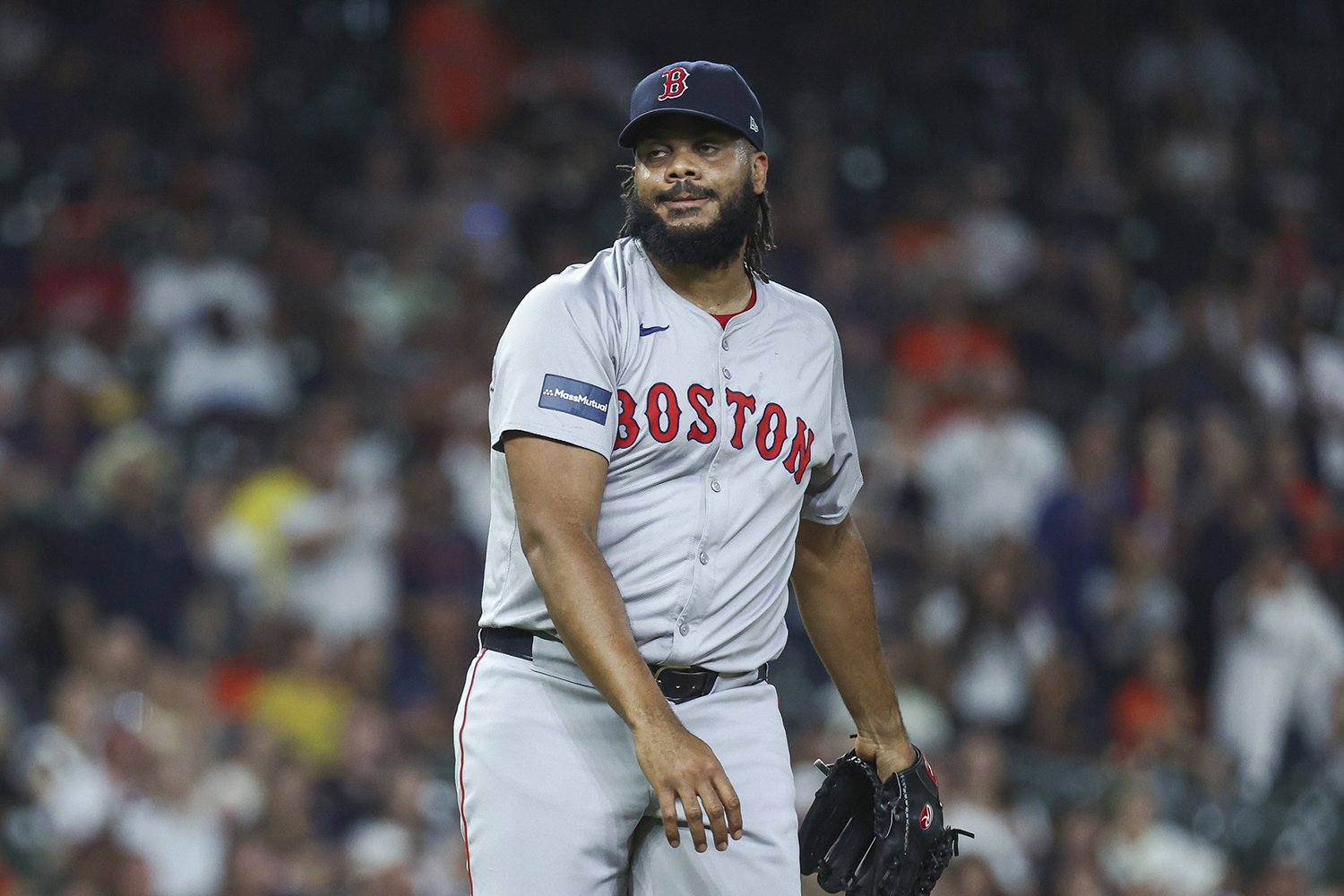 In case you hadn’t noticed, Kenley Jansen has quietly put up an extremely solid season. His 52.2 innings pitched rank second among Boston relievers. His 3.42 ERA and 3.04 FIP rank second as well. He’s put up 1.4 fWAR, most among Boston’s relievers, and less than a third of a win behind any starter except for Brayan Bello. Those 1.4 WAR also rank 21st among all relievers this season. I’m going to say that again because it bears repeating: 632 pitchers have thrown at least one inning in relief this season, and Jansen has put up more value than 611 of them. The Twins, the Orioles, the Diamondbacks – these are just a couple of the playoff teams that would kill for a reliable pitcher like Jansen right now. However, I don’t get the sense that the Red Sox are particularly concerned right now about whether or not they bring him back next season. I say that not because I have a source or any inside information about the situation. I don’t. I say that simply because they’re not necessarily using him the way a team normally uses a pitcher whose long-term health is a priority. Jansen pitched a scoreless ninth inning against the Rays on Wednesday, earning his 27th save of the season in the process. He also injured his shoulder. Jansen quickly retired his first two batters, then grimaced repeatedly while facing the third, prompting a visit from Alex Cora and a trainer after Jansen issued a walk. The visit didn’t last long. Jansen walked another batter, putting the winning run on base, then went to a three-ball count on the next before fighting back for a strikeout to end the game. “He’s been dealing with some shoulder stuff,” Cora said after the game. “I checked with him. He’s like, ‘I’m good, I’m good to go.’” To be clear, this is nothing new. Jansen pitched through a lat injury earlier this month. On September 6, he told reporters, “I won’t pitch until this [calms] down.” It’s not clear when the injury first reared its head, as he didn’t pitch that day. However, he pitched the next day, which doesn’t really sound like the injury was given much time to calm down. He next pitched in back-to-back games on September 11 and 12. Back-to-backs are particularly tough on a pitcher’s arm. They’re definitely not standard protocol for a pitcher who just put an injury behind them, or, in what was almost certainly Jansen’s case, attempting to pitch through an injury. Perhaps you remember the hubbub from back in May, when Buster Olney reported on the rules that Josh Hader laid down for the Brewers following the 2019 season: “He would not pitch more than two days in a row; he would not pitch more than three outs; he would pitch only in a save situation or when the score was tied.” Some fans didn’t like the idea of a player dictating his own usage to a team, but they kept Hader healthy — not to mention one of the absolute best pitchers in baseball — for the next three years. When Hader reached free agency following the 2023 season, wrote Olney, “Team doctors reviewed his medical records, which sources from multiple front offices described as ‘very unusual’ because they didn't reflect the wear and tear normally seen for a reliever with as many years of service as Hader.” Just to break down the timeline again, Jansen revealed that he was hurt on September 6 and said that he wouldn’t pitch until the injury improved. Then he pitched the next day. Not at all coincidentally, his velocity also ticked way down. Starting on September 7, his sinker has averaged 91.4 mph, down more than two full ticks from the 93.5 he averaged earlier in the season. Four days later, the Sox had him pitch in back-to-back games. He got five days off after that, but it shouldn’t come as a shock at all that after taking the mound on Wednesday, he left in even worse shape. The injury is now described as affecting both his lat and shoulder, but there isn't much clarity about what exactly is wrong. Jansen is about to be a free agent, and ending the season on the IL is not a great way to command top dollar on the open market. More importantly, he’s a ferocious competitor who badly wants to win. He recently told reporters that he signed in Boston because both Cora and erstwhile general manager Chaim Bloom promised him that the Sox would be fighting for a championship. “A.C. and Chaim at that time convinced me really well that they’d definitely contend for a title that second year,” he said. The Sox still have a tiny chance to sneak into the playoffs, and shelving their closer is not exactly a path to success. That’s a whole lot of incentives for Jansen to keep pitching and for the Red Sox to let him. Pete Abraham of the Boston Globe tweeted before yesterday’s game that Jansen, “doesn’t want to go on the IL.” It doesn’t get much simpler than that, and Jansen was filmed throwing on the field soon after. These are not easy decisions. The Red Sox aren’t just going to give up on the season, and Jansen is determined to do all he can to help them win. He's a veteran who has been around the block, and he'll be 37 in just over a week. Although just about any pitcher will tell the manager he's fine with the game on the line, few have so thoroughly earned the right to make their own decisions about their play and health. Still, there’s no universe where letting Jansen keep pitching isn’t a major risk to his long-term health. From all we can tell, both sides seem to be fine with that calculus, but that’s the reality of the situation and we should be honest about it.
 -
Alex Cora Wants the Red Sox Stars To Play Every Day. Is That a Good Idea?
Davy Andrews posted an article in Red Sox
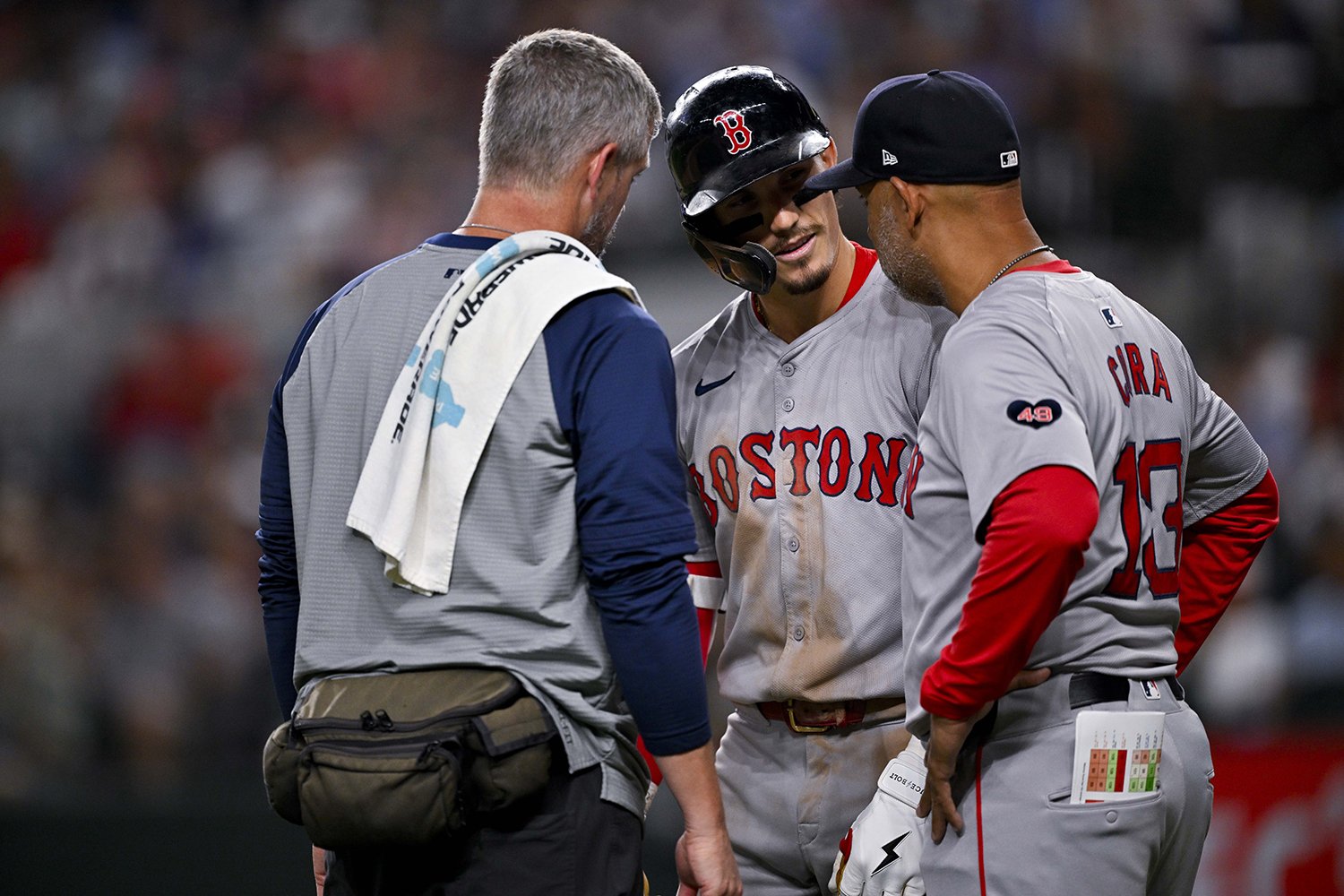 On Friday morning, with the Red Sox in New York to face the Yankees, Alex Cora took a trip over to Secaucus, New Jersey, to appear on MLB Network’s morning show, MLB Central. Cora’s comments were illuminating, and you can listen to the whole segment here. In this article, I want to break down two things he said, one that I liked and one that I took issue with. When Robert Flores asked what fans don’t understand about a manager’s job, Cora let out a long, “Ummm,” and looked at his watch with perfect comedic timing. “I mean, we only have 30 minutes,” he joked. But his serious answer was great and it came without any hesitation whatsoever: “Twenty-six guys,” he said. “You have to manage 26 guys, and they’re all different. From different backgrounds, they have different goals. Yes, the Boston Red Sox want to make it to the playoffs and win the World Series, but each individual has their own goal, right? Thirty homers, .300, 30 saves, all that. And you have to manage that.” He went on to discuss media responsibilities and other aspects of the job, but it was clear that managing all of those different personalities and priorities is top of mind for him, and it was an impressive answer. His second answer left me a little worried. Cora started by saying that during spring training, he asked Jarren Duran whether he’d be up for playing 162 games this season. “I think it’s very important for the Boston Red Sox that the leadoff guy plays every single day. Yeah, you always talk about it here: you have to post, right? Because when Roman Anthony and Marcelo Mayer and [Kyle] Teel and [Kristian] Campbell—they come here, and this is what we do.” Cora makes a fair point. The Red Sox now have the best farm system in baseball and the future looks extremely bright. Having a clubhouse full of players who give it their all and lead by example is extremely important. The team should do whatever it takes to give those prospects the best chance of figuring out the right way to conduct themselves at the big-league level. On the other hand, research shows that expecting players to post for 162 games just doesn’t make a ton of sense. For one thing, both intuition and research tell us that baseball players — like all humans — do better when they get rest. In 2014, Russell Carleton wrote for Baseball Prospectus about how unrested players tend to make worse swing decisions. Just last month, Kiri Oler wrote for FanGraphs about players who have seen their bat speed drop over a period of five or more days with no rest. After they get a day off, those players see their bat speed bounce right back up to their season average. As you may know, plate discipline and bat speed tend to go hand in hand, as players are able to swing harder at hittable pitches. In other words, these two studies are a decade apart, but their conclusions support each other perfectly. This stuff is real and increasingly measurable. Players really do need a day off sometimes. Moreover, getting your regulars some rest also comes with the added benefit of giving your substitutes more playing time, which keeps them more engaged and limits the long layoffs that can wreak havoc on a hitter’s timing and confidence. Cora continued, drawing a dubious example into his argument. “The Atlanta Braves,” he said. “I mean they play. And we live in an era that we take care of the players so much, right? Bro, you know what? Your best players, they have to be on the field most of the time.” Cora’s not wrong about the Braves. They don’t believe in rest days at all. Last season, they had eight different players who played in at least 138 games (and three who played in at least 159), and they battered the rest of the league and cruised into the playoffs with the best record in baseball. Then what happened? You could argue that the Braves, whose record-setting offense pummeled the league during the regular season, looked gassed during their short postseason run. They batted just .186 as the Phillies took them out 3-1 in the NLDS. This season, eight of those nine players who played at least 138 games have either gotten hurt, seen their production crater, or both. Most notably, Ronald Acuña Jr. played in 159 games in his first full season back from an ACL tear, cruising to the NL MVP. He never looked 100% this season and tore his other ACL in May. First baseman has played in more than 450 consecutive games (including every game both this season and last season), and his production has fallen off so dramatically that he’s gone from fourth in the MVP voting to a replacement-level player. Third baseman Austin Riley played in 159 games, finished seventh in the MVP voting, and then saw his production crater this season before a broken hand knocked him out in August. Ozzie Albies played 148 games last season and got MVP votes, but this year he's been below replacement-level and suffered two broken bones. I could go on. Regression to the mean obviously played some part in this reversal: the Braves’ position players were unusually good and unusually healthy last season. It was an unlikely outcome last year, and it would be much more unlikely to happen two years in a row. Still, it’s hard to draw a clearer line from no rest in one season to injury and underperformance in the next. The really interesting thing is that, when it comes to himself, Cora seems to understand the power of a break. “I’ll tell you, something that is a lot different between now than in 2018,” he said earlier in the interview. “I would be grinding in the hotel right now. Looking at the computer, looking at the iPad; matchups, whatever. Bro, now? No, no, no. We get up in the morning, we run. We go to Central Park. I just run three miles. I have to disconnect myself from this madness.” That is an extremely healthy outlook, and Cora alluded to the effects that unplugging for an hour a day had on him both mentally and physically. The game is always changing, and managers will always necessarily be more old school than their players (with the notable exception of erstwhile owner/manager/middle schooler Billy Heywood of the Twins). Still, I have to imagine that there are people in the front office who are aware of the salubrious effect of rest. I hope that they’ll prevail on Cora to see that what works for him can work for his players too.
 -
On a recent MLB Network appearance, Alex Cora made it clear that he expects Jarren Duran and other Red Sox stars to be in the lineup every single day. A few words in defense of rest. On Friday morning, with the Red Sox in New York to face the Yankees, Alex Cora took a trip over to Secaucus, New Jersey, to appear on MLB Network’s morning show, MLB Central. Cora’s comments were illuminating, and you can listen to the whole segment here. In this article, I want to break down two things he said, one that I liked and one that I took issue with. When Robert Flores asked what fans don’t understand about a manager’s job, Cora let out a long, “Ummm,” and looked at his watch with perfect comedic timing. “I mean, we only have 30 minutes,” he joked. But his serious answer was great and it came without any hesitation whatsoever: “Twenty-six guys,” he said. “You have to manage 26 guys, and they’re all different. From different backgrounds, they have different goals. Yes, the Boston Red Sox want to make it to the playoffs and win the World Series, but each individual has their own goal, right? Thirty homers, .300, 30 saves, all that. And you have to manage that.” He went on to discuss media responsibilities and other aspects of the job, but it was clear that managing all of those different personalities and priorities is top of mind for him, and it was an impressive answer. His second answer left me a little worried. Cora started by saying that during spring training, he asked Jarren Duran whether he’d be up for playing 162 games this season. “I think it’s very important for the Boston Red Sox that the leadoff guy plays every single day. Yeah, you always talk about it here: you have to post, right? Because when Roman Anthony and Marcelo Mayer and [Kyle] Teel and [Kristian] Campbell—they come here, and this is what we do.” Cora makes a fair point. The Red Sox now have the best farm system in baseball and the future looks extremely bright. Having a clubhouse full of players who give it their all and lead by example is extremely important. The team should do whatever it takes to give those prospects the best chance of figuring out the right way to conduct themselves at the big-league level. On the other hand, research shows that expecting players to post for 162 games just doesn’t make a ton of sense. For one thing, both intuition and research tell us that baseball players — like all humans — do better when they get rest. In 2014, Russell Carleton wrote for Baseball Prospectus about how unrested players tend to make worse swing decisions. Just last month, Kiri Oler wrote for FanGraphs about players who have seen their bat speed drop over a period of five or more days with no rest. After they get a day off, those players see their bat speed bounce right back up to their season average. As you may know, plate discipline and bat speed tend to go hand in hand, as players are able to swing harder at hittable pitches. In other words, these two studies are a decade apart, but their conclusions support each other perfectly. This stuff is real and increasingly measurable. Players really do need a day off sometimes. Moreover, getting your regulars some rest also comes with the added benefit of giving your substitutes more playing time, which keeps them more engaged and limits the long layoffs that can wreak havoc on a hitter’s timing and confidence. Cora continued, drawing a dubious example into his argument. “The Atlanta Braves,” he said. “I mean they play. And we live in an era that we take care of the players so much, right? Bro, you know what? Your best players, they have to be on the field most of the time.” Cora’s not wrong about the Braves. They don’t believe in rest days at all. Last season, they had eight different players who played in at least 138 games (and three who played in at least 159), and they battered the rest of the league and cruised into the playoffs with the best record in baseball. Then what happened? You could argue that the Braves, whose record-setting offense pummeled the league during the regular season, looked gassed during their short postseason run. They batted just .186 as the Phillies took them out 3-1 in the NLDS. This season, eight of those nine players who played at least 138 games have either gotten hurt, seen their production crater, or both. Most notably, Ronald Acuña Jr. played in 159 games in his first full season back from an ACL tear, cruising to the NL MVP. He never looked 100% this season and tore his other ACL in May. First baseman has played in more than 450 consecutive games (including every game both this season and last season), and his production has fallen off so dramatically that he’s gone from fourth in the MVP voting to a replacement-level player. Third baseman Austin Riley played in 159 games, finished seventh in the MVP voting, and then saw his production crater this season before a broken hand knocked him out in August. Ozzie Albies played 148 games last season and got MVP votes, but this year he's been below replacement-level and suffered two broken bones. I could go on. Regression to the mean obviously played some part in this reversal: the Braves’ position players were unusually good and unusually healthy last season. It was an unlikely outcome last year, and it would be much more unlikely to happen two years in a row. Still, it’s hard to draw a clearer line from no rest in one season to injury and underperformance in the next. The really interesting thing is that, when it comes to himself, Cora seems to understand the power of a break. “I’ll tell you, something that is a lot different between now than in 2018,” he said earlier in the interview. “I would be grinding in the hotel right now. Looking at the computer, looking at the iPad; matchups, whatever. Bro, now? No, no, no. We get up in the morning, we run. We go to Central Park. I just run three miles. I have to disconnect myself from this madness.” That is an extremely healthy outlook, and Cora alluded to the effects that unplugging for an hour a day had on him both mentally and physically. The game is always changing, and managers will always necessarily be more old school than their players (with the notable exception of erstwhile owner/manager/middle schooler Billy Heywood of the Twins). Still, I have to imagine that there are people in the front office who are aware of the salubrious effect of rest. I hope that they’ll prevail on Cora to see that what works for him can work for his players too. View full article
-
Jarren Duran has a gift for avoiding double plays, even when he hits a double-play ball. How does he do it? If you watched yesterday’s 5-2 loss to the Yankees, you surely noticed that Jarren Durran grounded into two back-breaking double plays, the second of which strangled a potential rally in the crib and ended the game. A GIDP is normally a rare occurrence for the fleet-footed and left-handed-swinging star, but it may be even less common than you realize. In fact, coming into Sunday’s game, just four of Duran’s 475 batted balls had ended up in double plays. That works out to 0.84%, and of the 381 players who have hit at least 100 balls in play this season, it ranked 362nd. Even after grounding into two double plays yesterday, he still ranks 326th, with a 1.3% rate. We can get even more granular by limiting ourselves to double play situations. Durran has been up with a runner on first and fewer than two outs 127 times. He's now grounded into a double play 4.7% of the time. Of the 182 players who have been in that situation at least 100 times, that ranks 134th. Until yesterday's double-double, he was down near the very, very bottom with a 3.1% rate than ranked 162nd. But what I'm really interested in is how Durran avoids double plays. It's not necessarily that he doesn't hit many double plays. It's what he does when he hits one. Let's look at what happens when the batter hits a groundball in a double-play situation. Poor Kris Bryant has hit six such grounders, and he’s been doubled up every single time. Duran is at the other end of the spectrum. Coming into Sunday’s game, he had hit 32 groundballs in that situation, so his four double plays represented a 12.5% double play rate. This season, there have been 155 players who have hit at least 25 such balls, and that 12.5% mark ranks 144th. Duran really is unusually good at avoiding double plays, even when he hits a double-play ball. Knowing that, if you didn’t watch Sunday’s game, you might be wondering what it actually takes to double Duran up. If you did watch the game, then you know the answer already: It takes an absolute rocket with laser-guided precision. Here’s the first double play in the top of the seventh inning, with the Sox still only down 4-2. The ball was absolutely scorched, leaving Duran’s bat at 111.9 mph. That makes it the 12th-hardest grounder of the season to end up as a double play. The play was extremely close, but only because Gleyber Torres supplied such a wide toss that Anthony Volpe had to execute a pirouette before firing to first base. Even the speedy Duran would have been out by a few steps if Volpe had received anything resembling a clean feed. Here’s the ninth-inning double play ball. This ball was crushed at 105.8 mph. That’s not at the very top of the list, but among the 3,000 or so double plays this season, it ranks around 200th, putting it in the seventh percentile. Not only were both of these balls blasted, they were also hit directly at a fielder. That’s what it takes to double up Duran: a surgical strike. Duran’s bat speed, average exit velocity, and hard-hit rate all rank in the 70th percentile or better. Those are great numbers, but it means that when it comes to hitting the ball hard, he’s still looking up from below at roughly a quarter of the league. However, if we just look at double play balls, Duran catapults right to the top of a somewhat dubious leaderboard. Duran now has six GIDP this season. Five of them qualify as hard-hit and three were hit above 100 mph (with one at 99.9 for good measure). In all, they average 100.7 mph. Only two players have a higher average exit velocity on double play balls: Giancarlo Stanton at 102.6 mph and Pedro Pagés at 101.1. The funny thing is that Stanton and Pagés are at the top of the leaderboard for completely different reasons than Duran. At this point in his career, the 34-year-old Stanton is not so much slow as he is stationary. He’s glacially slow, in the sense that if you were to put Giancarlo Stanton and a glacier in a footrace, one-on-one, Stanton would somehow find a way to finish third. It doesn’t take a hard-hit ball to double him up; there’s no kind of ball on which you couldn’t double him up. He’s at the top simply because he’s physically incapable of swinging or hitting the ball at anything but max effort. Of course all his double-play balls are hard-hit. That’s the only way he knows how to hit a baseball. Anytime you put together a leaderboard for murdering baseballs, you’ll find his name at the top. He is Giancarlo Stanton, the world leader in turning spheres into oblate spheroids. Pagés, on the other hand, is purely a fluke. How’s this for a backhanded compliment: the St. Louis catcher is a little bit faster than Stanton. Unlike Duran, it doesn’t take a hard-hit ball to double him up. Unlike Stanton, he’s not an exit velocity demigod. He hasn’t played too much, and when he has, he hasn’t hit the ball particularly hard. Here’s how he finds himself in second place: Of his 10 hardest-hit balls of the year, three have ended up as double plays. He also grounded into double plays on his 21st- and 36th-hardest hit balls of the season. That is some truly miserable luck. I don’t know what he did to anger the baseball gods, but he’s going to need to make things right in a hurry. So that’s the company Duran’s keeping. Stanton is at the top of the list based on an inability to hit the baseball at anything other than warp speed, and Pagés is there because the universe hates him. Duran, on the other hand, is there because his game features such a perfect combination of speed and power that his double-play balls don’t just need to be tailor-made, they need a couple rounds of alterations too. Here are the four double play balls he’d hit before yesterday’s game. These four look eerily like the two from Sunday, right down to the fact that two of them came in the same game, on August 25 against the Diamondbacks. The two against the Rockies were separated by an enormous two days). All six balls were hit hard directly at a middle infielder, and that middle infielder was stationed very close to second base. In four of them, the shortstop kept the ball himself and stepped on the bag before firing to first. What does it take to double up Jarren Duran? A lot. View full article
-
 If you watched yesterday’s 5-2 loss to the Yankees, you surely noticed that Jarren Durran grounded into two back-breaking double plays, the second of which strangled a potential rally in the crib and ended the game. A GIDP is normally a rare occurrence for the fleet-footed and left-handed-swinging star, but it may be even less common than you realize. In fact, coming into Sunday’s game, just four of Duran’s 475 batted balls had ended up in double plays. That works out to 0.84%, and of the 381 players who have hit at least 100 balls in play this season, it ranked 362nd. Even after grounding into two double plays yesterday, he still ranks 326th, with a 1.3% rate. We can get even more granular by limiting ourselves to double play situations. Durran has been up with a runner on first and fewer than two outs 127 times. He's now grounded into a double play 4.7% of the time. Of the 182 players who have been in that situation at least 100 times, that ranks 134th. Until yesterday's double-double, he was down near the very, very bottom with a 3.1% rate than ranked 162nd. But what I'm really interested in is how Durran avoids double plays. It's not necessarily that he doesn't hit many double plays. It's what he does when he hits one. Let's look at what happens when the batter hits a groundball in a double-play situation. Poor Kris Bryant has hit six such grounders, and he’s been doubled up every single time. Duran is at the other end of the spectrum. Coming into Sunday’s game, he had hit 32 groundballs in that situation, so his four double plays represented a 12.5% double play rate. This season, there have been 155 players who have hit at least 25 such balls, and that 12.5% mark ranks 144th. Duran really is unusually good at avoiding double plays, even when he hits a double-play ball. Knowing that, if you didn’t watch Sunday’s game, you might be wondering what it actually takes to double Duran up. If you did watch the game, then you know the answer already: It takes an absolute rocket with laser-guided precision. Here’s the first double play in the top of the seventh inning, with the Sox still only down 4-2. The ball was absolutely scorched, leaving Duran’s bat at 111.9 mph. That makes it the 12th-hardest grounder of the season to end up as a double play. The play was extremely close, but only because Gleyber Torres supplied such a wide toss that Anthony Volpe had to execute a pirouette before firing to first base. Even the speedy Duran would have been out by a few steps if Volpe had received anything resembling a clean feed. Here’s the ninth-inning double play ball. This ball was crushed at 105.8 mph. That’s not at the very top of the list, but among the 3,000 or so double plays this season, it ranks around 200th, putting it in the seventh percentile. Not only were both of these balls blasted, they were also hit directly at a fielder. That’s what it takes to double up Duran: a surgical strike. Duran’s bat speed, average exit velocity, and hard-hit rate all rank in the 70th percentile or better. Those are great numbers, but it means that when it comes to hitting the ball hard, he’s still looking up from below at roughly a quarter of the league. However, if we just look at double play balls, Duran catapults right to the top of a somewhat dubious leaderboard. Duran now has six GIDP this season. Five of them qualify as hard-hit and three were hit above 100 mph (with one at 99.9 for good measure). In all, they average 100.7 mph. Only two players have a higher average exit velocity on double play balls: Giancarlo Stanton at 102.6 mph and Pedro Pagés at 101.1. The funny thing is that Stanton and Pagés are at the top of the leaderboard for completely different reasons than Duran. At this point in his career, the 34-year-old Stanton is not so much slow as he is stationary. He’s glacially slow, in the sense that if you were to put Giancarlo Stanton and a glacier in a footrace, one-on-one, Stanton would somehow find a way to finish third. It doesn’t take a hard-hit ball to double him up; there’s no kind of ball on which you couldn’t double him up. He’s at the top simply because he’s physically incapable of swinging or hitting the ball at anything but max effort. Of course all his double-play balls are hard-hit. That’s the only way he knows how to hit a baseball. Anytime you put together a leaderboard for murdering baseballs, you’ll find his name at the top. He is Giancarlo Stanton, the world leader in turning spheres into oblate spheroids. Pagés, on the other hand, is purely a fluke. How’s this for a backhanded compliment: the St. Louis catcher is a little bit faster than Stanton. Unlike Duran, it doesn’t take a hard-hit ball to double him up. Unlike Stanton, he’s not an exit velocity demigod. He hasn’t played too much, and when he has, he hasn’t hit the ball particularly hard. Here’s how he finds himself in second place: Of his 10 hardest-hit balls of the year, three have ended up as double plays. He also grounded into double plays on his 21st- and 36th-hardest hit balls of the season. That is some truly miserable luck. I don’t know what he did to anger the baseball gods, but he’s going to need to make things right in a hurry. So that’s the company Duran’s keeping. Stanton is at the top of the list based on an inability to hit the baseball at anything other than warp speed, and Pagés is there because the universe hates him. Duran, on the other hand, is there because his game features such a perfect combination of speed and power that his double-play balls don’t just need to be tailor-made, they need a couple rounds of alterations too. Here are the four double play balls he’d hit before yesterday’s game. These four look eerily like the two from Sunday, right down to the fact that two of them came in the same game, on August 25 against the Diamondbacks. The two against the Rockies were separated by an enormous two days). All six balls were hit hard directly at a middle infielder, and that middle infielder was stationed very close to second base. In four of them, the shortstop kept the ball himself and stepped on the bag before firing to first. What does it take to double up Jarren Duran? A lot.
