


Davy Andrews
-
Posts
196 -
Joined
-
Last visited
Content Type
Profiles
Boston Red Sox Videos
2026 Boston Red Sox Top Prospects Ranking
Boston Red Sox Free Agent & Trade Rumors, Notes, & Tidbits
Guides & Resources
2025 Boston Red Sox Draft Pick Tracker
News
2026 Boston Red Sox Draft Tracker: Picks & Bonuses
Forums
Blogs
Events
Store
Downloads
Gallery
Everything posted by Davy Andrews
-
 Last week, for the second time during this offseason, the Red Sox sent a player they no longer had room for to Pittsburgh in exchange for an untested draft pick. Catching up on some news from last week, the Red Sox pulled off their second trade of the offseason with the Pirates. It was a swap of right-handed pitchers, with Boston sending Chase Shugart, whom they’d designated for assignment earlier in the week, to Pittsburgh, and receiving Matt McShane in return. In an odd twist, not only is McShane is the second right-handed to be traded from the Pirates to the Red Sox for a DFA’d player this offseason, he’s the second one from the 2024 draft class who never ended up throwing a pitch in a game for the Pittsburgh organization. As you might recall, back in December, the Red Sox traded and Enmanuel Valdez to the Pirates for 19th-rounder Joe Vogatsky, whom the Pirates drafted in the 19th round out of James Madison University. In some ways, the movie makes perfect sense and reflects where the two teams are. Shugart is 28 years old and made his major league debut with the Red Sox last season, running a 4.15 ERA over 8 2/3 innings and six appearances. He hasn’t run great numbers in the minors, and projections see him as a replacement-level arm. That’s not very useful to the Red Sox right now, as they have their sights set on making it into the playoffs. However, he’s a big-league ready arm with a fastball that averages 96 mph. The Pirates have their sights set a bit lower, and they have room on their roster to at least take a chance that Shugart figures things out this season. Just as they did back in December during the Valdez-Vogatsky trade, the Red Sox managed to get a lottery ticket in exchange for a player who wasn’t much use to them but had a chance of being useful to the Pirates. As for McShane, he’s listed at 6-foot-4 and 220 pounds, but because he never got into a game with Pittsburgh, there isn’t much to go on aside from his excellent college numbers. McShane was selected in the 13th round of the draft out of Saint Joseph’s University, where he went 14-2 with a 3.76 ERA over 119 2/3 innings pitched. McShane racked up 125 strikeouts in his three years as a Hawk. He also impressed in two summers with the Bourne Braves of the Cape Cod League, making the All-Star team in 2023. He ran a 2.18 ERA in 23 appearances and 45.1 innings, striking out nearly 30% of the batters he faced while allowing just two home runs. According to Jake Bargery of Prospects McShane’s velocity ticked up in 2024, and his fastball reached 96 mph while sitting 93 to 95. However, Bargery noted that this was a particularly high-effort 93 to 95. The fastball was complemented by an effective slider and a somewhat scattershot changeup. If you want to draw your own conclusions, you can watch video of his pro day at Saint Joseph’s (below) or some game footage. For right now, there’s no way to know if and when McShane, or Vogatsky for that matter, will have any impact on the Red Sox. The ability to get a couple lottery picks for a couple players who no longer fit on your roster is a luxury, and the Red Sox will likely view anything they get from them as a bonus. View full article
 -
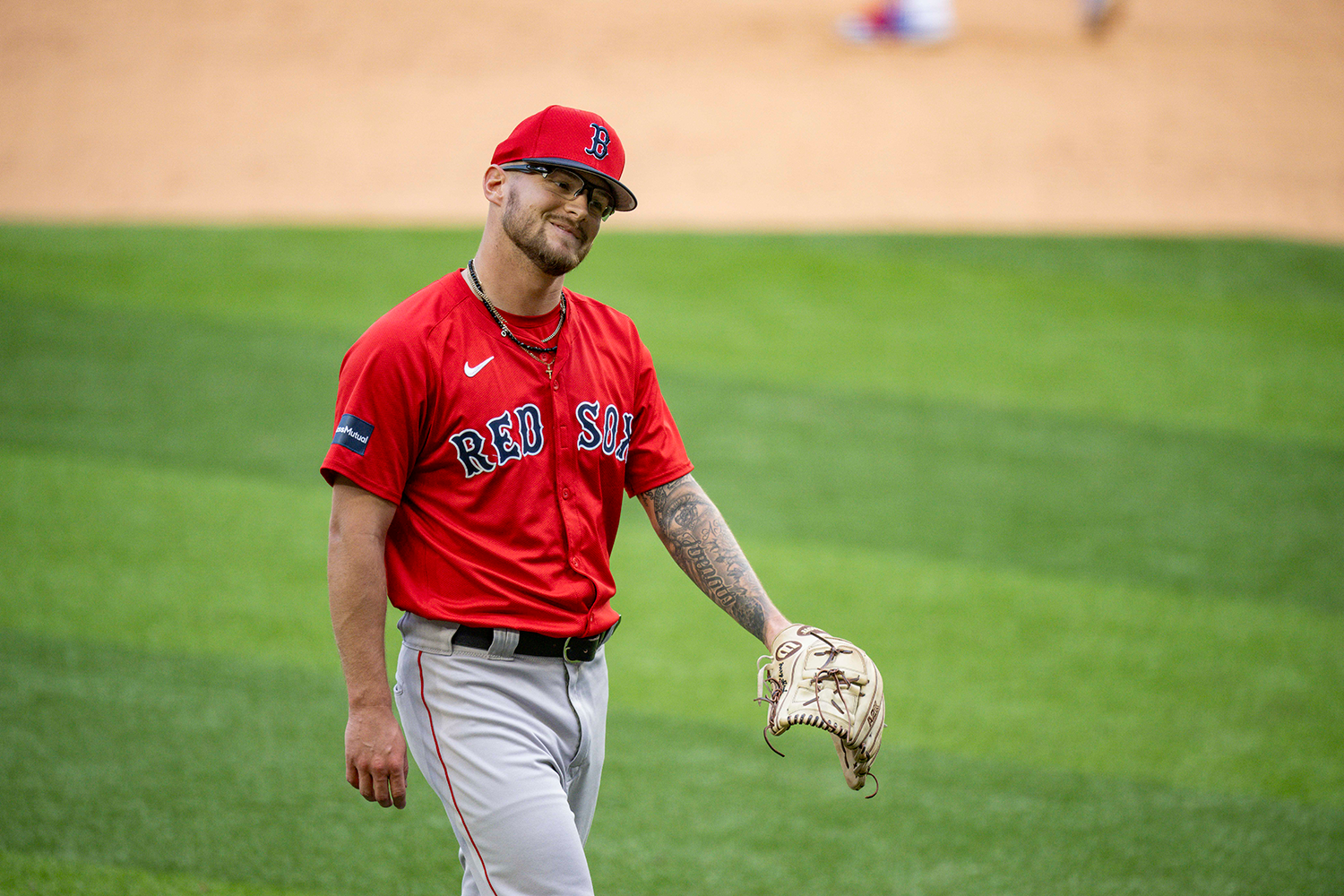 Catching up on some news from last week, the Red Sox pulled off their second trade of the offseason with the Pirates. It was a swap of right-handed pitchers, with Boston sending Chase Shugart, whom they’d designated for assignment earlier in the week, to Pittsburgh, and receiving Matt McShane in return. In an odd twist, not only is McShane is the second right-handed to be traded from the Pirates to the Red Sox for a DFA’d player this offseason, he’s the second one from the 2024 draft class who never ended up throwing a pitch in a game for the Pittsburgh organization. As you might recall, back in December, the Red Sox traded and Enmanuel Valdez to the Pirates for 19th-rounder Joe Vogatsky, whom the Pirates drafted in the 19th round out of James Madison University. In some ways, the movie makes perfect sense and reflects where the two teams are. Shugart is 28 years old and made his major league debut with the Red Sox last season, running a 4.15 ERA over 8 2/3 innings and six appearances. He hasn’t run great numbers in the minors, and projections see him as a replacement-level arm. That’s not very useful to the Red Sox right now, as they have their sights set on making it into the playoffs. However, he’s a big-league ready arm with a fastball that averages 96 mph. The Pirates have their sights set a bit lower, and they have room on their roster to at least take a chance that Shugart figures things out this season. Just as they did back in December during the Valdez-Vogatsky trade, the Red Sox managed to get a lottery ticket in exchange for a player who wasn’t much use to them but had a chance of being useful to the Pirates. As for McShane, he’s listed at 6-foot-4 and 220 pounds, but because he never got into a game with Pittsburgh, there isn’t much to go on aside from his excellent college numbers. McShane was selected in the 13th round of the draft out of Saint Joseph’s University, where he went 14-2 with a 3.76 ERA over 119 2/3 innings pitched. McShane racked up 125 strikeouts in his three years as a Hawk. He also impressed in two summers with the Bourne Braves of the Cape Cod League, making the All-Star team in 2023. He ran a 2.18 ERA in 23 appearances and 45.1 innings, striking out nearly 30% of the batters he faced while allowing just two home runs. According to Jake Bargery of Prospects McShane’s velocity ticked up in 2024, and his fastball reached 96 mph while sitting 93 to 95. However, Bargery noted that this was a particularly high-effort 93 to 95. The fastball was complemented by an effective slider and a somewhat scattershot changeup. If you want to draw your own conclusions, you can watch video of his pro day at Saint Joseph’s (below) or some game footage. For right now, there’s no way to know if and when McShane, or Vogatsky for that matter, will have any impact on the Red Sox. The ability to get a couple lottery picks for a couple players who no longer fit on your roster is a luxury, and the Red Sox will likely view anything they get from them as a bonus.
 -
100%. It's a very short track record, but at this point there's nothing not to like.
-
Campbell has learned to elevate the baseball, and he's not the only player in the system who is reaping the rewards. In his Sunday Notes column at FanGraphs, David Laurila published an interview with Kristian Campbell conducted at this week’s rookie development camp. David speaks to many Red Sox players and coaches, and I've written before about how vital his interviews are, especially for Red Sox fans. This week’s entry was no exception, and it highlighted the way that Boston's player development department is helping hitters become the best versions of themselves. Campbell has changed his swing since being drafted out of Georgia Tech, and when asked about it, he answered simply, “It’s been all about pat path.” He went on, “Instead of being flat, or straight down, I’m trying to hit the ball at a good angle. That’s what I lacked coming into pro baseball, hitting the ball in the air. I never really hit for power before last year.” The numbers bear that out. We don’t have batted ball stats for Campbell’s 2023 season at Georgia Tech, but in his 22 games in the Red Sox organization, he ran a 50% groundball rate. That number dropped to 43% in 2024. Not at all coincidentally, Campbell’s isolated slugging percentage rose from .162 to .228. Campbell has always had excellent bat-to-ball skills, and thanks to a subtle adjustment to his posture and his hand placement, he’s hitting for power and he’s one of the top prospects in all of baseball. I realize that not everyone is on board with the launch angle revolution. Teaching players to hit the ball in the air, emphasizing power over contact, doesn’t sit well with some. However, I want to show you a very simple graph. All I did was take each MLB team’s fly ball rate and wRC+ from 2013 to 2024. The correlation is extremely strong. If you’re a math person, r = .72. If you’re not a math person, just look at that trendline. The Red Sox are the navy blue dot. Over the past 12 seasons, teams that have hit more fly balls have just plain hit much better. An increase of two percentage points in fly ball rate is associated with a six-point increase in wRC+. Now, that’s not just due to fly ball rate. It’s also due to the fact that the smarter teams have caught on to the importance of elevating the ball and figured out how to find and develop players who can do so, and teams that are ahead in one area tend to be ahead in multiple areas. Still, I think the graph speaks for itself. I've written about how Romy Gonzalez has enough power to become a completely different player if he figures out how to lift the ball, and how Rob Refsnyder seemed to take that step last season. In case you’re wondering, Roman Anthony's batted ball stats have followed a similar trajectory to Campbell's. In fact, when Jarrett Seidler broke down Baseball Prospectus's recent prospect rankings, he wrote, "Boston’s track record of swing speed and plane improvements is very real; Anthony himself is perhaps the biggest example of that in recent years." In his three years with the organization, Anthony's fly ball rate has gone from 20% to 24% to 31%, and his ISO has gone from .056 to .194 to .207. This is not an accident. Here’s how Red Sox hitting coordinator John Soteropulos described to Laurila what the team wanted Campbell to work on: "His development program focused on two key objectives, improving ball flight and increasing bat speed. On the ball flight front, we identified specific bio-mechanical markers in his swing that needed refinement. The most significant factor affecting his bat path was the way his torso moved throughout the swing. Since the bat rotates around the spine, his excessive forward lean toward the pitcher created a steep bat path with low attack angles. We implemented a structured training program designed to address these inefficiencies, alongside other areas of focus.” I have to tell you, coach-speak aside, this is exactly what I want to hear from the Red Sox right now. They’re embracing biomechanical analysis, which is the new frontier in player in development. They’re emphasizing bat speed. They’re not just telling players to elevate the ball; they’re helping them do so with instruction tailored to the way their body moves and they're finding success. Regardless of whether or not they turn into stars at the big-league level, Anthony and Campbell wings for the team’s scouting and drafting apparatus, but the biggest wins are on the player development side. They didn’t come to the team as top prospects; the team helped them become top prospects. View full article
-
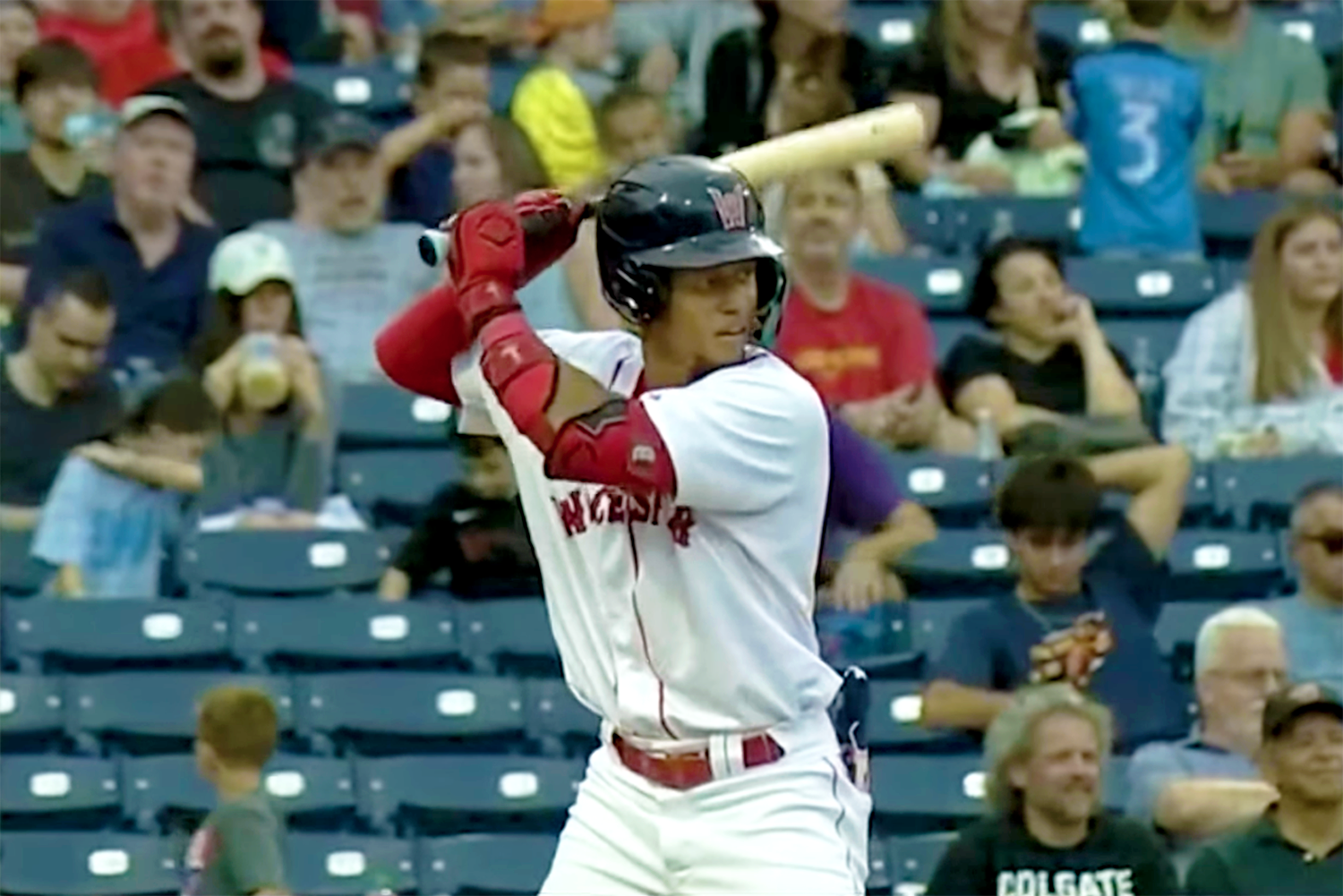 In his Sunday Notes column at FanGraphs, David Laurila published an interview with Kristian Campbell conducted at this week’s rookie development camp. David speaks to many Red Sox players and coaches, and I've written before about how vital his interviews are, especially for Red Sox fans. This week’s entry was no exception, and it highlighted the way that Boston's player development department is helping hitters become the best versions of themselves. Campbell has changed his swing since being drafted out of Georgia Tech, and when asked about it, he answered simply, “It’s been all about pat path.” He went on, “Instead of being flat, or straight down, I’m trying to hit the ball at a good angle. That’s what I lacked coming into pro baseball, hitting the ball in the air. I never really hit for power before last year.” The numbers bear that out. We don’t have batted ball stats for Campbell’s 2023 season at Georgia Tech, but in his 22 games in the Red Sox organization, he ran a 50% groundball rate. That number dropped to 43% in 2024. Not at all coincidentally, Campbell’s isolated slugging percentage rose from .162 to .228. Campbell has always had excellent bat-to-ball skills, and thanks to a subtle adjustment to his posture and his hand placement, he’s hitting for power and he’s one of the top prospects in all of baseball. I realize that not everyone is on board with the launch angle revolution. Teaching players to hit the ball in the air, emphasizing power over contact, doesn’t sit well with some. However, I want to show you a very simple graph. All I did was take each MLB team’s fly ball rate and wRC+ from 2013 to 2024. The correlation is extremely strong. If you’re a math person, r = .72. If you’re not a math person, just look at that trendline. The Red Sox are the navy blue dot. Over the past 12 seasons, teams that have hit more fly balls have just plain hit much better. An increase of two percentage points in fly ball rate is associated with a six-point increase in wRC+. Now, that’s not just due to fly ball rate. It’s also due to the fact that the smarter teams have caught on to the importance of elevating the ball and figured out how to find and develop players who can do so, and teams that are ahead in one area tend to be ahead in multiple areas. Still, I think the graph speaks for itself. I've written about how Romy Gonzalez has enough power to become a completely different player if he figures out how to lift the ball, and how Rob Refsnyder seemed to take that step last season. In case you’re wondering, Roman Anthony's batted ball stats have followed a similar trajectory to Campbell's. In fact, when Jarrett Seidler broke down Baseball Prospectus's recent prospect rankings, he wrote, "Boston’s track record of swing speed and plane improvements is very real; Anthony himself is perhaps the biggest example of that in recent years." In his three years with the organization, Anthony's fly ball rate has gone from 20% to 24% to 31%, and his ISO has gone from .056 to .194 to .207. This is not an accident. Here’s how Red Sox hitting coordinator John Soteropulos described to Laurila what the team wanted Campbell to work on: "His development program focused on two key objectives, improving ball flight and increasing bat speed. On the ball flight front, we identified specific bio-mechanical markers in his swing that needed refinement. The most significant factor affecting his bat path was the way his torso moved throughout the swing. Since the bat rotates around the spine, his excessive forward lean toward the pitcher created a steep bat path with low attack angles. We implemented a structured training program designed to address these inefficiencies, alongside other areas of focus.” I have to tell you, coach-speak aside, this is exactly what I want to hear from the Red Sox right now. They’re embracing biomechanical analysis, which is the new frontier in player in development. They’re emphasizing bat speed. They’re not just telling players to elevate the ball; they’re helping them do so with instruction tailored to the way their body moves and they're finding success. Regardless of whether or not they turn into stars at the big-league level, Anthony and Campbell wings for the team’s scouting and drafting apparatus, but the biggest wins are on the player development side. They didn’t come to the team as top prospects; the team helped them become top prospects.
 -
Connor Wong came out of nowhere to be one of the best offensive catchers in baseball in 2024. What should we expect from him in 2025? In 2024, Connor Wong put up a .280 batting average and ran a 110 wRC+. That made him 10% better than the average hitter. And because the average catcher – for whom defense is much more of a priority than offense – ran a wRC+ of just 91, it made Wong nearly 19% better than his counterparts behind the plate. He even ran a 17-game hit streak before the All-Star break. It was a huge departure for Wong, who came into the season with a career 77 wRC+ and .231 batting average, and it seemed to portend good things. After all, although he’s 28 years old, 2024 was just Wong’s fourth overall season and second full season in the big leagues. On the other hand, Wong’s profile had some clear indications of batted ball luck. How much of his 2024 breakout should we expect to carry over into 2025? If this question sounds familiar, that's because it is. Alex Mayes wrote about it a month ago, and it's definitely worth your time to go back and read what he wrote. However, I wanted to take a second look at it because, as the recent addition of Blake Sabol made clear, the Red Sox are not going to be adding significantly in the catching department this season. Connor Wong is the starter, and whoever ends up as the backup will come into the job with little to no pedigree. The answer to the question of whether Wong's breakout is at all sustainable is going to have an outsized effect on Boston's season. If he goes back to running a 78 wRC+ and represents a black hole in the lineup every game, the Red Sox will have a hard time looking like a playoff contender. Let’s take the bad news first and look into batted ball luck. First, Wong ran a .348 batting average on balls in play. Among players who made at least 450 plate appearances in 2024, that was the seventh-highest mark. Nearly everyone else in the top 20 fell into one of two categories. The first group was Guys Who Hit the Ball Super, Duper Hard, and it featured names like Aaron Judge, Marcell Ozuna, and Vladimir Guerrero Jr.. The second group was Guys Who Are Super, Duper Fast, and it featured names like Elly De La Cruz, Oneil Cruz, Jarren Duran, and Julio Rodríguez (and as you might have noticed, most of these super-fast players also hit the ball very hard). Wong is not in either group. He’s well below average in every contact quality metric, and while he has good speed (excellent for a catcher), he’s not a burner. Most projection systems expect Wong to run a BABIP around .315, and so should we. Next, we need to look at wOBA and xwOBA. wOBA is a metric that takes a player’s overall batting line and puts it on a similar scale to batting average, and xwOBA calculates the same number, but instead of looking at the actual results, it looks at the player’s launch angle and exit velocity to tell you the wOBA the player should have expected to run. From 2023 to 2024, Wong improved his xwOBA from .274 to .288, which is a good sign. However, his .330 actual wOBA was more than 40 points above that expected mark. The results said Wong was hitting like Giancarlo Stanton, but his exit velocity and launch angle sad that he should have been hitting like Anthony Volpe. Among players with at least 400 PAs, that 42-point gap was the second-highest in baseball, which is usually an indicator that the player is due to come back down to earth. xwOBA disliked Wong so intensely for a reason that I mentioned earlier: he did not hit the ball hard. His 86.5-mph average exit velocity was a huge step back from the 89.1 he put up in 2023, and it put him in just the 11th percentile. Likewise, his 34.5% hard-hit rate put him in the 20th percentile. These are extremely bad numbers. However, I think they undersell Wong just a little bit. If you look at his 90th percentile exit velocity, usually a better gauge of a player’s overall power, he was definitely worse in 2024 than he was in 2023, dropping from 105.5 mph to 104.1. However, even that second mark still put him in the 56th percentile. Wong mishits a lot of balls, which hurts his overall EV numbers, but when he really connects, he can hit the ball hard. In another encouraging sign, Wong has so far given some indications that he possesses a skill that tends to allow players to overperform their xwOBAs with some consistency: he’s been great a pulling the ball in the air. xwOBA only predicts how well a player will hit based on their exit velocity and launch angle; it ignores their spray angle (whether they pull it, hit it up the middle or the other way). That’s the right call, as spray angle is a lot more random than those other two factors. However, there are a few players who possess a sort of cheat code when it comes to beating wOBA. They specialize in pulling the ball in the air – think Isaac Paredes, José Ramírez, and Alex Bregman – and because ballparks are shorter down the line than in center, puled balls in the air end up creating tons of damage. Those players are able to consistently overperform their xwOBAs. Wong has only had two full seasons, but in 2023, his pulled fly ball rate put him in the 64th percentile, and in 2024, it put him in the 77th percentile. And keep in mind that because he’s hitting at Fenway Park, those pulled air balls are even more valuable. If he can keep that trend going – and that’s a big if – Wong might have a chance of continuing to beat his underlying numbers. Before we get too hung up on balls in play, however, I want to make sure we appreciate the biggest change in Wong’s game. Form 2023 to 2024, he slashed his strikeout rate from 33.3% to 23.4%. That’s a huge drop, and it took Wong from one of the most strikeout-prone players in all of baseball to nearly approaching the middle of the pack. How did he do it? For starters, he cut his chase rate from 34.5% to 29.5%. Once again, that’s an enormous drop. He also made a big improvement inside the zone, swinging more often and making more contact when he did swing. To be clear, all of those numbers are still worse than average. However, they are really encouraging, because these kinds of plate discipline gains tend to be sticky from year to year. They mean that Wong might have better plate discipline and contact skills than we thought. So after looking at all these factors, what should our takeaway be? Wong made much better swing decisions and got much better at putting the bat on the ball. He was hitting the ball softer, but he was also optimizing his contact. When I look at all of the numbers, I keep trying to figure out what the ideal version of Wong should look like. According to Statcast, his 72-mph bat speed is right around the league average, but even after making way more contact in 2024, his whiff rate and squared-up rate are well below league-average, as are his exit velocity numbers. Wong has the bat speed to hit the ball harder, but even after a big step forward, his bat-to-ball skills are bad enough that he rarely makes solid enough contact to get to his power. If he’s going to keep succeeding, he’ll have to keep pulling the ball in the air, and I don’t think one or two seasons is enough of a track record for us to expect that. Common sense tells us to expect a step back next season, and the projection systems see Wong putting up a wRC+ around 90. I think it’s fair to say that if he outperforms that mark, we should consider his 2025 season a success. As for his defense, I’m sure we’ll be writing about that soon enough. View full article
-
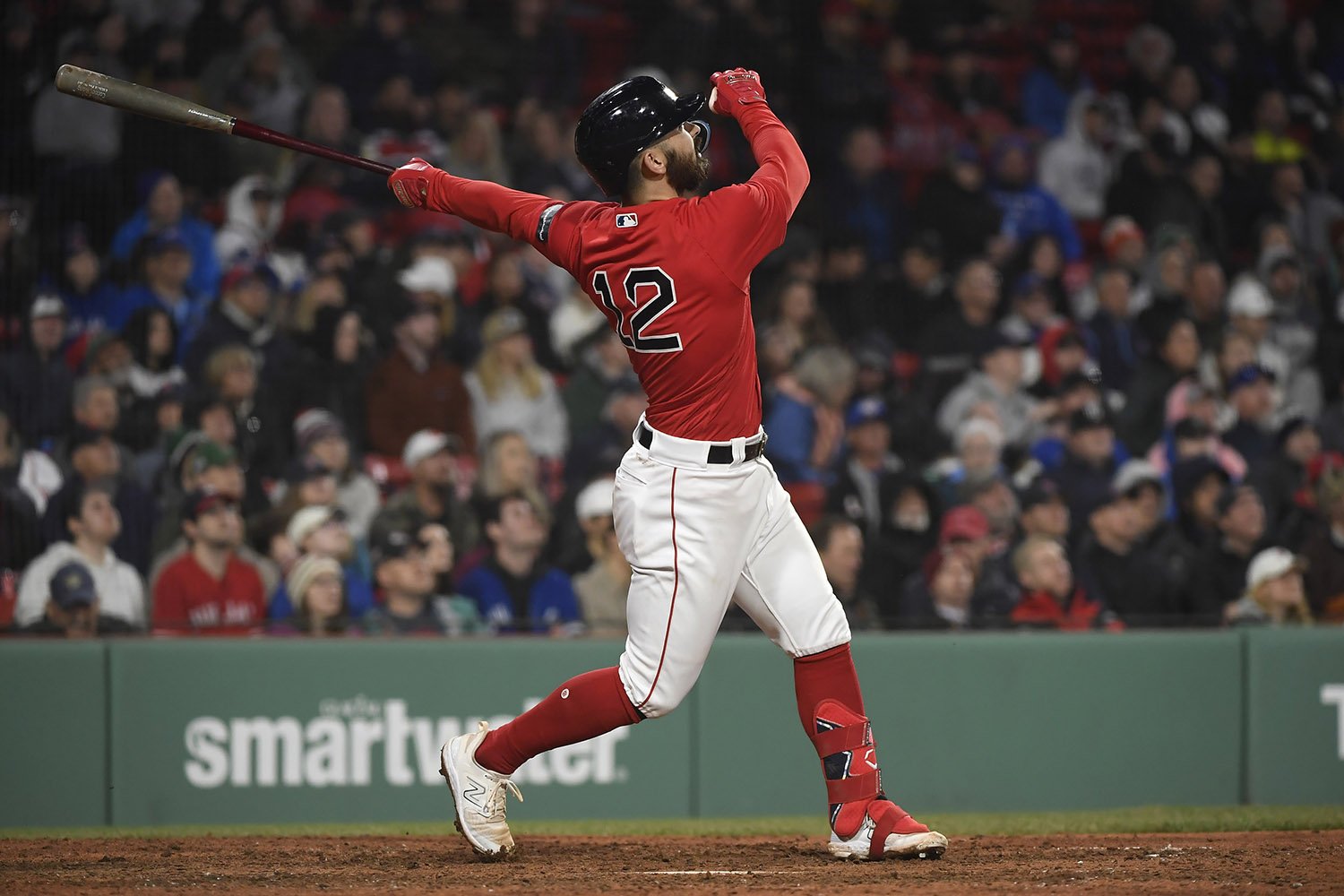 In 2024, Connor Wong put up a .280 batting average and ran a 110 wRC+. That made him 10% better than the average hitter. And because the average catcher – for whom defense is much more of a priority than offense – ran a wRC+ of just 91, it made Wong nearly 19% better than his counterparts behind the plate. He even ran a 17-game hit streak before the All-Star break. It was a huge departure for Wong, who came into the season with a career 77 wRC+ and .231 batting average, and it seemed to portend good things. After all, although he’s 28 years old, 2024 was just Wong’s fourth overall season and second full season in the big leagues. On the other hand, Wong’s profile had some clear indications of batted ball luck. How much of his 2024 breakout should we expect to carry over into 2025? If this question sounds familiar, that's because it is. Alex Mayes wrote about it a month ago, and it's definitely worth your time to go back and read what he wrote. However, I wanted to take a second look at it because, as the recent addition of Blake Sabol made clear, the Red Sox are not going to be adding significantly in the catching department this season. Connor Wong is the starter, and whoever ends up as the backup will come into the job with little to no pedigree. The answer to the question of whether Wong's breakout is at all sustainable is going to have an outsized effect on Boston's season. If he goes back to running a 78 wRC+ and represents a black hole in the lineup every game, the Red Sox will have a hard time looking like a playoff contender. Let’s take the bad news first and look into batted ball luck. First, Wong ran a .348 batting average on balls in play. Among players who made at least 450 plate appearances in 2024, that was the seventh-highest mark. Nearly everyone else in the top 20 fell into one of two categories. The first group was Guys Who Hit the Ball Super, Duper Hard, and it featured names like Aaron Judge, Marcell Ozuna, and Vladimir Guerrero Jr.. The second group was Guys Who Are Super, Duper Fast, and it featured names like Elly De La Cruz, Oneil Cruz, Jarren Duran, and Julio Rodríguez (and as you might have noticed, most of these super-fast players also hit the ball very hard). Wong is not in either group. He’s well below average in every contact quality metric, and while he has good speed (excellent for a catcher), he’s not a burner. Most projection systems expect Wong to run a BABIP around .315, and so should we. Next, we need to look at wOBA and xwOBA. wOBA is a metric that takes a player’s overall batting line and puts it on a similar scale to batting average, and xwOBA calculates the same number, but instead of looking at the actual results, it looks at the player’s launch angle and exit velocity to tell you the wOBA the player should have expected to run. From 2023 to 2024, Wong improved his xwOBA from .274 to .288, which is a good sign. However, his .330 actual wOBA was more than 40 points above that expected mark. The results said Wong was hitting like Giancarlo Stanton, but his exit velocity and launch angle sad that he should have been hitting like Anthony Volpe. Among players with at least 400 PAs, that 42-point gap was the second-highest in baseball, which is usually an indicator that the player is due to come back down to earth. xwOBA disliked Wong so intensely for a reason that I mentioned earlier: he did not hit the ball hard. His 86.5-mph average exit velocity was a huge step back from the 89.1 he put up in 2023, and it put him in just the 11th percentile. Likewise, his 34.5% hard-hit rate put him in the 20th percentile. These are extremely bad numbers. However, I think they undersell Wong just a little bit. If you look at his 90th percentile exit velocity, usually a better gauge of a player’s overall power, he was definitely worse in 2024 than he was in 2023, dropping from 105.5 mph to 104.1. However, even that second mark still put him in the 56th percentile. Wong mishits a lot of balls, which hurts his overall EV numbers, but when he really connects, he can hit the ball hard. In another encouraging sign, Wong has so far given some indications that he possesses a skill that tends to allow players to overperform their xwOBAs with some consistency: he’s been great a pulling the ball in the air. xwOBA only predicts how well a player will hit based on their exit velocity and launch angle; it ignores their spray angle (whether they pull it, hit it up the middle or the other way). That’s the right call, as spray angle is a lot more random than those other two factors. However, there are a few players who possess a sort of cheat code when it comes to beating wOBA. They specialize in pulling the ball in the air – think Isaac Paredes, José Ramírez, and Alex Bregman – and because ballparks are shorter down the line than in center, puled balls in the air end up creating tons of damage. Those players are able to consistently overperform their xwOBAs. Wong has only had two full seasons, but in 2023, his pulled fly ball rate put him in the 64th percentile, and in 2024, it put him in the 77th percentile. And keep in mind that because he’s hitting at Fenway Park, those pulled air balls are even more valuable. If he can keep that trend going – and that’s a big if – Wong might have a chance of continuing to beat his underlying numbers. Before we get too hung up on balls in play, however, I want to make sure we appreciate the biggest change in Wong’s game. Form 2023 to 2024, he slashed his strikeout rate from 33.3% to 23.4%. That’s a huge drop, and it took Wong from one of the most strikeout-prone players in all of baseball to nearly approaching the middle of the pack. How did he do it? For starters, he cut his chase rate from 34.5% to 29.5%. Once again, that’s an enormous drop. He also made a big improvement inside the zone, swinging more often and making more contact when he did swing. To be clear, all of those numbers are still worse than average. However, they are really encouraging, because these kinds of plate discipline gains tend to be sticky from year to year. They mean that Wong might have better plate discipline and contact skills than we thought. So after looking at all these factors, what should our takeaway be? Wong made much better swing decisions and got much better at putting the bat on the ball. He was hitting the ball softer, but he was also optimizing his contact. When I look at all of the numbers, I keep trying to figure out what the ideal version of Wong should look like. According to Statcast, his 72-mph bat speed is right around the league average, but even after making way more contact in 2024, his whiff rate and squared-up rate are well below league-average, as are his exit velocity numbers. Wong has the bat speed to hit the ball harder, but even after a big step forward, his bat-to-ball skills are bad enough that he rarely makes solid enough contact to get to his power. If he’s going to keep succeeding, he’ll have to keep pulling the ball in the air, and I don’t think one or two seasons is enough of a track record for us to expect that. Common sense tells us to expect a step back next season, and the projection systems see Wong putting up a wRC+ around 90. I think it’s fair to say that if he outperforms that mark, we should consider his 2025 season a success. As for his defense, I’m sure we’ll be writing about that soon enough.
 -
The 35-year-old Robert Stock arrived back in Boston after a very long journey, and he doesn't look anything like he did the first time around. Did you miss Robert Stock? Your answer might depend on how much of the lost season of 2020 you blocked out. The Red Sox went 24-36 and finished dead last in the AL East, and in all likelihood less you remember about it, the better off you are. Here comes a reminder anyway. On Tuesday, Chris Cotillo of MassLive reported that the Red Sox and the 35-year-old right-hander have agreed to a minor-league deal that includes an invitation to spring training. Matt Corr broke the deal down for us on Wednesday, but Stock’s odyssey is fascinating enough that it deserves a full retelling. Most recently, Stock pitched for the Naranjeros de Hermosillo of the Mexican winter league, with whom he won the pitching Triple Crown: leading the league with 10 wins, 78 strikeouts, and a 1.60 ERA over 14 starts and 84 1/3 innings. Those kinds of numbers tend to turn some heads, and on January 10, the team announced that he would be missing the semifinals against Jalisco in order to undergo a physical with the Sox. (Their announcement also expressed some hope that he would return after the physical; if the Naranjeros make it past Jalisco, it would be really fun if the Red Sox actually let him pitch in the finals.) Stock has had a long journey. He started as a two-way player, a right-handed pitcher and left-handed-hitting catcher. During his teen years, Baseball America three times named him the best player in the country for his age. He enrolled a year early at USC at age 16 in order to become draft eligible at age 19, and the Cardinals selected him in the second round of the draft in 2009. Stock started his professional career as a catcher, but switched to pitching after running a .644 OPS in Single A in 2011. Stock bounced from the Cardinals to the Astros to the Pirates to the Reds, and his long road to the majors culminated in 2018, when he debuted with the Padres. Stock ran a 2.50 ERA and 2.71 FIP over 32 relief appearances and struck out just under a batter an inning. Despite a worrisome walk rate, it looked like he had finally made it. He had not. Stock made just 10 appearances with the Padres in 2019, running a gruesome 10.13 ERA in the majors and a 3.86 ERA in Triple A. The Phillies picked him up on waivers after the season, then waived him again in July. He spent the short 2020 as a low-leverage relief arm with the Red Sox. Over 10 appearances and 13 1/3 innings, he ran a 4.73 ERA despite a 3.34 FIP. Stock pitched briefly for the Cubs and Mets in 2021, running an 8.00 ERA, with (somehow) even worse peripherals. He spent 2022 with the Doosan Bears of the KBO, and things started to change. Stock pitched only as a starter in Korea, running a 3.60 ERA and a 4.02 over 29 starts. Despite walking an alarming 4.5 batters per nine innings, the performance earned him a minor-league deal with the Brewers. However, pitching mostly out of the bullpen, he struggled to an 8.22 ERA in triple-A Nashville, and by June, he was pitching for the Long Island Ducks of the independent Atlantic League. Once again a starter, Stock went 9-4 with a 4.40 ERA in Long Island, and even threw a no-hitter. Stock signed with the Tecolotes de los Dos Laredos of the Mexican League, going 9-4 and running a 3.38 ERA over 19 starts and 98 2/3 innings. Along with his electric winter ball performance, that was enough to earn him yet another chance. During his time in the majors, Stock was known for walks, a four-seam fastball that could touch 100 mph, and not much else. Stock also had major issues both hitting the strike zone and inducing chases, resulting in a disastrous 23.1% walk rate. On the other hand, his career groundball rate is a beautiful 49.8%, and during his year in Korea, FanGraphs credits him with an absurd 69.6%. That would certainly make him a good fit for Fenway Park, but I wouldn’t be so sure that the Red Sox are getting the same Robert Stock you might remember. Here he is pitching in Mexico, now a full-on side-armer. A recent clip on Stock's YouTube channel includes his velocity and movement profile, highlighting a 95 mph sinker with 18 inches of arm-side run and a sweeper with 20 inches of glove-side break. Needless to say, he never exhibited stuff that looked anything like that back during the Red Sox. After 14 years as a professional, Stock has reinvented himself into an East-West pitcher, a classic sinker-slider guy rather than a flamethrower. It’s not hard to see why the Red Sox might think they can make that package work, presumably out of the bullpen once again. Stock's is a story of incredible perserverance, and just getting this chance is a huge accomplishment. That said, even during his extremely successful time in Mexico, he still walked nearly four batters per nine innings. If Stock is going to find his way to Boston, he has to find a way – for the first time in a pitching career that is now 13 years old – to cut down on the walks. View full article
-
The Incredible Odyssey and Recent Reinvention of Robert Stock
Davy Andrews posted an article in Red Sox
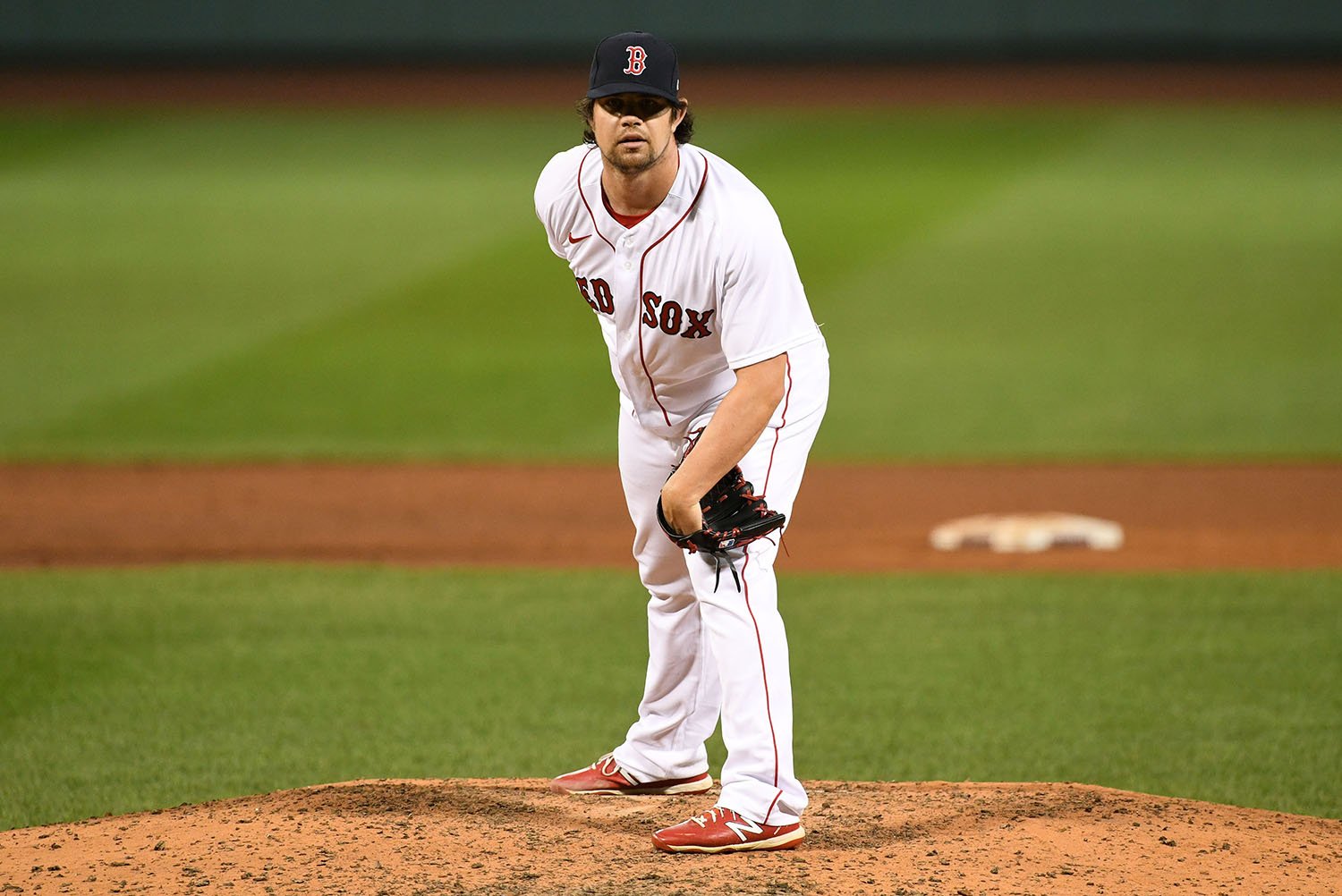 Did you miss Robert Stock? Your answer might depend on how much of the lost season of 2020 you blocked out. The Red Sox went 24-36 and finished dead last in the AL East, and in all likelihood less you remember about it, the better off you are. Here comes a reminder anyway. On Tuesday, Chris Cotillo of MassLive reported that the Red Sox and the 35-year-old right-hander have agreed to a minor-league deal that includes an invitation to spring training. Matt Corr broke the deal down for us on Wednesday, but Stock’s odyssey is fascinating enough that it deserves a full retelling. Most recently, Stock pitched for the Naranjeros de Hermosillo of the Mexican winter league, with whom he won the pitching Triple Crown: leading the league with 10 wins, 78 strikeouts, and a 1.60 ERA over 14 starts and 84 1/3 innings. Those kinds of numbers tend to turn some heads, and on January 10, the team announced that he would be missing the semifinals against Jalisco in order to undergo a physical with the Sox. (Their announcement also expressed some hope that he would return after the physical; if the Naranjeros make it past Jalisco, it would be really fun if the Red Sox actually let him pitch in the finals.) Stock has had a long journey. He started as a two-way player, a right-handed pitcher and left-handed-hitting catcher. During his teen years, Baseball America three times named him the best player in the country for his age. He enrolled a year early at USC at age 16 in order to become draft eligible at age 19, and the Cardinals selected him in the second round of the draft in 2009. Stock started his professional career as a catcher, but switched to pitching after running a .644 OPS in Single A in 2011. Stock bounced from the Cardinals to the Astros to the Pirates to the Reds, and his long road to the majors culminated in 2018, when he debuted with the Padres. Stock ran a 2.50 ERA and 2.71 FIP over 32 relief appearances and struck out just under a batter an inning. Despite a worrisome walk rate, it looked like he had finally made it. He had not. Stock made just 10 appearances with the Padres in 2019, running a gruesome 10.13 ERA in the majors and a 3.86 ERA in Triple A. The Phillies picked him up on waivers after the season, then waived him again in July. He spent the short 2020 as a low-leverage relief arm with the Red Sox. Over 10 appearances and 13 1/3 innings, he ran a 4.73 ERA despite a 3.34 FIP. Stock pitched briefly for the Cubs and Mets in 2021, running an 8.00 ERA, with (somehow) even worse peripherals. He spent 2022 with the Doosan Bears of the KBO, and things started to change. Stock pitched only as a starter in Korea, running a 3.60 ERA and a 4.02 over 29 starts. Despite walking an alarming 4.5 batters per nine innings, the performance earned him a minor-league deal with the Brewers. However, pitching mostly out of the bullpen, he struggled to an 8.22 ERA in triple-A Nashville, and by June, he was pitching for the Long Island Ducks of the independent Atlantic League. Once again a starter, Stock went 9-4 with a 4.40 ERA in Long Island, and even threw a no-hitter. Stock signed with the Tecolotes de los Dos Laredos of the Mexican League, going 9-4 and running a 3.38 ERA over 19 starts and 98 2/3 innings. Along with his electric winter ball performance, that was enough to earn him yet another chance. During his time in the majors, Stock was known for walks, a four-seam fastball that could touch 100 mph, and not much else. Stock also had major issues both hitting the strike zone and inducing chases, resulting in a disastrous 23.1% walk rate. On the other hand, his career groundball rate is a beautiful 49.8%, and during his year in Korea, FanGraphs credits him with an absurd 69.6%. That would certainly make him a good fit for Fenway Park, but I wouldn’t be so sure that the Red Sox are getting the same Robert Stock you might remember. Here he is pitching in Mexico, now a full-on side-armer. A recent clip on Stock's YouTube channel includes his velocity and movement profile, highlighting a 95 mph sinker with 18 inches of arm-side run and a sweeper with 20 inches of glove-side break. Needless to say, he never exhibited stuff that looked anything like that back during the Red Sox. After 14 years as a professional, Stock has reinvented himself into an East-West pitcher, a classic sinker-slider guy rather than a flamethrower. It’s not hard to see why the Red Sox might think they can make that package work, presumably out of the bullpen once again. Stock's is a story of incredible perserverance, and just getting this chance is a huge accomplishment. That said, even during his extremely successful time in Mexico, he still walked nearly four batters per nine innings. If Stock is going to find his way to Boston, he has to find a way – for the first time in a pitching career that is now 13 years old – to cut down on the walks.
 -
If you were starting to worry that the Red Sox were punting on the catcher position, by all means, keep worrying. For the third time this offseason, the Red Sox have gone bargain-hunting at the catcher position. On Wednesday, Hunter Noll of Beyond the Monster reported that the team had acquired Blake Sabol from the Giants. This wasn't a traditional trade, as the Red Sox sent San Francisco a currently undisclosed amount of international bonus pool money. In order to make room for Sabol on the 40-man roster, the team designated Chase Shugart for assignment. The Giants had already DFA’d Sabol last week, but with the Red Sox extremely thin at the catcher position, he was clearly worth parting for some bonus money that they might or might not have spent. The international signing period opened on Wednesday, and in accordance with standard (and ethically abominable) practice, the top players had already agreed to handshake deals with teams, often years in advance. According to a recent report from Eric Longenhagen, the Red Sox are expected to make just two premier international free agent signings. They’re rumored to be committed to shortstop Dorian Soto and center fielder Harold Rivas for $1.2 million and $1 million, respectively. The Red Sox started out with a bit under $6.3 million in their pool, and though they’ll definitely sign several more players who weren’t prominent enough to make Longenhagen’s list, they clearly had some space left over. Sabol, whom the Giants poached from the Pirates in the 2023 Rule 5 draft, is both a catcher and an outfielder, but given Boston’s glut of outfielders, it seems obvious that the team is only bringing him in for his potential behind the plate. After rental Danny Jansen became a free agent, the Red Sox went into the offseason with Connor Wong as the only catcher on the 40-man roster. In November, they signed 31-year-old career backup Seby Zavala to a minor-league deal. In December they traded away star catching prospect Kyle Teel as the centerpiece of the Garrett Crochet deal. The next day, they traded for the Yankees’ fourth-string catcher, Carlos Narváez, in exchange for the organization’s top pitching prospect, Elmer Rodriguez-Cruz. Sabol has 382 big-league plate appearances under his belt, and he never put up a wRC+ below 115 in any of his stops during his three years in the Pittsburgh organization, though he also ran some absurd BABIP numbers. The Giants gave him a real chance in 2023, getting him into 110 games, catching roughly 60% of the time. His defense graded out poorly, and though he put up 91 wRC+, perfectly fine for a catcher, the underlying metrics were scary. He hit the ball hard enough, but whiffed and struck out more than a third of the time. Sabol spent nearly all of the 2024 season in the minors, putting up an 86 wRC+. He seems likely to battle with Narváez for the backup catcher spot. Wong had a great 2024 season at the plate, but it was propped up by some extremely unsustainable underlying metrics. Both Wong and Sabol have worrisome defensive numbers, and both Narváez and Sabol are question marks at the plate. Zavala has never hit, but does have some solid defensive metrics to his name. Combined, Narváez, Sabol, and Zavala have fewer than 1,000 major-league PAs. With Sabol as the third catcher on the 40-man, Zavala makes sense as an emergency option, but the Red Sox are rolling with untested players who don’t project to contribute much. According to Steamer, not one of them is projected for a wRC+ above 90. If there’s a takeaway here, it’s that the Red Sox don’t seem to be too interested in investing in the catcher position. They're going for low-cost, low-ceiling options. Maybe it’s because they didn’t like the options available in free agency and they’re waiting until next year. Maybe they believe that they can get more out of these catchers than the teams who previously employed them. Or maybe their priorities simply lie elsewhere. View full article
-
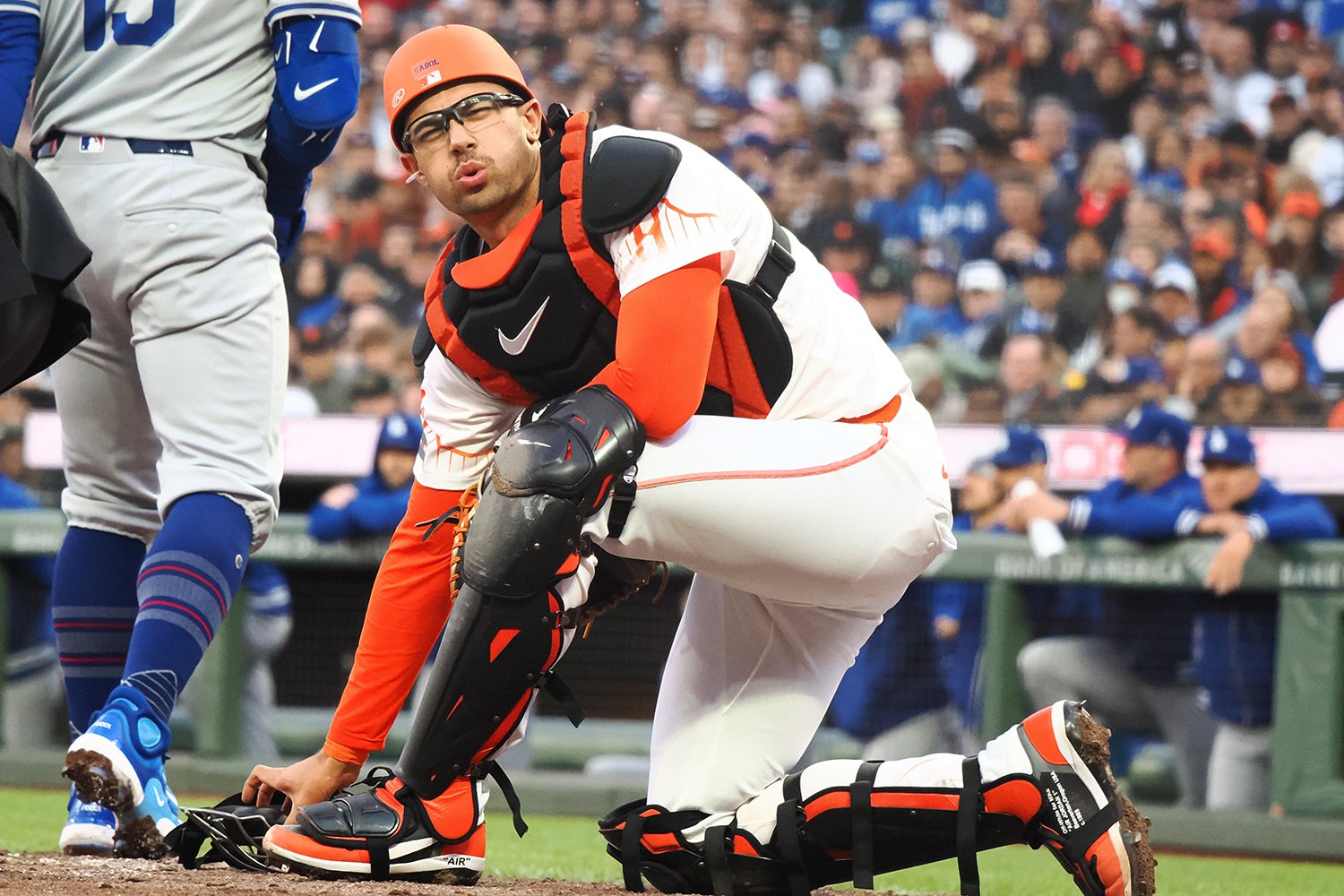 For the third time this offseason, the Red Sox have gone bargain-hunting at the catcher position. On Wednesday, Hunter Noll of Beyond the Monster reported that the team had acquired Blake Sabol from the Giants. This wasn't a traditional trade, as the Red Sox sent San Francisco a currently undisclosed amount of international bonus pool money. In order to make room for Sabol on the 40-man roster, the team designated Chase Shugart for assignment. The Giants had already DFA’d Sabol last week, but with the Red Sox extremely thin at the catcher position, he was clearly worth parting for some bonus money that they might or might not have spent. The international signing period opened on Wednesday, and in accordance with standard (and ethically abominable) practice, the top players had already agreed to handshake deals with teams, often years in advance. According to a recent report from Eric Longenhagen, the Red Sox are expected to make just two premier international free agent signings. They’re rumored to be committed to shortstop Dorian Soto and center fielder Harold Rivas for $1.2 million and $1 million, respectively. The Red Sox started out with a bit under $6.3 million in their pool, and though they’ll definitely sign several more players who weren’t prominent enough to make Longenhagen’s list, they clearly had some space left over. Sabol, whom the Giants poached from the Pirates in the 2023 Rule 5 draft, is both a catcher and an outfielder, but given Boston’s glut of outfielders, it seems obvious that the team is only bringing him in for his potential behind the plate. After rental Danny Jansen became a free agent, the Red Sox went into the offseason with Connor Wong as the only catcher on the 40-man roster. In November, they signed 31-year-old career backup Seby Zavala to a minor-league deal. In December they traded away star catching prospect Kyle Teel as the centerpiece of the Garrett Crochet deal. The next day, they traded for the Yankees’ fourth-string catcher, Carlos Narváez, in exchange for the organization’s top pitching prospect, Elmer Rodriguez-Cruz. Sabol has 382 big-league plate appearances under his belt, and he never put up a wRC+ below 115 in any of his stops during his three years in the Pittsburgh organization, though he also ran some absurd BABIP numbers. The Giants gave him a real chance in 2023, getting him into 110 games, catching roughly 60% of the time. His defense graded out poorly, and though he put up 91 wRC+, perfectly fine for a catcher, the underlying metrics were scary. He hit the ball hard enough, but whiffed and struck out more than a third of the time. Sabol spent nearly all of the 2024 season in the minors, putting up an 86 wRC+. He seems likely to battle with Narváez for the backup catcher spot. Wong had a great 2024 season at the plate, but it was propped up by some extremely unsustainable underlying metrics. Both Wong and Sabol have worrisome defensive numbers, and both Narváez and Sabol are question marks at the plate. Zavala has never hit, but does have some solid defensive metrics to his name. Combined, Narváez, Sabol, and Zavala have fewer than 1,000 major-league PAs. With Sabol as the third catcher on the 40-man, Zavala makes sense as an emergency option, but the Red Sox are rolling with untested players who don’t project to contribute much. According to Steamer, not one of them is projected for a wRC+ above 90. If there’s a takeaway here, it’s that the Red Sox don’t seem to be too interested in investing in the catcher position. They're going for low-cost, low-ceiling options. Maybe it’s because they didn’t like the options available in free agency and they’re waiting until next year. Maybe they believe that they can get more out of these catchers than the teams who previously employed them. Or maybe their priorities simply lie elsewhere.
 -
Some of us have been waiting for this day for quite a while. This morning, Baseball Prospectus released its rankings for the top 100 prospects across baseball. Unsurprisingly, Roman Anthony is still ranked number one. The big news is that Kristian Campbell's incredible 2024 season has pushed him all the way up to number three. Marcelo Mayer checks in at number 25. No other Red Sox prospects made the list, which is unsurprising after the amount of prospect capital they moved in order to get Garrett Crochet and Carlos Narváez. The Dodgers are the only team with two prospects in the top 10 and three in the top 25. View full rumor
-
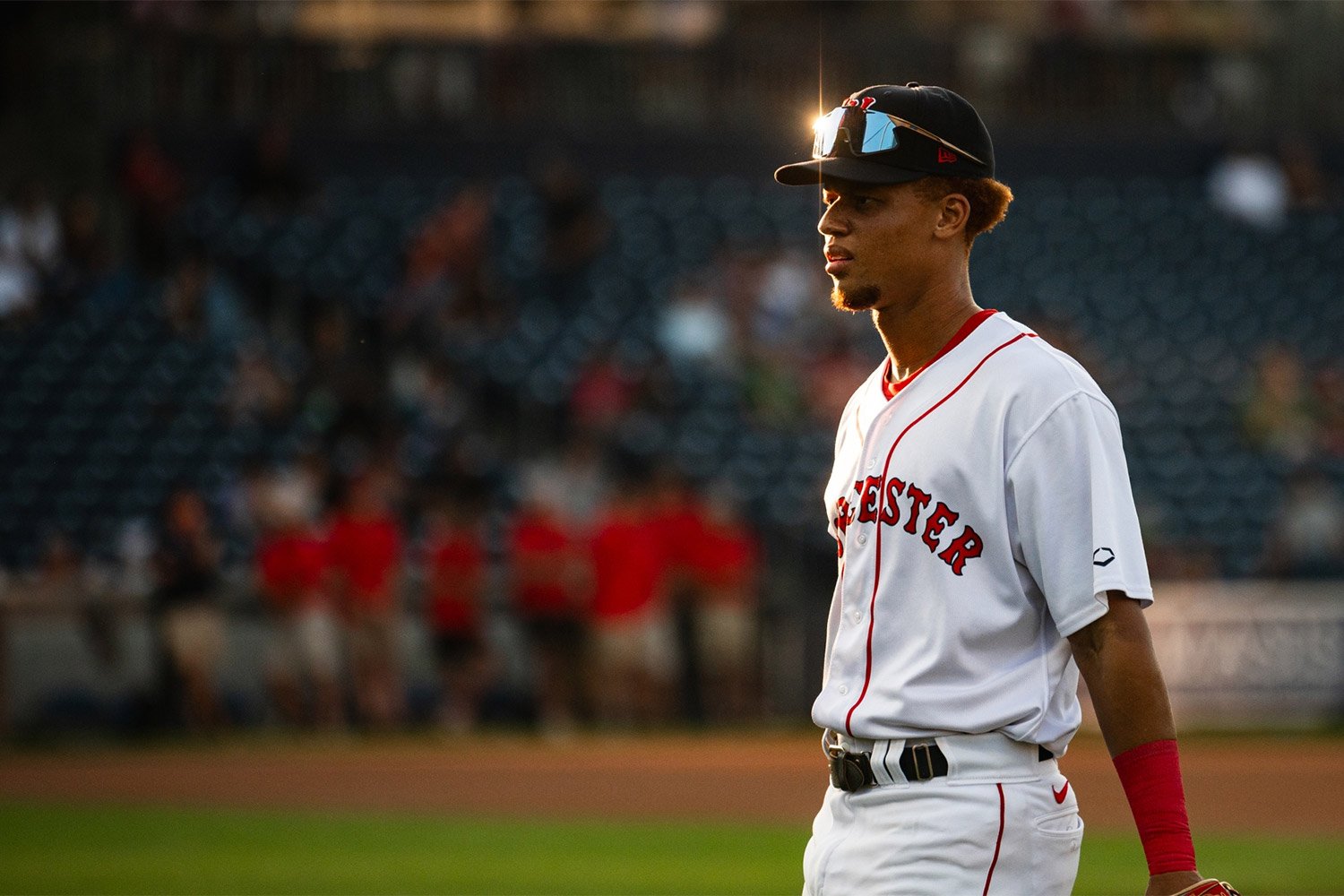 Some of us have been waiting for this day for quite a while. This morning, Baseball Prospectus released its rankings for the top 100 prospects across baseball. Unsurprisingly, Roman Anthony is still ranked number one. The big news is that Kristian Campbell's incredible 2024 season has pushed him all the way up to number three. Marcelo Mayer checks in at number 25. No other Red Sox prospects made the list, which is unsurprising after the amount of prospect capital they moved in order to get Garrett Crochet and Carlos Narváez. The Dodgers are the only team with two prospects in the top 10 and three in the top 25.
 -
And if you believe that one... Over the past three days, Red Sox fans have been bombarded with quotes from players, coaches, and executives at Saturday’s Fenway Fest. This is a Red Sox team with a lot to talk about, and we’ll be covering some of the more interesting takeaways from the event. Our first subject is Masataka Yoshida, about whom Colin McCarthy of Boston.com and Chris Cotillo of MassLive reported several quotes. We should start by letting him speak for himself, and understandably, he discussed the trade rumors that have been swirling throughout the offseason. “I kind of kept (the rumors) muted so I wasn’t really paying attention,” Yoshida said, through interpreter Yutaro Yamaguchi. “I did pay attention to those but it’s out of my control so we’ll see what happens.” We shouldn’t underestimate how difficult it is to be a major league ballplayer while surrounded by trade speculation, let alone doing so in your second season in a new country and while battling through a shoulder injury would require offseason surgery. Manager Alex Cora also addressed Yoshida’s position on the roster, telling reporters that the Red Sox wanted him in the outfield: “Yeah, our outfield defense was great last year, but in a perfect world, if he was healthy, he was going to play the outfield. The throwing part of it wasn’t there so that’s the reason he actually didn’t play. Hopefully, we can get him there and we can use him in the outfield, too.” Cora continued: There are two main things to unpack here. First, as we know, Yoshida’s thumb and shoulder injuries were serious, and they likely affected him at the plate. According to every measure of contact quality, Yoshida hit the ball harder in 2023 than he did in 2024. It’s no stretch to pin at least some of that on the injury. The second claim, that the Red Sox want Yoshida to play the outfield, is a stretch at best. Yoshida played just one emergency inning in the field in 2024, and even before the injury became public knowledge, there was a pretty simple explanation. During his healthy 2023 season, Yoshida graded out as one of the worst fielders in the game. Although he played left for just under half a season in 2023, Statcast had his fielding costing the Red Sox 12 runs, fifth-most in all of baseball. According to Defensive Runs Saved, Yoshida cost the Red Sox four runs, which is very bad, but not necessarily catastrophic. I will refrain from putting together a blooper reel, but suffice it to say that eye test wasn’t kind either. With a sprint speed of 26.1 feet per second, Yoshida is one of the slower players in baseball. According to Statcast, he averaged the seventh-slowest jump among all outfielders in 2023. He really struggled with balls hit near the base of the green monster, and baserunners felt extremely confident running on his arm. According to Statcast, the gap between his advance rate and his expected advance rate was tied for the highest rate in the league. That pretty much covers every aspect of being an outfielder. Fenway has a unique outfield, and maybe a healthy, more experienced Yoshida would have been better out there in 2024, but the idea that the roster is better with him in the field is laughable. First, in Jarren Duran, Ceddanne Rafaela, and Wilyer Abreu, the Red Sox boast three of the best young outfield defenders in baseball. Second, even if Yoshida were to slide into the outfield, there’s no right-handed bat to take over the designated hitter spot. There’s no way to know how much Alex Cora believes what he told reporters. Unfortunately, the most cynical take is also most obvious one: he’s puffing Yoshida up to increase his trade value. Entering his age-31 season with three years and $55.8 million left on his contract, reports indicate that the rehabbing Yoshida has yet to generate any interest around the league. The Red Sox will likely have to pay down some money if they hope to move him. Yoshida has a career 121 wRC+ against righties and an 84 wRC+ against lefties. A DH who should really only be platooning isn’t a particularly valuable piece, but a bounce back candidate who can play the outfield has significantly more value. If planting this story was Cora's goal, then he succeeded, as there are now headlines like "Red Sox Hoping To Use Masataka Yoshida in Outfield" out there. It's hard to imagine this moving the needle, however. The truth is, however, that even if a fully healthy Yoshida could play in the outfield, there are few teams for whom he’d represent an improvement in the outfield. View full article
-
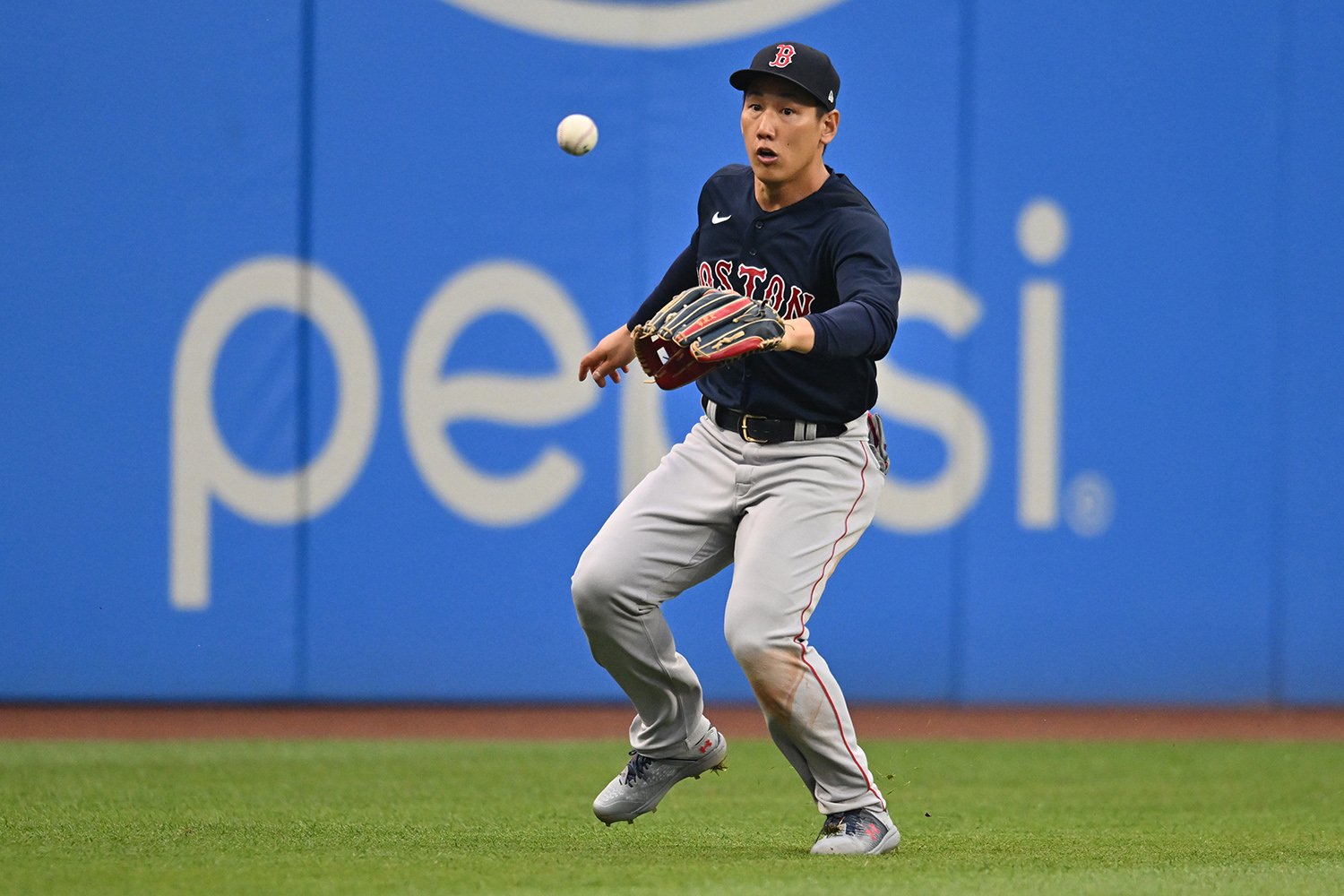 Over the past three days, Red Sox fans have been bombarded with quotes from players, coaches, and executives at Saturday’s Fenway Fest. This is a Red Sox team with a lot to talk about, and we’ll be covering some of the more interesting takeaways from the event. Our first subject is Masataka Yoshida, about whom Colin McCarthy of Boston.com and Chris Cotillo of MassLive reported several quotes. We should start by letting him speak for himself, and understandably, he discussed the trade rumors that have been swirling throughout the offseason. “I kind of kept (the rumors) muted so I wasn’t really paying attention,” Yoshida said, through interpreter Yutaro Yamaguchi. “I did pay attention to those but it’s out of my control so we’ll see what happens.” We shouldn’t underestimate how difficult it is to be a major league ballplayer while surrounded by trade speculation, let alone doing so in your second season in a new country and while battling through a shoulder injury would require offseason surgery. Manager Alex Cora also addressed Yoshida’s position on the roster, telling reporters that the Red Sox wanted him in the outfield: “Yeah, our outfield defense was great last year, but in a perfect world, if he was healthy, he was going to play the outfield. The throwing part of it wasn’t there so that’s the reason he actually didn’t play. Hopefully, we can get him there and we can use him in the outfield, too.” Cora continued: There are two main things to unpack here. First, as we know, Yoshida’s thumb and shoulder injuries were serious, and they likely affected him at the plate. According to every measure of contact quality, Yoshida hit the ball harder in 2023 than he did in 2024. It’s no stretch to pin at least some of that on the injury. The second claim, that the Red Sox want Yoshida to play the outfield, is a stretch at best. Yoshida played just one emergency inning in the field in 2024, and even before the injury became public knowledge, there was a pretty simple explanation. During his healthy 2023 season, Yoshida graded out as one of the worst fielders in the game. Although he played left for just under half a season in 2023, Statcast had his fielding costing the Red Sox 12 runs, fifth-most in all of baseball. According to Defensive Runs Saved, Yoshida cost the Red Sox four runs, which is very bad, but not necessarily catastrophic. I will refrain from putting together a blooper reel, but suffice it to say that eye test wasn’t kind either. With a sprint speed of 26.1 feet per second, Yoshida is one of the slower players in baseball. According to Statcast, he averaged the seventh-slowest jump among all outfielders in 2023. He really struggled with balls hit near the base of the green monster, and baserunners felt extremely confident running on his arm. According to Statcast, the gap between his advance rate and his expected advance rate was tied for the highest rate in the league. That pretty much covers every aspect of being an outfielder. Fenway has a unique outfield, and maybe a healthy, more experienced Yoshida would have been better out there in 2024, but the idea that the roster is better with him in the field is laughable. First, in Jarren Duran, Ceddanne Rafaela, and Wilyer Abreu, the Red Sox boast three of the best young outfield defenders in baseball. Second, even if Yoshida were to slide into the outfield, there’s no right-handed bat to take over the designated hitter spot. There’s no way to know how much Alex Cora believes what he told reporters. Unfortunately, the most cynical take is also most obvious one: he’s puffing Yoshida up to increase his trade value. Entering his age-31 season with three years and $55.8 million left on his contract, reports indicate that the rehabbing Yoshida has yet to generate any interest around the league. The Red Sox will likely have to pay down some money if they hope to move him. Yoshida has a career 121 wRC+ against righties and an 84 wRC+ against lefties. A DH who should really only be platooning isn’t a particularly valuable piece, but a bounce back candidate who can play the outfield has significantly more value. If planting this story was Cora's goal, then he succeeded, as there are now headlines like "Red Sox Hoping To Use Masataka Yoshida in Outfield" out there. It's hard to imagine this moving the needle, however. The truth is, however, that even if a fully healthy Yoshida could play in the outfield, there are few teams for whom he’d represent an improvement in the outfield.
 -
With the arbitration deadline looming, the two sides seem to be thinking long-term. The Red Sox gave up a haul of prospects for Garrett Crochet, headlined by catcher Kyle Teel, who could be playing for the White Sox as early as this season. They didn’t necessarily make that sacrifice because they thought that the last two years of Crochet’s arbitration period were worth it on their own. They were also paying for the chance to sign the 25-year-old left-hander to a long-term contract extension. On Wednesday night, MassLive’s Chris Cotillo reported that preliminary dialog about an extension has begun between the Red Sox and Crochet’s representatives at agency CAA. At the moment, however, the main focus is on agreeing on a contract value for this year, as the arbitration deadline is today. That could actually matter a great deal in terms of getting an extension done. Arbitration is an unpleasant experience, with the player’s representatives making a pitch for why their client should be paid a higher amount and the team’s making a pitch for why the player should be paid a lower amount. An independent arbitrator then chooses one of those numbers. Because of the adversarial nature, and because the amounts in question are miles below what the player is actually worth on the open market, it can get ugly. In extreme cases, the team’s presentation – in which they basically lay out a detailed case for why the player is worthless, sometimes to save as little as a few hundred thousand dollars – can have ugly side effects. Josh Hader said publicly that the process poisoned his relationship with the Brewers. MLB Trade Rumors predicted that Crochet would end up with $2.9 million during the 2025 season, a fraction of what he’s worth. Avoiding arbitration could help build some goodwill and avoid acrimony going into serious extension negotiations, even if it means paying Crochet more right now. Besides, if Crochet does sign an extension, it will buy out his arbitration years for much more than even the highest possible figure he could make in arbitration, preempting the deal that the sides are currently working on. Right now, the name of the game is demonstrating that the team is serious. That’s not to say that negotiations will be easy. Craig Breslow has yet to negotiate a big contract during his time leading the Red Sox. These negotiations could have a big effect on the future of the team and his legacy. Crochet’s future as a starter has some real concerns. He was a reliever coming up and missed the entire 2022 season due to Tommy John surgery. All 32 of his big-league starts came in 2024. He threw just 146 innings and pitched into the seventh just three times all season. He’s pitched like an ace, but the risk created by his short track record and injury history will limit his value. The two sides will have to balance that risk with his tremendous upside. By all indications, Crochet is acutely aware of this dynamic. That’s why he made it clear at the trade deadline that he intended to take care of his arm. He planned to pitch during the playoffs only if the team that traded for him agreed to an extension beforehand, which ended up killing interest in a midseason move. It’s hard to fault Crochet for protecting his future that way, considering that until 2024, the highest innings total of his career was 65, and it came when he was a 20-year-old sophomore at Tennessee in 2019. There’s no guarantee that an extension will actually happen. Cotillo has said it’s “unclear if the sides have gotten close yet.” but for now, these are all good indications. View full article
-
The Red Sox Have Begun Extension Talks With Garrett Crochet
Davy Andrews posted an article in Red Sox
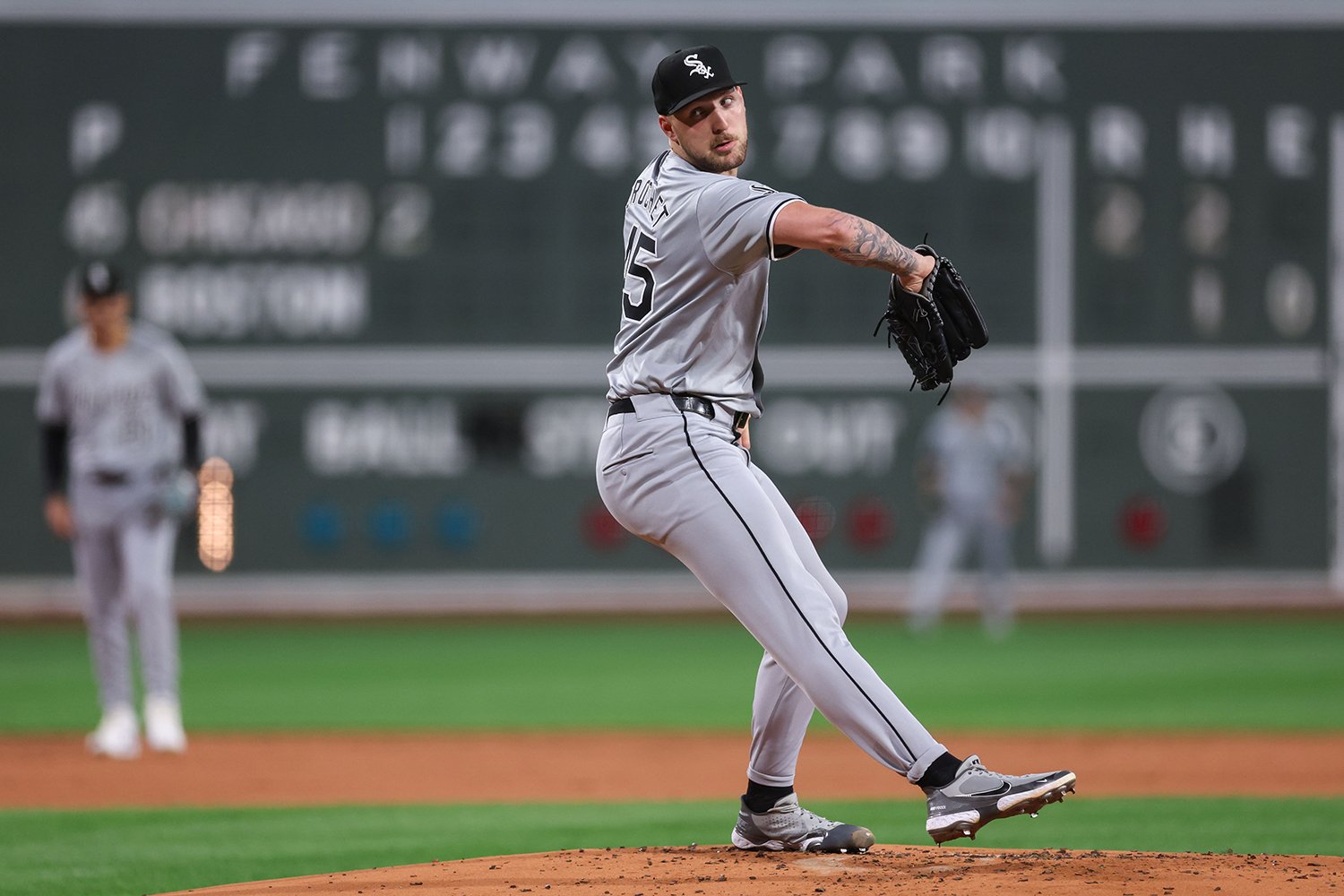 The Red Sox gave up a haul of prospects for Garrett Crochet, headlined by catcher Kyle Teel, who could be playing for the White Sox as early as this season. They didn’t necessarily make that sacrifice because they thought that the last two years of Crochet’s arbitration period were worth it on their own. They were also paying for the chance to sign the 25-year-old left-hander to a long-term contract extension. On Wednesday night, MassLive’s Chris Cotillo reported that preliminary dialog about an extension has begun between the Red Sox and Crochet’s representatives at agency CAA. At the moment, however, the main focus is on agreeing on a contract value for this year, as the arbitration deadline is today. That could actually matter a great deal in terms of getting an extension done. Arbitration is an unpleasant experience, with the player’s representatives making a pitch for why their client should be paid a higher amount and the team’s making a pitch for why the player should be paid a lower amount. An independent arbitrator then chooses one of those numbers. Because of the adversarial nature, and because the amounts in question are miles below what the player is actually worth on the open market, it can get ugly. In extreme cases, the team’s presentation – in which they basically lay out a detailed case for why the player is worthless, sometimes to save as little as a few hundred thousand dollars – can have ugly side effects. Josh Hader said publicly that the process poisoned his relationship with the Brewers. MLB Trade Rumors predicted that Crochet would end up with $2.9 million during the 2025 season, a fraction of what he’s worth. Avoiding arbitration could help build some goodwill and avoid acrimony going into serious extension negotiations, even if it means paying Crochet more right now. Besides, if Crochet does sign an extension, it will buy out his arbitration years for much more than even the highest possible figure he could make in arbitration, preempting the deal that the sides are currently working on. Right now, the name of the game is demonstrating that the team is serious. That’s not to say that negotiations will be easy. Craig Breslow has yet to negotiate a big contract during his time leading the Red Sox. These negotiations could have a big effect on the future of the team and his legacy. Crochet’s future as a starter has some real concerns. He was a reliever coming up and missed the entire 2022 season due to Tommy John surgery. All 32 of his big-league starts came in 2024. He threw just 146 innings and pitched into the seventh just three times all season. He’s pitched like an ace, but the risk created by his short track record and injury history will limit his value. The two sides will have to balance that risk with his tremendous upside. By all indications, Crochet is acutely aware of this dynamic. That’s why he made it clear at the trade deadline that he intended to take care of his arm. He planned to pitch during the playoffs only if the team that traded for him agreed to an extension beforehand, which ended up killing interest in a midseason move. It’s hard to fault Crochet for protecting his future that way, considering that until 2024, the highest innings total of his career was 65, and it came when he was a 20-year-old sophomore at Tennessee in 2019. There’s no guarantee that an extension will actually happen. Cotillo has said it’s “unclear if the sides have gotten close yet.” but for now, these are all good indications.
 -
According to Katie Woo, who covers the Cardinals for The Athletic, the Cardinals are running out of options in their quest to clear Nolan Arenado's salary from their books. After Arenado, who has a full no-trade clause, nixed the idea of being traded to the Astros, "there has been next to no traction in his trade talks," she wrote. Arenado was open to the Dodgers, but they weren't interested. The Yankees checked in, but weren't willing to pay what the Cardinals wanted. That leaves the Red Sox. Woo wrote, "Multiple league sources indicate the Red Sox represent Arenado's last chance to get dealt before the 2025 season." Alex Mayes wrote about the possibility of trading for Arenado here at Talk Sox this morning, but the extent of Boston's interest in Arenado is unclear. The 33-year-old is owed $74 million over the next three years and is coming off the worst two-season stretch of his career. He would represent a clear defensive upgrade at third base, but the Red Sox would have to displace franchise cornerstone Rafael Devers in order to make room for him. View full rumor
-
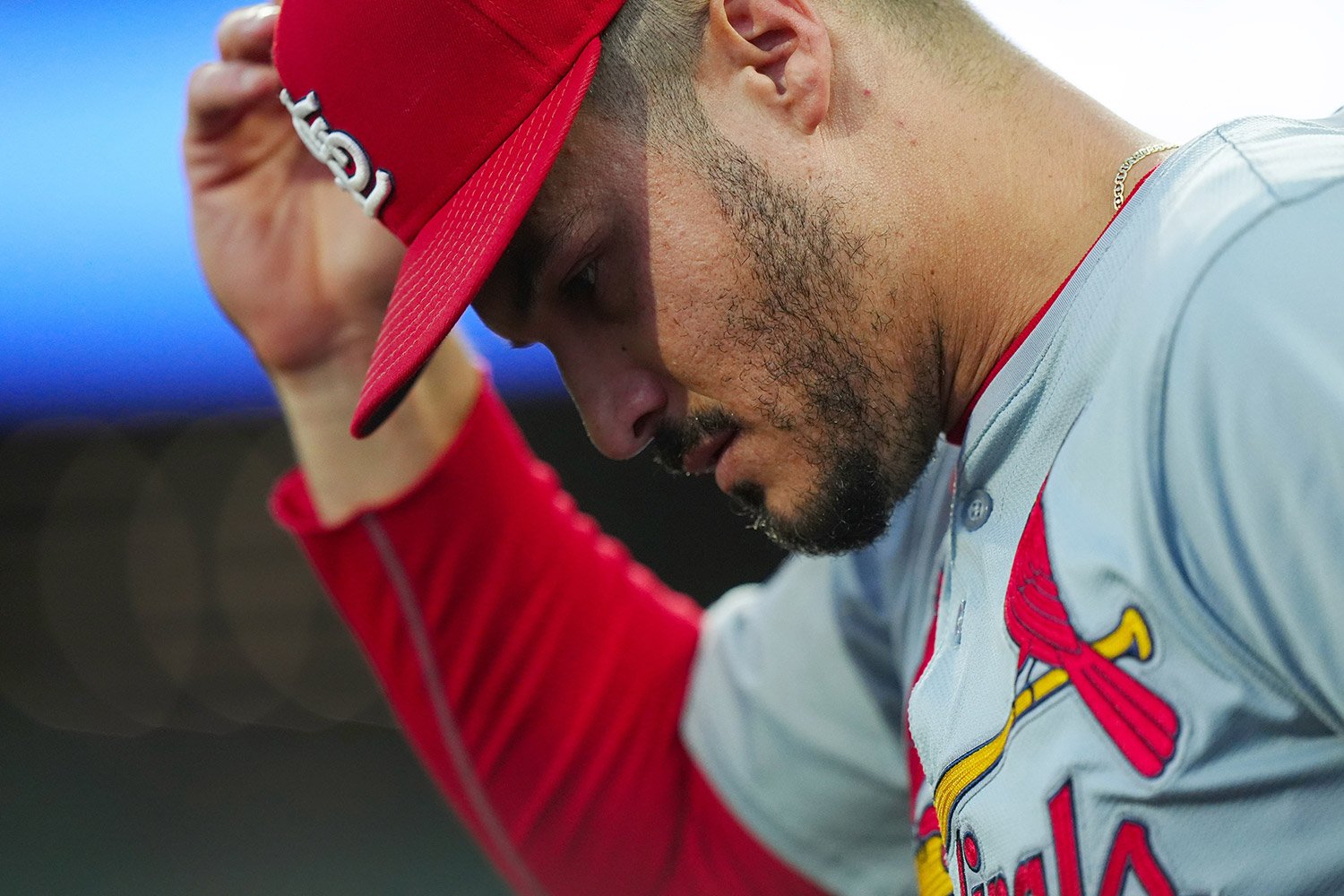 According to Katie Woo, who covers the Cardinals for The Athletic, the Cardinals are running out of options in their quest to clear Nolan Arenado's salary from their books. After Arenado, who has a full no-trade clause, nixed the idea of being traded to the Astros, "there has been next to no traction in his trade talks," she wrote. Arenado was open to the Dodgers, but they weren't interested. The Yankees checked in, but weren't willing to pay what the Cardinals wanted. That leaves the Red Sox. Woo wrote, "Multiple league sources indicate the Red Sox represent Arenado's last chance to get dealt before the 2025 season." Alex Mayes wrote about the possibility of trading for Arenado here at Talk Sox this morning, but the extent of Boston's interest in Arenado is unclear. The 33-year-old is owed $74 million over the next three years and is coming off the worst two-season stretch of his career. He would represent a clear defensive upgrade at third base, but the Red Sox would have to displace franchise cornerstone Rafael Devers in order to make room for him.
 -
Not only is this the best way to us Rafaela's talents, it should be awfully fun to watch. Last week, Craig Breslow, the only Chief Baseball Officer in Major League Baseball, spoke with beat reporters over Zoom about a variety of subjects. He said several interesting things, but I’d like to focus on one in particular. Breslow told reporters that the plan is to hand center field over to Ceddanne Rafaela. “I think he’s a guy that we will try to keep in center as much as possible,” said Breslow. This is exciting news, and I have been banging this particular drum for a while now. The best way for Rafaela to help the Red Sox is to hand him the starting center field job and let him track down some balls in the gap. Rafaela has all the tools to be an elite center fielder, but thanks to Trevor Story’s shoulder injury, he spent more time in the infield than the outfield during the 2024 season. “Ceddanne’s versatility is a huge asset," said Breslow. "The defensive floor at multiple positions makes him a really functional piece on a roster.” The numbers would beg to differ. According to Statcast’s Fielding Run Values, he was worth six runs in the outfield and negative five in the infield. According to Defensive Runs Saved, Rafaela was worth 12 runs in center field, fifth-most in all of baseball, despite playing just 631 1/3 innings at the position. Even if you combine 2023 and 2024, he still hasn’t come close to getting a full season’s worth of time as a big-league center fielder. Imagine how good he could be if he got to actually focus on playing that position. Breslow seems to understand that, saying, “I’m not sure we saw the best of him even defensively because of the fact that he was switching back and forth between center and shortstop.” Rafaela’s bat was a big disappointment in 2024. More importantly, the underlying numbers were downright scary. His chase and whiff rates were some of the highest we’ve ever seen ever since we started tracking those numbers, and they tend to be very predictive of future performance. If you’re expecting Rafaela to suddenly turn into a great hitter, you’ll be waiting a long time. However, Rafaela can still provide real value if the team lets him cook in center (at least until Roman Anthony arrives). If he should make a small improvement at the plate, or even just get a little bit lucky in the BABIP department, he can be an extremely valuable player. I understand that circumstances may not allow this to happen. Even a medium-sized step back in the field would make Rafaela’s bat unplayable in an everyday role. There’s also the possibility that Wilyer Abreu continues to run eye-watering platoon splits, so Rafaela ends up starting in center most days, then moving over to right against left-handed starters while Jarren Duran takes over center. That would seem to be a less challenging task than being pressed into emergency infield duty. Lastly, a very foreseeable future includes Rafaela as an overpaid, but nonetheless excellent fourth outfielder, serving as a great defensive replacement and pinch runner. But as the team is constituted right now, the best way forward is to let Rafaela become the best center fielder he can possibly be. It’s encouraging that Breslow sees that. View full article
-
Craig Breslow Says the Red Sox Will Keep Ceddanne Rafaela in Center Field
Davy Andrews posted an article in Red Sox
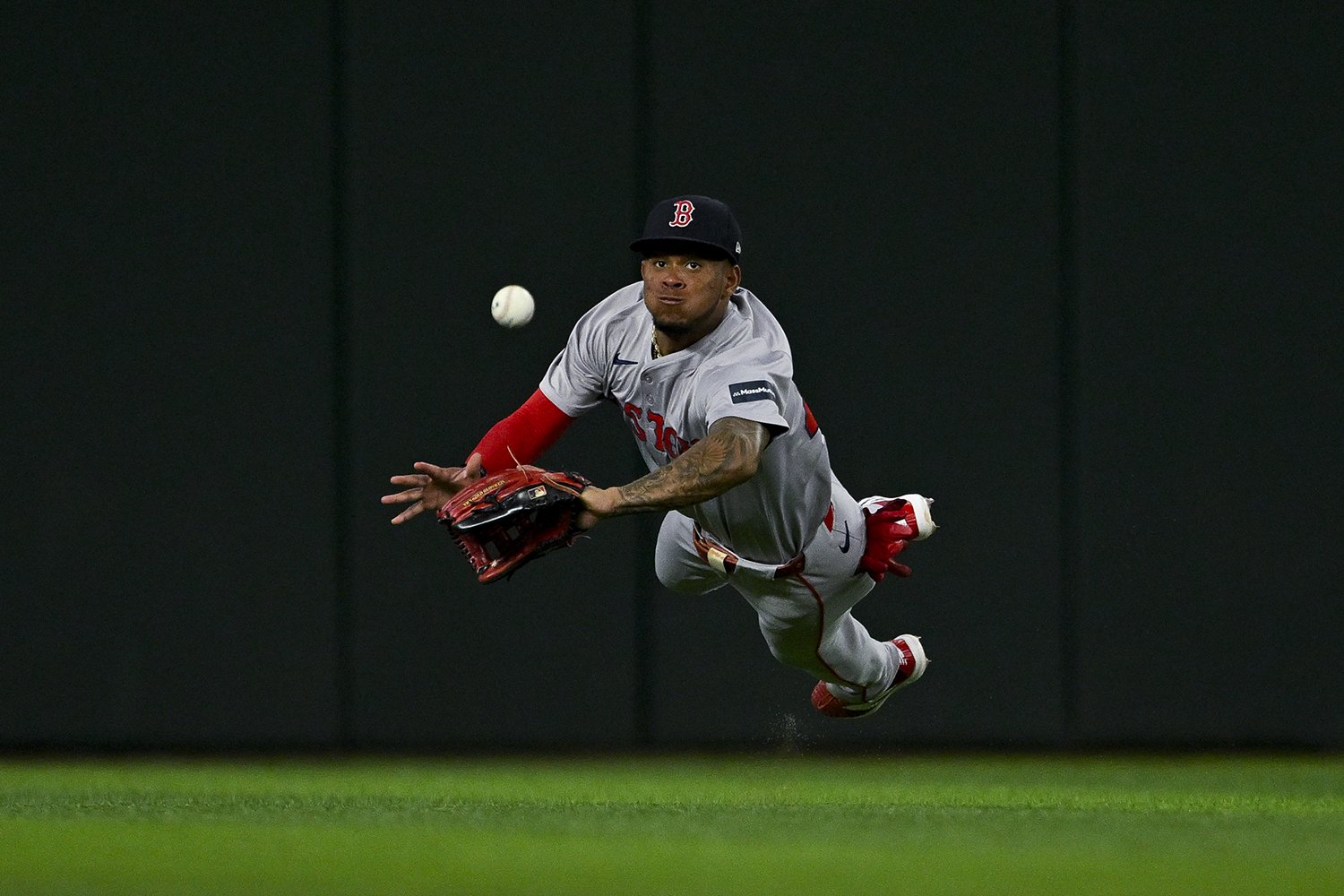 Last week, Craig Breslow, the only Chief Baseball Officer in Major League Baseball, spoke with beat reporters over Zoom about a variety of subjects. He said several interesting things, but I’d like to focus on one in particular. Breslow told reporters that the plan is to hand center field over to Ceddanne Rafaela. “I think he’s a guy that we will try to keep in center as much as possible,” said Breslow. This is exciting news, and I have been banging this particular drum for a while now. The best way for Rafaela to help the Red Sox is to hand him the starting center field job and let him track down some balls in the gap. Rafaela has all the tools to be an elite center fielder, but thanks to Trevor Story’s shoulder injury, he spent more time in the infield than the outfield during the 2024 season. “Ceddanne’s versatility is a huge asset," said Breslow. "The defensive floor at multiple positions makes him a really functional piece on a roster.” The numbers would beg to differ. According to Statcast’s Fielding Run Values, he was worth six runs in the outfield and negative five in the infield. According to Defensive Runs Saved, Rafaela was worth 12 runs in center field, fifth-most in all of baseball, despite playing just 631 1/3 innings at the position. Even if you combine 2023 and 2024, he still hasn’t come close to getting a full season’s worth of time as a big-league center fielder. Imagine how good he could be if he got to actually focus on playing that position. Breslow seems to understand that, saying, “I’m not sure we saw the best of him even defensively because of the fact that he was switching back and forth between center and shortstop.” Rafaela’s bat was a big disappointment in 2024. More importantly, the underlying numbers were downright scary. His chase and whiff rates were some of the highest we’ve ever seen ever since we started tracking those numbers, and they tend to be very predictive of future performance. If you’re expecting Rafaela to suddenly turn into a great hitter, you’ll be waiting a long time. However, Rafaela can still provide real value if the team lets him cook in center (at least until Roman Anthony arrives). If he should make a small improvement at the plate, or even just get a little bit lucky in the BABIP department, he can be an extremely valuable player. I understand that circumstances may not allow this to happen. Even a medium-sized step back in the field would make Rafaela’s bat unplayable in an everyday role. There’s also the possibility that Wilyer Abreu continues to run eye-watering platoon splits, so Rafaela ends up starting in center most days, then moving over to right against left-handed starters while Jarren Duran takes over center. That would seem to be a less challenging task than being pressed into emergency infield duty. Lastly, a very foreseeable future includes Rafaela as an overpaid, but nonetheless excellent fourth outfielder, serving as a great defensive replacement and pinch runner. But as the team is constituted right now, the best way forward is to let Rafaela become the best center fielder he can possibly be. It’s encouraging that Breslow sees that.
 -
On Monday night, Anthony Franco of MLB Trade Rumors wrote that Chris Martin is signing a one-year deal with the Rangers. This outcome always seemed the likeliest, as the 38-year-old Martin lives in Texas and had made it known that he was looking to retire after 2025 and wanted to spend his final season pitching closer to home. All the same, it's a sad day for the Red Sox. It's hard to overstate just how good Martin has been, not just with the Red Sox over the past two years, but over his entire career. Martin has a career 2.96 FIP. This century, among the 366 different relievers who have thrown at least 300 innings, that ranks 25th. Since 2020, 70 relievers have thrown at least 200 innings. Among that group, Martin's 2.66 ERA ranks ninth. The Red Sox have added to the bullpen this offseason, but they haven't added anyone with a consistent track record for success like Martin's, and they're sure to miss him. View full rumor
-
On Monday night, Anthony Franco of MLB Trade Rumors wrote that Chris Martin is signing a one-year deal with the Rangers. This outcome always seemed the likeliest, as the 38-year-old Martin lives in Texas and had made it known that he was looking to retire after 2025 and wanted to spend his final season pitching closer to home. All the same, it's a sad day for the Red Sox. It's hard to overstate just how good Martin has been, not just with the Red Sox over the past two years, but over his entire career. Martin has a career 2.96 FIP. This century, among the 366 different relievers who have thrown at least 300 innings, that ranks 25th. Since 2020, 70 relievers have thrown at least 200 innings. Among that group, Martin's 2.66 ERA ranks ninth. The Red Sox have added to the bullpen this offseason, but they haven't added anyone with a consistent track record for success like Martin's, and they're sure to miss him.
-
Rafael Devers’ Best Defensive Plays of the Season, Part Two
Davy Andrews posted an article in Red Sox
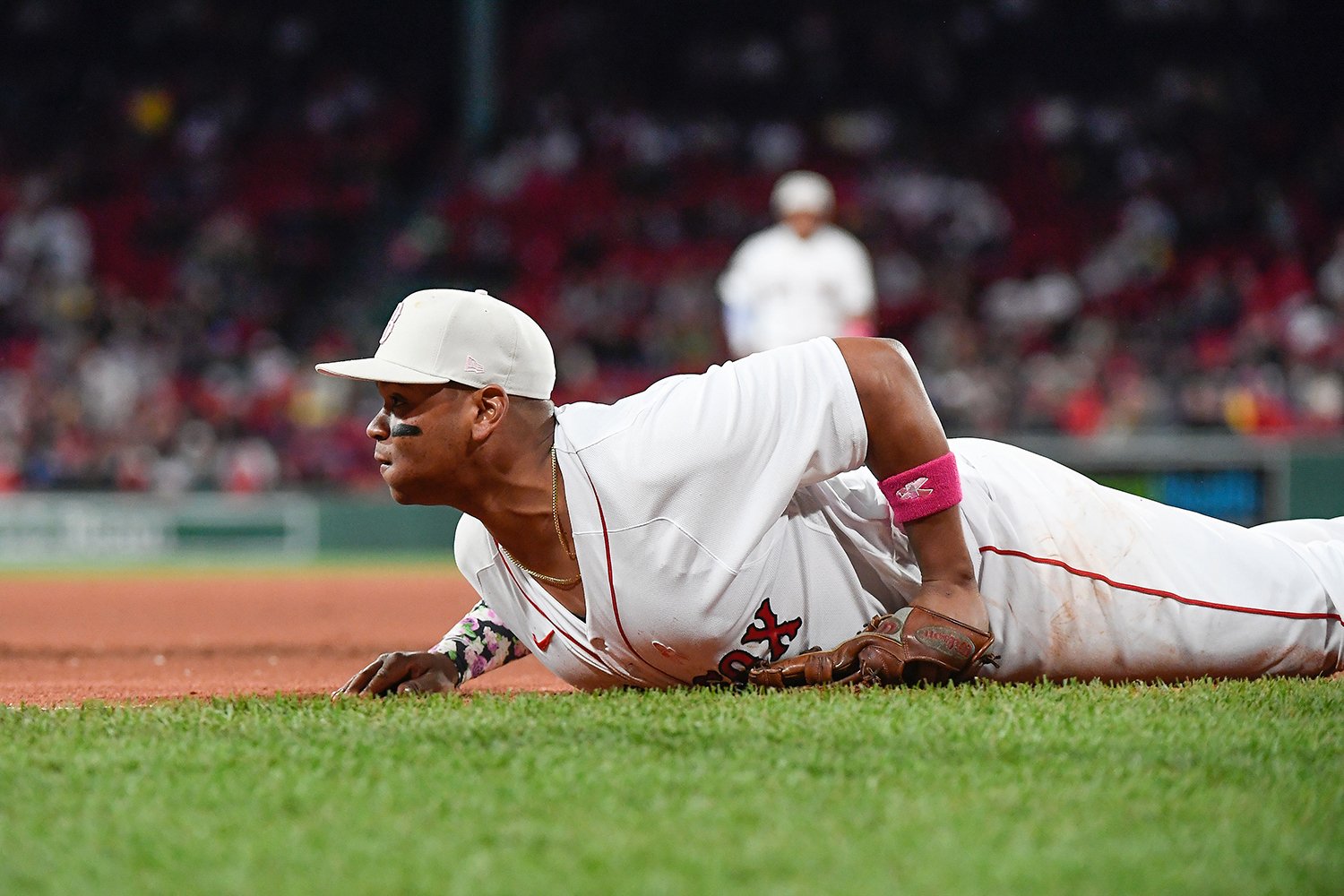 So earlier tearlier this week, I decided I’d watch every play Rafael Devers made this season, then I’d pull out the best of the best to show you what it looks like when Devers is really on his game. It was just a little holiday treat, a way of finding some joy in what is universally acknowledged as the least joyful part of his game. But here’s the thing, and it’s not a thing I expected: Devers made too many great plays. I started at the end of the season and worked my way backwards, but I found more than enough plays for a whole article before we’d even made it out of September. I’m not going to write a whole article for each month of the season – that would be pretty ludicrous considering the player in question – so this is the second and final installment of Devers’ defensive plays of the 2024 season. Let’s enjoy them together. We’ll start with a diving backhanded stop from back in August. This is the kind of play that fuels all those arguments about how Devers’ defense passes the eye test. Playing way over at the shortstop position with Corey Seager batting left handed, he made an incredible diving play. Seager absolutely demolished this ball. It left the bat at 106.5 mph, and Devers needed every inch of his dive to corral it. How can you not look at that play and think, “That’s the guy the defensive metrics hate so much?” Up second is yet another backhanded stop from back in August. With two outs and a runner on first, this play might have saved a run. It’s not just that the ball was hit hard, it’s that Devers had to make a quick, back-handed stop without having any time to put himself in position to get a good hop. That in-between hop can eat up the best of defenders, but Devers kept both his body and his glove low, so even though the ball seemed to skip on him, he was able to secure it and get the force out at second. One of the common threads of these great plays is Devers making it work despite getting tricky hops. Sometimes that’s because he’s dealing with a ball that gives him no choice, but sometimes it’s because he just didn’t do everything he could to get himself in good position. This next play probably features a bit of both. DJ LeMahieu hits a soft chopper and Devers charges hard, snagging the ball barehanded on the bounce and firing a strike. This was a do-or-die play and Devers definitely didn’t have time to wait back and get a better hop. However, from watching on television, there’s no way for us to see the jump that Devers got. LeMahieu is particularly slow at this point in his career, and perhaps a better third baseman gets a better jump on this ball and has an easier play. All the same, the execution was downright flawless. A couple days earlier, Devers did a solid Derek Jeter impression on a popup down the third base line. We shouldn’t overlook the amount of ground that Devers covered after starting this play deep in the hole against the left-handed Ben Rice. The real degree of difficulty points come from the proximity of the tarp. Devers was barely able to slow down before securing the ball, and without any time, he simply climbed over it and crashed into the netting, which it turns out, doesn’t just protect fans. Devers courage isn’t just about braving the tarp, though, it’s about daring to venture into the seats at Yankee Stadium. If there’s one thing we learned from the World Series, it’s that opposing players should stay as far away from the front row as possible. The Yankees were also Devers’ most frequent victim. Here he is robbing a hit from Aaron Judge. There’s no doubt that this is an excellent stop. It’s a low liner, and Devers makes a slick diving pickup, spins around on his knees, and then nails the runner at second. However, the really interesting thing about this play is that the umpire’s view allows you to see just how late Devers’ jump actually is. A great fielder reads the pitch and the swing and starts moving before the ball is even struck. Judge has fully finished his backswing before Devers even starts leaning toward his left side. This is how our eyes deceive us! If you liked that play, you’ll love this one off the bat of Nick Castellanos. As you might guess, ball was hit at nearly the exact same exit velocity and launch angle, and Devers made a nearly identical play. The next time you hear someone complaining that they wish Devers could be more consistent on defense, show them those two plays back-to-back. He can consistently make that tricky glove-side dive, spin, and throw. Seriously, he can make some tremendous plays going to his left. But here’s the really interesting thing. The advanced metrics, Devers really struggles going to his left. According to Statcast, he saved the Red Sox a run on balls where he had to go in or go back, and saved the team two runs when he had to move to his right, toward third base. Going to his left, he cost the team 10 runs! If not for balls hit to his left, he would’ve graded out as an excellent third baseman. I don’t think it’s just that he needs to work on that area of his game. For the most part, he was better going to his left earlier in his career, then last season it flipped, and he’s been better going to his right. I suspect that the team had him work on moving to his right, but the gains he made there simply came at a cost. Maybe you just can’t cover everything.
 -
That’s right, part two. The much-maligned third baseman made even more great plays. Let Devers cook. So earlier tearlier this week, I decided I’d watch every play Rafael Devers made this season, then I’d pull out the best of the best to show you what it looks like when Devers is really on his game. It was just a little holiday treat, a way of finding some joy in what is universally acknowledged as the least joyful part of his game. But here’s the thing, and it’s not a thing I expected: Devers made too many great plays. I started at the end of the season and worked my way backwards, but I found more than enough plays for a whole article before we’d even made it out of September. I’m not going to write a whole article for each month of the season – that would be pretty ludicrous considering the player in question – so this is the second and final installment of Devers’ defensive plays of the 2024 season. Let’s enjoy them together. We’ll start with a diving backhanded stop from back in August. This is the kind of play that fuels all those arguments about how Devers’ defense passes the eye test. Playing way over at the shortstop position with Corey Seager batting left handed, he made an incredible diving play. Seager absolutely demolished this ball. It left the bat at 106.5 mph, and Devers needed every inch of his dive to corral it. How can you not look at that play and think, “That’s the guy the defensive metrics hate so much?” Up second is yet another backhanded stop from back in August. With two outs and a runner on first, this play might have saved a run. It’s not just that the ball was hit hard, it’s that Devers had to make a quick, back-handed stop without having any time to put himself in position to get a good hop. That in-between hop can eat up the best of defenders, but Devers kept both his body and his glove low, so even though the ball seemed to skip on him, he was able to secure it and get the force out at second. One of the common threads of these great plays is Devers making it work despite getting tricky hops. Sometimes that’s because he’s dealing with a ball that gives him no choice, but sometimes it’s because he just didn’t do everything he could to get himself in good position. This next play probably features a bit of both. DJ LeMahieu hits a soft chopper and Devers charges hard, snagging the ball barehanded on the bounce and firing a strike. This was a do-or-die play and Devers definitely didn’t have time to wait back and get a better hop. However, from watching on television, there’s no way for us to see the jump that Devers got. LeMahieu is particularly slow at this point in his career, and perhaps a better third baseman gets a better jump on this ball and has an easier play. All the same, the execution was downright flawless. A couple days earlier, Devers did a solid Derek Jeter impression on a popup down the third base line. We shouldn’t overlook the amount of ground that Devers covered after starting this play deep in the hole against the left-handed Ben Rice. The real degree of difficulty points come from the proximity of the tarp. Devers was barely able to slow down before securing the ball, and without any time, he simply climbed over it and crashed into the netting, which it turns out, doesn’t just protect fans. Devers courage isn’t just about braving the tarp, though, it’s about daring to venture into the seats at Yankee Stadium. If there’s one thing we learned from the World Series, it’s that opposing players should stay as far away from the front row as possible. The Yankees were also Devers’ most frequent victim. Here he is robbing a hit from Aaron Judge. There’s no doubt that this is an excellent stop. It’s a low liner, and Devers makes a slick diving pickup, spins around on his knees, and then nails the runner at second. However, the really interesting thing about this play is that the umpire’s view allows you to see just how late Devers’ jump actually is. A great fielder reads the pitch and the swing and starts moving before the ball is even struck. Judge has fully finished his backswing before Devers even starts leaning toward his left side. This is how our eyes deceive us! If you liked that play, you’ll love this one off the bat of Nick Castellanos. As you might guess, ball was hit at nearly the exact same exit velocity and launch angle, and Devers made a nearly identical play. The next time you hear someone complaining that they wish Devers could be more consistent on defense, show them those two plays back-to-back. He can consistently make that tricky glove-side dive, spin, and throw. Seriously, he can make some tremendous plays going to his left. But here’s the really interesting thing. The advanced metrics, Devers really struggles going to his left. According to Statcast, he saved the Red Sox a run on balls where he had to go in or go back, and saved the team two runs when he had to move to his right, toward third base. Going to his left, he cost the team 10 runs! If not for balls hit to his left, he would’ve graded out as an excellent third baseman. I don’t think it’s just that he needs to work on that area of his game. For the most part, he was better going to his left earlier in his career, then last season it flipped, and he’s been better going to his right. I suspect that the team had him work on moving to his right, but the gains he made there simply came at a cost. Maybe you just can’t cover everything. View full article
