


Red Sox Video
Pitchers rarely become better after losing one of the skills that made them successful. For most starters, a steady decline in ground-ball rate is the beginning of a warning sign. Fewer ground balls often lead to more damaging contact, more home runs, and eventually worse results.
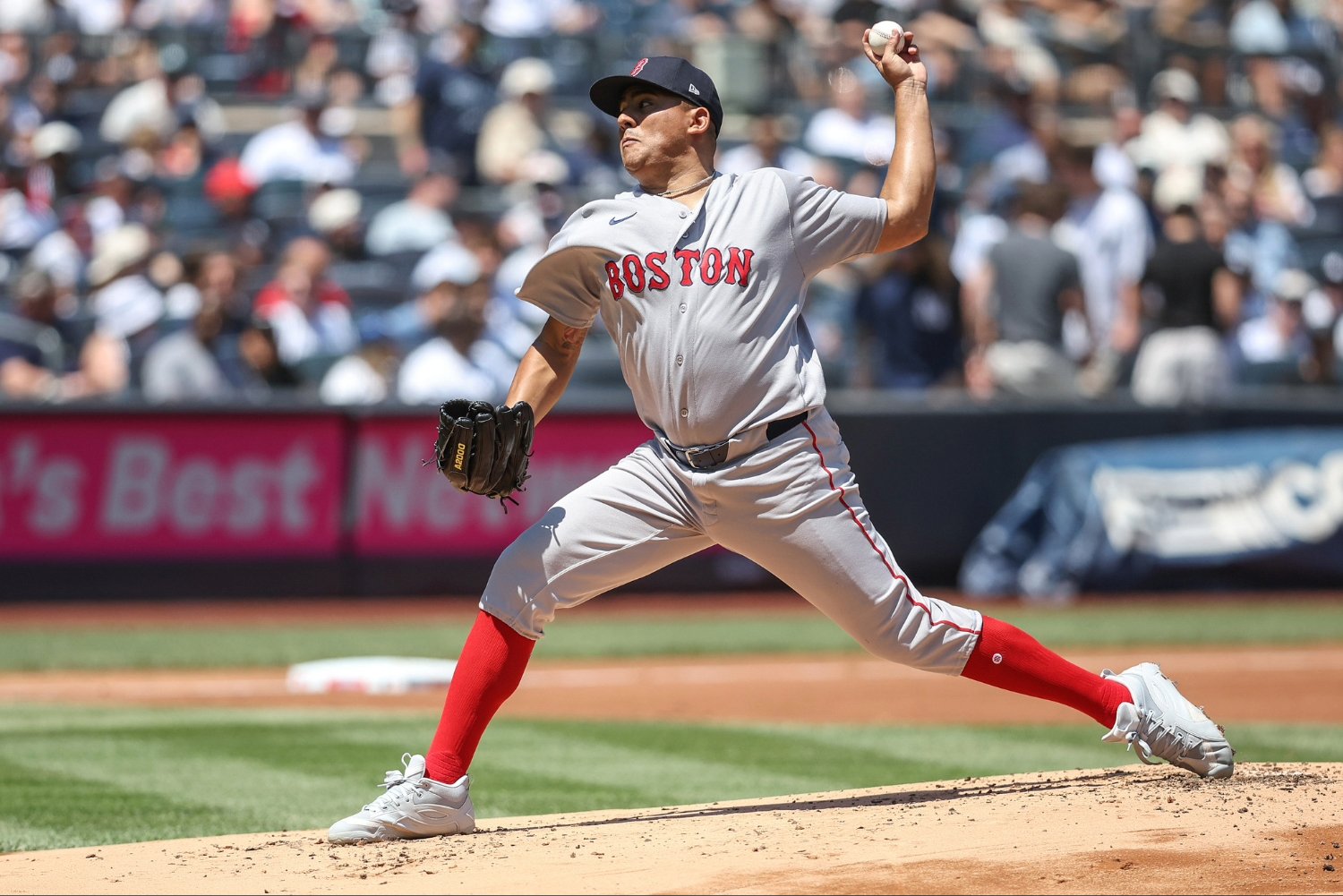
Yet Ranger Suarez has managed to move in the opposite direction. The defining characteristic of his pitching profile is gradually fading, but the overall package may be more effective than ever. That contradiction lies at the center of Suárez’s first season with the Boston Red Sox.
When Boston signed the veteran left-hander, the expectation was straightforward: add a dependable starter capable of stabilizing the rotation. What the Red Sox have received instead is a pitcher who continues to adapt, finding new ways to dominate even as some of the traits that once defined him become less prominent.
Through his first 12 starts of 2026, Suárez owns a 3.18 ERA and a 2.94 FIP. Those numbers are impressive on their own, but the path he has taken to reach them is even more fascinating. For years, his identity revolved around his ability to generate ground balls. His sinker anchored the entire approach, forcing hitters to pound the ball into the dirt while limiting damaging contact and keeping home runs under control.
That foundation still exists. It simply no longer tells the whole story.
Ranger Suárez Is Producing Fewer Ground Balls and Better Results
Let's take a quick look at his year-over-year evolution over the past six seasons.
|
Season |
GB% |
K/9 |
HR/9 |
ERA |
FIP |
|
2021 |
59.2% |
9.1 |
0.34 |
1.36 |
2.72 |
|
2022 |
55.4% |
7.5 |
0.87 |
3.65 |
3.87 |
|
2023 |
48.5% |
8.6 |
0.94 |
4.18 |
3.90 |
|
2024 |
51.9% |
8.7 |
0.84 |
3.46 |
3.37 |
|
2025 |
46.8% |
8.6 |
0.80 |
3.20 |
3.21 |
|
2026 |
36.0% |
8.7 |
0.55 |
3.18 |
2.94 |
The contradiction immediately jumps off the page.
His ground-ball rate has fallen to the lowest point of his career as a starter. Under normal circumstances, that trend would raise concerns about sustainability. Instead, his home-run rate has dropped while his ERA has remained remarkably stable, and his FIP has improved to one of the best marks of his career.
Taken together, those trends point to something more meaningful than luck or favorable variance. They reveal a pitcher who has successfully evolved his approach without sacrificing effectiveness. Suárez is no longer relying exclusively on contact management. Increasingly, he is preventing quality contact from happening in the first place.
A New Path to Dominance
Now, let's get a bit more granular and look at the main features of his arsenal.
|
Pitch |
AVG |
xBA |
wOBA |
xwOBA |
Whiff% |
K% |
|
Curveball |
.162 |
.146 |
.205 |
.190 |
45.5% |
52.5% |
|
Four-Seam Fastball |
.188 |
.246 |
.250 |
.341 |
21.3% |
21.6% |
|
Sinker |
.224 |
.277 |
.275 |
.320 |
17.9% |
20.0% |
The curveball stands out immediately. Opponents are hitting just .162 against it. Its .146 expected batting average and .190 expected weighted on-base average rank among the most dominant pitch-level indicators in baseball. The pitch has long been Suárez's signature weapon, and across his career, no offering in his arsenal has suppressed offensive production more effectively, with opponents posting a wRC+ of just 55 against it.
The traditional numbers are impressive enough, but the underlying swing metrics reveal why the pitch has become so effective. Because the story of Suárez's curveball extends beyond strikeouts. At its core, it is a story about deception.
The Curveball That Is Reshaping His Profile
With the help of some new Baseball Savant data, we can really begin to understand exactly how good this pitch is becoming.
|
Season |
Whiff% |
Avg. Miss Distance |
Flawed Swing% |
Perfect Contact% |
|
2023 |
39.0% |
4.7" |
14% |
10% |
|
2024 |
36.5% |
4.1" |
16% |
12% |
|
2025 |
25.0% |
4.5" |
8% |
15% |
|
2026 |
47.5% |
4.6" |
18% |
5% |
Hitters are missing against Suárez's curveball at the highest rate of the last four seasons. At the same time, they are producing clean contact less frequently than ever before. The perfect-contact rate has fallen to just 5%, while the flawed-swing rate has climbed to its highest level in years.
The combination is, to say the least, devastating.
When hitters commit, they often miss entirely, and even when they do make contact, the quality of that contact is usually poor. That dynamic helps explain why Suárez continues to thrive despite generating fewer ground balls than at any other point in his career.
The shift becomes even more apparent in high-leverage situations. With runners in scoring position, opponents are striking out nearly 30 percent of the time against the southpaw. Those are not the numbers of a traditional pitch-to-contact starter. They belong to a pitcher who can end threats on his own, even without overpowering velocity.
Perhaps that is the most compelling takeaway from Suárez's season. The ground-ball specialist who built his reputation in Philadelphia has not disappeared. Instead, he has expanded his identity, pairing his traditional strengths with a level of swing-and-miss ability that has become increasingly important to his success.
Ranger Suárez no longer relies solely on weak contact to control games. He now prevents hitters from producing clean swings in the first place, a transformation that helps explain why so many of the underlying metrics support what has been one of the most effective stretches of his career.
For a Red Sox team searching for stability in its rotation, that evolution may prove even more valuable than the version of Suárez they originally believed they were acquiring.






Recommended Comments
There are no comments to display.
Create an account or sign in to comment
You need to be a member in order to leave a comment
Create an account
Sign up for a new account in our community. It's easy!
Register a new accountSign in
Already have an account? Sign in here.
Sign In Now