


Red Sox Video
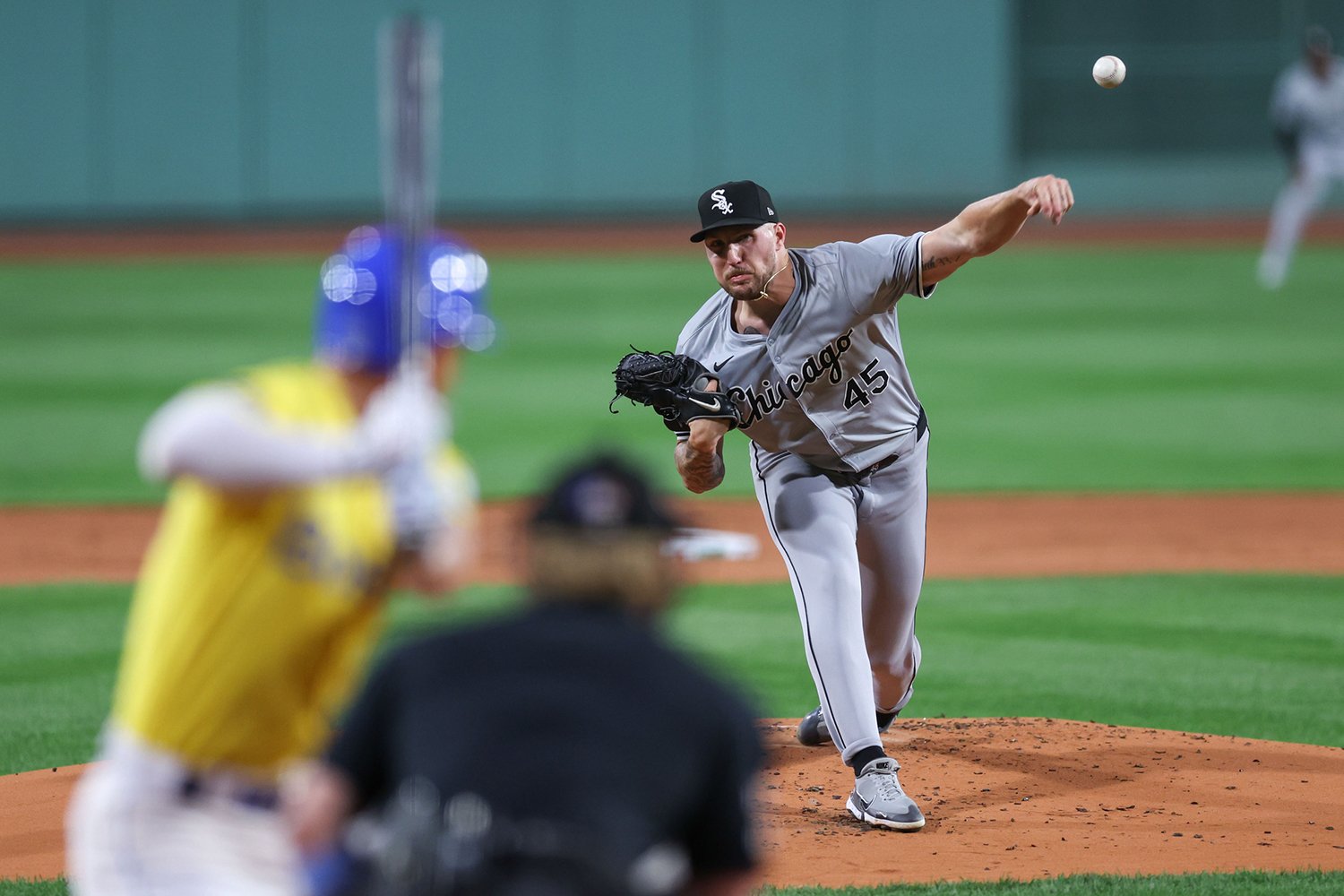
Well, that escalated quickly. A few minutes before 2:00 PM Eastern on Wednesday, Craig Breslow’s appearance on MLB Network was cancelled. Moments after that announcement, the reason for his no-show started rippling through both the internet and the Trinity Ballroom at the Hilton Anatole in Dallas, site of the Winter Meetings. The Red Sox were finalizing a trade that would send a package headlined by catching prospect Kyle Teel to Chicago in exchange for left-handed starting pitcher Garrett Crochet. A trade that would free Crochet from the lifeless White Sox had been expected since before the trade deadline, and it has finally come to pass. As a result, Boston’s Big Four has been reduced to a Big Three, and the Red Sox have also sent minor-leaguers Braden Montgomery, Chase Meidroth, and Wikelman Gonzalez to Chicago. We’re covering this blockbuster trade from many angles. The purview of this article is simple: What exactly are the Red Sox getting in Garrett Crochet?
Crochet is 25 years old, and he was picked eleventh overall in the 2020 draft out of the University of Tennessee. He pitched mostly out of the bullpen in college, running a 4.64 ERA and missed time due to either injury or an off-the-field issue at the start of the 2020 season. Regardless of the results, scouts were awed by a filthy slider and a fastball that touched 99 mph, giving Crochet some of the best stuff in the entire draft class. Crochet pitched at the White Sox’ alternate site for a few months, then got called up to Chicago for a cup of coffee in September. Despite some wildness, he didn’t allow a run or a walk over five relief appearances and ended up making the team’s postseason roster. However, in his sole playoff appearance, he had to leave due to a season-ending flexor tendon strain. As is so often the case, the flexor tendon strain eventually led to a UCL tear. Crochet excelled out of the bullpen for the White Sox in 2021, running a 2.82 ERA and 2.80 FIP over 54 relief appearances, but in 2022, he felt a pop during spring training and underwent Tommy John surgery in April. He missed the entire 2022 season and pitched just 25 total innings in 2023, six in Double A, 6 1/3 in Triple A, and 12 2/3 with the White Sox.
Coming into the 2024 season, he was still considered one of the top young pitchers in the game and the White Sox were set to convert him into a starter – their Opening Day starter, no less – despite the fact that he had just 75 1/3 total professional innings under his belt. Crochet didn’t disappoint, making a full 32 starts and pitching 146 innings. He earned an All-Star selection, running a 3.58 with extraordinary peripherals. His expected ERA, FIP, and expected FIP were all well below 3.00. His 209 strikeouts ranked seventh in baseball, despite the fact that all six of the players ahead of him threw at least 31 more innings than he did. Despite the low innings total, FanGraphs had Crochet at 4.7 WAR, eighth-best among all pitchers. His fastball averaged 97.1 mph, and stuff metrics drooled over his entire repertoire.
Crochet leads with that fastball, throwing it 53.7% of the time, and he pairs it with a 91.5-mph cutter. You surely know that the Red Sox threw fewer fastballs than any team in baseball during the 2024 season, but rest assured that Corchet will keep on throwing both pitches, along with a sinker that he uses sparingly. Together, Statcast calculated Crochet’s three fastballs were worth 21 runs during the 2024 season. That ranked seventh in all of baseball, behind names like Zack Wheeler, Cade Smith, Tarik Skubal, Paul Skenes, Emmanuel Clase, and Sean Manaea. That’s some extremely good company. Crochet attacks lefties with his sweeper 19% of the time. Against righties, he’ll throw both the sweeper and a changeup roughly 8% of the time. However, those numbers are slightly deceptive, because Crochet didn't start throwing his sinker until August. By September, he was throwing it nearly 30% of the time to lefties and 11% of the time to righties. It will be really fascinating to see how the Red Sox help him shape his pitch mix going forward.
What makes Crochet so hard to hit? For starters, left-handed pitchers rarely throw as hard as he does, let alone left-handed starters with a five-pitch mix that includes three or four plus offerings. Because he’s 6-foot-6, he has elite extension, which makes his pitches play even faster. Among pitchers who threw at least 500 pitches in 2024, Crochet’s four-seamer graded out as the 37th-fastest in baseball, but its 98.4-mph perceived velocity pushed it up to 25th. Among left-handed pitchers, both of those ranks jumped all the way up to third.
Crochet’s movement also means that his pitches play off each other beautifully. Take a look at his movement profile, courtesy of Baseball Savant.

For a start, all of Crochet’s pitches feature much more horizontal movement than the average pitch. Next, notice that you could draw a straight line between Crochet’s four-seamer, cutter, and sweeper? The four-seamer and the sweeper leave his hand moving in completely opposite directions. That’s called mirroring, and it makes it extremely hard on hitters. Moreover, notice how his cutter sits right between the two? That allows it to tunnel with both pitches. All of a sudden, any time a batter sees either a four-seamer or a sweeper, they need to take an extra moment and make sure that it’s not a cutter, and the overpowering nature of Crochet’s stuff means that they don’t get many moments in the first place. All of this makes it extremely hard for hitters to sit on any particular pitch.
Because his stuff is genuinely elite, Crochet doesn’t get too fancy. He pounds the strike zone, running a 55.6% zone rate that puts him right around the league’s 90th percentile. Both because his stuff is so filthy and because hitters know that he’s going to attack the zone, Crochet racks up tons of chases when he does venture outside the zone. He earns tons of whiffs, fueling a huge 35% strikeout rate and a miniscule 6% walk rate. Crochet is right around the league average in terms of hard-hit rate, and because all of his pitches feature so much rise, he also allows his share of fly balls. However, he also induces tons of mishits. According to Statcast, batters squared up the ball on just 18.4% of their swings against Crochet, the sixth-lowest total in all of baseball. Most of the other players in the top 10 were flame-throwing relievers. His groundball rate was still well higher than average, and a pitcher who induces a lot of groundballs while also striking out everyone in sight will have very few weaknesses.
There is some genuine injury risk here. Crochet has thrown shockingly few big-league innings, and the Red Sox will no-doubt want to have a serious plan in place to help build up Crochet’s stamina and keep him healthy throughout the season. Still, Crochet immediately slots in as the ace of the rotation. Because he’s left-handed, because he features elite velocity, and because he leans so heavily on his fastball, Crochet offers an extremely different look from all of the other pitchers in the rotation. That kind of diversity makes it extremely hard for any one team to match up well against them in the playoffs, and that’s what we should be thinking about from now on: the playoffs. The Red Sox have a legit Game 1 starter, and because all he cost was prospects, they still have plenty of money to spend in free agency. The fun might just be beginning.






Recommended Comments
Create an account or sign in to comment
You need to be a member in order to leave a comment
Create an account
Sign up for a new account in our community. It's easy!
Register a new accountSign in
Already have an account? Sign in here.
Sign In Now