


Red Sox Video
The Boston Red Sox need a first baseman—there’s no question about that. While Triston Casas is still on the roster, the young first baseman has shown an inability to remain on the field due to various injuries. While there have been tough luck injuries in the case of 2024 and 2025, not many bring up the fact that he missed significant time at the end of his rookie season in 2023 (his final game being on September 14) and only played in 103 games in 2022 between the minor leagues and Boston. While Casas states he plans to be ready for Opening Day, it’s highly likely he opens the year with Triple-A Worcester to get constant reps before coming back up to Boston.
While the team had Nathaniel Lowe play first base for part of August and most of September, he wound up being designated for assignment and then non-tendered by the team to open up a roster spot on the 40-man roster. Now, the only healthy options currently on the 40-man roster are Romy González and Tristan Gray. Both are better in a utility role, moving around the field constantly. In González’s case he may be in line for significant play time at second base depending on how the rest of the offseason shapes out.
With that, the Red Sox may be willing to move on from Casas due to his injury history and look towards what is a rather interesting first base group in this free agent class. Already one quality first baseman is gone as Josh Naylor re-signed with Seattle for five-years and $92.5 million. Despite Naylor being the first domino to fall, there are still plenty of options that could fit with the Red Sox.
Pete Alonso (3.6 fWAR)
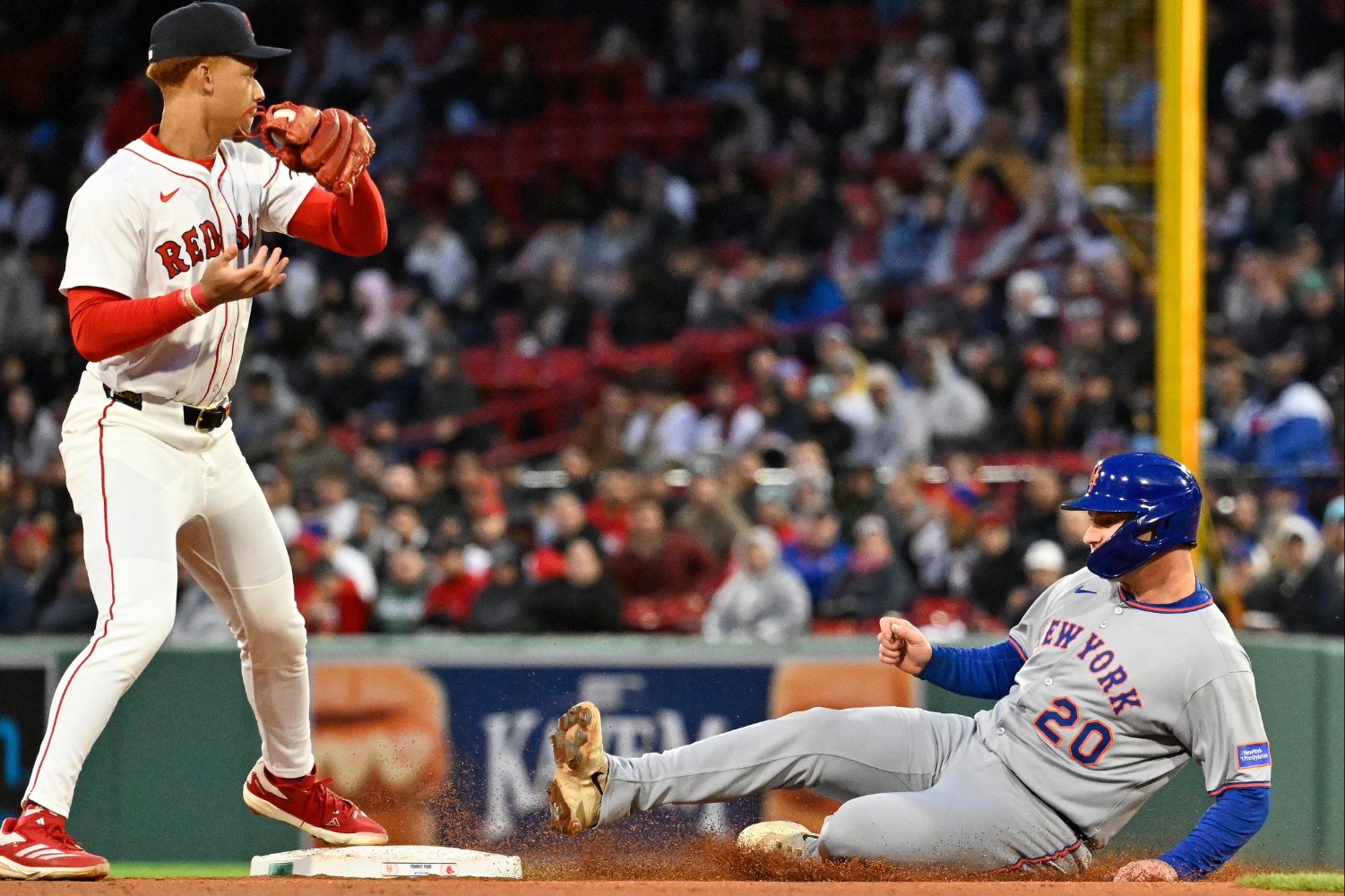
Alonso is very much the top first baseman on the market and is DiamondCentric’s 10th overall free agent this offseason. He was previously a free agent last year before resigning with the New York Mets with an opt-out after the 2025 season in hopes that he would have a rebound season. To say that worked out would be an understatement.
Playing in all 162 games for the second straight season, Alonso slashed .272/.347/.524, good for an OPS of .871 and a wRC+ of 141, tied for the second-best of his career. He also had 41 doubles, a triple, 38 home runs and 126 RBIs, which would have made him the team leader in home runs and RBIs and tied for the team lead in doubles with Jarren Duran.
Alonso very much loves to swing big, having struck out 162 times last year, but his power output led to his fourth straight All-Star game selection, his first career Silver Slugger and his highest MVP finish since the 2022 season. What makes Alonso a great target is he hits the ball hard—really hard. His average exit velocity (93.5 mph), barrel percentage (18.9%), and hard-hit rate (54.4%) are all some of the highest in the league. And he fits right in with the team’s approach to increasing bat speed as his average was 75.3 mph.
Of course, Alonso doesn’t come without his own fair share of issues. As a batter, he can be prone to chasing as he did 27.4% of the time last season while whiffing on 25.6% of his swings overall. Even then, his defense is what could be a real issue down the road. Last season, he finished with 10 errors and finished with a fielding percentage of .992. Dig deeper, and you'll find that Alonso finished last season with -9 defensive runs saved along with a fielding run value of -8 and an outs above average of -9. In short, he was a very bad fielder, even if his fielding percentage says otherwise. With Alonso entering his age-31 season and projected to earn a multi-year contract that would see him play into his late-30s, he will very likely be forced into becoming a full-time designated hitter.
Murakami has made a name for himself since 2019 when he truly broke out in his second season with the Yakult Swallows. Since becoming a starter that season, he has hit 30 or more homes in all but two of his years in Japan. In the case of those two seasons, he missed significant time and is coming off of a 2025 season that saw him hit 22 home runs in 56 games. For fairness, I’m only including his Central League stats and not his Eastern League stats since the Eastern League is the Pacific Central League’s equivalent to MLB’s minor leagues. In those 56 games, he would go on to hit .273/.379/.663, good for an OPS of 1.043. Yet most of his slugging came from his home runs, as he only hit seven doubles, a trend that continued from 2024 where he had just 13 doubles in 143 games. He also drove in 47 runs.
Murakami can hit. There’s no denying that, as he has plus-plus exit velocity when he makes contact. When he makes contact is an issue, though, as he has significant swing-and-miss concerns where it seems sometimes he might be selling out at the plate to hit a home run. Last season in just 56 games, Murakami had a whiff rate of 36.7% and a strikeout rate of 28.6%, both an improvement over his 2024 numbers but still concerning when you remember that players from Japan tend to see their swing-and-miss numbers get worse in MLB. It could take some time for Murakami to adjust to velocity as he hit just .095 against pitches 93 mph or faster in 2025, a slight improvement from his 2024 average of .093.
That being said, one positive besides his amazing power is that Murakami walks. Last year he had a 14.3% walk rate,
Defensively, Murakami has played third base and first base along with a little outfield in the mix, but since 2021 has mainly been a third baseman. Though with 100 errors at the position in 1760 fielding chances, he is likely to play first base or even be a designated hitter with a MLB team. Should the Red Sox pursue him, it would most likely be as a first baseman.
He will eventually be a great hitter, but the Red Sox may not want to spend time getting Murakami up to speed against major-league velocity. Some scouts believe he’ll have to change his swing if he wants to succeed in the majors and if the Red Sox are going to invest the money he’s expected to get (around $92 million as projected by DiamondCentric, plus a posting fee), the Red Sox need to make sure they get the right hitter for the job.
Okamoto, who is also from Japan, is a more complex case than Murakami. While older (he’ll turn 30 at the end of June compared to Murakami entering his age-26 season), Okamoto may be more what the Red Sox are looking for in a first baseman. Much like Murakami, he missed significant time last year, playing in just 69 games where he hit .327/.416/.598 with a 1.014 OPS. He also had 21 doubles, a triple, 15 home runs and 49 RBIs. Okamoto has spent 11 years playing for the Yomiuri Giants where he has showcased great contact skills and displayed power to go with it, hitting .277/.361/.521 with 248 career home runs. Last season, Okamoto finished with the exact same walk and strikeout rate as well, 11.3%.
Okamoto doesn’t hit the ball as hard as Murakami or Alonso, but he still rocked a hard-hit rate of 32.1% in 2025 and his contact skills may put him above the other two, as he made contact on 80.4% of his swings in 2025.
He has the kind of skill set a competing team looks for in a first baseman: a combination of power and average, the ability to consistently put the ball in play and limit strikeouts, and work a double-digit walk rate. The latter showcased his keen eye and ability to work the strike zone. Likewise, Okamoto has improved his contact against velocity over the past few seasons, showing that he might transition from the NPB to MLB at a faster rate than Murakami. In his career, Okamoto has had a plate appearance end with pitches of 93 mph or faster 289 times. In those 289 plate appearances, Okamoto hit .289/.383/.534 with 19 home runs and 61 RBIs, far better numbers than his Japanese counterpart.
Defensively, Okamoto has played first base, third base and outfield and is currently viewed as an above-average defender at first base, something that could prove to be a tie-breaking factor, especially for Craig Breslow as he hopes to improve the defense at first base in Boston.
Okamoto may have the lowest ceiling of this trio, but he balances a reasonable floor with an acceptable price tag (projected for four years, $68 million).
There are other first basemen out there, but these three seem to be the best fit for the Red Sox at the moment. Of course, should they decide to go in a different direction and make a big signing for third base or second base, they could always trade for a first baseman on a cheap contract or employ a platoon of Casas and González. Either way, infield upgrades should be coming to Boston soon enough.






Recommended Comments
There are no comments to display.
Create an account or sign in to comment
You need to be a member in order to leave a comment
Create an account
Sign up for a new account in our community. It's easy!
Register a new accountSign in
Already have an account? Sign in here.
Sign In Now