


Red Sox Video
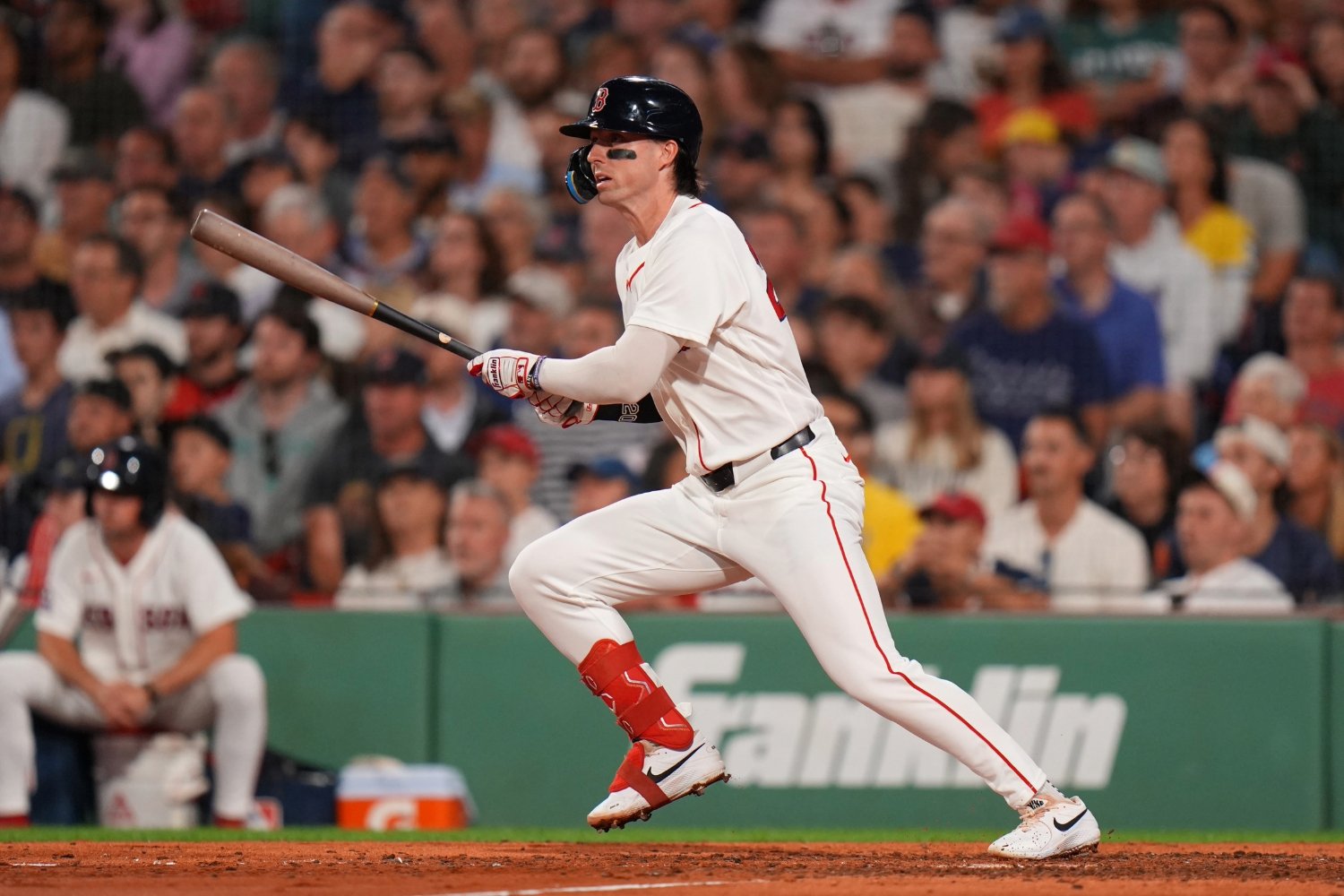
After whiffing on Alex Bregman in free agency, Nico Hoerner was floated as a potential fit for the Boston Red Sox. It turns out they didn’t need Hoerner. Boston has their very own contact-oriented, squared-jawed second baseman with a nice flow.
On the surface, Nick Sogard and Nico Hoerner look like very similar hitters. Sogard isn’t a Statcast darling, nor is Hoerner. They don’t hit the ball hard. Their bat speeds grade in the bottom tenth of the league. They won’t turn any heads with their 86.8 and 86 mph exit velocities, nor do they barrel the ball often. Their greatest strengths lie in their plate discipline and contact efficiency.

Let’s start with the most obvious difference: Hoerner is a faster player. His 77th percentile sprint speed helps boost his expected batting average to the 99th percentile. He’s also an elite defender and has won two Gold Gloves manning the keystone. It’s a bit of a stretch to say that Sogard will win a Gold Glove sometime during his career. Nonetheless, he’s a serviceable defender. In previous seasons, he filled in wherever infield help was needed, but he’s found a semi-permanent home at second this year, posting a -1 DRS, 1 OAA, and 2 FRV across 260 innings.
Two years ago, FanGraphs’ Ben Clemens conducted a deep dive on squared-up rate versus launch angle. Following his methodology, I created a chart comparing Nick Sogard and Nico Hoerner’s contact quality across every ball they’ve hit into play over the past two seasons.
Hoerner squares up even when he’s hitting the ball into the dirt. He squares up 75% to 78% of balls hit at negative launch angles, which is nearly the same rate as his line drives (10-25 degrees). It’s rare to see a hitter who maintains their quality of contact that far below the line drive band, but Hoerner is a contact artist with elite bat control.

Sogard’s squared-up rate falls roughly 16 percentage points, from 82.5% at 12 degrees to 66.7% at -14 degrees. Hoerner drops five points over the same stretch. In the sweet spot range (8 to 32 degrees), they’re squaring up at nearly identical rates. Their gap never exceeds 3.5 points, and the lead oscillates three times across the range. Hoerner peaks in the 18-22 degree bucket, averaging an 80.6% squared-up rate. Sogard's peak sits lower and wider, squaring up between 80% and 83% of the time from -2 to 14 degrees. Hoerner’s squared-up rate collapses above 38 degrees, whereas Sogard's plateaus around 60%. This is the exact opposite of their grounder gap.
Sogard and Hoerner’s swing path tilt numbers are nearly identical at 33 degrees and 32 degrees, respectively. Their attack angles have a nine-degree gap, a byproduct of where they’re pitched.
| Player | Swings | Bat Speed | Attack Angle | Swing Length | Tilt | Ideal AA% | EV | LA |
|---|---|---|---|---|---|---|---|---|
| Nick Sogard | 304 | 69.2 | 14° | 7.1 ft | 33° | 50.0% | 87.1 | 17° |
| Nico Hoerner | 946 | 68.3 | 5° | 7.3 ft | 32° | 45.6% | 87.0 | 12° |
A steeper attack means the bat is traveling upward upon contact. It matches low pitches better, since the ball is descending into the bat path. It produces more lift on contact, resulting in higher launch angles and more fly balls and homers. A flatter attack angle covers the top of the zone better and yields more line drives and grounders. Generally speaking, we see contact hitters utilize flatter attack angles.
Statcast divides the strike zone into four areas: the Heart, Shadow, Chase, and Waste Zone.

Hoerner has played in more games than Sogard this year, so raw pitch counts aren’t an exact apples-to-apples comparison. Normalized via heat-maps, Hoerner’s seen a higher number of pitches in the Heart.
Sogard bats left most of the time. As a lefty, pitchers attack him in the bottom shadow zone (Attack Zone 18).
As a righty, Sogard sees more pitches in the heart of the plate (Attack Zones 2, 5, and 8).
What happens when they connect with the ball? Hoerner hits more grounders, but as previously mentioned, he squares those up, so they’re not weak dribblers. His speed also bails him out of grounders that would be outs for most hitters.
| Player | GB% | FB% | LD% | PU% | Pull Air% |
|---|---|---|---|---|---|
| Nick Sogard | 38.9% | 21.5% | 29.5% | 10.1% | 24.2% |
| Nico Hoerner | 43.5% | 20.8% | 28.2% | 7.6% | 13.0% |
Sogard doesn’t have elite speed to beat out grounders, but that isn’t a huge factor in his batted ball profile. Pulling the ball in the air reaps benefits for hitters. Over a third of them leave the yard. Sogard’s 24.2% pull-air rate is nearly double Hoerner’s. He’s seen that number jump across both sides of the plate. Last year, he recorded a 19.6% pull-air rate batting left, whereas this year it’s up to 23.5%. On the right side, it jumped from 23.1% to 26.7%. Fenway rewards switch hitters. Batting left, a line drive can sneak into the stands for a ground-rule double. Batting right, a pulled ball in the air connects with the Green Monster.
| Nick Sogard's Statcast Profile on Pulled Balls | ||||||||||||
|---|---|---|---|---|---|---|---|---|---|---|---|---|
| Season | BBE | EV | LA | Barrel% | Hard-Hit% | ISO | BA | xBA | SLG | xSLG | wOBA | xwOBA |
| 2025 | 32 | 90.2 | 8 | 9.4% | 46.9% | .125 | .344 | .341 | .469 | .589 | .350 | .394 |
| 2026 | 66 | 88.6 | 9 | 7.6% | 42.4% | .288 | .394 | .363 | .682 | .557 | .459 | .394 |
Playing in a career-high 52 games in the majors this year, Sogard has sharpened his plate discipline. He’s cut his strikeout rate from 23.1% in 2025 to 19.9% in 2026, while bolstering his walk rate to 12.7% from 4.8%. He’s also not feasting on meatballs from mediocre guys. He’s hit home runs off Max Fried and Yennier Cano, two star pitchers.
Looking at Hoerner and Sogard’s spray charts, you see the difference in their batted ball profiles. Hoerner’s is a wall of singles piled up in the infield and shallow outfield, which is exactly where you’d expect a guy with a five-degree attack angle to hit the ball. His home runs cluster down the left field line. Sogard’s damage varies based on his handedness.
Nico Hoerner is a veteran second baseman. His profile is what a flat swing and elite bat control produce over six seasons. Heading into his age-30 season in 2027, it’s safe to say he’s hit his ceiling. He probably won’t ever hit more than 15 home runs in a season, which is fine, since the Cubs have plenty of other power hitters in their lineup to drive him home.
Unlike Hoerner, Sogard’s still trying to figure out who he is as a hitter. Does he try to tap into his power, or does he stick to a contact-oriented approach? The Red Sox already have the latter in Caleb Durbin.
Going forward, Sogard’s future looks murky. The team is loaded with solid, but not elite infielders. Boston traded for Curtis Mead, who fractured his left wrist in his debut. Mead has been on the 10-day IL and hasn’t swung yet. We probably won’t see him take the field for Boston again this year. Mead had a breakout first half with a surge in power, though his defense isn’t on par with Sogard’s. It’ll be interesting to watch the battle for second base whenever spring training occurs next year.
Sogard has only appeared in 113 games across three seasons in Boston. This year, he’s blossomed into an X-factor for the team, and it’s safe to say he’s earned his spot on the postseason roster. He provides defensive versatility and elite plate discipline on both sides of the plate. His pull-air rate plays well in Fenway Park, and he has a knack for clutch hits. The Red Sox play better when Sogard is in the lineup, and his presence won’t be overlooked in October.






Recommended Comments
Create an account or sign in to comment
You need to be a member in order to leave a comment
Create an account
Sign up for a new account in our community. It's easy!
Register a new accountSign in
Already have an account? Sign in here.
Sign In Now