


Red Sox Video
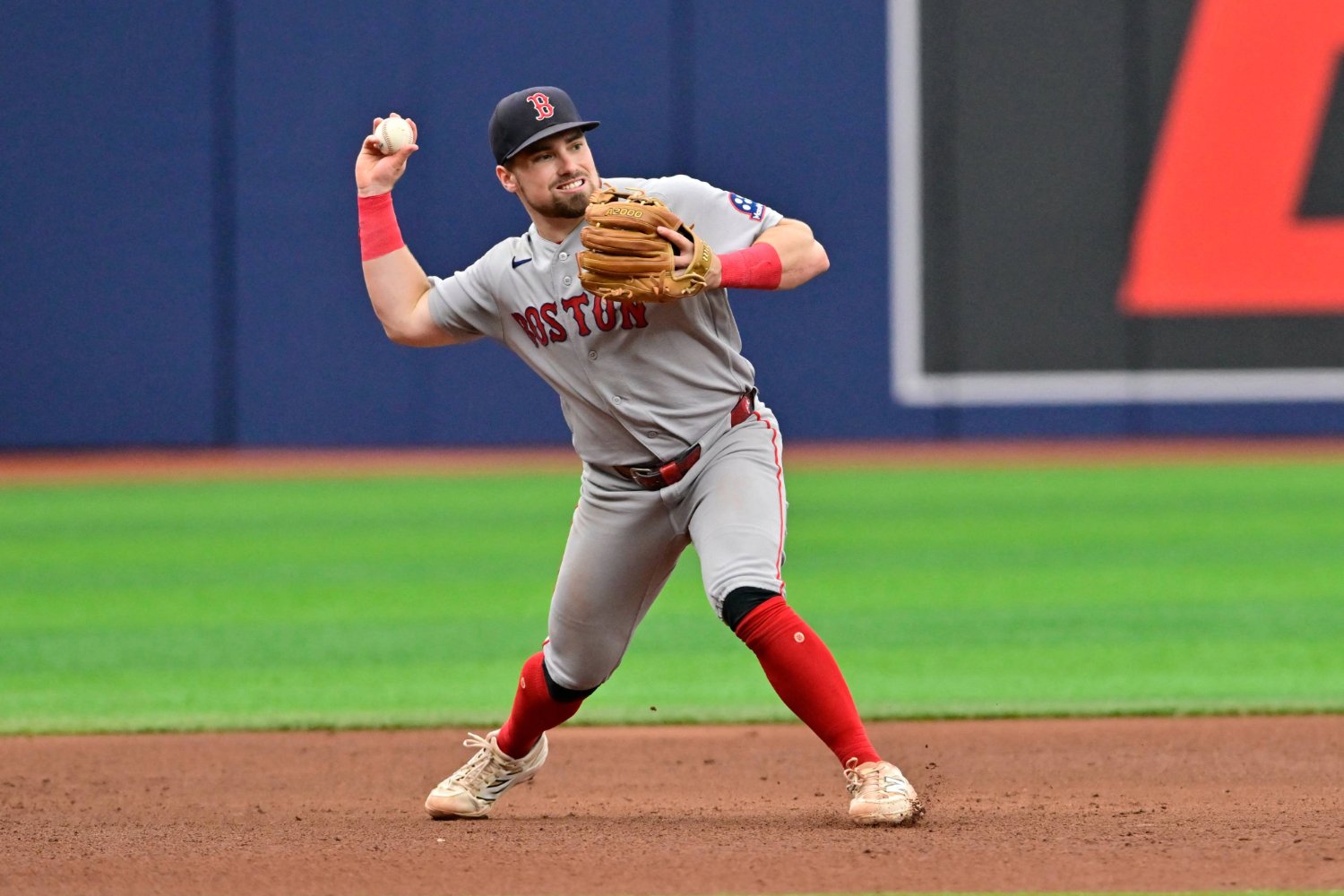
In baseball, there is an old saying that the second year is even more difficult than the rookie one; there's a reason the "sophomore slump" still exists in our lexicon today. For Boston Red Sox third baseman Caleb Durbin, his start to Year 2 was puzzling, but he managed to find his rhythm before it was too late.
Durbin entered May 28 batting just .163, with a .241 on-base percentage and a .479 OPS in 48 games. Even so, he improved his plate discipline, a step that helped him achieve better pitch selection and turned him into one of the most productive hitters in clutch situations for the rest of the season.
After opening with just 48 and 43 wRC+ in March/April and May, respectively, he raised his wRC+ to 163 in June—his highest point of the entire season—and the only considerable drop he experienced came in September, when he fell to 99. Between May 28 and the end of the season, Durbin hit .283/.369/.435, with 12 home runs among his 30 extra-base hits and a .803 OPS in 105 games, ranking among the American League’s best hitters in several categories.
He finished the season with a .248/.332/.378 slash line, 13 home runs, 64 RBIs, 20 stolen bases in 26 attempts, and 3.1 fWAR, surpassing his 2.7 mark in his first year. However, he could not avoid his major contact problems against fastballs, part of what prevented his season from being even more productive.
This is not a new challenge for Durbin, as his inconsistency against high velocity has been his Achilles’ heel for several reasons. The main one remains his poor bat speed, finishing in the 6th percentile last year and the 13th this season. Despite improving from 67.9 mph with the Milwaukee Brewers in 2025 to 71.8 mph with his adjustments in Boston, his swing continued to look limited.
Therefore, the league’s strategy was reasonable. In 2026, pitchers attacked him with more fastballs than in 2025, increasing the percentages from 57.3 to 60.3, and his whiff rate skyrocketed from 6.0% to 15.3%, with many more strikeouts (18.4 K% compared to 5.7%).
Still, he graded out positively by run value, and we can attribute that to the fact that he was one of the league’s best hitters in clutch situations. With runners in scoring position, he hit .288 and recorded a .816 OPS in 125 at-bats, with three home runs and 50 RBIs—he also hit two grand slams. When Durbin recorded at least one RBI, he helped his team win 34 out of 46 games.

Even with his problems against fastballs, we can see Durbin in the 88th percentile in whiff% and the 91st in K%, figures similar to those from his first year (plus an added advantage in his plate discipline, finishing in the 45th percentile in BB%). His power could improve in the future, but that would involve some changes to his swing and moving away from what he has been able to do best: putting the ball in play.
That's only half of where his value comes from, too. Durbin was recently selected as one of the three Gold Glove finalists at third base this season, and he led the American League at the position in Fielding Run Value (+6) and Outs Above Average (+6), two stats that make him a strong favorite to win the award.
I know the last impression Durbin left us with was disappointing, when we saw him struggle against the New York Yankees’ pitching until finishing 0-for-7 in the Wild Card Series. But he's becoming a more complete player in front of our eyes, with a chance to be one of the league's best third basemen before long.





Recommended Comments
There are no comments to display.
Create an account or sign in to comment
You need to be a member in order to leave a comment
Create an account
Sign up for a new account in our community. It's easy!
Register a new accountSign in
Already have an account? Sign in here.
Sign In Now