


Dojji
-
Posts
18,632 -
Joined
-
Last visited
Content Type
Profiles
Boston Red Sox Videos
2026 Boston Red Sox Top Prospects Ranking
Boston Red Sox Free Agent & Trade Rumors, Notes, & Tidbits
Guides & Resources
2025 Boston Red Sox Draft Pick Tracker
News
2026 Boston Red Sox Draft Tracker: Picks & Bonuses
Forums
Blogs
Events
Store
Downloads
Gallery
Everything posted by Dojji
-
I don't think Hanley was ever intended to be the third baseman. I'm under the impression that his shoulder won't allow him to field the position properly anymore.
-
Pablo's contract is a sunk cost. If they can get him onto the blasted field without him breaking down immediately like last year, I'll take that as a clear improvement.
-
Exactly. A deep bullpen. Miller was the ace of the bullpen, but "relief ace" and specifically tying it back to the long-since-dead rival to the closer model, are both real stretches. In other words, exactly what I've been saying. The correct answer to the relief ace v closer model is "why are you asking such a stupid question? Of course you have both on an ideal roster." Which guy you put where is mostly a matter of window dressing.
-
Socialism, then
-
I'm saying that Miller proves my point, not yours. He was not doing his job alone, Miller was the front man in a deep bullpen. And it was the depth of the bullpen, not Miller's performance specifically, that told the tale and made the difference in the playoffs for the Tribe. Also, Miller wasn't the only good man in that bullpen, the rank and file of the Guardians pen deserves more credit than it gets. Cleveland had one of the best bullpens in baseball from top to bottom. To call it the Miller show in any way is pure and absolute disrespect to the rest of that very deep and effective pen that virtually carried the team to within 1 run of a World Series win. If he hadn't had a good rank and file pen around him, it wouldn't have mattered what role he played, the opposing teams, including our Sox, would have simply played around the innings he happened to work, as happens all to often in shallow bullpens. The Guardians got as far as they did because they had a deep bullpen, led by Miller and Allen. The decision of whether Miller or any one of 4 other relievers should have closed is utterly academic and pointless because either way you would have both a good closer and a good stable of middle innings . So you look to Miller as a validation of the dead, buried, subsumed and rapidly turning into petroleum Relief Ace model, I see the truth -- a good, deep bullpen that made a large impact in the playoffs and sports media blatherskite notwithstanding, was NOT defined by any one member's performance.
-
We tried something like that once. We asked for 7 out of Schilling and 2 out of Papelbon. We did it in part of the 5 game stretch in 06 we commonly know as the Boston Massacre, so you can guess how it ended. Papelbon, who barely surrendered any runs at all that year, blew it in the 9th. Because Jonathan Papelbon was not prepared, and was not able, to pitch 2 innings just because we fervently wished he could. This should probably not have surprised us, but then, nobody actually said that fans are good at risk assessment. We tend to let wishful hoping dominate our thought processes. Frankly I see a lot of wishful thinking and woulda-coulda-shoulda in the relief ace model proponents. News flash: if you have to assume everything goes ABSOLUTELY PERFECTLY in decisionmaking, execution and results in order for your model to be successful, especially comparing it to a time-tested model teams have been winning with for decades despite everything that goes wrong over the course of a real season, then your model ain't worth the toilet paper it was written on. Every time the relief ace model has been tried in realtime, the team has abandoned it within 2-3 years. That alone snould be enough to tell proponents of the relief ace models that their model is flushworthy, but see above about fans -- we aren't the best judges of the laws of probability. There *is* a reason the traditional model works. It prevents managers from abusing and overworking their relief arms. It gives defined rules to prevent any one reliever's work load from becoming excessive. And it lets the relievers know in which role they're likely to be deployed to give them time to prepare mentally. The advantage of the fireman model is not enough to offset the disadvantage of abandoning all those subtle benefits. Every time it's been tried this has been verified. It's like Communism. A great idea on paper that was never designed to actually be implemented in realtime, every time it's tried the people trying it wind up wishing they hadn't, and that never stops its proponents from objecting that it has never been "done right" or given a fair test.
-
And that's how you burn out or overwork your fireman, or consistently commit him too early. The only time to know what the highest leverage situation in the game will be, is after it's over. If you don't have good men to bring in in any given situation, it's entirely academic and pointless to argue about exactly which situations you cover with poor relievers. The likely difference is less than 1 win in an average season. Managers just plain have better things to spend time on.
-
Whoever you bring in, you're leaving yourself open to an 8th inning rally if you expend your "fireman." Also this stuff looks good on paper until you add prior usage of the bullpen into the scneario. The same scenario you mention above, how does it change if you've used your "Miller" 3 of the last 4 games? The reason the model is useless is because you can never count on one reliever to get all the critical outs. Even the Tigers were smart enough to use Zumaya AND Rodney. Squashing rallies throughout the middle innings over 162 is too big a job to have one solitary Dutchman with all his fingers in every hole in every dike. A 9th inning "closer" role is something you can expect a reliever to handle physically most of the time it happens to be important, since not every game is close and late. A relief ace model is basically begging for 2, maybe 3 such "aces," otherwise the one guy you have winds up hideously overworked. And at that point the "model" is just "have good pitchers to work the middle innings." This is not rocket science. The only good bullpen is a DEEP bullpen. Anything else is a debate about how to rearrange deck chairs on the Titanic.
-
so what you're basically saying is that managers need to be literally precognitive so that they never pull their starter early and then give up even more runs later on. The only perspective the relief ace model really works from is the perspective of hindsight because there's no way of being sure which threat was the most decisive until all the numbers are already in. For a guy calling the game in realtime the relief-ace model is just an excuse to second guess him. The most likely end result of a relief ace model is you wind up burning the guy at the first real sign of trouble, and not having him if the opposing team rallies even worse in an inning or so, and probably overworking him over the course of the season. Managers have a problem with knowing when not to use a guy unless they have a good system in place, that's part of what the Eckerlseyan inning-role system provides them I think the best team that ever tried to relief ace was probably the 06 Tigers, with Zumaya and Rodney as the main firemen and the mediocre Todd Jones closing things out. They did OK for reasons that had nothing to do with the bullpen, got to the World Series by getting lucky with their opponents in the two previous playoff series, specifically the ancient, dying Yankees core and an A's team that had no business getting to the ALCS, and wound up getting walloped by a pretty mediocre-on-paper Cardinals team that used a conventional closer (I think Adam Wainwright actually played that role for the team at the time). After getting beaten by a radically inferior team that did things the right way, the Tigers switched to a more standard closer model not long afterward. So you see, it's not like teams never tried it. It's that teams tried it then realized why it didn't work and went back to the correct, Eckersleyan model. if you don't have that guy who can get outs in middle innings, AND that guy who can get outs in the 9th, whichever one you don't have is gonna screw you over. The whole debate is so much forum fluff.
-
I've always maintained that this is a pointless conversation. THere are three possibilities for a team -- they can either have zero, 1, or more than 1 good relievers. If you have more than 1 good reliever the whole thing is moot because you have a guy for both jobs. If you have only 1 good reliever, the whole thing is moot -- close with him, you're screwed in middle innings, use him in middle innings you're screwed at the end of the game. If you have 0 good relievers, the whole thing is moot -- you have no good relievers so your bullpen sucks. At no point in this conversation is the conversation in general actually worth having.
-
No. What we're saying is that we want one of our most consistent relievers in the 9th inning because a lead blown in the 9th is the hardest of all blown leads to recover from due to having the least time. So putting your stingiest run-allower in the position where giving up a run would go worst for you just makes sense statistically and logically.
-
I find that 4 billion number incredibly suspect. We have the ability and technolocy to comfortably feed everyone in the world, three times over. If we built the best infrastructure we have technology for, everywhere it was needed I'm convinced that would be more like 15 times over. Hell, we're paying farmers NOT to grow food so we don't drive the prices so low that inefficient third world sharecroppers go under. If we got really serious about farming, this planet could produce several times the food it does now, and what it produces now would be more than enough if our distribution network was efficient. A static number like that ignores the fact that we've progressively gotten better and better at finding ways to make this planet support more of us. At this point the only limiting factor I'm truly aware is the global water economy. If we were better about developing the undeveloped parts of the world nobody would go to bed hungry tomorrow.
-

mlb trying to raise the strike zone, make IBBs automatic
Dojji replied to Northern Star's topic in Other Baseball
But they're NOT losing their audience. Baseball is making more money than it EVER has. What we have here is executives guessing themselves into an early grave and making panic moves as a result. They're afraid that their fortunes are tied into an older generation and that as the years go on demographics will shift against them. They're ignoring the fact that baseball is the sport with THE greatest historical legacy of any major sport in North America, and only lost its primacy because of the strikes in the 90's followed by the idiocy of the league looking the other way vis-a-vis steroids in an effort to build the league's image back up afterward, which backfired explosively in the early 2000s. Just give us baseball, cut the BS, and people will not only watch, but disillusioned fans (and their kids) will come back. All they need to do is cut the bullcrap they themselves keep trying to insert into the game. They seem constitutionally incapable of reaching that solution though.. Fortunately we have enough older execs that have seen generation shifts before that I have my doubts any truly radical changes will be made. A few more strikes called at the letters however is probably a good thing, since that's, you know, the actual strike zone, and I have no idea why umpires were allowed to reduce the strike zone to belt-to-knees as it is. -
I was gonna say, no one with a mobile device would thank Moonslav for posting that.
-
I generally feel like focusing too much on any one signing or transaction is an exercise in straining at gnats. You don't get a good idea of the performance of a GM by stressing about any one move. You have to analyze the strength and health of the franchise over his tenure to really get a picture. I will say that Theo's efforts after 07 were focused on maintaining an increasingly precarious balancing act, and the moment that he fell off the tightrope was probably the 2009-2010 offseason. the inability to properly replace Jason Bay, the loss of Jonathan Papelbon without a true replacement, the final demise of Mike Lowell, the beginning of the end of Tim Wakefield, the signing of Scutaro to try to play starting SS which I still maintain was a disproportionately major mistake due to a combination of the delusion of adequacy and the opportunity cost relative to other possible acquisitions at shortstop... I think it's pretty clear that it was that offseason when the franchise took the serious step backward that Theo spent the rest of his tenure trying to recover from That was also IIRC the year that we stopped getting lucky with the minor leaguers and young players we developed from the minors. Middlebrooks, Reddick, Buchholz, and Bard spring to mind as players from which we asked a lot and got very little, and it was the 2010 season where that trend really started biting us in the tail..
-
I have no idea what Moonslav is on about. There were only 4 key players in 07 that were also key in 2004 -- Manny, Papi, Tek and Schilling. That team doesn't sniff the Series without the new blood brought in after 04, especially Pedey, Youk, Lowell, Pap, Okajima, and Beckett (and to an extent we don't always appreciate, depth guys like Gabbard, Delcarmen and Tavarez). The big acquisitions, Drew, Lugo, Daisuke, Gagne, did less well but from a GM standpoint that actually matters LESS than the fact that the team was more than well eniugh built for it to win even if key pieces underperformed significantly, a sign of a GM on his game
-
What will be the 2017 greatest weakness for the Sox?
Dojji replied to mvp 78's topic in Boston Red Sox Talk
That statement is far less ridiculous thsn you make it out to be. It's like tne recent pleasantness last Sunday where I'm convinced one of the biggest factors in the outcome was the pure experience of the winning team at finding ways to win -- whether or not it bears fruit in any individual game it's reasonable to expect that experience, intelligence, and having the skills to play for a single run more easily than your opponent would when the situation warrants it, on average, help a team win more than their share of tight games. -
and by no means was that winning based only or solely on the 2004 core. Yes the core slowly declines from 2007 on but I think Theo was brilliant in slowing down entropy and keeping the team competitive for longer than we honestly should have expected. And it's beyond debate that Theo was brilliant in 2007 in particular That was what gave us a surprise window in 2013 as the last gasp of the 2007 core
-
Actually I was thinking more of that one song, but I know that song tracks directly back to Ecclesiastes. Either way, the point is valid. A time for everything and everything in its time. Load up when it's time to load up, rebuild when it's time to rebuild, don't rebuild when it's time to load up or load up when it's time to rebuild. Determining which is which is something like 99% of a GM's job, trying to do both at the same time and sustain it indefinitely is a fan wet dream and is never going to happen for more than a few years at a time. I get the desire to try to have both a good farm system and a big league roster that's primed to complete but generally speaking a franchise is doing well to get one of the two, much less try for both, it's a crazy alchemy that requires luck as a major ingredient so never happens for more than a decade at a time. Generally, to crib from the Bible again, teams that try to be hot and cold at the same time just wind up lukewarm, with strengths in both areas but not enough of them to get anything real done, exhibit A probably being the Mariners in recent years. I don't really want to see this franchise become the Mariners, and I suspect I'm not alone in this. Ironically. Kimmi's much-loved Cherington actually managed to commit both errors over a very short tenure with the team, which is actually an amazing feat. He dialed back after 2013 when we still had a core worth competing with, then tried to ramp up prematurely in 2015. His inability to accurately call the shots in those 2 seasons are what took him from a ring winner to unemployed. There is no job more important for a GM to do than determining when it is time to do what, and Cherington failed spectacularly in that area.
-
What will be the 2017 greatest weakness for the Sox?
Dojji replied to mvp 78's topic in Boston Red Sox Talk
That's still a small enough spread that factors that you'd think might be too small to matter are going to have an influence. -
That's wrong. What happens in the playoffs comes down to talent and performance in a small sample size. The only difference between the playoffs and the regular season is that in the playoffs, you can't count on things to average out. That's all the more reason not to lean on just-enough-to-get-there levels of talent and try to build the best playoff roster you can! We did not win ANY of our World Series rings by doing anything less than the absolute best we could to build the major league roster within the money and talent this team had available to do so. Anything less than 100% effort to win World Series rings when the team is this young, this deep, and this talented, would be incompetent negligence on the part of the front office. And the fans would be absolutely right to call the kind of timid half-measures we'd been experiencing since 2013 as the unacceptable BS they are. The team is built to win now, you can't win now when half your head is focusing on the next 5 years, the time for that crap is in the past or the future, right now it's time for eyes-on-the-prize. That's limited thinking. There will always be a time to put the hammer down and win with what you have. Just like there will always be a time to ease off on the gas and let the farm system recuperate. Not recognizing that there is a time to build and a time to destroy is a weakness in a GM. There will never be one strategy that is perfect for all situations, there will always be a need for situational adjustments. And there will always be a time to compare where you are with where you want to be and decide how best to get there. Right now where we want to be, is our players in their locker room taking champagne showers. DD has made the right moves to try and get us there. if it doesn't work, it was still exactly, EXACTLY the right thing to try and I will stand by that. This is the Boston Red Sox. We do not need to screw around trying to have it both ways with an opportunity this brilliantly golden in our hands just waiting for us to take advantage of it. We did not get the championships we have by disdaining opportunities to improve our chances to win this year, and we're not going to start now. Theo absolutely would have pulled the trigger on the Sale trade in exactly the same situation DD did, we know that because he DID that, with Josh Beckett and Curt Schilling among others I'm probably forgetting. Theo knows how to go for it. He did it in 03 and 04 despite knowing we'd pay for it in 05 and 06, did it again in 2007 knowing there'd be consequences in 09 and 10, and he's doing it with the Cubs right now. A few less-than-peak years down the road is worth taking a golden opportunity and Theo is smart enough to see this. His protegee did the same thing in 2013, or at least tried to, when it was clear that the team was putting something special together. Now his protegee's replacement did it and it's somehow unprecedented and strange? Not buying it for one microsecond.
-
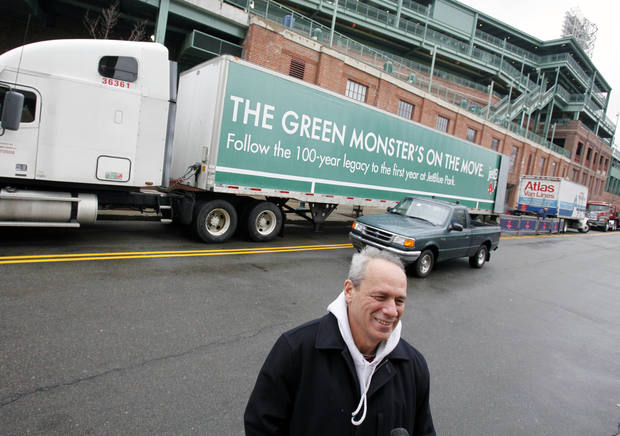
It's here it's here it's here it's here! get hyped! http://www.masslive.com/redsox/index.ssf/2017/02/boston_red_sox_truck_day_2017.html
-
Which perfectly explains why Swihart was hustled out of the catcher's role last year in favor of defense first guys. Oh wait. It absolutely doesn't. Remember this is also the guy who went out and got Gerald Laird, who was definitely a defense first guy, in order to augment his team and try to get it over the top in the middle of Detroit's peak seasons and bridge to Alex Avila, their young all-rounder.
-
What will be the 2017 greatest weakness for the Sox?
Dojji replied to mvp 78's topic in Boston Red Sox Talk
No, but the range is so small that factors that seem like they should be far too small to make a difference wind up manifesting in surprising ways at times. -
How do you figure?

